All of us reserve a special place in our hearts for the bikes we rode and dreamed of in our youth. Rewind further to the machines our fathers (and mothers) grew up with, and the yearning to recapture the past’s emotions and excitement can burn just as strongly. The allure of simpler, more innocent times pulls hard when a motorcycle is involved.
That’s why the Goodwood Revival is one of the best classic motorcycle events of the year. Actually, let’s make that one of the best motorcycle events of the year, classic or otherwise.
By Adam “Chad” Child | Photography by Oli Tennent/Goodwood
Held every September at Goodwood Motor Circuit in West Sussex on the south coast of England, the Revival serves up three days of classic racing on both two wheels and four. Owned by the Eleventh Duke of Richmond, the former World War II fighter base—think Spitfires, Hurricanes and even the occasional P-51 Mustang—is gloriously old-school, seriously fast and not overly equipped with modern concepts such as gravel and runoff.
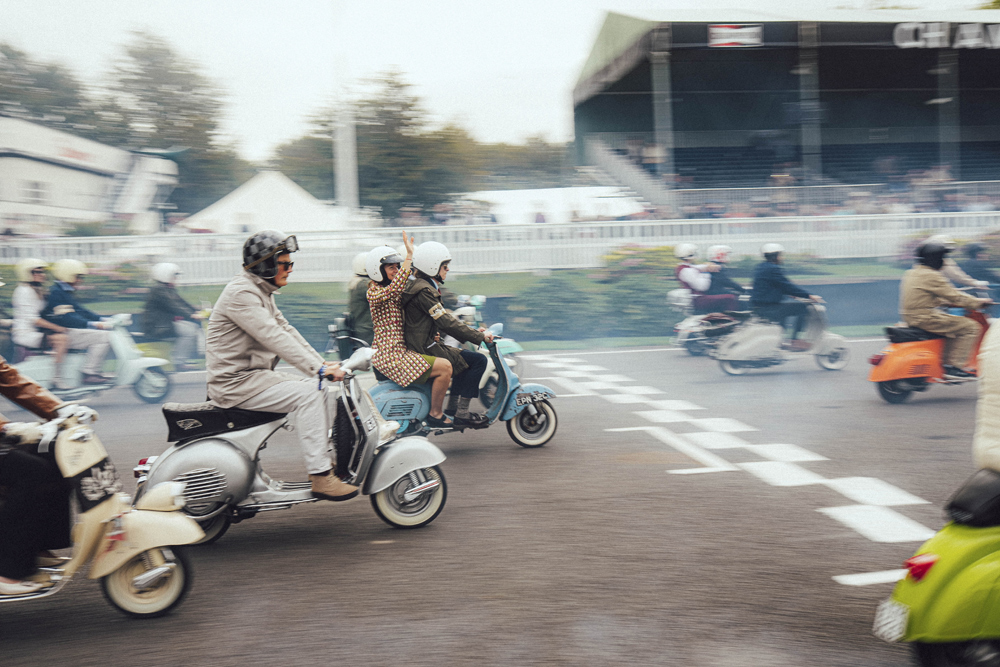
But unlike most race meetings, the racing is only half the entertainment. Celebrities mingle with professional racers, while 150,000 spectators over three days arrive in period costume. Once through the gates, you are transported back to a time of clipped accents and gentlemen racers, to a golden era of post-war euphoria and fast and dangerous motorsport. At Goodwood, the correct tweed jacket with an accompanying flat cap can be every bit as important as a well-sorted set of Amal carburetors.
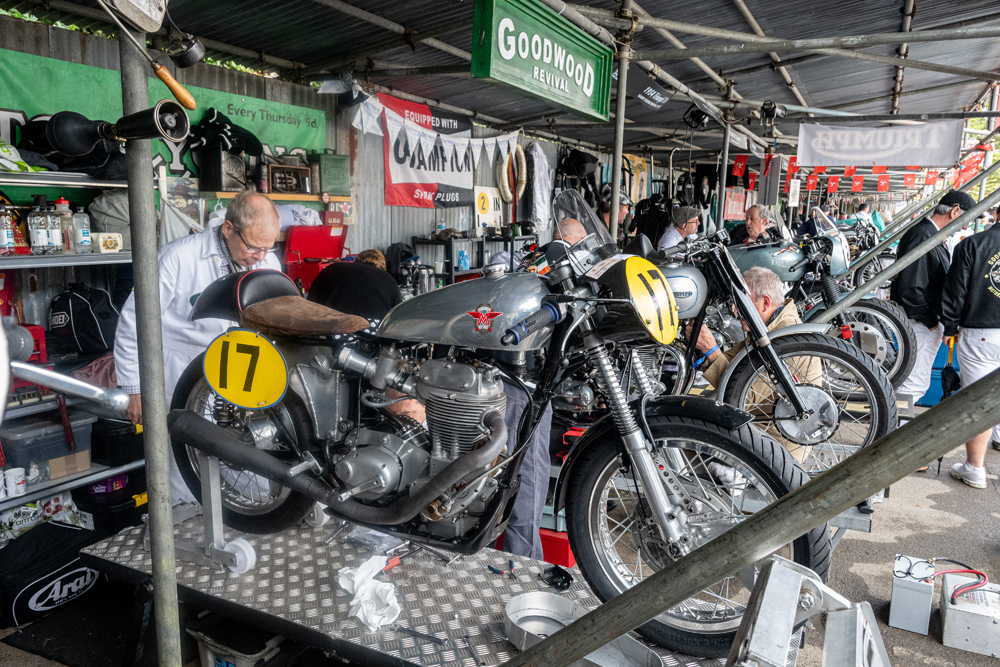
Everyone plays along. Catering staff, medics, marshals and photographers all look as though they’ve wandered off a 1952 film set, complete with stiff upper lips and lashings of derring-do. Even the mechanics remain improbably smart while elbow-deep in mechanical mayhem and engines that regard oil-tightness as a vulgar modern affectation.
The Runners & Riders | Goodwood Revival 2026
The Revival is fully immersive. And, out on track, I am drowning in a very different type of nostalgia: adrenaline-soaked, pinch-me-before-I-wake-up nostalgia.
Former World Superbike Champion Tom Sykes is just ahead of me, sparks shooting from the right-hand exhaust of his 1950 Vincent Black Lightning as it touches down on the historic Goodwood racetrack. He is clearly struggling with ground clearance on right-hand corners; his V-twin’s two beautiful exhausts, worth who knows how much, are being ground to atoms on the asphalt.
His bike is rapid on the straights, wickedly so for a machine some seven decades old, but heading into the double-right at the back of the Goodwood circuit, I spot my chance. I brake as late as I dare on our beautifully prepared 1953 Matchless G80 and aim for the inside. But this is Tom Sykes I’m trying to outbrake. The door slams shut.
I regroup and set up for the chicane. But just as I bend my G80 into the turn, a Norton appears underneath me. It’s Troy Bayliss. Yes, that Troy Bayliss, the multiple WSBK Champion. He’s been stalking us, studying our lines. Now he dives for the inside and leaves me nowhere to go. It’s breathtakingly close: hard, committed and millimeter perfect. No prisoners taken.
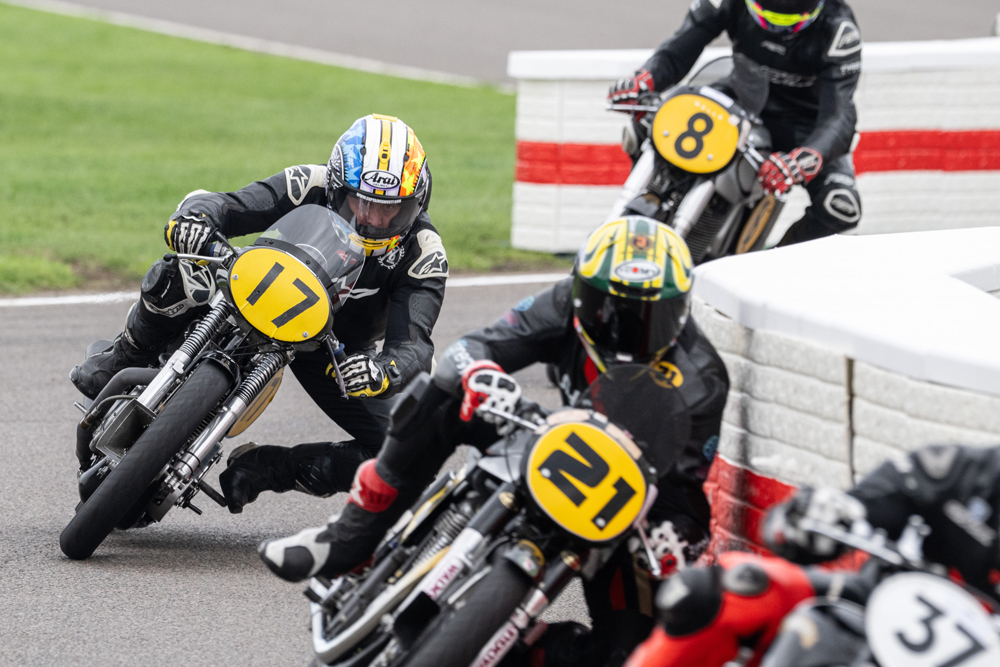
Troy grabs the place on the way in, but he’s compromised the exit. I get as close to the infamous Goodwood ‘wall’ as possible, clip the curb on the exit, tuck in and drive the Matchless hard. The Norton is right ahead, but I have the momentum, and my Matchless has more drive. Across the start-finish line, I pull alongside and give Troy a cheeky tap on the backside, just enough to remind him that my Matchless has the legs on his Norton.
Turns out none of us won the drag into turn one. As we bumped and barged our priceless classics into each other, Isle of Man TT winner Davey Todd, enjoying supercharged power on his 1928 BMW R57 Kompressor, took that honor. But it’s easy to see why, for so many, the Barry Sheene Memorial Trophy is the Revival’s headline act.
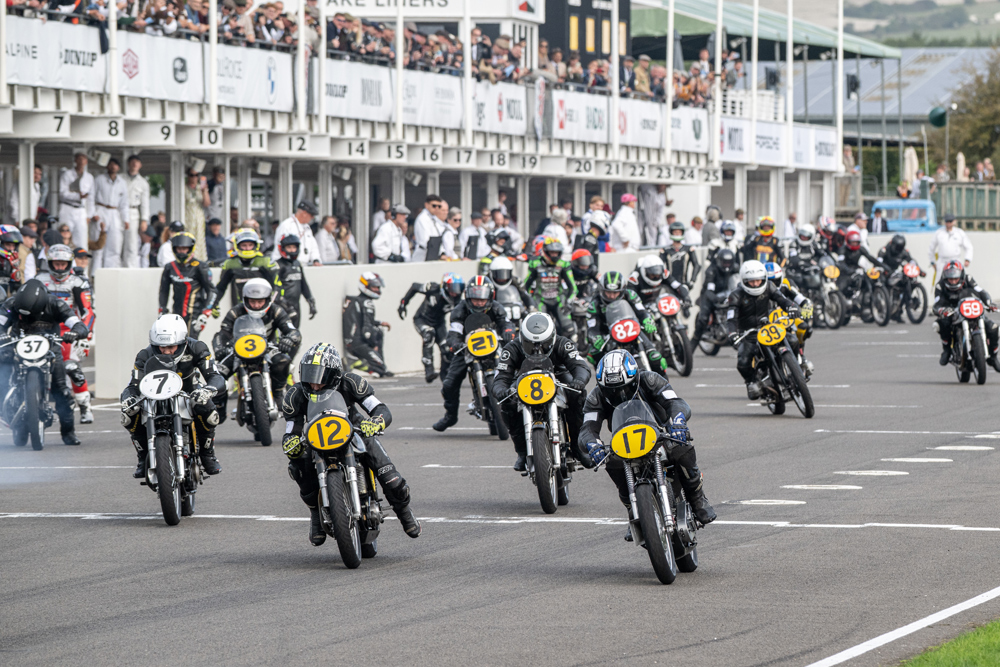
The fiercely competitive double-header features a mouthwatering collection of classic racing machinery piloted by an intriguing mix of former world champions, TT racers, classic racing specialists and passionate classic-bike owners. Qualifying takes place on Friday, followed by a 30-minute race on Saturday and another on Sunday. There is drinking in between.
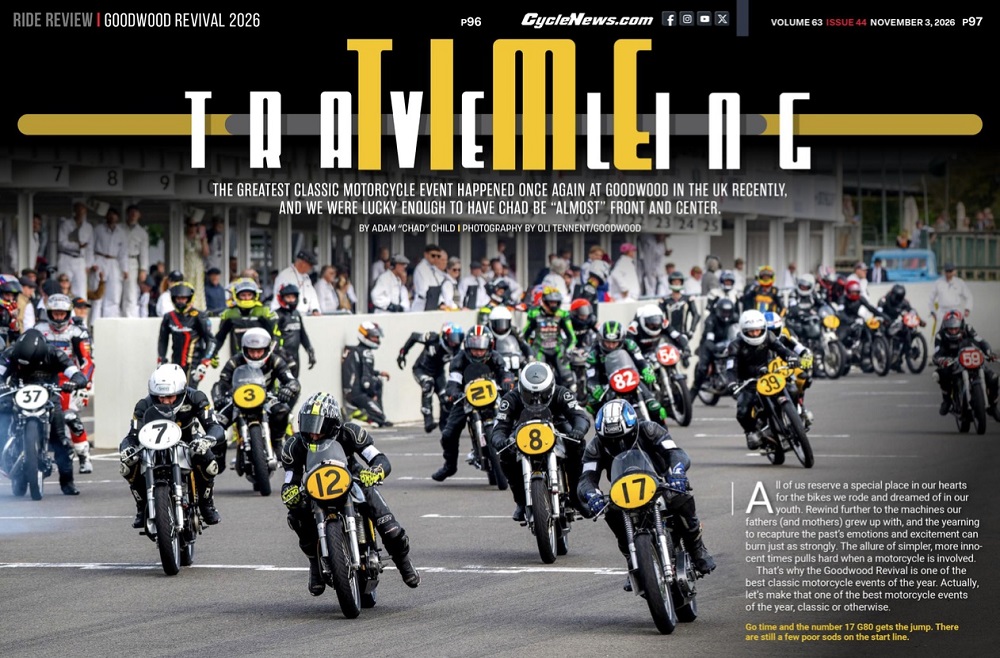
Both races begin with a Le Mans-style start, the riders sprinting across the track to their waiting bikes. Each machine is shared by two competitors, who swap at around half-distance. One is usually a star or professional rider; the other is the bike’s owner or an experienced classic-racing specialist. It is a race quite unlike anything else.
In recent years, MotoGP legends such as Dani Pedrosa, Wayne Gardner and Kevin Schwantz have all raced at Goodwood. This year, Bayliss stepped up to make his Goodwood debut and faced a phalanx of real-roads racers, including 23-time TT winner John McGuinness, Peter Hickman, Todd and Ian Hutchinson.
If the rider list is impressive, the machinery is enough to make nostalgia victims go weak at the knees. Racing machines must be pre-1955; Manx Nortons are the weapon of choice for many, with big, powerful Vincents also popular, some coming all the way from Australia.
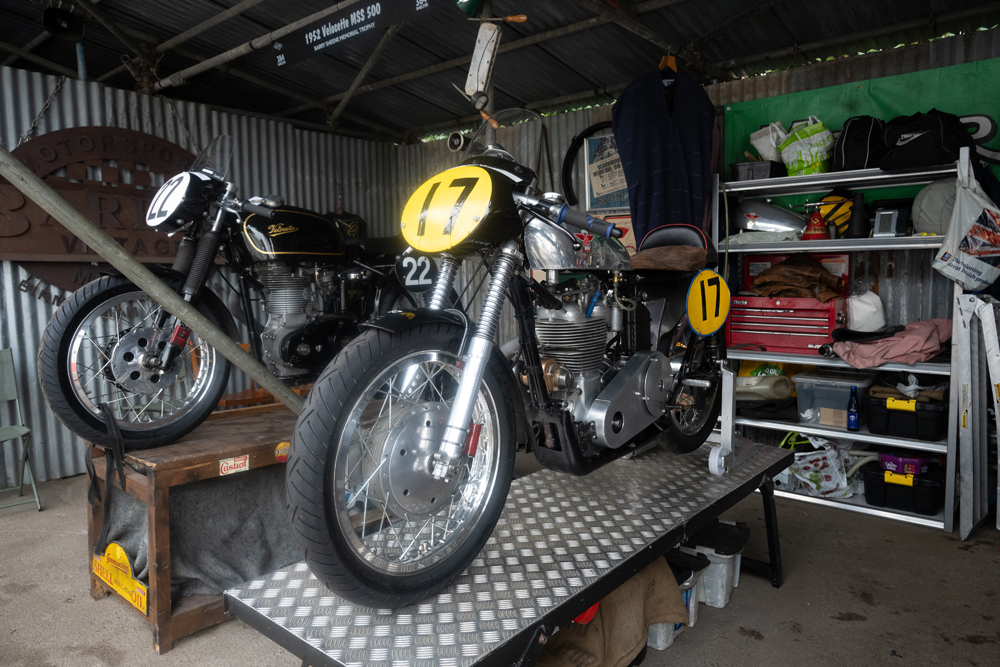
I was fortunate enough to be invited by the Duke (Revival entries are by invitation only) to ride a beautiful 1953 G80 Matchless owned and raced by British classic racing specialist Stuart Tonge. His hand-built and immaculately tuned Matchless is a work of art. The engine alone takes around 50 hours to assemble, and the finished bike looks far too exquisite to risk around Goodwood, a circuit that asks extremely impolite questions of aging machinery.
Goodwood opened in 1948 and its 2.4-mile layout remains much as it was in the 1950s. The track is mainly flat, fearsomely fast and steeped in history, and its list of famous drivers and riders is seemingly endless. Formula One buffs know it as the circuit that ended Stirling Moss’s international career after his near-fatal crash in 1962.
The Barry Sheene Memorial Trophy is only one of 14 races, with cars dating back to the 1930s also pounding around the circuit. Consequently, the surface can acquire a slimy cocktail of oil, fuel and rainwater. Now add narrow classic tires, irreplaceable motorcycles and a grid full of teak-tough riders who have built careers by refusing to back off, and you get the picture.
Practice at Goodwood is unlike a conventional practice session. You get 30 minutes, one bike and two riders. Our plan was simple: My teammate Stuart would go first. He’s the classic expert and knows the Matchless so intimately he can tell if it’s one or two horsepower down simply by listening to it and feeling how it pulls. No laptop, no data engineer, no frantic tapping at a keyboard. Just decades of experience and a highly calibrated backside.
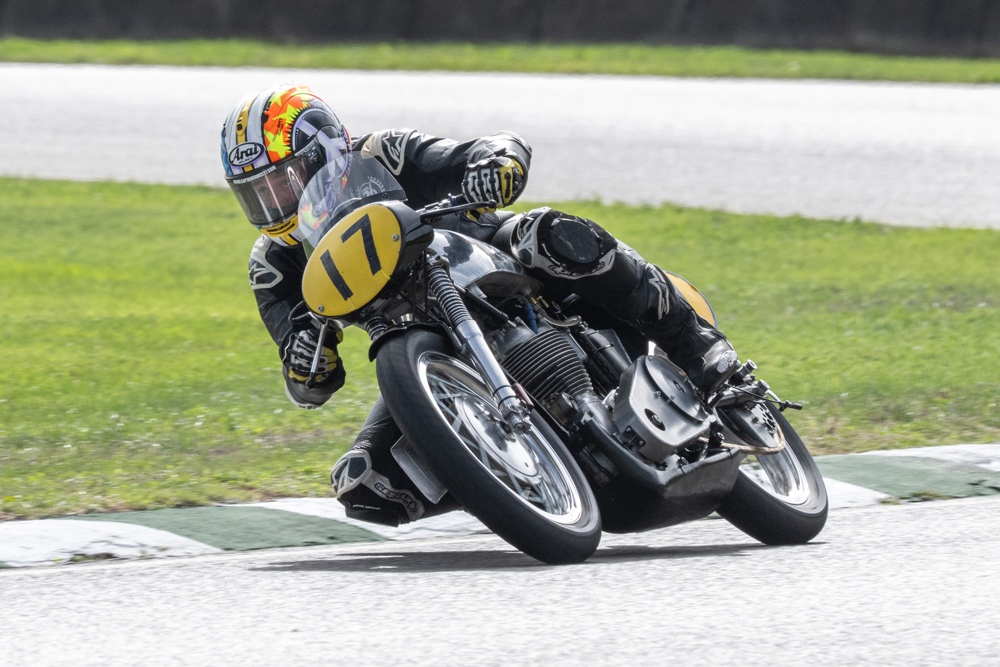
After a few laps, he’d hand over to me—my job being to put the hammer down and qualify us somewhere inside the top 15. Then Stuart would jump back on for the final four or five laps, finishing with a plug chop so we could check the fueling back in the paddock.
By the end of Friday, we had qualified 14th and were feeling confident and looking good, although the latter was mainly down to the tailoring of our period attire. We knew we didn’t have the power to live with the Vincents or the multi-cylinder machinery. Our real fight was with the single-cylinder Manx Nortons, which produce roughly the same 45 to 50 horsepower as our Matchless.
The riders’ briefing before race one is another pinch-me moment. I look around the room and see legends such as former 250 GP winner Jeremy McWilliams and Bayliss sitting alongside some exceptionally quick classic-racing specialists. It’s a privilege just to be among them, although I can’t help feeling slightly out of place, like I’ve wandered into the wrong meeting and nobody has checked my pass.
After the briefing, the jokes and paddock camaraderie begin to fade. Goodwood suddenly echoes to the thunder of pre-1955 motorcycles running without baffles, exactly as nature intended. The mood changes. The tweed caps come off, the post-war finery is peeled away, and the visors click shut.
Somehow, I Ride Around the TT Legend | Goodwood Revival 2026
The starting procedure is wonderfully simple. We roll out of the paddock and complete a lap of the circuit, surrounded by a huge crowd dressed like it’s 1948. Then we line up on the right-hand side of the track, leave the bikes running with our teammates and walk across to the opposite side.
There are no lights. This isn’t MotoGP. Nobody is studying a dashboard or waiting for an electronic launch-control map to engage. We simply stand there and wait for the flag to drop.
Then comes the undignified bit. It’s a flat-out sprint across the track, leg over the bike, clutch in, right foot up for the race-pattern shift, clutch out and go. Thirty classic motorcycles launch towards turn one. No electronics. No baffles. Not much room. Just 30 priceless old bikes charging into the first corner, elbow to elbow, as though 1955 never ended.
The instant the flag twitches, I’m sprinting across the track towards my Matchless. I nail it. Many riders aren’t accustomed to a right-foot gear change, a race-pattern shift and the slightly grumpy low-down fueling of a pre-1955 motorcycle. By turn one, I’ve already gained a stack of places.
I spot my mate John McGuinness on the inside and commit to the outside. Somehow, I ride around the TT legend, which is not a sentence I get to write very often, but John immediately retaliates and gets me back into the right-hand kink.
I’m cautious. There are no tire warmers and no sighting laps to generate heat. The narrow rubber is barely warm, the track isn’t exactly tropical and binning Stuart’s immaculate Matchless on lap one would make for a fairly awkward conversation.
But by the time we cross the start-finish line, my Brit single has carved through the pack and reached seventh. For several laps I enjoy that furious battle with Sykes and Bayliss before being called in to hand over to Stuart, who finishes the race in style, consistently lapping smoothly without overstressing the Matchless. We finish a highly credible sixth and celebrate like we’d won it.
Then the Pit Board Appeared: “SEND IT” | Goodwood Revival 2026
Stuart started and ended lap one in second place. Unfortunately, he was surrounded by world-class riders and, inevitably, was gradually picked off by the pros despite being on the pace and setting personal bests, which is all you can ask from a man wrestling an elderly racing motorcycle around Goodwood at indecent speed.
At half-distance, we were just inside the top 10, and now it was over to me. Leaving pit lane midway through the half-hour race, I could already see Scott Smart, son of Imola 200 winner Paul and a classy BSB rider in his day, and Howie Mainwaring-Smart up the road. I reeled them in quickly and worked out that we must have been running somewhere around fifth or sixth.
Sixth would do nicely. We’d finished sixth on Saturday, so another one would be more than respectable. Sensible, even. Then the pit board appeared: “SEND IT,” it said. So much for sensible.
That meant revving the long-suffering Matchless all the way to its 6500 rpm redline, hanging onto every gear and pushing every braking marker until it became less of a marker and more of a vague suggestion. The old girl was giving absolutely everything.
Next on the road was TT ace Nathan Harrison, and I began closing him down. Meanwhile, teammate Stuart, his brother Simon—our brilliantly talented mechanic—and the rest of the crew had become highly animated on the pit wall. Every time I crossed the line, they waved, pointed and generally behaved as though the paddock was on fire. The message was clear: stop admiring the scenery and get on with it.
I’d been hoping for a relaxing final stint. Perhaps a gentle ride to sixth, a polite wave at the crowd and an early cup of tea. Instead, I was riding every lap like I’d stolen the bike and could hear the cops behind me.
With two laps remaining, I set a personal best. The pit wall became even more frantic. I lost the front twice and was on the limit. Eventually, the checkered flag appeared. The team was ecstatic, jumping around on the pit wall. I assumed we’d finished fifth but as I exited the chicane on the cool-down lap and headed toward parc ferme, the marshals stopped me and directed me toward the start-finish area.
Hang on. Why was I going there? Because we’d finished third. With two laps remaining, former World Superbike contender Eugene Laverty had retired from third place, promoting us from fourth onto the podium. Somehow, after starting the second stint just inside the top 10, the Matchless had dragged us all the way to a rostrum finish at Goodwood.
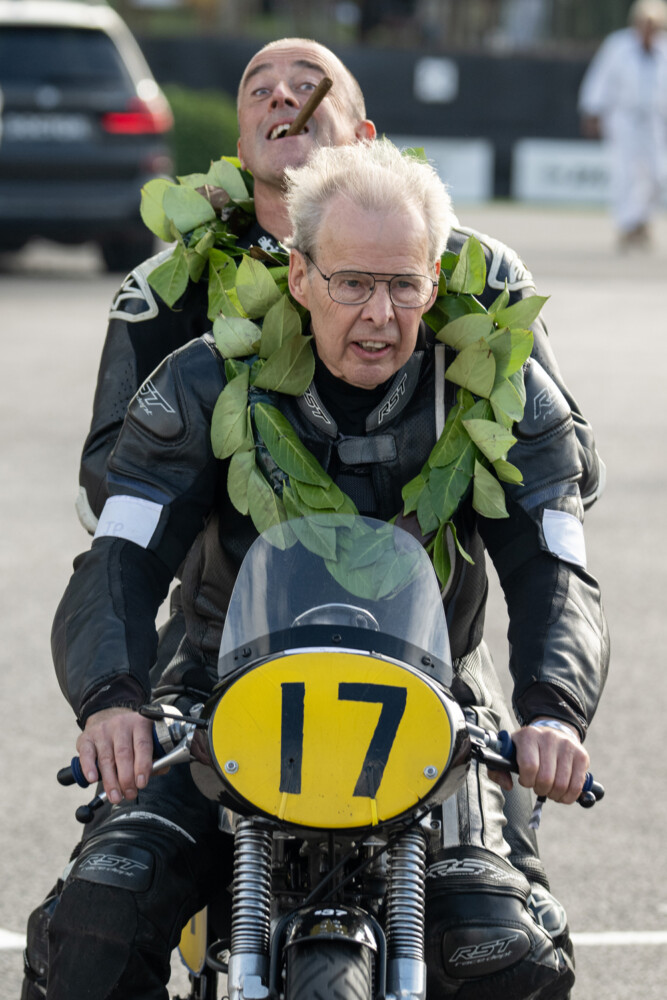
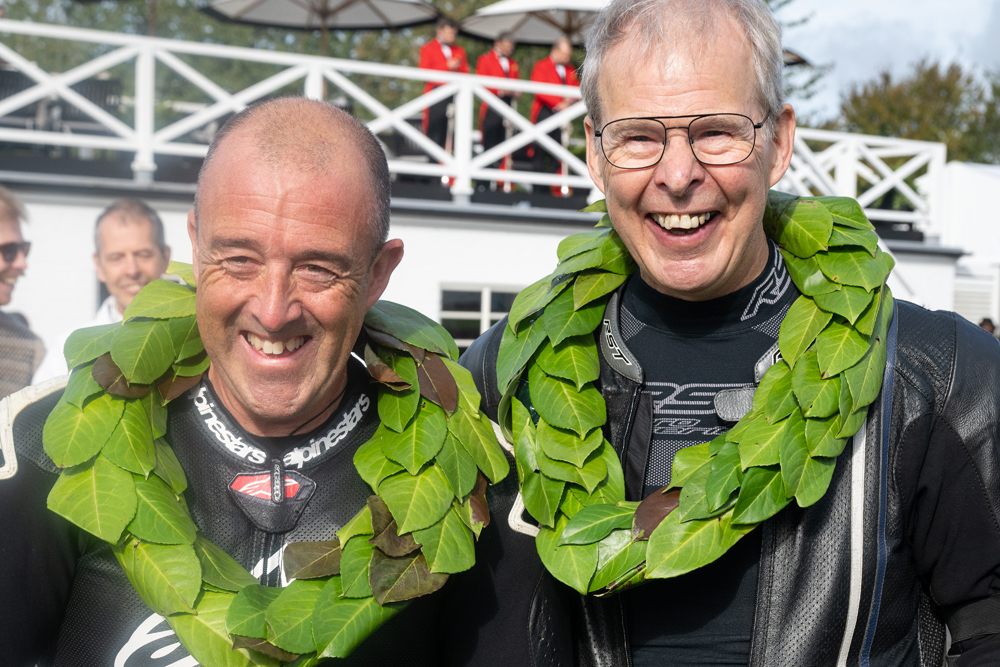
This was the stuff of dreams. A laurel around my neck, a cigar in my mouth, hugging anyone unfortunate enough to be close by, and sharing a podium with McGuinness, who finished second. If I’m dreaming, I don’t want to wake up.
Stuart had poured countless hours into building and preparing the bike, and it had been faultless all weekend. Not temperamental. Not incontinent. Not even mildly offended by the mechanical abuse we handed it. For a classic racing motorcycle, that practically qualifies it for sainthood.
The Goodwood Revival is one of the great racing events of the British calendar and standing on the podium in front of family and friends was overwhelming. It was an experience that will take some beating.CN
Click here to read the Goodwood Revival 2026 in the Cycle News Digital Edition Magazine.