Cycle News In The Paddock
COLUMN
Making Racing Closer by Making Racing Slower
It’s not fair. One make doing all the winning. Worse than that, it’s predictable, so it’s not entertaining. Something needs to be done!
For once, this column isn’t about MotoGP, or not directly. The premier series is currently off enjoying a summer break, wildfires and sunstroke permitting.
We’re looking at WorldSBK and British Superbikes. Production-based racing, where the different makes take part because of the shared mantra—win on Sunday, sell on Monday—and where Ducati’s Panigale V4 is making mincemeat of the opposition.
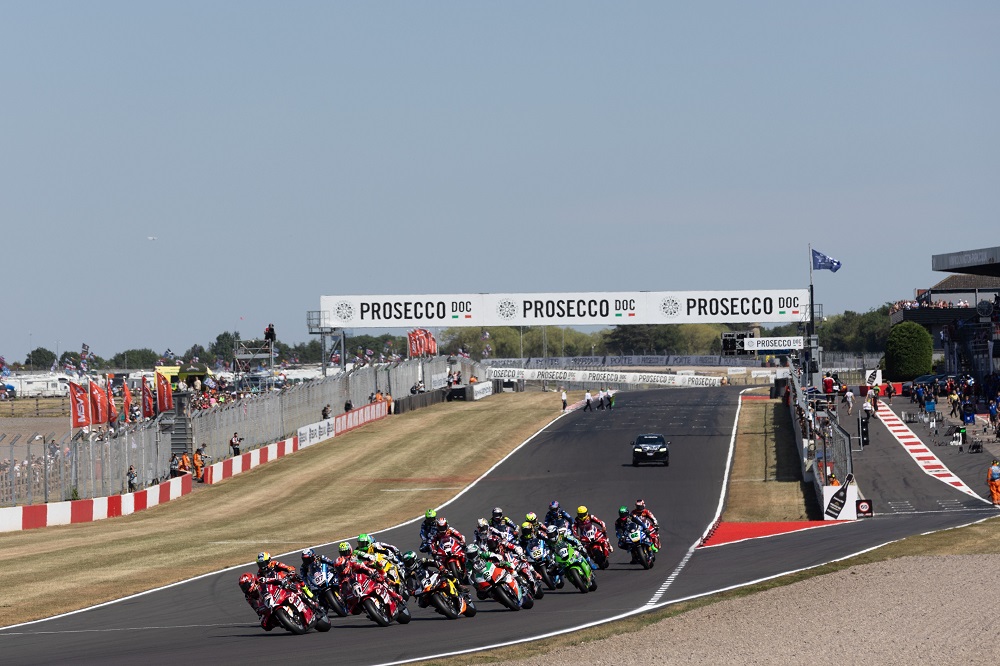
Oddly (maybe you can tell me why) it’s different in the USA, where Yamahas currently hog the top places. Elsewhere, Ducatis have won every race so far in WorldSBK and every race bar one in the British series.
Domination by one make is somewhat normal in racing. The prime past example: MV Agusta, which pretty much owned GP racing from the mid-1950s to the mid-1970s. After that, domination was batted back and forth between Honda and Yamaha, right up to the new-century four-strokes. Then, for the past four years, Ducati took a turn, though now under threat by Aprilia.
MSEG (MotoGP Sports Entertainment Group, formerly Dorna) has tried hard to make it more equal: dumbed-down technical regs, one-for-all tires and electronics, and limited testing. And then more fine-tuning: the concessions system that limits development and testing for successful teams, and vice versa for the also-rans, to help them catch up.
But these are prototypes and have to be dealt with differently.
Superbikes are based on existing showroom models, so rather than addressing development, you must deal with what you’ve already got.
You can’t speed up the slow ones. So you have to slow down the winners. Rather the antithesis of what racing is about.
There are three basic ways of doing this: adding weight, restricting fueling or cutting revs.
Adding ballast is controversial to say the least, largely for safety reasons. And there are further complications with riders of different weights—you have to go for combined weights.
Fueling also has problems, whether done electronically or (more old-fashioned) by physical restrictions to the inlet tracts. Not least because it can upset the fine-tuning balance of a high-performance engine. Bluntly, it can mar throttle response, making a bike not only more difficult to ride, but potentially even dangerous.
WorldSBK use fueling anyway, with a sophisticated system that possibly ameliorates these problems. This controls flow rate, measured in kilograms an hour and changed in half-kilogram steps. It was introduced last year, and this year alone, Ducati and bimota have both been hit by reductions for being too fast, Ducati twice; while Yamaha has been granted extra. All without making any discernible difference to results. Ducati’s Nicolo Bulega has won every race but one, which went to his teammate, Iker Lecuona.
BSB uses revs for the Superbike class and fueling for the support classes. So far this year Ducati’s V4-R Panigale has been docked from 16,000 rpm to 15,750, without altering the results in the slightest.
But in the Supersport class, “Next Generation” rules offer a completely different way of finding parity. Instead of being based on cubic capacity as is traditional, the class is open to a wide variety of bikes, ranging from 600cc fours to 955cc twins, via 765cc triples. They are further manipulated by throttle controls—Ducati currently on 80 percent of full opening. And it works. For example, at the most recent BSB race at Brands Hatch, the top six all finished inside 1.5 seconds and spanned the range: Triumph triple, Honda and Yamaha fours, and Ducati twin.
It’s intriguing to think that new thinking might add variety to Superbikes as well, not only to the grids but also to the results, making it all less predictable and more fun for the riders and fans, and more commercially attractive for the manufacturers.
But there are philosophical questions here about the meaning and value of racing. Is it just entertainment, making it fair game to slow the fast ones down? Or is it a genuine sport, giving the participants—engineers and riders—a chance to achieve and then demonstrate excellence?
And there’s the matter of riders. The very best of them are able to overcome machine weaknesses—indeed, to use them to display exceptional talent. For example, Ducati is dominant in WorldSBK, but Toprak Razgatlioglu was able to beat them, riding both Yamaha and BMW.
Racing is different for every stakeholder. For the manufacturers, it’s a high-pressure showroom. They race because they want to sell more motorcycles. For the riders, it’s personal. For promoters and circuit owners, it needs to make money. And for the fans, it must be entertaining.
But when you have to slow racing down for the lowest common denominator, it feels as though something is wrong. CN