Starting in 2027, MotoGP will use new weekend format.
MotoGP’s new format was introduced to both reduce track time and make the weekend easier to understand for new viewers, according to deputy CEO Carlos Ezpeleta.
2027 MotoGP Restructured Weekend Format Key Updates
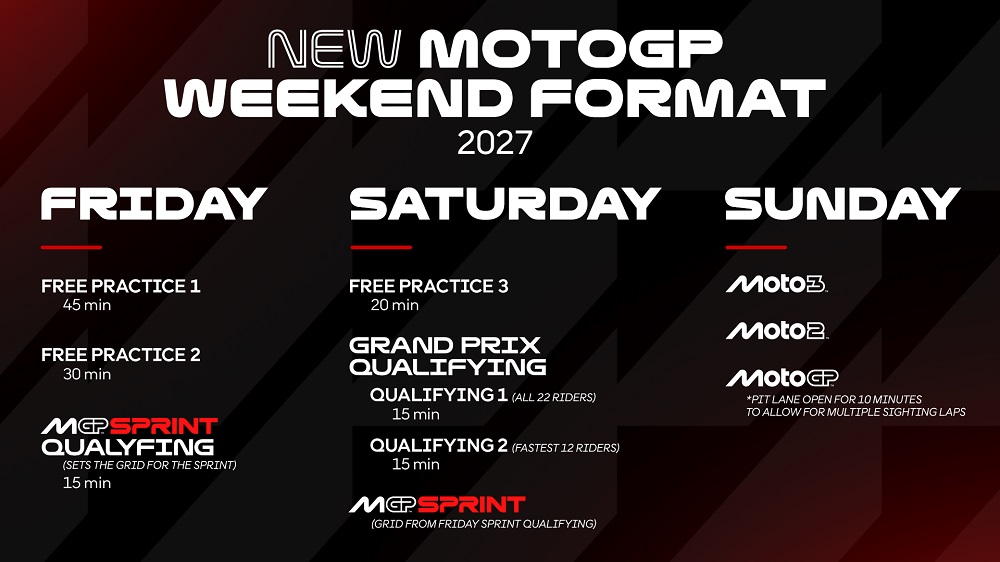
- Friday will now comprise a 45-minute FP1, a 30-minute FP2 and a 15-minute Sprint qualifying session for all riders, deciding the grid for the Tissot Sprint on Saturday.
- Saturday will comprise a 20-minute FP3 followed by a 15-minute Grand Prix Qualifying 1 and 15-minute Grand Prix Qualifying 2. All riders will take part in Q1 before the top 12 graduate to Q2 to decide pole position and the front four rows for the Grand Prix race.
- On Sunday, the 10-minute warmup will be replaced by pitlane opening for 10 minutes for the MotoGP Grand Prix, allowing multiple sighting laps
The decision to introduce a separate 15-minute qualifying session on Friday afternoon for the Sprint, then a Q1 session with all 22 riders—12 of whom progress to Q2—to determine Sunday’s grid, and do away with Sunday warmup, was largely unpopular among the MotoGP grid.
“We were approached by the teams in Misano about a revised schedule aimed at reducing the amount of track time,” said Ezpeleta. “Speaking to Michelin, they confirmed 80 percent of the riders actually do two time attacks on Friday afternoon. Then 12 riders do two time attacks in Q1, and another two riders do an extra two, and the other ones join them, so another 12 riders do another two time attacks for Q2.
“All of this is already happening. How do we use that to make it easier to understand for the fans, and for it to be actually less stressful for a number of the riders? Plus, ensuring the grid is different for the weekend’s two races allows them to have two opportunities and not be that much under stress on Friday afternoon,” Ezpeleta said.
Read what the riders thought about this in Cycle News 2026 Indonesian MotoGP News and Results
The following is the official statement from MotoGP…
MotoGP fans have even more to look forward to in 2027. Alongside the new bikes and technical regulations, the sport announces a new-look weekend for next year with the introduction of a qualifying session for the MotoGP Sprint—creating distinct grids for the Sprint and Grand Prix race at every round. The new format balances an incredible spectacle for fans and new stakes in each session with well-balanced track time for riders, teams and factories.
The new Friday format begins with a 45-minute Free Practice 1, as now, before a 30-minute Free Practice 2 replaces Practice. This new, shorter FP2 is not timed for entry into any other session. Friday’s action then concludes with the new 15-minute Sprint qualifying for all riders that decides the starting positions for the Tissot Sprint on Saturday afternoon.
Saturday for MotoGP begins with FP3, a 20-minute free practice session, before qualifying for the Grand Prix race. All riders will take part in Grand Prix Qualifying 1, and the top 12 will go through to GP Q2. The Sprint then provides the perfect Saturday crescendo, racing with the grid from Friday’s Sprint qualifying session.
Sunday’s action will now begin with the Moto3 and Moto2 races. The track time previously used for MotoGP Warm Up will move to ahead of the MotoGP Grand Prix as pitlane opens for ten minutes for multiple sighting laps, giving riders the opportunity for a shakedown ahead of lights out. The race then gets underway with the grid set from GP Q1 and GP Q2.
MotoGP in 2027: two different grids, two incredible showdowns and the introduction of our all-new technical regulations. Watch 2026 reach its crescendo in the closest title fight in history and then get ready for even more spectacular MotoGP, coming soon.
A regularly updated version of the FIM Grand Prix Regulations which contains the detailed text of the regulation changes may be viewed HERE.