Ducati has entered the street-legal dual sport market with the all-new Desmo450 EDS. We spent a day riding it in California’s mountains to get a firsthand look and experience.
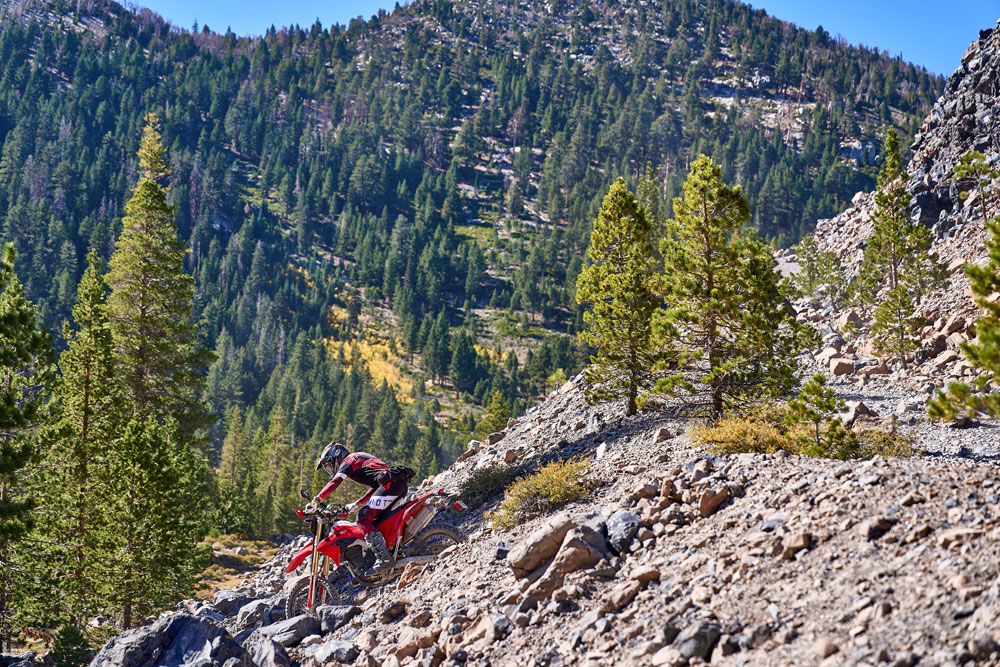
Photos by Gregor Halenda Photography
If there is one thing we know about Ducati, it’s that it isn’t afraid to try something new. After decades of building some of the world’s most exotic street motorcycles, the Italian manufacturer is making a serious push into the dirt-bike market. First came the Desmo450 MX motocrosser, followed by the off-road-focused Desmo450 EDX, and now the Desmo450 EDS, Ducati’s first modern street-legal dual sport motorcycle.
Yes, a Ducati dual sport. Who would’ve thought?
The EDS, short for enduro street legal (or, if you want, enduro dual sport), is based on the Desmo450 MX but features significant changes to make it better suited for off-road riding and, of course, street legal. It’s designed for riders who want a high-performance dirt bike they can ride to the trails rather than haul it there in a pickup truck.
But building a competitive dual sport isn’t as simple as installing lights, mirrors and a license plate on a motocross bike. It must meet emissions and noise regulations while remaining comfortable on pavement without sacrificing serious off-road performance. That’s a difficult balancing act, but Ducati was up for the challenge.
Ducati recently introduced the bike to the North American press, and I spent the day riding it around Mammoth Lakes, California, tackling mountain trails, rocky sections, sandy dirt roads, fast two-track and pavement. It was a good start to get acquainted with Ducati’s newest off-road creation.
And I came away impressed.
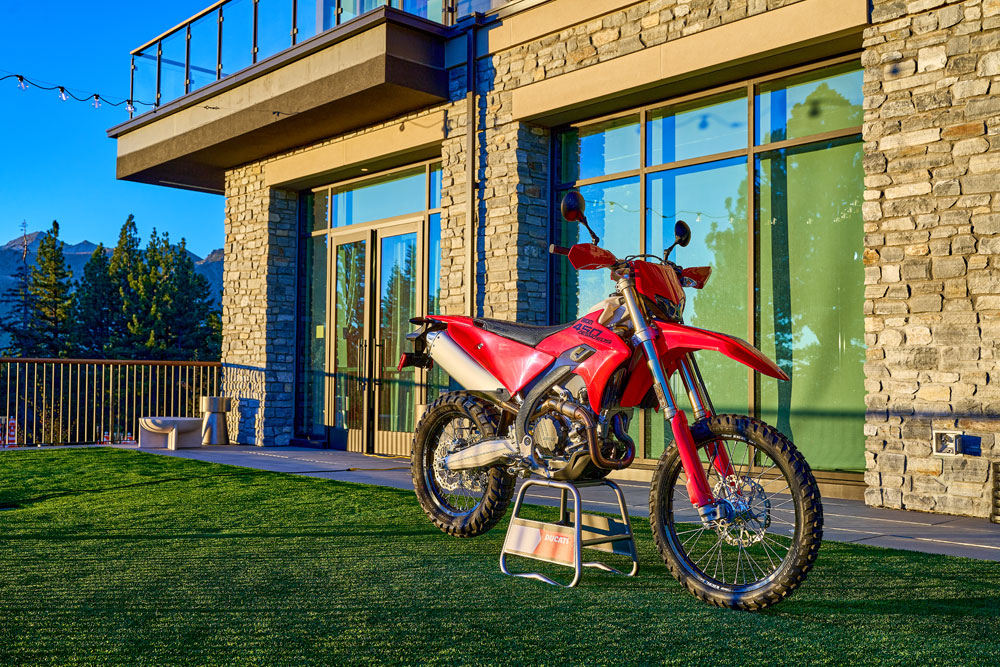
What’s Underneath? | 2027 Ducati Desmo450 EDS Review
The Desmo450 EDS is powered by a 449.6cc liquid-cooled, four-valve, single-cylinder engine featuring Ducati’s signature Desmodromic valve system. Rather than relying on conventional valve springs, the system mechanically opens and closes the valves. Ducati has used this technology for decades across its high-performance street and MotoGP-winning race bikes.
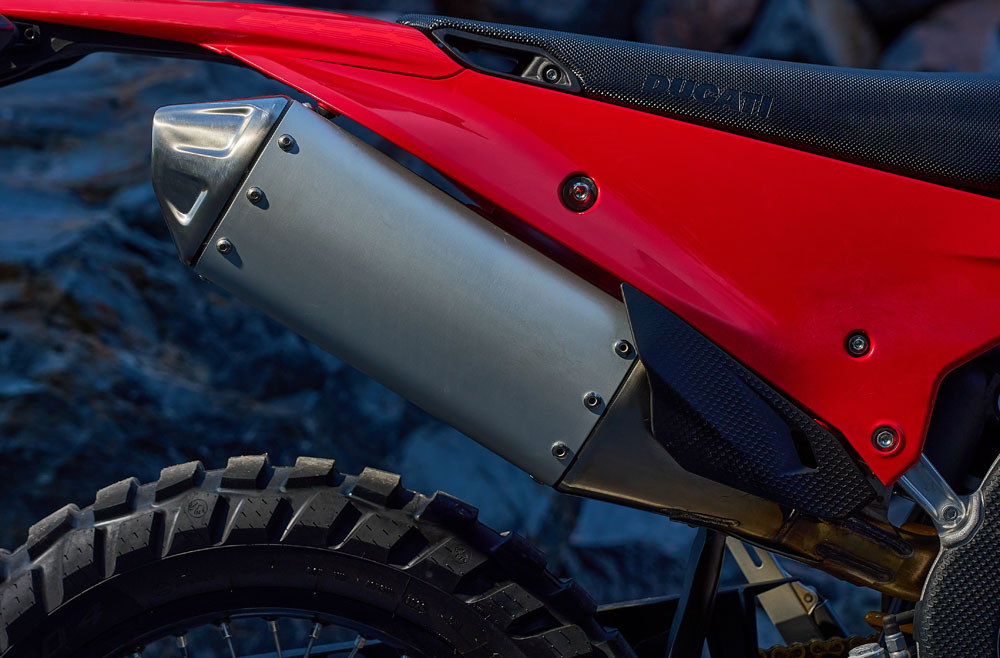
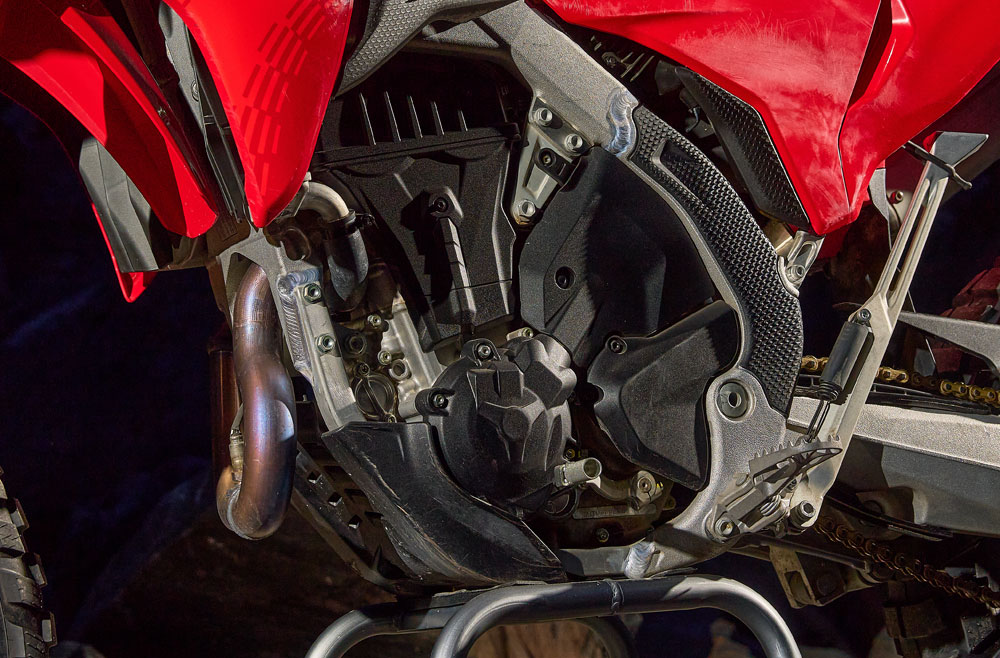
Although derived from the Desmo450 MX, the engine differs significantly. It features different camshafts, a smaller 42mm throttle body, lower compression, increased rotating inertia and a revised exhaust. Ducati says the goal was smoother, more manageable power without sacrificing performance.
Ducati also fitted it with a six-speed transmission, versus the MX’s five-speed, with dedicated gear ratios. First gear is shorter for technical riding, while sixth is taller for pavement.
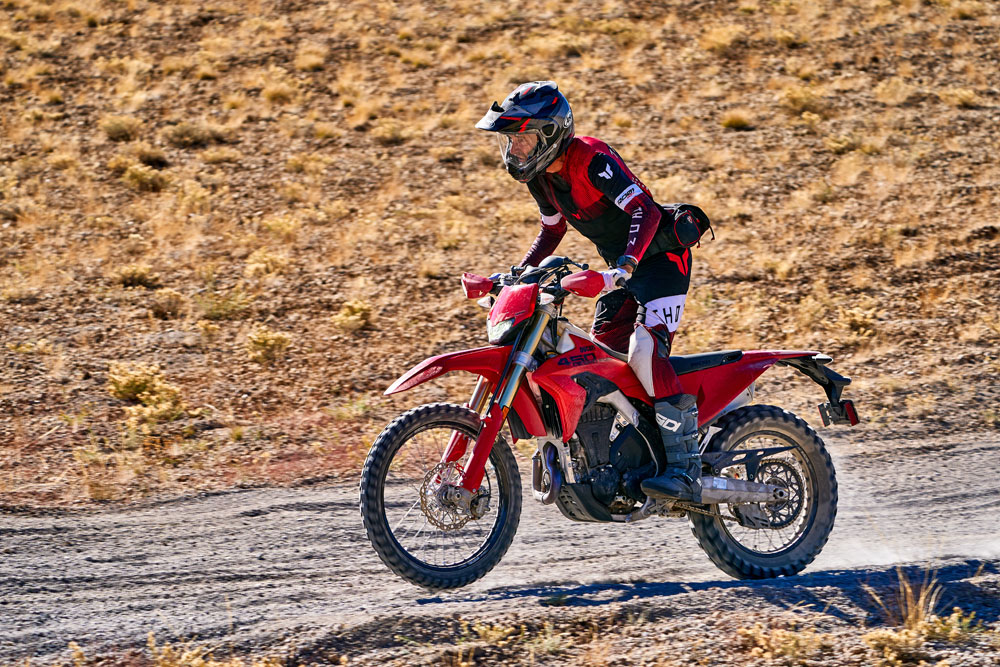
The aluminum perimeter frame is derived from the motocrosser but features revised engine mounts and stiffness characteristics for off-road riding. Ducati says the frame weighs less than 20 pounds and comprises 11 major components.
Showa supplies the fully adjustable suspension, with a 49mm inverted fork offering 12.2 inches of travel and a linkage-equipped shock providing 11.9 inches. Ducati said it worked with Showa and multiple-time Enduro World Champion Antoine Meo to develop EDS-specific settings.
Brembo brakes, Galfer discs and Excel rims complete the rolling package.
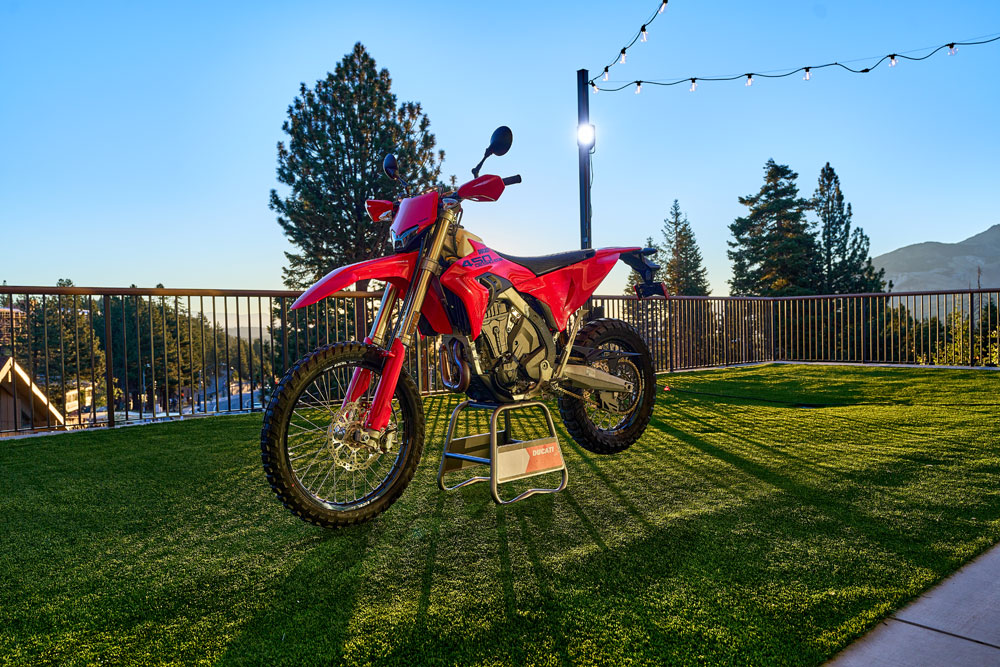
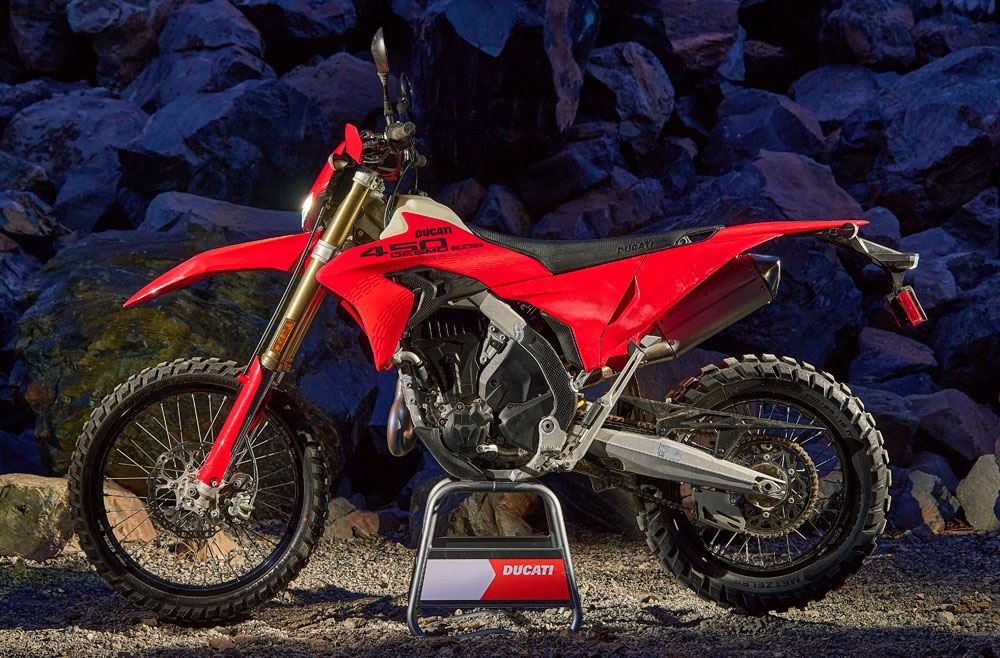
Standard equipment includes handguards, engine protection, an electric radiator fan, LED lighting and a transparent fuel tank, versus the EX’s solid black, 2.25-gallon fuel tank.
Ducati claims 264.3 pounds without fuel, competitive for a street-legal, high-performance 450 dual sport, though hardly featherweight.
The price? $12,995. Nobody said owning a Ducati would be cheap, but it’s in the ballpark. It’s $504 less than KTM’s comparable 500 EXC-F, which lists for $13,499, and $604 less than the Husqvarna FE 501S. However, it’s a few hundred dollars more than Beta’s 2027 RS 430, 480, and 500 dual sports. The Honda CRF450RL should probably be included as well; it lists for $10,799, $ 2196 less than the Ducati. All things to consider, for sure.
Let’s Ride | 2027 Ducati Desmo450 EDS Review
One of the first things that struck me about the Desmo450 EDS was its engine. It’s unquestionably one of the motorcycle’s strongest attributes.
The Ducati has excellent low-end torque and an impressive ability to chug along at very low rpm without complaining. You can lug the engine down to almost zero rpm, and it keeps pulling. Stalling was never a concern for me, even in extremely slow-going, technical terrain. That’s important on a dual sport, where you might spend one minute cruising a dirt road and the next picking through rocks, ruts or a steep climb. You don’t want to constantly slip the clutch or shift gears to keep the engine happy. The Ducati makes this kind of riding pretty darn easy.
What’s particularly impressive is that the engine doesn’t sacrifice top-end performance for its excellent low-rpm manners. Quite the opposite. Twist the throttle, and the Desmo keeps pulling, seemingly forever. It revs to the moon. I never really felt an obvious rev limit, though I’m sure it exists somewhere.
The powerband is exceptionally broad, smooth and linear. There’s no sudden or violent hit when you grab a handful of throttle, just a strong, steady rush of acceleration that builds with the revs.
Don’t mistake smooth for slow, however. The Ducati makes plenty of power and responds immediately when you want to get moving. Yet the power never feels intimidating or difficult to control. Maybe the approximately 8000-foot elevation had something to do with that; if so, probably not much. I have the feeling the motor is just as rider-friendly at high altitude as it is at low altitude. Hopefully we can verify that in the near future.
I soon discovered that third gear quickly becomes your go-to gear. I found I could leave the transmission in third across a surprisingly wide range of terrain and be happy. Thanks to the engine’s impressive flexibility, you can handle tight corners, flowing trails and moderate climbs in the same gear, usually third gear. Its user-friendly power delivery makes a long day in the saddle on the Ducati very doable.
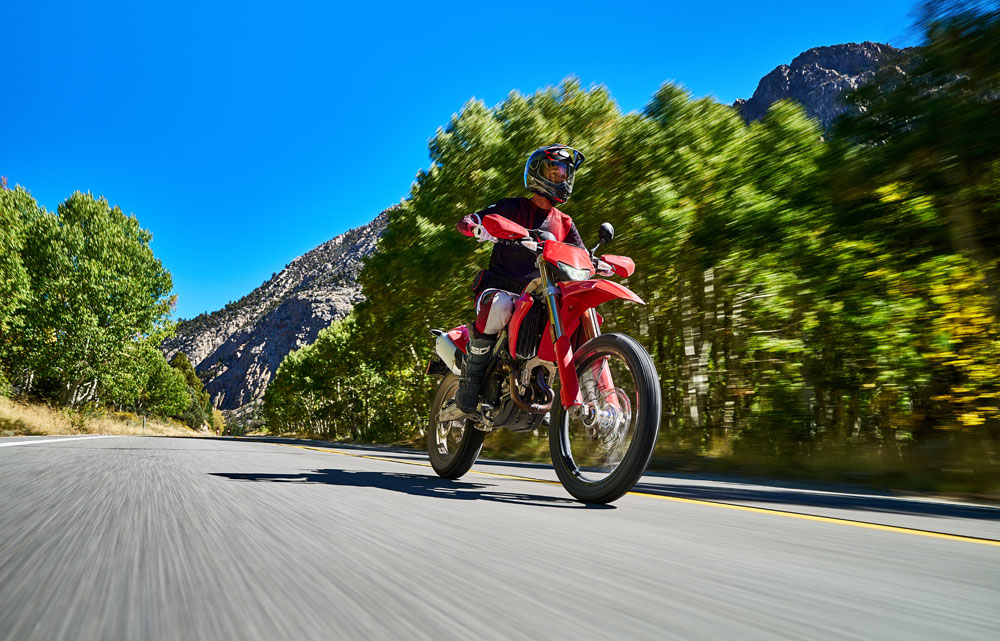
The six-speed transmission complements the engine well. Shifting is generally smooth and precise, and the gear ratios are well chosen. First is low enough for technical riding, while the middle gears work across a broad range of conditions. Sixth is particularly tall, which I appreciated on pavement. The Ducati cruises comfortably at highway speeds without feeling overworked, and it still has plenty of power for passing.
There is one annoyance, however. Finding neutral while stopped with the engine running can be frustrating. Hopefully, this improves with break-in.
The clutch is excellent. Lever pull is light, engagement predictable, and modulation smooth. Combined with the engine’s strong low-end torque, slow-speed riding is very easy for a big-bore single.
Another pleasant surprise is the lack of vibration. The Ducati is remarkably smooth for a single, with little noticeable vibration through the handlebars or footpegs, even at higher rpm.
The exhaust is relatively quiet, compared to the MX model. Ducati clearly worked hard to meet street-legal sound and emissions requirements without strangling the engine. Fortunately, none of these measures seem to have compromised performance.
You’ll notice large black plastic covers on parts of the engine, added to reduce mechanical noise and help meet regulations so it can be sold in all 50 states. These odd-looking covers, however, seem easy to remove if you want.
Keeping It Simple | 2027 Ducati Desmo450 EDS Review
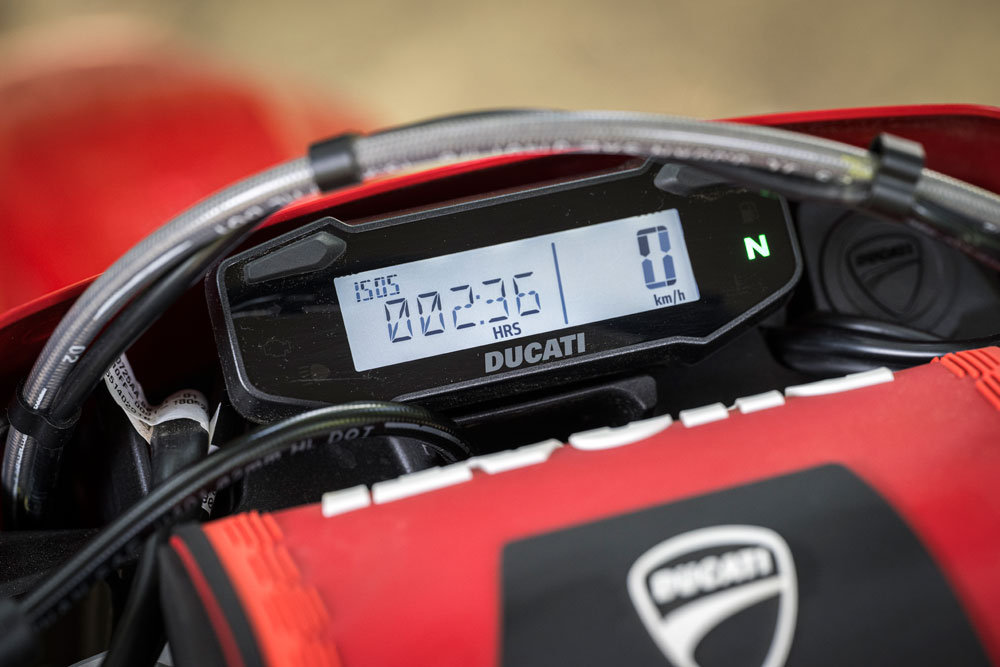
Our test bike was left completely stock, meaning no multiple engine maps, traction-control settings or electronic adjustments to worry about. Those come as extras.
You simply start the engine and ride.
I like that.
For those seeking more adjustability and performance, however, Ducati offers optional electronics and upgrades. A basic electronics kit, priced at approximately $260, unlocks selectable engine mapping, traction control, launch control and engine-brake control. Additional racing packages are planned to reduce weight and increase horsepower. With the appropriate Ducati Performance Racing Kit installed, claimed output reaches 54 horsepower, with exhaust options offering even more. You’ll be able to manage these features via Ducati’s X-Link app.
Ducati says its traction-control system is unique in that, when unlocked, it is designed specifically for off-road use. Rather than simply cutting power whenever the rear wheel spins, it distinguishes between useful and excessive wheelspin. It can also recognize situations, such as jumps, when intervention isn’t desirable.
The system offers four intervention levels and can be temporarily overridden with a light pull of the clutch lever. We couldn’t test these features because our bike wasn’t equipped with the kit, but the technology is intriguing. These modifications may affect street legality, depending on where you live, so check before handing over your credit card.
However, the stock bike we rode performed so well that I never felt I was missing out on anything.
Suspension & Handling | 2027 Ducati Desmo450 EDS Review
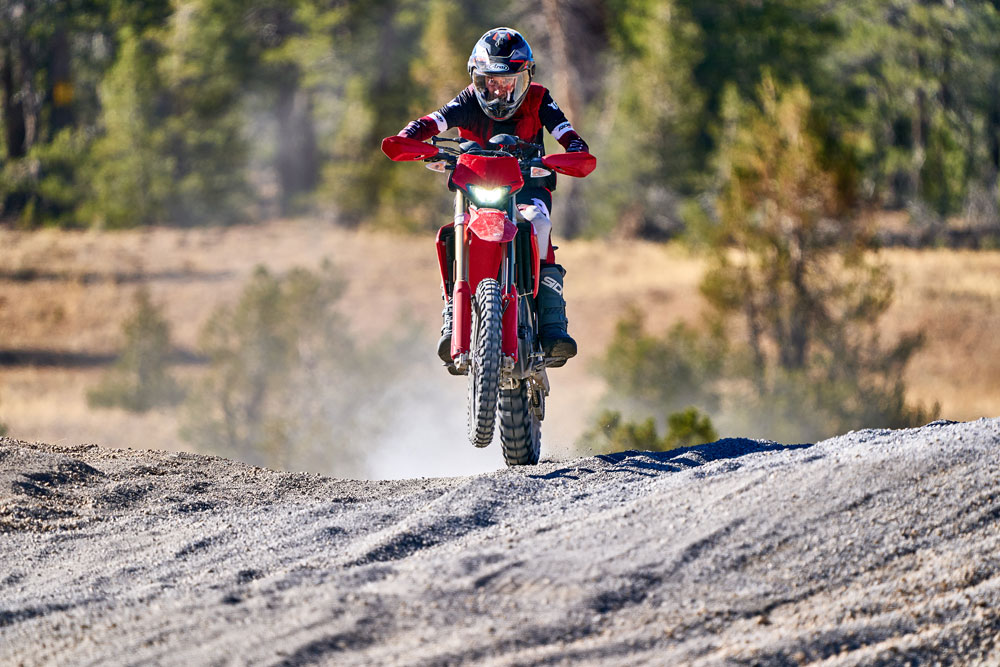
The Ducati’s suspension is another strong point. Showa developed the fork specifically for enduro riding, using softer springs and different damping characteristics than the Desmo450 MX. The goal is improved compliance over rocks, roots and smaller obstacles while maintaining control at higher speeds.
For the most part, Showa and Ducati (and Meo) got it right.
At approximately 165 pounds in street clothes, I found the stock spring rates just about right for me. The suspension is comfortable and balanced, and I had no rush to make adjustments.
The fork is especially good over small bumps and ripples, absorbing trail chatter without being overly harsh. The rear shock is equally impressive, delivering good tractability and keeping the rear wheel planted over uneven terrain.
I did notice one quirk with the fork, however. When the front wheel fully extends, particularly when it leaves the ground, the fork occasionally produces a slightly noticeable top-out sensation. It’s not severe enough to affect control, but it’s there. Perhaps a damping adjustment would help.
Otherwise, I had few complaints about the Ducati’s suspension in Mammoth.
The Ducati handles well, too. It’s stable, predictable and surprisingly agile for a street-legal dual sport weighing more than 260 pounds. It goes where it’s pointed, too, without much effort from the rider.
It’s not a light motorcycle, but it doesn’t feel particularly heavy once moving. You become much more aware of it when picking the bike up after a tipover than when in motion. On the trail, the Ducati feels nimble; direction changes are easy, and it responds quickly without feeling nervous.
The Ducati comes fitted with Metzeler Karoo 4 tires, which weren’t ideally suited to the terrain around Mammoth Lakes, which is primarily dry and loose. The Karoo 4s aren’t particularly aggressive tires and struggled for traction on this ride. I would’ve preferred something with more bite, especially when accelerating and braking. The front tire doesn’t inspire confidence on the dry, loose dirt, either.
On pavement, however, the Karoos are excellent: smooth, predictable and remarkably quiet, which is why Ducati chose them—to reduce tire noise for regulatory reasons. It’s another compromise manufacturers face when building a high-performance dirt bike that must meet street-legal noise requirements. So, if you plan to spend most of your time off-road on the Ducati, put more aggressive tires at the top of your to-do list.
Comfort & Ergonomics | 2027 Ducati Desmo450 EDS Review
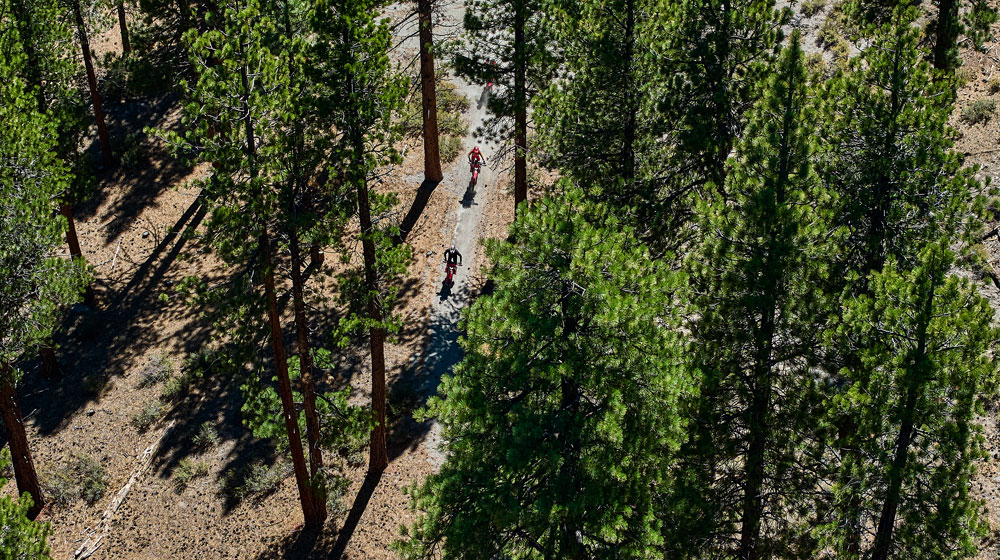
Ducati did a good job with the EDS’s ergonomics. The motorcycle feels narrow through the middle, and the handlebar, seat and footpeg relationship is comfortable and natural. There’s plenty of room to move, and transitioning between sitting and standing is simple.
Standing ergonomics are particularly good. At a little over 6 feet tall, I never felt cramped or forced into an awkward position on the pegs.
The seat, however, is another story. It’s hard. Really hard. It’s tolerable when you’re on the pegs most of the day, but you’ll notice it on longer pavement sections where you sit more, or just at the end of a long day. I’d gladly trade a little firmness for more cushioning. The good news is that Seat Concepts is just a few clicks or a phone call away.
The grippy seat cover, however, is excellent and helps keep you planted when accelerating or riding rough terrain.
Otherwise, the EDS is comfortable for an off-road bike. Low vibration and a tall sixth gear make pavement riding more pleasant than expected. It isn’t a touring bike, of course, and the 2.25-gallon tank limits range, but for connecting trails, exploring backroads or riding from home to your favorite off-road area, the Ducati is more than capable.
The Maintenance Question | 2027 Ducati Desmo450 EDS Review
Maintenance is worth thinking about; after all, it is a high-revving, high-performance motorcycle. The EDS may be street-legal, but its engine is derived from competition. Consequently, maintenance is more involved than it would be with a typical low-stress dual sport. Ducati’s adaptive maintenance system considers riding conditions and engine loads rather than relying entirely on fixed intervals. It lists piston replacement and valve-clearance checks at approximately 90-120 hours, depending on use, with a more extensive engine overhaul at roughly 180-240 hours. Those aren’t alarming numbers for a competition-derived 450, but they’re worth considering if you plan to rack up miles.
The Verdict | 2027 Ducati Desmo450 EDS Review
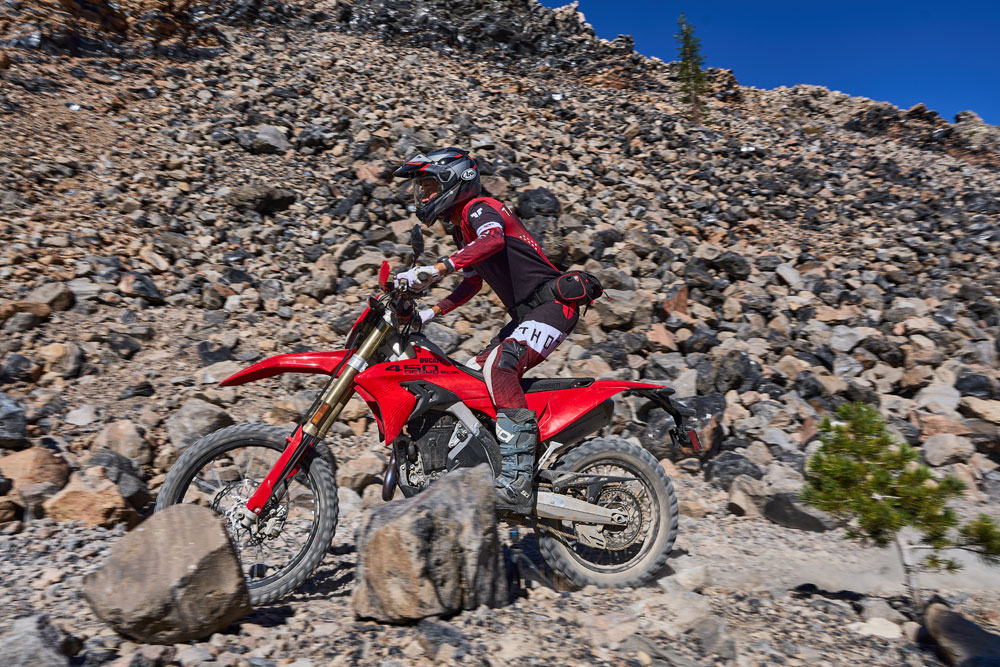
Ducati might be relatively new to modern off-road motorcycles, but you wouldn’t know it after riding the Desmo450 EDS. The bike feels well-developed, refined and surprisingly easy to ride. Its engine stands out, combining excellent low-end torque, smooth power delivery and seemingly endless top-end performance. Add a well-spaced six-speed transmission, light clutch, excellent suspension and predictable handling, and you have a motorcycle that’s both capable and enjoyable.
I also appreciate that Ducati keeps the stock bike relatively simple to begin with. You don’t need multiple riding modes or sophisticated electronics to enjoy it right out of the crate. But if you like all that other stuff, the potential is there.
As much as I enjoyed riding the EDS, the bike isn’t perfect. The seat is extremely hard, the fork occasionally tops out, neutral can be frustrating to find, and the stock tires aren’t ideal for dry and loose terrain. The weight is noticeable at times, and the small fuel tank and competition-oriented maintenance schedule are worth considering.
And at $12,995, it sits firmly in premium dual sport territory.
Still, after a day riding around Mammoth Lakes, I came away impressed by how complete the package feels.
Ducati didn’t simply turn its motocrosser into a street-legal dirt bike. It developed a motorcycle with its own personality, combining serious off-road performance with refinement that makes pavement riding surprisingly enjoyable. For a first effort in the modern street-legal enduro category, that’s quite an accomplishment.
Established dual sport manufacturers now have another serious competitor to worry about, without a doubt. And this one happens to be red, Italian and powered by a Desmo engine.
Who would’ve thought?CN
VIDEO | Is Ducati’s NEW Dual Sport Worth The Hype?

2027 Ducati Desmo450 EDS Specifications
| MSRP | $12,995 |
| Engine | Liquid-cooled, 4-stroke single-cylinder |
| Valvetrain | DOHC, 4-valve, Desmodromic |
| Displacement | 449.6cc |
| Bore x Stroke | 96 x 62.1mm |
| Compression Ratio | 12.9:1 |
| Fuel System | EFI, 42mm Mikuni throttle body |
| Starting System | Electric |
| Transmission | 6-speed |
| Clutch | Wet, multiplate, hydraulically operated |
| Horsepower (claimed) | 42 hp @ 6750 rpm |
| Torque (claimed) | 33 lb-ft @ 5750 rpm |
| Frame | Aluminum perimeter |
| Front Suspension | 49mm Showa inverted fork, fully adjustable |
| Rear Suspension | Showa shock, fully adjustable |
| Front-Wheel Travel | 12.2 in. |
| Rear-Wheel Travel | 11.9 in. |
| Front Brake | 260mm Galfer disc, two-piston Brembo caliper |
| Rear Brake | 240mm Galfer disc, single-piston Brembo caliper |
| Front Tire | 90/90-21 Metzeler Karoo 4 |
| Rear Tire | 140/80-18 Metzeler Karoo 4 |
| Rake/Trail | 27.3° / 4.6 in. |
| Wheelbase | 58.8 in. |
| Seat Height | 38.2 in. |
| Fuel Capacity | 2.2 gal. |
| Weight (claimed, w/o fuel) | 264.3 lbs. |
Click here to read the 2027 Ducati Desmo450 EDS Review in the Cycle News Digital Edition Magazine.