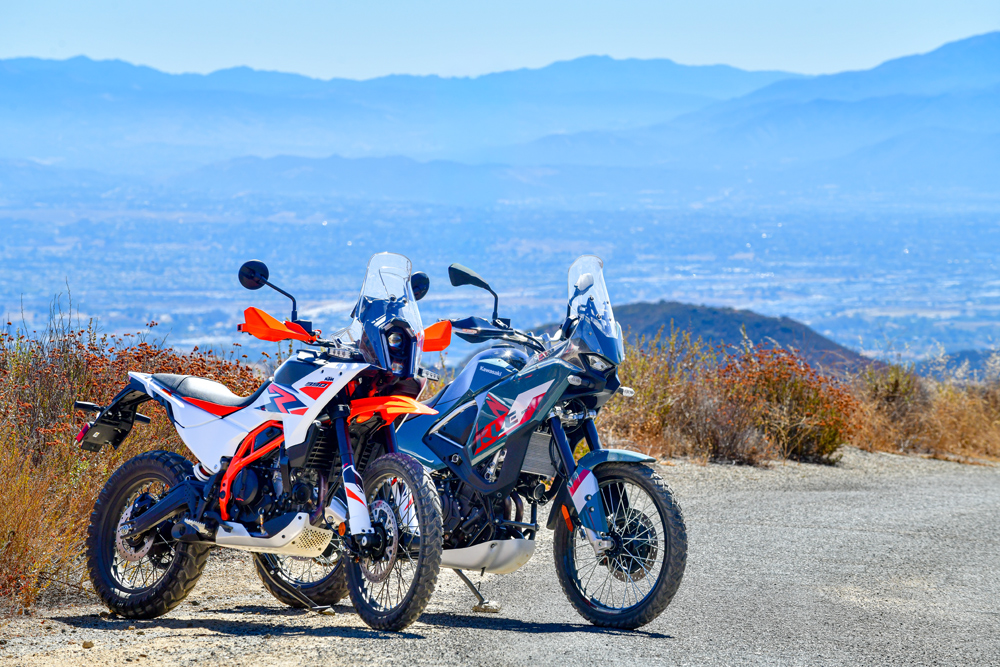
On paper, the KTM 390 Adventure R and the Kawasaki KLE500 SE ABS share a few key similarities, such as appealing MSRPs, non-intimidating engines and the word “adventure” in their job descriptions. But do these small-to-midsize ADV motorcycles perform similarly or completely differently? We took them for a ride to find out.
Photography by Kit Palmer
So, you’ve been bitten by the ADV bug, and the idea of going on long or semi-long adventure rides and exploring the great outdoors on motorcycles has infected you like a virus that just won’t go away. Only owning your own ADV motorcycle will cure your affliction. You eventually give in, take the plunge and decide to buy your first ADV motorcycle. But where do you start? With so many types, sizes and prices of ADV bikes out there, it can be mind-boggling.
Many ADV first-timers start conservatively, wanting a capable bike with an appealing price tag that isn’t intimidating to ride—one that doesn’t make 100 horsepower or weigh as much as your Toyota Corolla—yet still performs well and is comfortable enough for lengthy rides both on and off the road. And, of course, look cool, not like a budget or “beginner’s” bike. Enter the Kawasaki KLE500 SE ABS and the KTM 390 Adventure R, two bikes that we think fit the bill quite nicely, but in different ways.
At first glance, these two bikes might not seem all that comparable. After all, the Kawasaki is a 500, and the KTM is a 390, but in reality, they are much closer in displacement than their decals suggest. The KLE500 is actually a 450 (technically, 451), and the KTM is a 400 (technically, 398.7), just a little over a 50cc difference. That’s not a big difference. They are similarly priced, too, with the Kawasaki at $7499 and the KTM at $7699—just a $200 difference—and both are aimed at riders looking for approachable, versatile adventure motorcycles. So, we feel these bikes are close enough on the major talking points to compare, or at least to point out their strengths and weaknesses, and then you can decide which one is best for you.
Background Check
Before we head out, a quick background check. The KLE500 is a new model for Kawasaki for 2026, but the name isn’t new. Kawasaki introduced the original but short-lived KLE500 in 1991; welcome back.
The KTM 390 Adventure, meanwhile, has been around since 2020, but the more dirt-focused 390 Adventure R arrived just last year. The R debuted as part of KTM’s completely redesigned 390 Adventure lineup for 2025. It quickly earned a reputation as a strong off-road performer, and we can confirm that—we’ve been enjoying the 390 Adventure family ever since its arrival.
Enough of the Chit-Chat; Let’s Go Riding
The first thing you notice after riding these two bikes back-to-back is weight. The KTM feels dramatically lighter, which makes sense when you compare the numbers. KTM claims 388 pounds fully fueled versus Kawasaki’s 430-pound curb-weight figure for the California-spec KLE500 SE ABS that we rode. It doesn’t really matter how the manufacturers arrive at their numbers; the fact is, the KTM feels much lighter. The KLE holds more fuel, but only about half a gallon more: 4.2 gallons versus the KTM’s 3.7. It’s not that the KLE is an excessively heavy motorcycle; it’s more like the KTM is an excessively light motorcycle.
The KLE is very comfortable and well-suited for long days in the saddle, while the KTM is better for shorter jaunts. The KTM is comfortable at first, but its firmer, narrower seat will wear on you before the KLE’s plusher seat will. Both bikes offer excellent wind (and hand) protection, but the Kawasaki offers more adjustability, with three windscreen positions. You’ll need tools to make those adjustments, though.
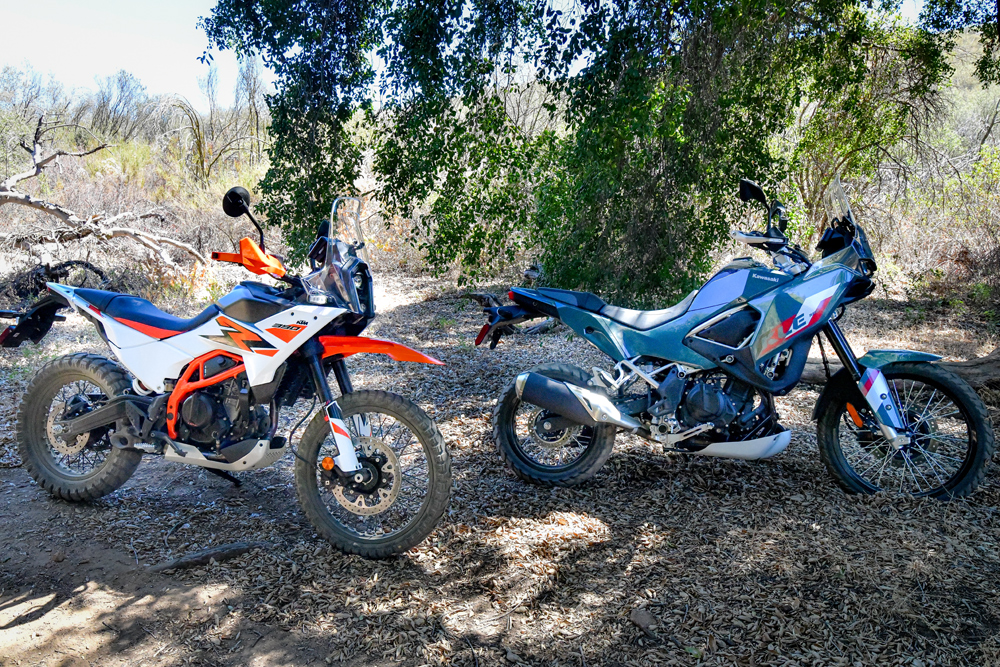
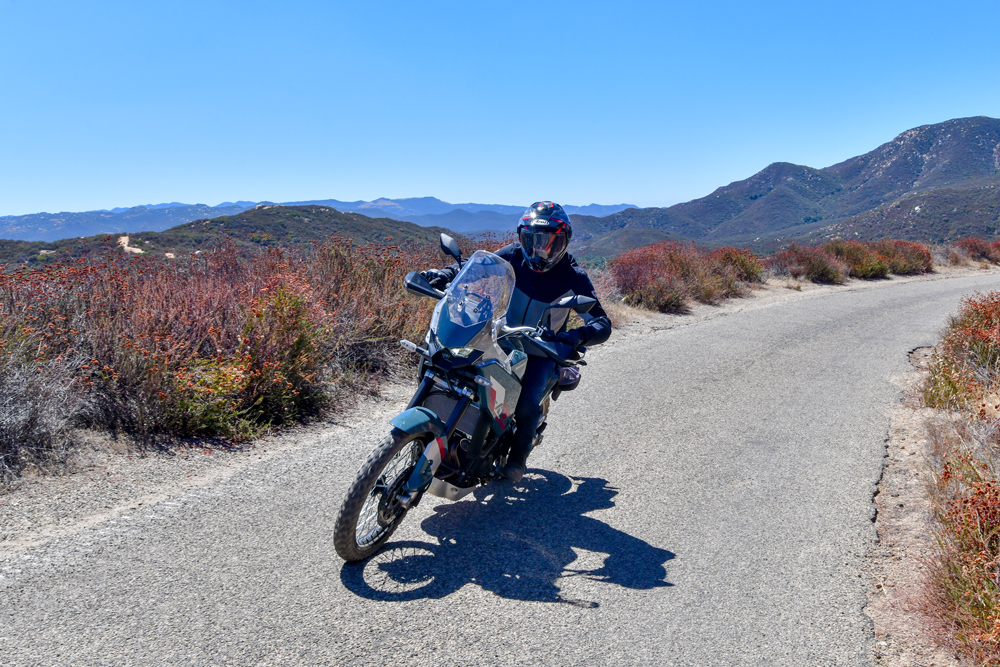
We first rode the KLE earlier this year in St. George, Utah, on mostly well-maintained dirt roads, then rode it back to the Los Angeles area, covering about 350 miles in one day on paved roads. We could not have done that on the KTM—well, maybe if we broke it into two or three days and did it all off-road. Now that would be fun. The KLE would be, too, if you find the right roads.
The KLE is built around a parallel-twin engine and the KTM around a single-cylinder engine, and both configurations have their advantages and disadvantages. Parallel-twins are traditionally smoother than singles in both power delivery and vibration, and things are no different here. The KLE’s engine is simple to manage on and off the road, and vibration is essentially nonexistent. You have nothing to fear when it comes to the Kawasaki’s user-friendly powerplant.
The KTM’s engine is downright spicy in comparison. It’s surprisingly powerful for just 398.7cc and performs better than you might expect on pavement and highways, though it’s no freeway miles crusher. You still must deal with the usual single-cylinder vibes in the handlebars and seat, but they’re acceptable for medium-length hauls on the road. You won’t notice the buzz, or care about it, on the trail.
Both engines also perform exceptionally well at low speeds, neither ever threatening to stall. Despite their different configurations, the Kawasaki’s parallel-twin and the KTM’s single deliver smooth, controllable, predictable power just off idle, with excellent tractability that less-experienced riders will especially appreciate off-road. Both also have light clutch pulls and excellent modulation, making slow-speed riding even easier.
With the KLE, you don’t get bogged down by rider aids and buttons because it doesn’t really have any. Besides its selectable ABS, the Kawasaki keeps things refreshingly simple. It does offer smartphone connectivity through Kawasaki’s Rideology The App Motorcycle. That’s about it.
The KTM, on the other hand, is loaded with electronics. It has cornering traction control, cornering ABS, Offroad ABS and three ride modes—Street, Rain and Offroad. Quickshifter+ and cruise control are optional extras that will increase the price. In other words, there’s plenty to play with on the KTM if electronics are your thing.
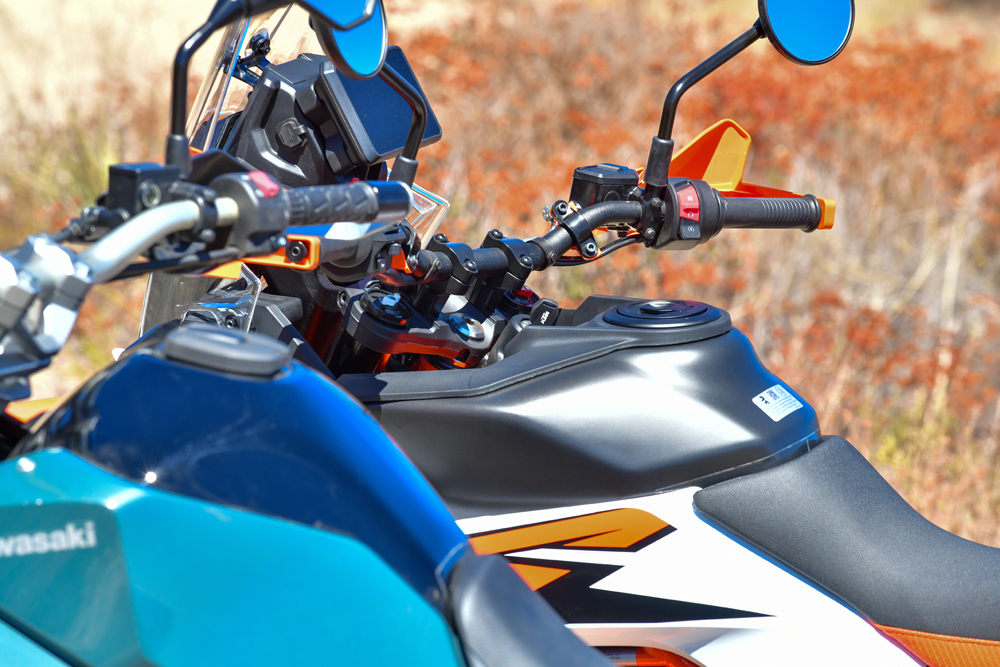
Both bikes offer slick TFT dashes, though the KTM’s looks more sophisticated, and both are fairly intuitive.
The KTM offers a far more sophisticated suspension package than the Kawasaki. The KTM features a 43mm WP Apex fork with 9.1 inches of travel and adjustable compression and rebound damping. The WP Apex shock also provides 9.1 inches of travel, with adjustable rebound damping and spring preload.
The Kawasaki uses a 43mm KYB inverted fork with 8.3 inches of travel and a Uni-Trak rear suspension system with 7.7 inches of travel. The fork is non-adjustable, while the shock offers spring-preload adjustment.
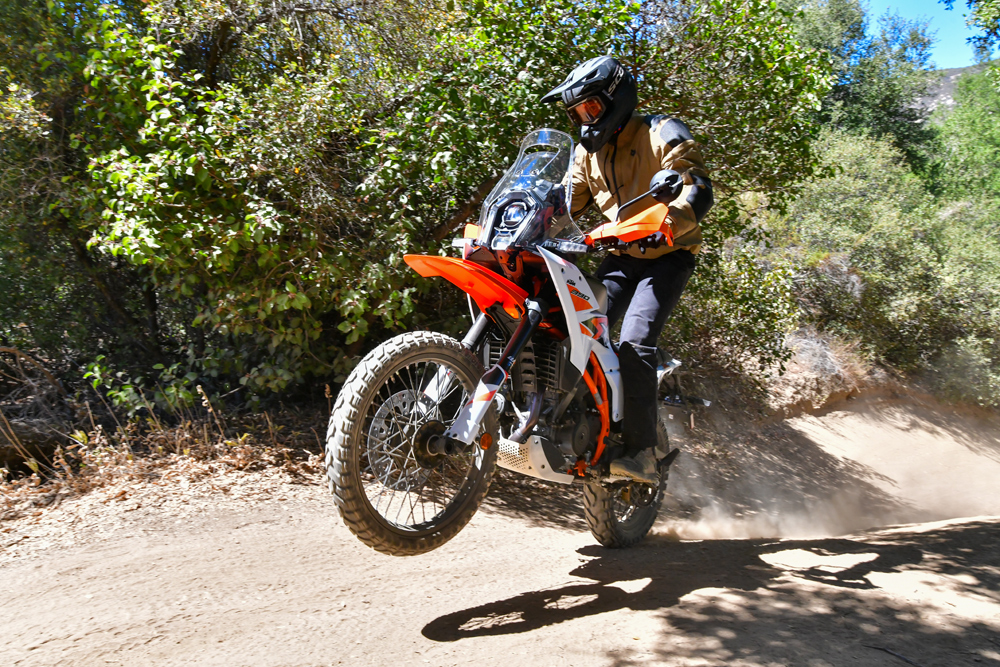
The KTM’s suspension is stiffer and tuned more for off-road riding, letting you ride it more aggressively on the dirt than the Kawasaki. On the flipside, the KTM feels harsher on the pavement. The KLE’s suspension works well in the dirt, but it isn’t in the same league as the KTM; it doesn’t take much to reach its limits. Until then, though, the off-road ride is better than you might expect. The KLE’s suspension shines on the tarmac, offering a smooth, comfortable ride that makes high-mileage days much easier on the back and body.
Ground clearance is night and day between the two. The KTM has 10.7 inches, and the Kawasaki has a paltry 7.3. You think about this a lot on the Kawasaki on rough dirt roads and in the rocks, and not at all on the KTM.
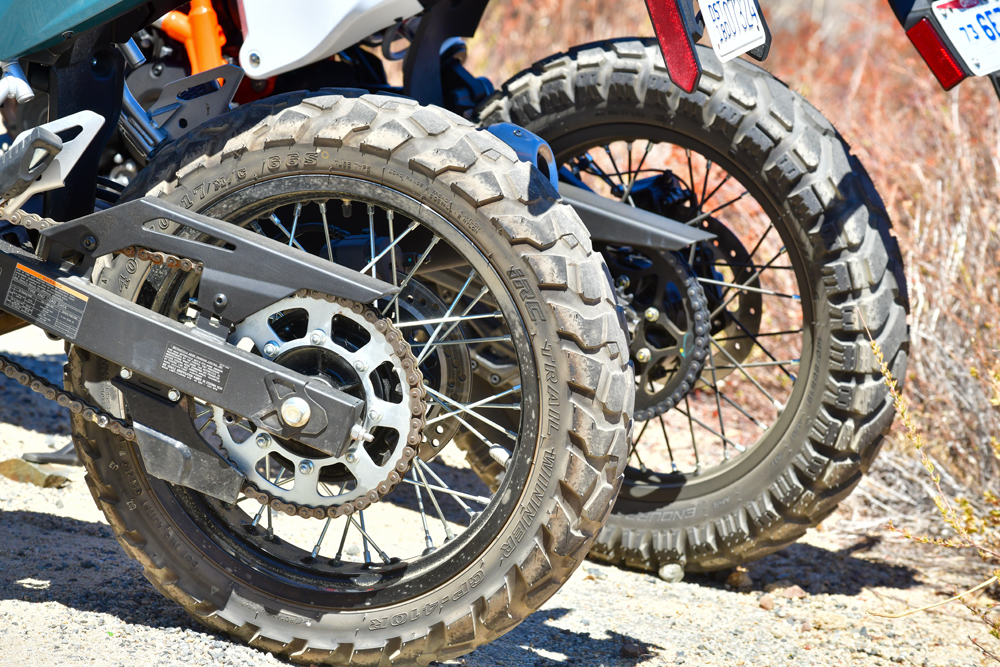
The KTM and Kawasaki also use different wheel combinations: 21-inch front/18-inch rear for the KTM and 21-inch/17-inch for the Kawasaki. Those new to adventure riding might not notice much difference on the road or dirt, but they might notice fewer off-road tire choices for the Kawasaki’s 17-inch rear wheel than the KTM’s more popular 18-inch rear wheel. Generally, a 17-inch rear favors road-oriented adventure riding, while an 18-inch rear offers more options for serious off-road use.
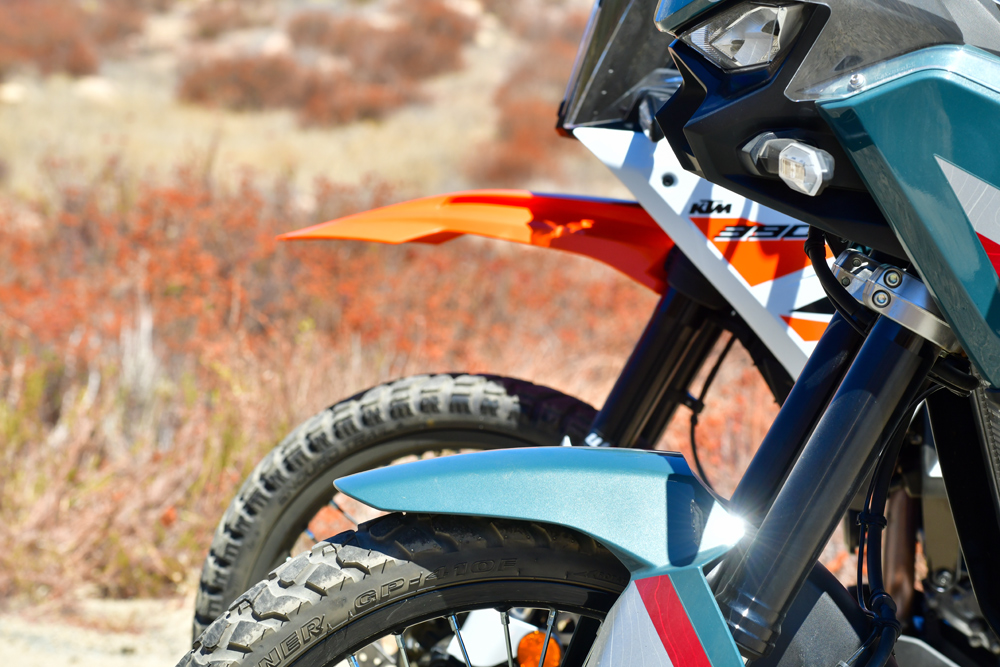
The Kawasaki comes with IRC GP-410 tires, while the KTM wears more aggressive Mitas Enduro Trail E07+ tires. Both do a good job splitting the difference between paved and dirt roads.
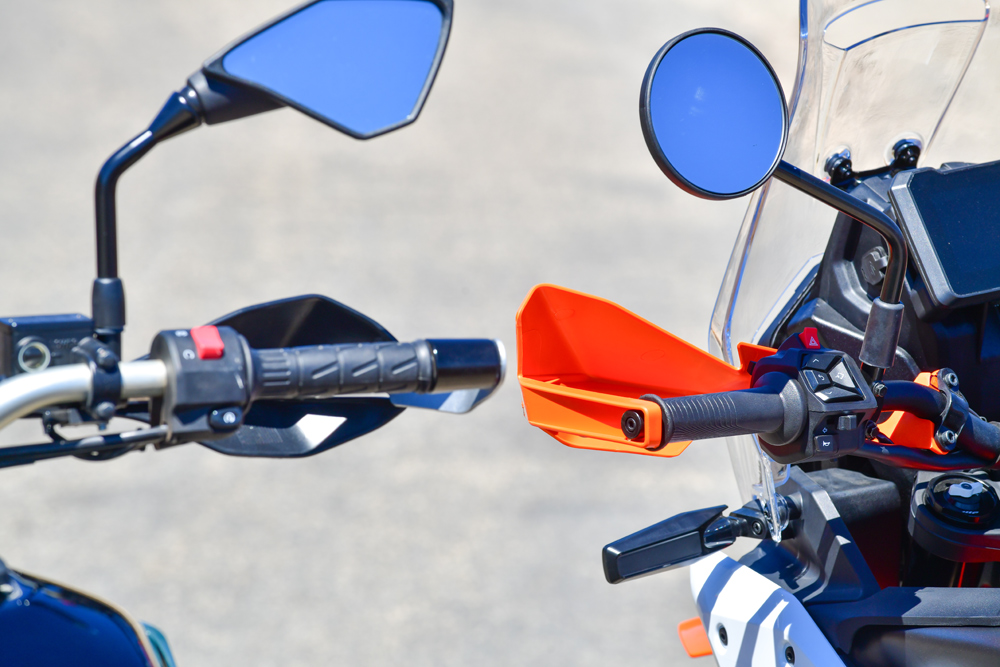
Overall, both bikes have comfortable ergonomics and feel good whether sitting or standing. The KTM feels more natural when standing, but the KLE is more comfortable on the pegs than you might expect. Overall, moving around while standing is easy and unrestrictive on both bikes.
Both have the same reasonable 34.3-inch seat height, but with the Kawasaki’s softer suspension and slightly cushier seat, it feels lower than the KTM. The Kawasaki also feels a little bigger overall, which may be due to its longer wheelbase: 61.2 inches versus the KTM’s 58.3. This also helps explain why the KTM feels quicker handling and nimbler on the trail, while the Kawasaki feels more planted on the road, especially through fast sweepers.
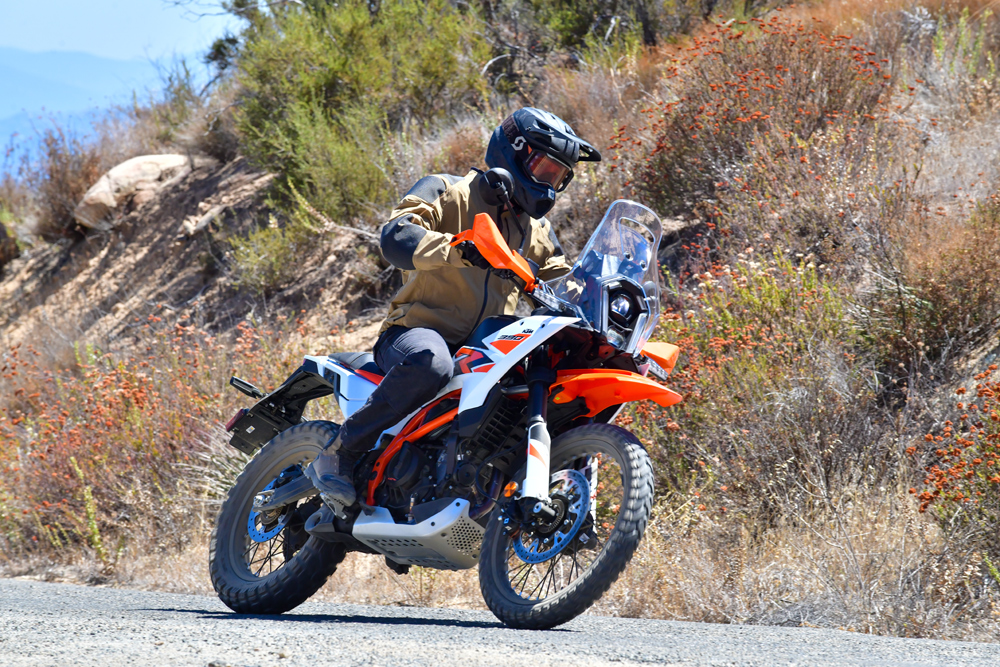
Low-speed handling is just as important as high-speed handling, especially for riders new to off-roading, and both bikes perform well here. However, the KTM’s lighter weight certainly gives it an advantage and inspires more confidence, especially in the sand and soft stuff, where the KTM shines compared with the Kawasaki and just about any adventure bike.
So, Which One?
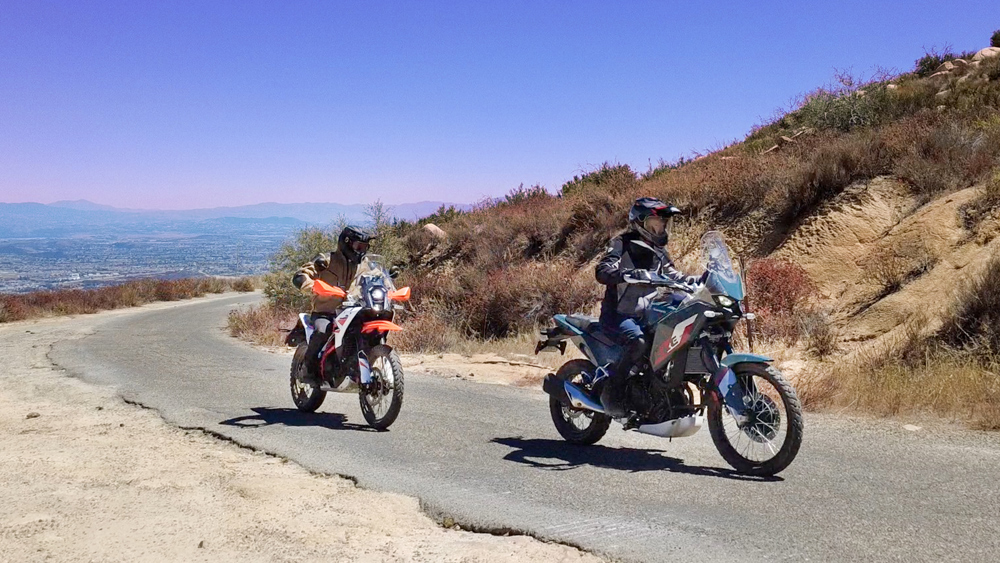
As it turns out, comparing the KTM 390 Adventure R and Kawasaki KLE500 SE ABS really is a little like comparing apples to oranges. They might sit in the same section of the ADV aisle, and their price tags are nearly identical, but they approach adventure riding in very different ways.
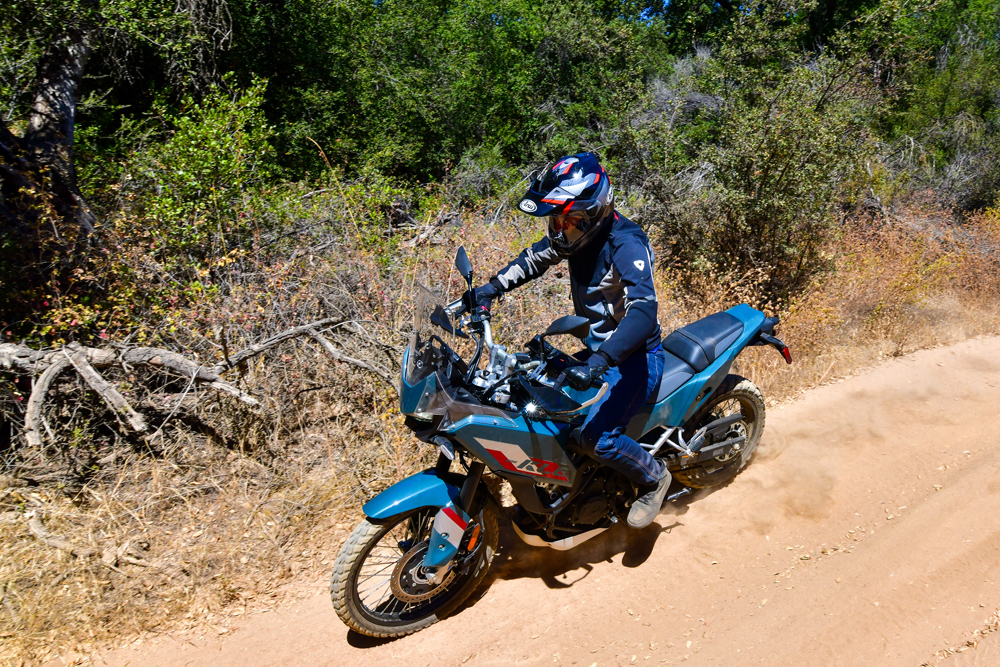
If you’re new to motorcycling, getting back into riding again, or just thinking about getting into ADV-type riding and don’t have much off-road riding experience, here’s the scoop on these two similar but, yes, different motorcycles: The KTM is clearly the more dirt-oriented option. It’s significantly lighter, has more ground clearance, better and more adjustable suspension, an 18-inch rear wheel, and a more aggressive personality. Its single-cylinder engine has plenty of punch, and when the pavement ends and the trail gets rough, the KTM quickly separates itself from the Kawasaki. If your idea of adventure riding involves seeking out challenging trails rather than avoiding them, the KTM is the better tool for the job.
The Kawasaki takes the opposite approach. It’s heavier, lower to the ground and not nearly as capable when the terrain gets ugly, but it’s smoother, more comfortable and easier to live with overall, especially when putting in the long miles. Its parallel-twin engine is friendly and nearly vibration-free, its suspension works exceptionally well on pavement, and its comfortable seat and relaxed nature make it the bike we’d rather be on for a 300-mile day with plenty of highways and sightseeing on tap.
For newer ADV riders, the Kawasaki might also be the less intimidating introduction to the category. It’s predictable, uncomplicated and doesn’t overwhelm you with electronics or aggressive performance. The KTM requires a little more commitment but rewards that commitment with considerably more capability when the riding gets serious and technical.
So, despite being separated by just $200, having similar engine displacements and billing themselves as “entry-level” adventure bikes, choosing between these two really isn’t about which motorcycle is better. It’s about where you want to ride. If dirt is the priority and pavement is just what connects the trails, consider the orange (KTM). If pavement and long days in the saddle are the priority and dirt roads are part of the adventure, consider the green apple (Kawasaki).
Green apples or oranges? Both are very tasty with the right meal CN
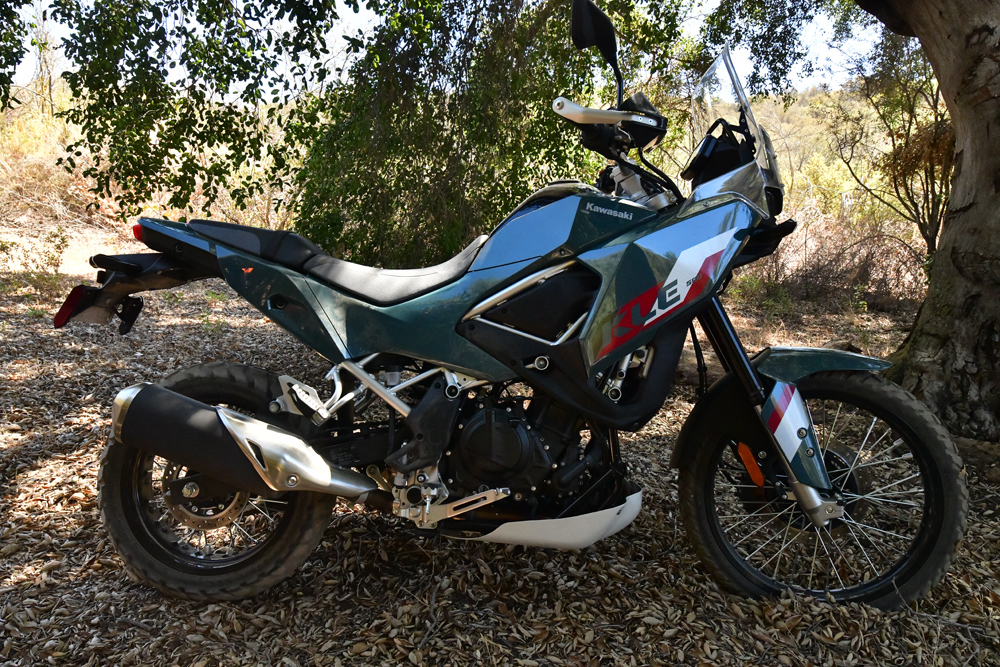
2026 Kawasaki KLE500 SE ABS Specifications
| MSRP | $7499 |
| Engine | Liquid-cooled, parallel-twin |
| Valvetrain | DOHC, 4-valve |
| Displacement | 451cc |
| Bore x Stroke | 70.0 x 58.6mm |
| Compression Ratio | 11.3:1 |
| Horsepower | 51 hp @ 10,000 rpm |
| Torque | 31.7 lb-ft @ 7500 rpm |
| Fueling | DFI, 32mm throttle bodies |
| Transmission | 6-speed |
| Final Drive | Chain |
| Frame | High-tensile-steel trellis |
| Front Suspension | 43mm inverted fork |
| Rear Suspension | Uni-Trak, preload adjustable |
| Front-Wheel Travel | 8.3 in. |
| Rear-Wheel Travel | 7.7 in. |
| Front Brake | 300mm disc, 2-piston caliper, ABS |
| Rear Brake | 230mm disc, 2-piston caliper, ABS |
| Front Tire | 90/90-21 in. |
| Rear Tire | 140/70-17 in. |
| Wheelbase | 61.2 in. |
| Rake/Trail | 28.0° / 4.1 in. |
| Seat Height | 34.3 in. |
| Ground Clearance | 7.3 in. |
| Fuel Capacity | 4.2 gal. |
| Weight (curb, claimed) | 430 lbs. (50-state) |
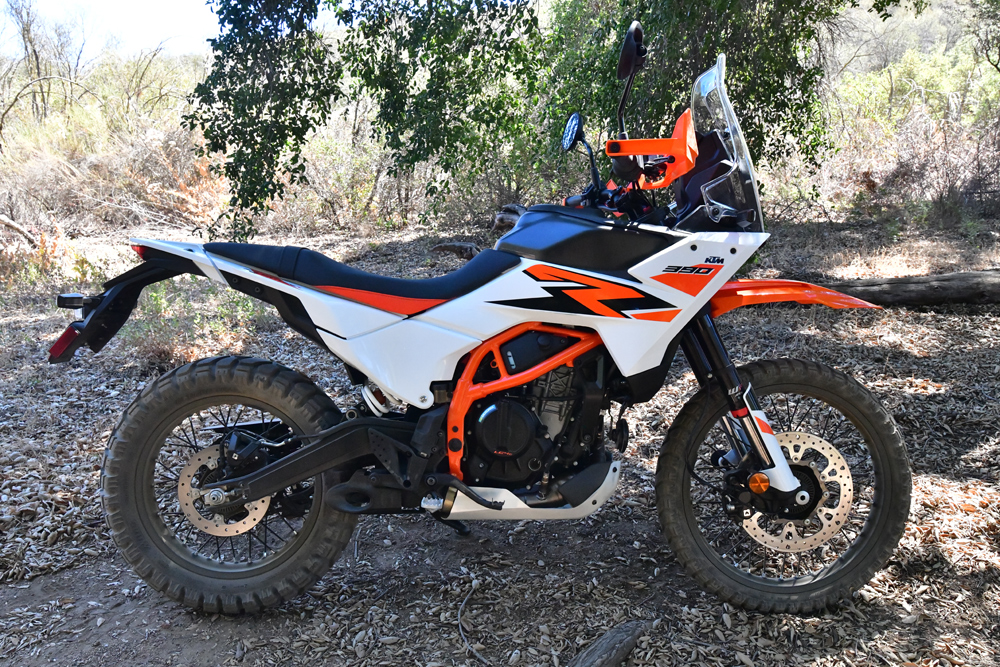
2026 KTM 390 Adventure R Specifications
| MSRP | $7699 |
| Engine | Liquid-cooled, single-cylinder |
| Valvetrain | DOHC, 4-valve |
| Displacement | 398.7cc |
| Bore x Stroke | 89.0 x 64.0mm |
| Compression Ratio | 12.6:1 |
| Horsepower | 44.4 hp |
| Torque | 28.8 lb-ft |
| Fueling | Bosch EFI, ride-by-wire |
| Transmission | 6-speed |
| Final Drive | Chain |
| Frame | Steel trellis |
| Front Suspension | 43mm WP Apex open-cartridge fork, compression/rebound adjustable |
| Rear Suspension | WP Apex Split Piston shock, preload/rebound adjustable |
| Front-Wheel Travel | 9.1 in. |
| Rear-Wheel Travel | 9.1 in. |
| Front Brake | 320mm disc, 2-piston ByBre caliper, ABS |
| Rear Brake | 240mm disc, 1-piston ByBre caliper, ABS |
| Front Tire | 90/90-21 in. |
| Rear Tire | 140/80-18 in. |
| Wheelbase | 58.3 in. |
| Rake/Trail | 27.1° / 4.3 in. |
| Seat Height | 34.3 in. |
| Ground Clearance | 10.7 in. |
| Fuel Capacity | 3.7 gal. |
| Weight (curb, claimed) | 388 lbs. (50-state) |
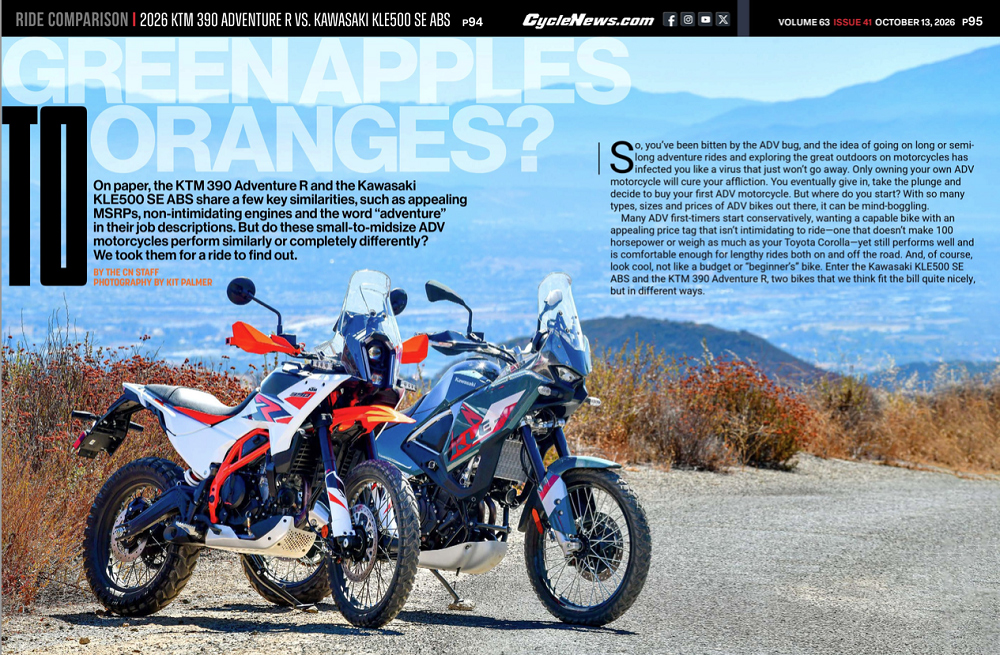
Click here to read the 2026 KTM 390 Adventure R vs. Kawasaki KLE500 SE ABS Comparo in the Cycle News Digital Edition Magazine.