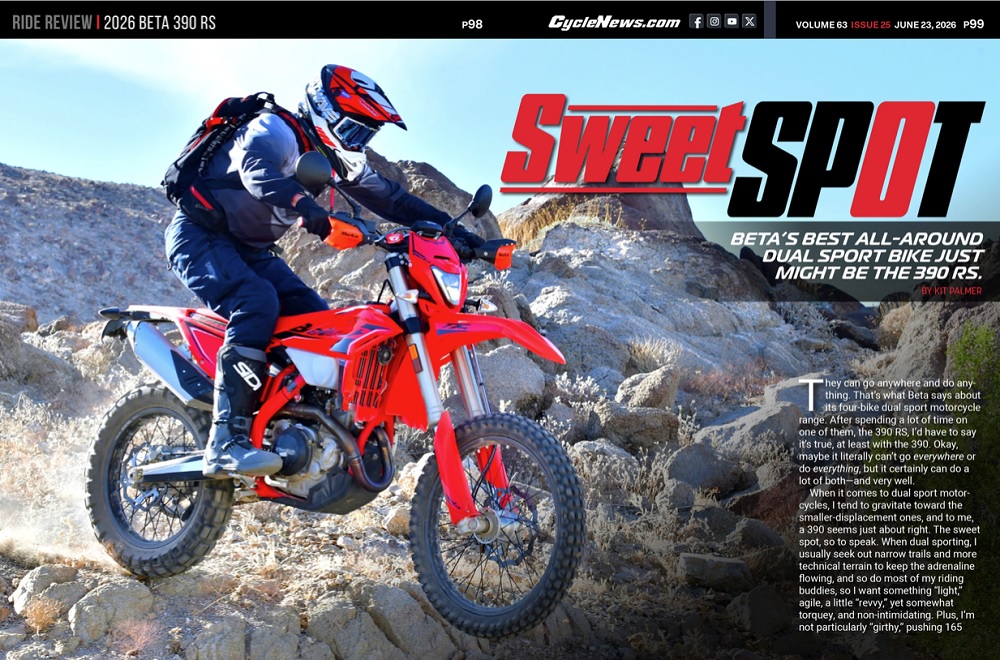
They can go anywhere and do anything. That’s what Beta says about its four-bike dual sport motorcycle range. After spending a lot of time on one of them, the 390 RS, I’d have to say it’s true, at least with the 390. Okay, maybe it literally can’t go everywhere or do everything, but it certainly can do a lot of both—and very well.
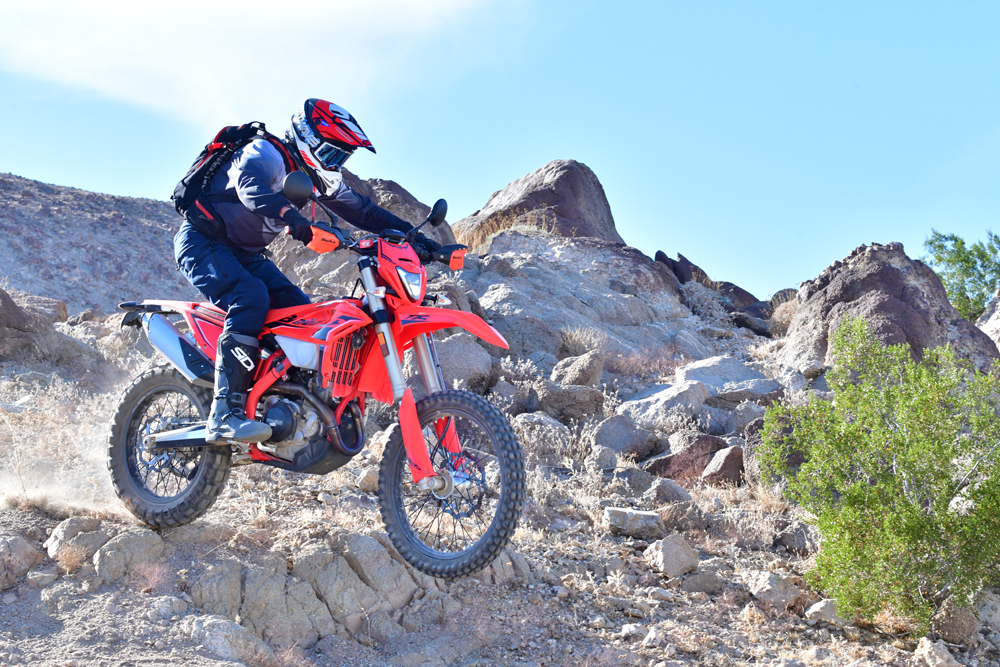
When it comes to dual sport motorcycles, I tend to gravitate toward the smaller-displacement ones, and to me, a 390 seems just about right. The sweet spot, so to speak. When dual sporting, I usually seek out narrow trails and more technical terrain to keep the adrenaline flowing, and so do most of my riding buddies, so I want something “light,” agile, a little “revvy,” yet somewhat torquey, and non-intimidating. Plus, I’m not particularly “girthy,” pushing 165 pounds with my 6-foot-1 frame, so I’m not looking for mega power, just good, usable power. For me, anything with more than 400cc of displacement, things can get a little, well, let’s just say more than I need, especially on high-performance 450cc-plus dual sport bikes, like Beta’s 500 RS, and KTM and Husqvarna’s big-bore bikes. So, I was eager to get some seat time on the 390, a motorcycle I had never ridden before.
What Is It? | 2026 Beta 390 RS Review
The entire RS range is closely based on Beta’s RR X-Pro racing “single-track” off-road bikes, which are slightly tamer versions of its high-performance, competition-bred RR Race cousins. For the 2026 model year (Beta did not offer the RS range in 2025 due to homologation and emissions issues), the RS range features all the updates that the latest RR X-Pro received. The RS range comprises four models: 350, 390, 430 and 500. In Beta’s words, “The 350 and 390 are the most nimble-feeling and offer a lightweight feel [hmm, right up my alley]. The 350 has an engine that likes to be revved up a little more, while the 390 offers additional torque [another plus]. The 430 has the same “rev” feel as the 350 but with more overall horsepower and torque. The 500 [which Beta says is its best-selling RS model] offers riders a very user-friendly engine with plenty of torque and a lighter-than-expected riding feel.”
BETA 390 RS TEST VIDEO

The 390, like the other RSs, has several updates, including the main frame, which is shared across the entire RS line. It features a larger, wider backbone tube that Beta claims reduces flex and gives the bike a more stable feel.
The bike now comes fitted with Xtrig Flexfix elastomer handlebar mounts that squelch vibration, and you can swap out inserts to get that perfect vibe feel.
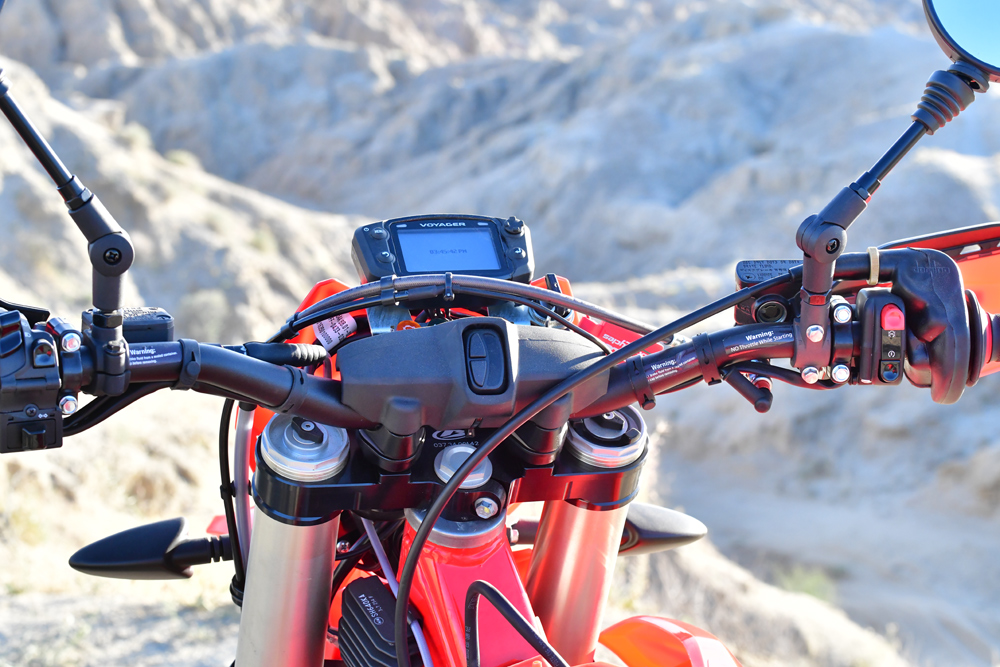
There’s a new rear-brake master cylinder with a larger volume and a new rear muffler with a removable spark arrestor. Traction control and map switch are now integrated into the handlebar pad, and a new 200-watt high-output stator powers an LED headlight and taillight.
Beta’s familiar Trail Tech Voyager meter system has been updated to include a GPS system that lets you share your route with friends and vice versa. Overall, the Voyager meter has 40-plus functions. There is also a push-button release seat.
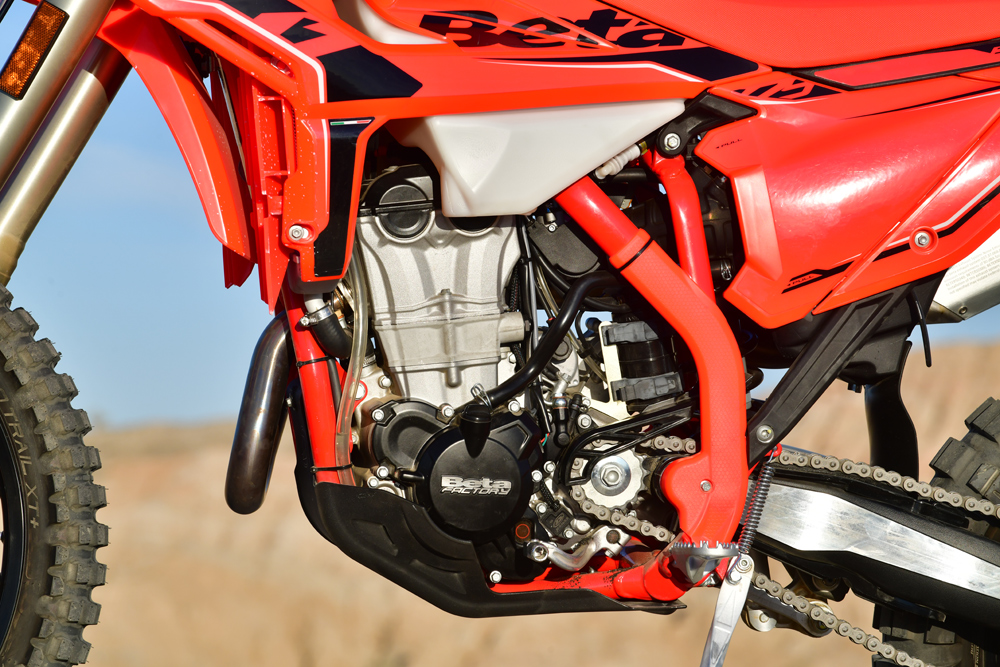
The 390 RS shares the same 88mm bore as the 350, but the 390 has a longer 63.4mm stroke than the 350’s 57.4mm, resulting in a larger displacement of 385.6cc versus the 350’s 349.1cc. The 390’s compression ratio is slightly lower at 12.48:1 compared to the 350’s 13.19:1. The 430, in comparison, has a shorter stroke than the 390 but has a 7mm larger bore, coming in at 430.9cc. The 430 also has a slightly lower compression ratio at 12.33:1.
Like all RS models, the 390 has a fuel injection system with a 42mm throttle body and dual injectors.
The 390 has a six-speed transmission with a wet, diaphragm-spring clutch.
The engine is carried in a molybdenum-steel double-cradle frame, providing quick, tool-less access to the airbox.
The RS is fitted with the same Sachs suspension components as the RR X-Pro models, with hand-operated adjusters on the upper fork tubes for preload, rebound and compression damping. (The RR Race models get the higher-end, pricier KYB suspension.)
According to Beta’s specs, the 390 has the same 36.8-inch seat height as the other RSs and shares the same 237-pound dry weight as the 350, which is just two pounds less than the 430 and 500.
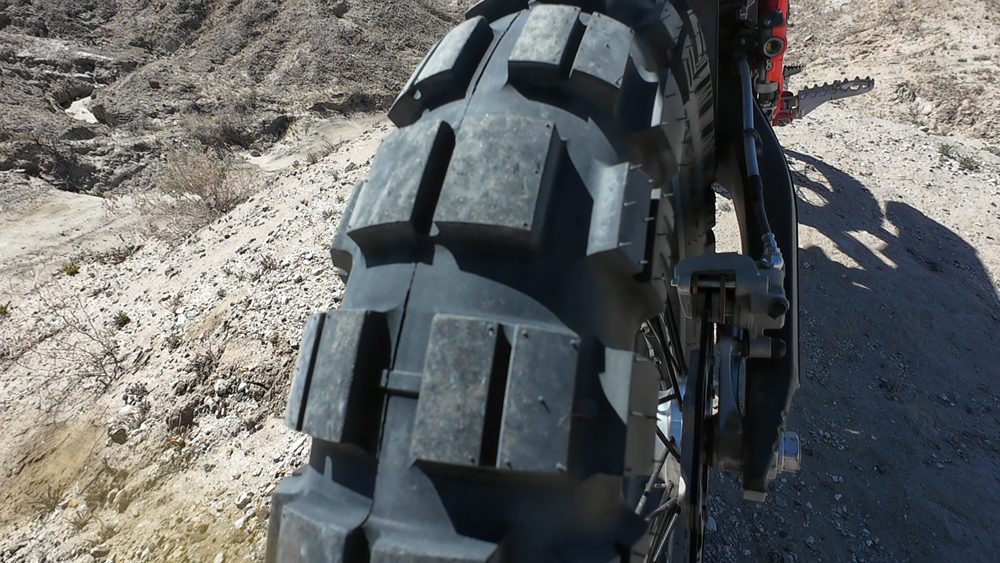
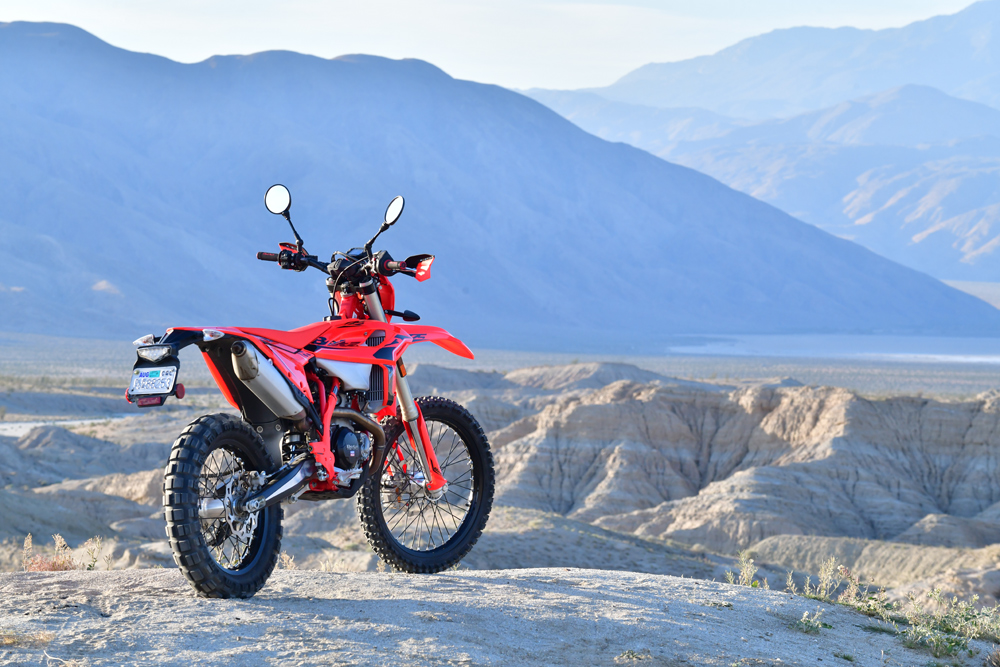
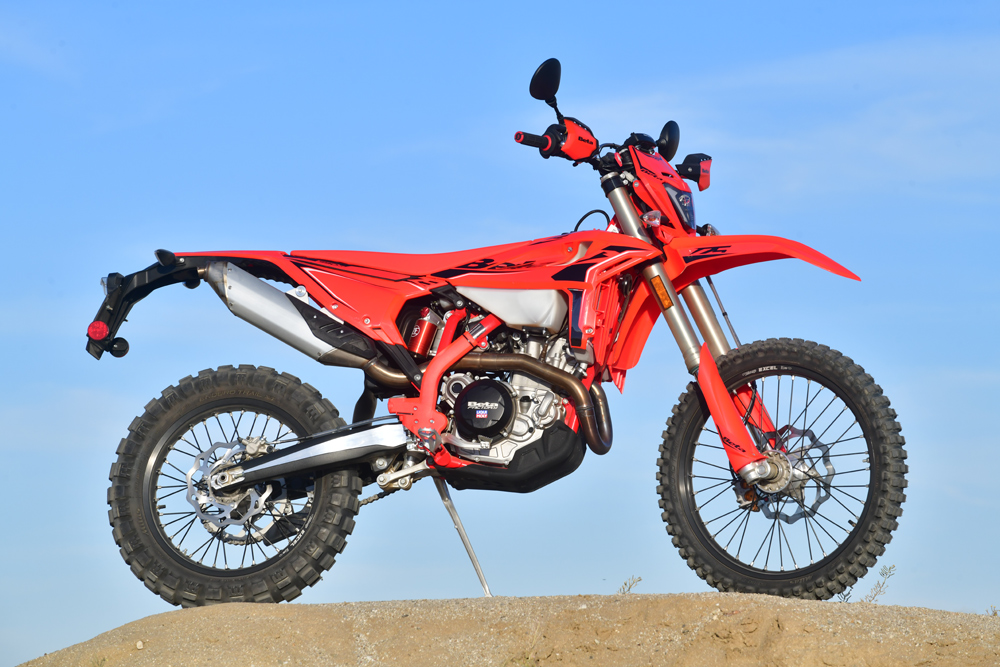
The 390, and the other RS models, come fitted with the most dual-sport-looking tires we’ve ever seen on a Beta motorcycle. The rear tire, with its adventure-bike-looking big-block knobs, is far less aggressive-looking than previous RS models, and Beta says the rubber, front and rear, uses a harder compound, resulting in a longer lifespan and less noise on the pavement. More than anything, this is likely to meet the latest ride-by sound test so the RS can be 50-state legal on the highway. Speaking of emissions, the 390 is fitted with a catalytic converter—placed in the header pipe—and all that to please CARB, and if you please CARB, you please everyone. The RS is also fitted with a more restrictive paper air filter rather than a traditional foam filter. We reviewed our bike with everything in place, no tampering, exactly how you’d get it from the dealer.
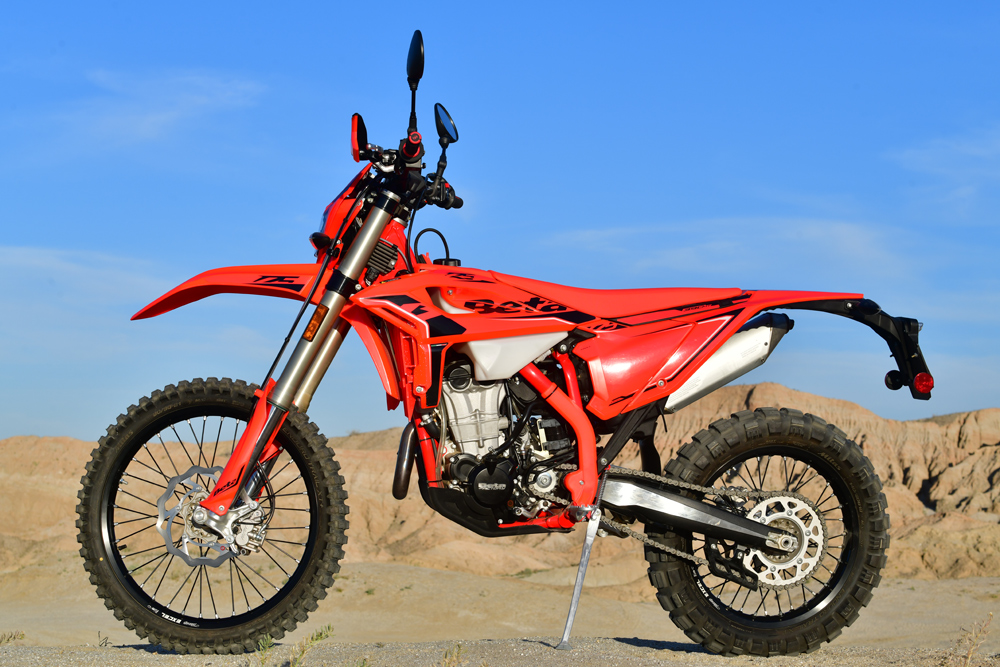
The Beta has several smaller cool features, such as a translucent fuel tank, fold-down mirrors, a radiator cooling fan, a skid plate, engine guards and handguards.
On The Move | 2026 Beta 390 RS Review
The Beta 390 RS is an easy motorcycle to ride and a lot of fun, both on and off the road, though mostly off the road. That’s no surprise. It’s essentially a barely street-legal high-performance enduro bike, unlike most Japanese-brand dual sports that place a lot of emphasis on road comfort. Still, the 390 is just comfortable enough to be tolerable on the pavement for those quick jaunts from one trailhead to the other or a quick side trip into town for lunch and gas. Those dual sport-looking tires do improve the ride on the pavement quite a lot; it’s much smoother and less bouncy. And it’s geared just tall enough to reach 60 mph without being overly revvy or vibey. It’s also on the pavement where you really notice the Beta’s hard-as-a-board seat; you don’t notice that as much on the dirt, where you spend a lot of your time standing on the pegs, but you will on the street.
It’s in the dirt where the 390 really shines, and the more technical the dirt trails, the better. You can certainly feel its RR X-Pro lineage in its snappy engine, firm suspension and nimble handling. The engine revs quickly, is peppy, and definitely feels a little “racey.” I’m a midrange kind of guy; I like room to work the throttle rather than just blipping, as you do most of the time on higher-horsepower, high-performance 450s and 500s. And I don’t want something that makes all its power above 7000 rpm, or thereabout, either. So, the 390 fits my personality just right. I found it very tractable, with great bottom-end and torque, yet it still likes to be revved. The meat of the fun is right in the middle, where I spent most of my time on the 390 and where I enjoy riding dirt bikes anyway. If all you do is ride in the dirt, you might find it geared a tick tall for the nasty, leg-dabbing, slow-going trails, but I found the stock gearing to work well for me overall, since I rode the 390 a bit on the pavement on almost every ride. The stock gearing, I think, is a good compromise.
The engine itself runs beautifully. Fueling is spot-on; it rarely stalls or flames out. It’s smooth and predictable, with a linear powerband that is anything but intimidating. Yet, it still makes very good and exciting power overall.
I loved the 390’s hydraulic clutch, which offers great feel and a light pull. It helps make the 390’s already manageable power even more manageable, which I appreciated when you’re threading the needle on technical, rocky terrain at walking speeds.
Like all Beta RSs, the 390 offers two engine map choices, indicated by a sun and a rain cloud on the mapping switch, which is now located on the handlebar pad and is easier to use. The sun is the standard position, and the rain cloud is meant for ultra-slick, wet conditions. Cloud mode further smooths power delivery—though the change is hardly noticeable—to help control rear-wheel spin. But the bike runs so smoothly and controllably in the first place that you hardly ever think of using it. The same goes for the push-button traction control, which is a nice touch, but you probably won’t use it much like me.
The Beta’s suspension is just as good as its motor. The fully adjustable Sachs ZF open-cartridge fork and Sachs ZF rear shock feel plush and work well on technical single-track trails. By plush, I mean plusher than the RR Race models, though much firmer than most of your typical Japanese-built dual sport bikes. It definitely bridges the gap between the two styles. At 165 pounds, the 390 leans a smidgen on the stiff side right out of the crate for me; however, I can see how heavier riders will like it as is or might want to stiffen things up a bit for aggressive riding. Adjusting the forks can’t get much easier with the new external hand-operated adjustment knobs. Overall, though, I think Beta hit the happy medium with the 390’s springers.
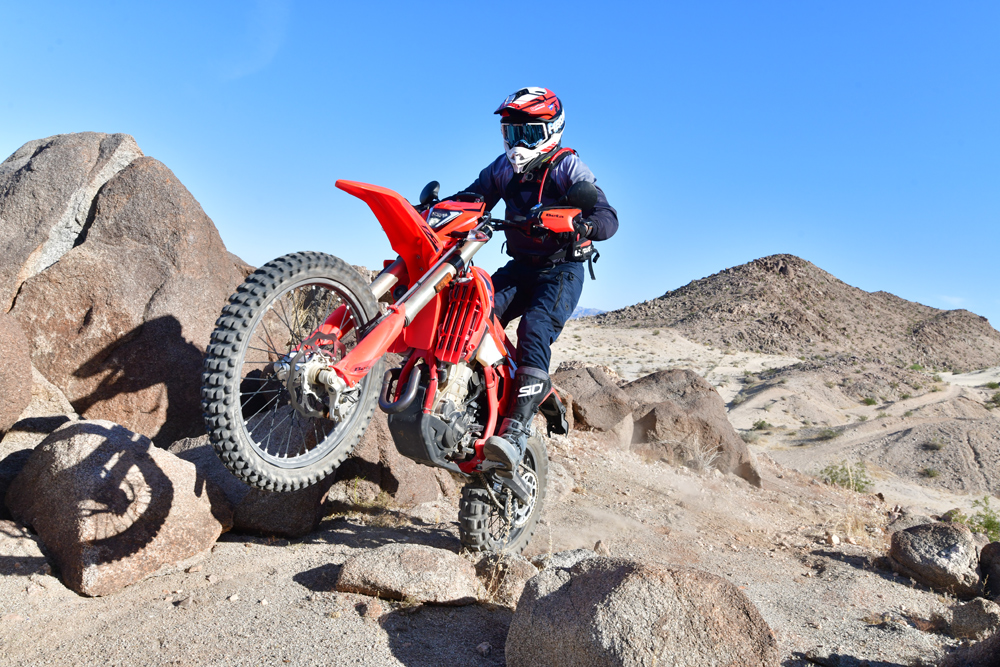
As mentioned, the 390 has a firm seat pad but is also quite narrow. In fact, the whole bike is ultra-thin and trim, feeling like a motocross bike between your legs. It’s easy to move around on and feels even lighter than its already light advertised dry weight of 237 pounds. As a result, the 390 is easy to maneuver over rocks, logs, and anything else that gets in its way.
The 390’s Nissin brakes are very strong yet very predictable and easy to modulate for any situation.
As much as I enjoy the 390, it’s not perfect. The fold-down mirrors don’t hold their position very well at speed, move around a lot and seem a bit flimsy, but they do fold down out of the way, so I’ll give Beta a pass on them. I had one rear blinker and the entire taillight/license plate assembly break off before the end of the third ride on it (with no crashes). And I always had a hard time finding neutral while idling at a stop. The range from the 2.4-gallon gas tank isn’t spectacular but seems reasonable. My range varied considerably, from about 40 to 55 mpg, across all sorts of terrain, mostly hard-packed trails and sandy washes and hills. I want to say I don’t like the new eco-friendly DOT Mitas Enduro Trail XT+ tires, but they are an improvement on pavement and better in the dirt than I expected (though not great). I admit they are good all-around tires for long rides that include both street and dirt.
Things I like but haven’t mentioned yet include the much-appreciated handguards, which are sturdy and effective; the radiator cooling fan, which helps prevent boil-overs; the generous 12.2 inches of ground clearance; the translucent fuel tank; and the excellent Trail Tech Voyager meter, which I haven’t fully unwrapped yet because it offers so much.
Do It All | 2026 Beta 390 RS Review
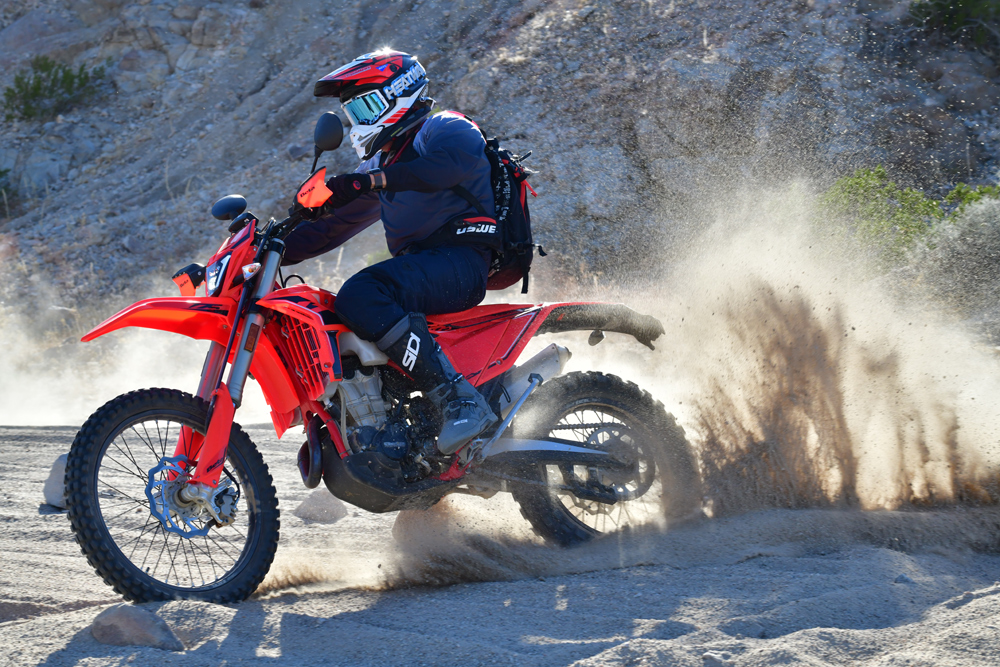
Yes, the Beta 390 RS can do just about everything. It feels so light and agile, and with an engine that is easy to manage and hard to fault, it gives you the confidence to go anywhere and try anything. Plus, it doesn’t wear you down as quickly as more powerful bikes do, so you can enjoy riding the 390 all day long, and you will want to ride it all day. Okay, so the 390 isn’t the best street bike by any means, but it wasn’t meant to be one, just a legal one.
Overall, the 390 RS is one of the most impressive off-road-focused dual sport motorcycles I’ve ever ridden. It performs well and has a race-bike feel yet is very easy to ride. You will, however, pay a premium price for the 390 RS, with its $12,490 MSRP. Yes, that’s expensive, but, as they say, you get what you pay for. However, you will pay a little more for comparable bikes from KTM (350 EXC-F $13,049) and Husqvarna (FE 350S $13,149). The nearest comparable Japanese dual sport is the Honda CRF450RL at $10,199, but it isn’t as off-road-capable as the RS.CN
2026 Beta 390 RS Specifications
| MSRP | $12,490 |
| Engine | Single-cylinder, 4-stroke |
| Valvetrain | 4-valve, titanium intake, steel exhaust |
| Cooling system | Liquid, w/ cooling fan |
| Bore x Stroke | 88mm x 63.4mm |
| Displacement | 385.6cc |
| Compression Ratio | 12.48:1 |
| Starting System | Electric w/ optional kickstart |
| Ignition | Dual-map Kokusan 200W output, on-demand traction control |
| Spark Plug | NGK LKAR8A-9 |
| Meter | Trail Tech Voyager GPS unit |
| Lubrication | Twin oil pumps w/ cartridge filter, separate compartments for engine and transmission |
| Fueling | 42mm throttle body w/ dual injectors |
| Clutch | Wet diaphragm-style |
| Transmission | 6-speed |
| Chain | O-ring |
| Frame | Molybdenum steel / double cradle w/ quick air filter access |
| Front Suspension | 48mm Sachs open-cartridge w/ compression, rebound & ignition spring preload adjustment |
| Rear Suspension | Aluminum body Sachs shock w/ adjustable rebound and high/low-speed compression |
| Front-Wheel Travel | 11.6 in. |
| Rear-Wheel Travel | 11.4 in. |
| Front Wheel/Tire | DOT Mitas Enduro Trail XT+ 90/90-21 in. |
| Rear Wheel/Tire | DOT Mitas Enduro Trail XT+ 140/80B-18 in. |
| Front Brake | Disc, 260mm floating rotor, Nissin |
| Rear Brake | Disc, 240mm rotor, Nissin |
| Wheelbase | 58.7 in. |
| Seat Height | 36.8 in. |
| Ground Clearance | 12.2 in. |
| Weight (dry, claimed) | 237 lbs. |
| Fuel Capacity | 2.4 gal. |
| Warranty | 24 Months Limited Warranty |