Cycle News Archives
COLUMN
750 Started, 200 Finished
By Kent Taylor
“There’s nothing worth having,” goes the old saying, “that isn’t worth working for.” Perhaps that was what the 750 entrants in the 1971 Jackass Enduro were telling themselves as they unloaded their Greeves, BSAs and DKWs from their Chevy C-10 and Ford F-100 (with Twin “I” Beam suspension) trucks, buckled their kidney belts, and stretched their aviator goggles over their open-face helmets. Several hours and 125 miles later, two-thirds of the field had limped back to those same trucks, thoroughly whipped, winded and possibly even wounded. Motorcycle infantrymen who charged into battle thinking “no pain, no gain” were now reduced to whimpering shells of men (and at least one woman), pleading, “no pain…no pain.”
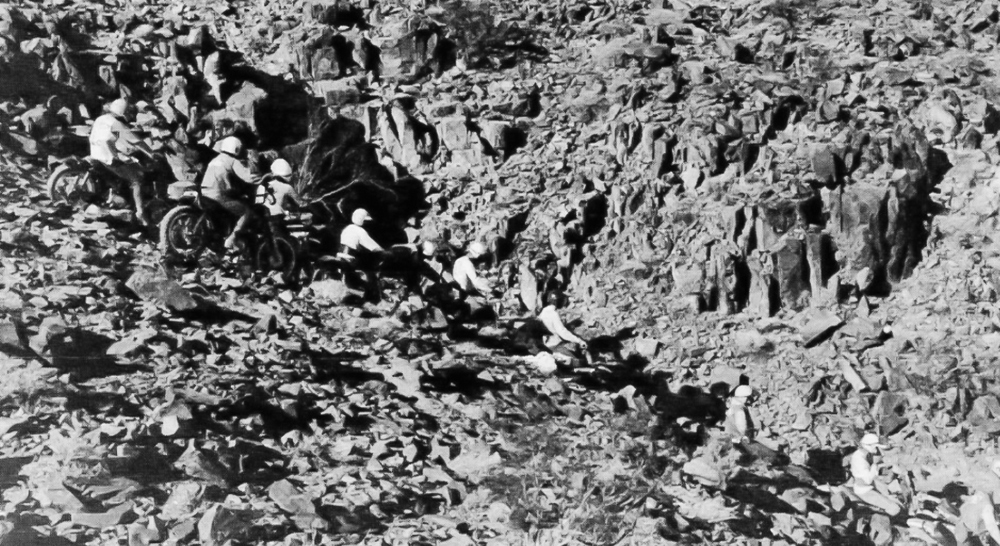
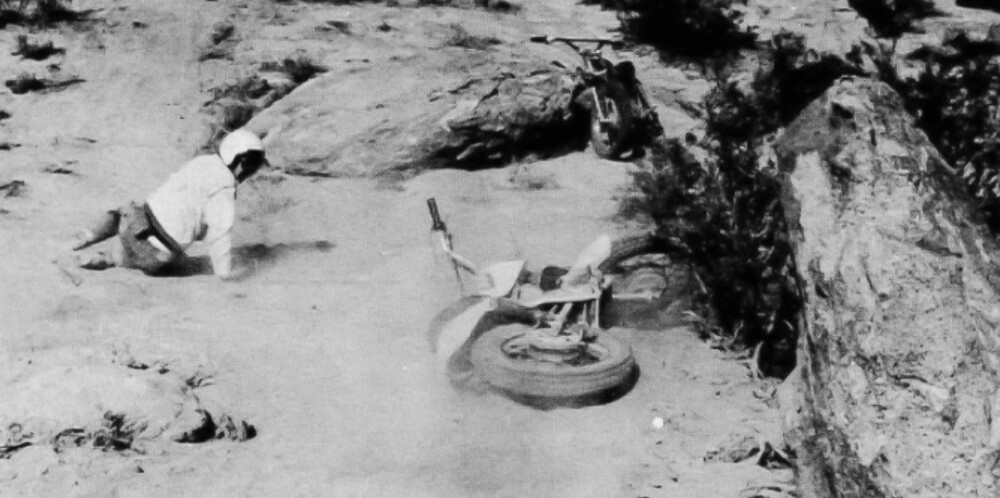
Cycle News not only covered the Jackass Enduro, editor Ron Schneiders also competed, riding his Sachs in the grueling event and stopping at various points along the way to shoot photos, most of which show riders either on the ground and separated from their motorcycles or engaging in some kind of body physics experiment in their efforts to avoid ending up in a photo like the aforementioned.
Scenic, postcard-pretty pics pop up while searching for the town of Red Mountain, California, home of the Jackass Enduro. Founded as a silver-mining town in 1919, it was originally called Osdick, then renamed Red Mountain in 1929, just in time for the stock-market crash and the subsequent Great Depression. Beautiful from afar, Schneiders’ photos reveal a more sinister side of the area.
There are rocks. Big rocks, bigger rocks and smaller rocks that are still pretty big, especially when one is trying to ride an early-1970s-era dirt bike over them. A stony downhill so treacherous that any mountain goat that wasn’t afflicted with wasting disease would steer clear of it was cruelly included in the enduro course. Racers line up like sheep heading for slaughter, foolishly taking their turn, each thinking that they can do something that every other rider has failed to accomplish.
“The first five miles were just a 30-mph warmup over desert trails,” Schneiders wrote. “Most everyone dropped a couple minutes, but it was easy to get back on schedule because the next section was 12 mph and rather easy at the beginning.” Clearly, the course had been laid out to lull the riders into thinking the Jackass would be just another ride. That notion vanished when they approached a steep ledge, so much so that they set aside their competitive instincts and began helping each other physically lower each other’s bikes to safety. Except for our man Schneiders.
“I didn’t have time for such foolishness, so I just skirted the crowd and pushed my Sachs over the edge. Anything on it that will break at less than 20 mph, broke a long time ago.”
Up next was the treacherous, rock-strewn downhill, which Schneiders believed signaled the “start of the real enduro. From there on, it was rock, rock and more rock into the noon check.” Rocky uphills, rocky downhills and where there weren’t any rocks, there were “deep, deep sand washes.” By noon, more than half of the entrants had quit “or were beaten into submission.” After a lunch break, everyone had about 10 miles over a trail, but that came to an end, and then, of course, more rocks. Enduro riders on 300-pound machines were now riding trials, climbing over boulders.
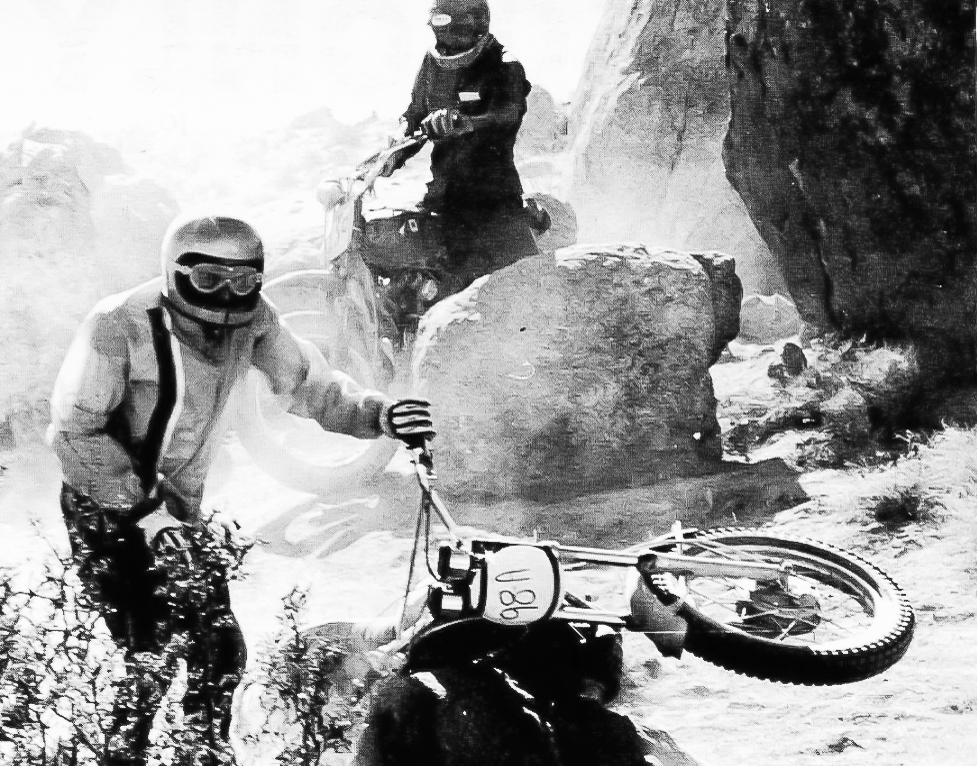
The Jackass then took a decidedly unusual, X-Files sort of turn. Schneiders writes, “I came upon one of the strangest things I’ve ever seen in an enduro. I rode into a small valley, not more than a mile long, and there were bikes and riders all over it. A few guys were riding toward me (backward on the course), some were trying to scale the hills that made up either side of the valley…and some were messing about down in a rock-filled gulch along the bottom. I figured there must be some fearsome obstacle along the trail somewhere, but I couldn’t see what it was. Whatever the obstacle, I never found out. Quite strange.”
In the end, fewer than 200 of the 750 starters completed the 1971 Jackass Enduro. Schneiders and a few others took pride in being part of that elite group, but as is quite often the case, some smart aleck comes along, griping that the event was too easy. “It’s the kind of run that can be won by a Class B rider riding without a watch or speedometer…riding as fast as he can [he will] win and timekeeping won’t even enter into it.” The sourpuss’ assessment is a bit easier to swallow when one learns that the source is none other than off-road legend Dave Ekins. Still, nobody likes a wise guy.
Schneiders wraps up his story with a tribute to one of the hardy souls who completed the Jackass, a fellow by the name of George Verkamp. “George finished the first loop with a flat tire, but he determinedly [started] the second loop anyway. He finished, and within his hour, too. His rims were square; he had several spokes missing from his flattened wheel; his handlebars had come loose… and his gas cap was missing. But he finished.” Verkamp’s reward for his effort? A bronze pin. Worth having? Questionable. Worth working for? “I doubt,” wrote Schneiders, “if many people have got enough money to buy it from him.” CN
Click here to read the Archives Column in the Cycle News Digital Edition Magazine.
Subscribe to six decades of Cycle News Archive issues