I’m not a fan of the Circuit of The Americas layout. Never have been. It’s two completely different circuits separated by a back straight that’s not straight, and it has corners designed for Formula One that curve back in on themselves, corners that aren’t much fun on a bike.
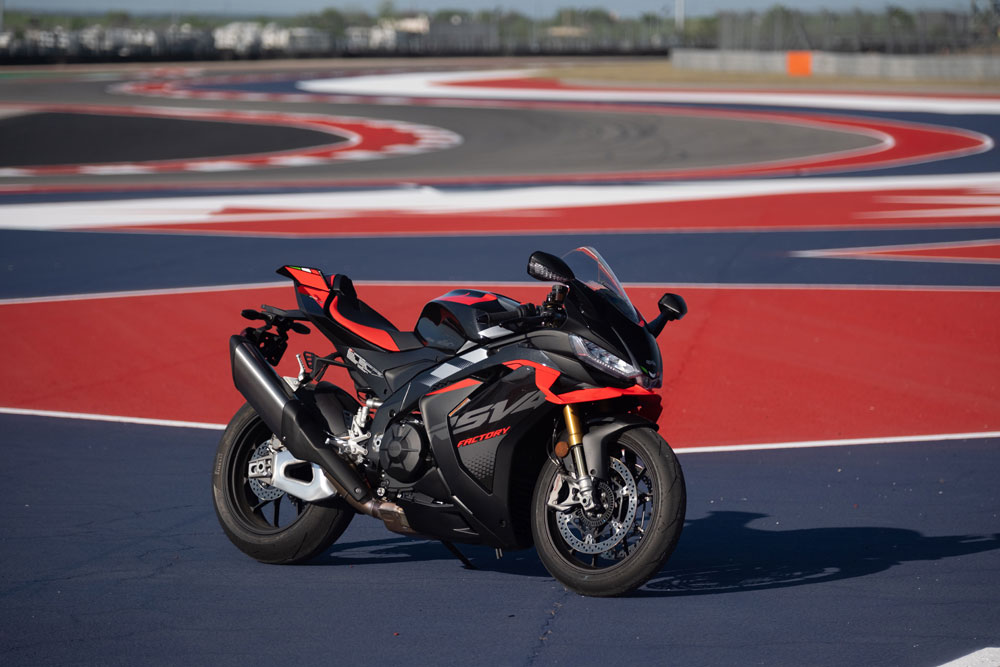
That is, unless you’ve got an Aprilia RSV4 Factory underneath you.
By Rennie Scaysbrook | Photography by Sam Bendall
For the RSV4 is, my friends, Aprilia sportbike royalty. The RSV4 is a marvel of engineering, its awesome 1099cc V4 now pumping out a claimed 217 horsepower, more than anyone else except the uber-expensive Ducati Panigale V4 R and the if-you-have-ask-you-can’t-afford-it Aprilia X 250th and Ducati’s limited-edition Superleggera V4 Centenario.
And you need all those horses to fire you down COTA’s not straight back straight.
At a time when superbike sales are under increasing global pressure, and we’re thrown yet another “sensible” midsize twin-cylinder streetbike year after year, Aprilia’s continued investment in the RSV4 shows the company that built its name on racing hasn’t given up the superbike ghost just yet.
The 1099cc V4 engine sits outside the displacement limits of most production-based racing championships, although it has taken part in the Isle of Man TT and in some MotoAmerica Superbike races, just without all the mods afforded to the 1000cc brigade.
Aprilia Racing CEO Massimo Rivola said last year he wanted to see WorldSBK return to its roots and become a superstock championship, one that sees you “unscrew the turn signals, the mirrors, and run. This would transmit a clear message that every manufacturer wants to promote,” he said. If that were to happen, the RSV4 would surely be at the top of many a rider’s wish list, because it packs more power and more tech than anyone else, and yes, that includes Ducati.
The RSV4 has always had a reputation for exceptional balance and front-end feel, and that DNA remains intact. For 2026 (2025 if you’re really playing at home), the RSV4 Factory gets a series of subtle geometry changes aimed to enhance both high-speed stability and low-speed agility. The Öhlins’ fork offset has been increased by 2mm, the engine sits 5mm higher in the chassis, and the swingarm pivot has also been raised by 2.5mm.
On paper, these are small adjustments, but together they influence weight transfer, corner-entry composure, and drive out of turns. Remember, Aprilia was the first to give you the ability to change the swingarm pivot height with the first-generation RSV4 Factory machines, so they know what they’re doing.
These changes have been paired with the latest Öhlins SmartEC3.0 electronic suspension, which uses AI to match the rider’s weight to the suspension settings, ensuring you get a near-perfect ride when you get out on track.
The original development rider for the RSV4 back in the late 2000s was a diminutive young chap by the name of Max Biaggi. The “Roman Emperor,” as he was known, is about 5-foot-4, and thus the bike was designed to fit him primarily, while it was a bit of a struggle for anyone noticeably taller.
That hasn’t totally changed for 2026, but the ride is a little comfier if you’re approaching six feet tall. The addition of wider clip-on handlebars provides more leverage and a touch more room to move around on the bike, which becomes particularly noticeable during extended track sessions. The RSV4 retains its ultra-compact, race-focused personality; it’s just a little more enjoyable for the rest of us who are lucky enough to throw a leg over from time to time.
Of course, the centerpiece of the RSV4 show remains that glorious V4 engine.
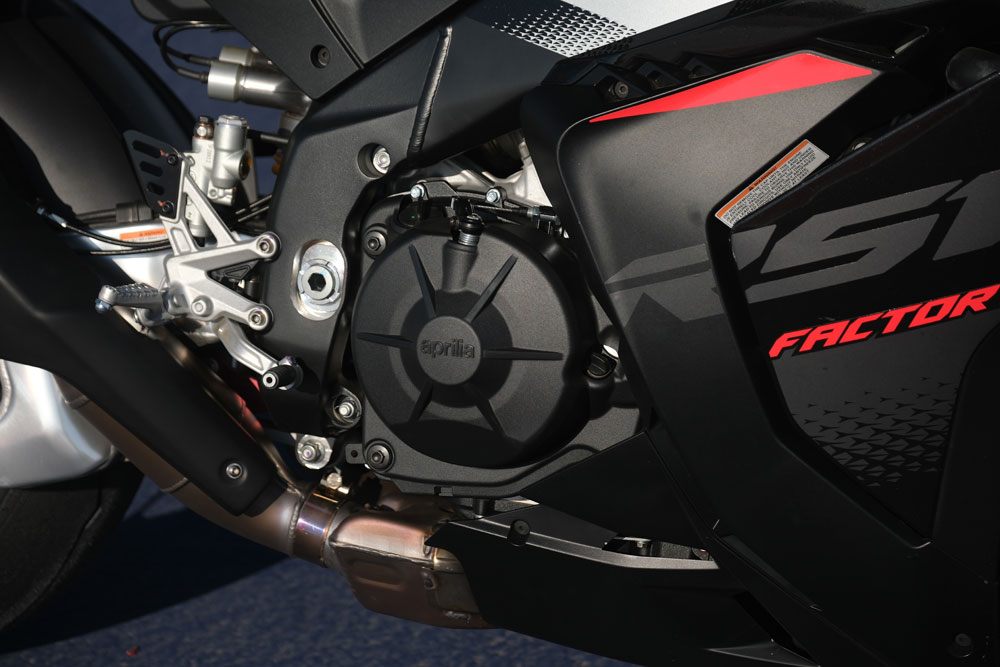
For 2026, the 1099cc V4 gets larger 52mm throttle bodies (up from 48mm), more fuel pressure, and a new exhaust system that ensures the bike meets Euro5+ emissions standards. The changes not only increase peak power from 214 to 217 horsepower but also improve low- to midrange performance, where you’ll spend most of the time on the street.
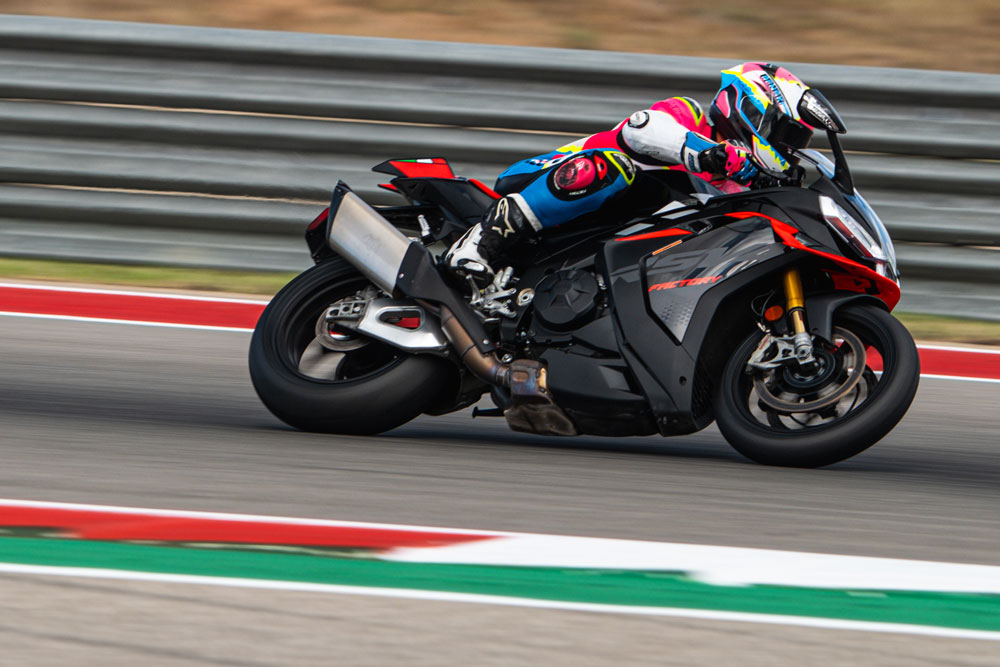
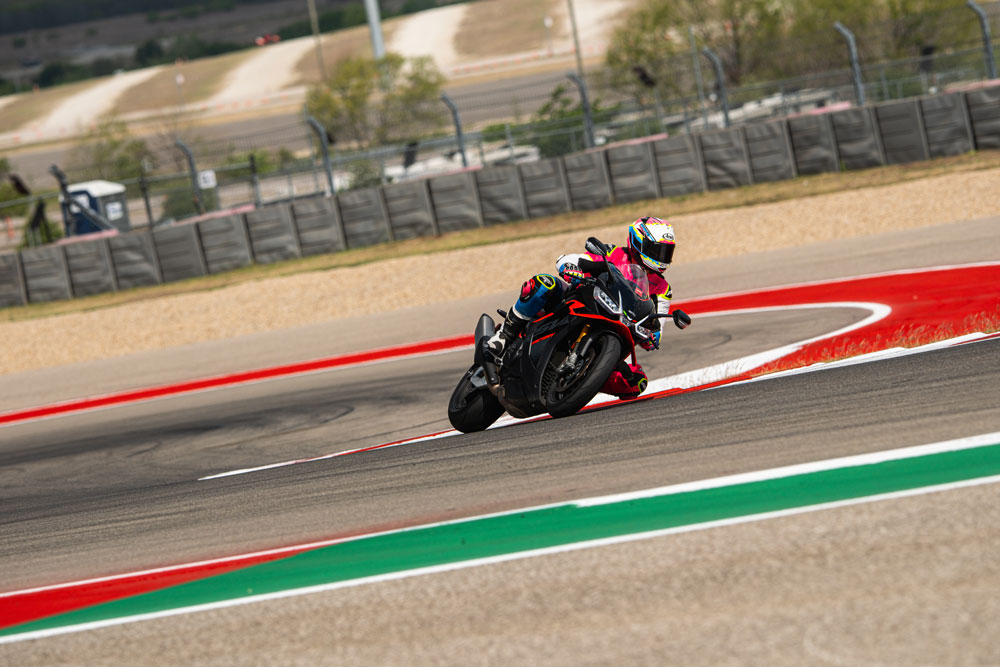
The smoother torque below 7000 rpm is noticeable. On the switch from COTA’s turn eight, nine and into the fast turn 10, the RSV4’s friendlier character delivered drive to the tire with plenty of gusto, but not the screaming urgency of an inline four-cylinder. Throttle response is delightfully deft, especially so given how much motor you have to play with, but the package never feels overwhelming, which is an incredible party trick to pull off.
Much of that is down to Aprilia’s electronics package, which brings the very fancy corner-by-corner GPS traction control to the game (more on that later). The electronics have been further refined, with smoother throttle calibration, improved traction-control intervention, and improved engine-braking strategies.
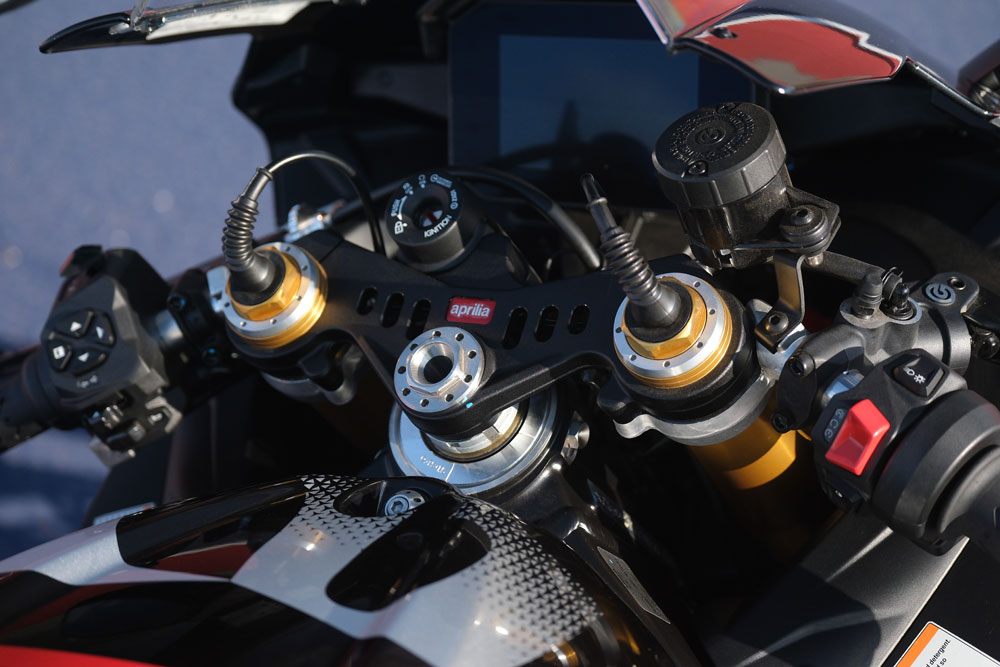
A new slide-control feature has also been introduced, giving riders greater confidence when pushing the limits of rear grip and giving you a little more life out of that poor rear Pirelli that you’re sending to the slaughterhouse with every passing lap.
The RSV4’s reworked quickshifter deserves special mention because it is so damn good at what it does, whether you’re cranking up through the gears on the front straight with the noise tube slammed against the stop or going down multiple gears at a time and braking for the near dead-stop, first-gear left-hander at the end of it. Both upshifts and downshifts are executed with remarkable smoothness, but it’s not perfect in that you still need to be precise with your shifts. No pussyfooting. Do it right, and the RSV4 will reward you every time.
Right, now onto the special part.
One of the standout features carried over—and further enhanced—for 2025 is the integrated GPS-based data-logging system. The 2026 RSV4 Factory (and Tuono V4 Factory), in conjunction with the Aprilia MIA app, allows for corner-by-corner changes to the bike’s eight-level traction control, three-stage wheelie control, and three-stage engine-braking parameters, as long as you set the limits yourself.
The system works by having you select a circuit in the MIA app (hopefully Aprilia has your circuit loaded in the app; if they haven’t, you’ll have to get in touch with them to have them do so). Then, you individually select the various levels you want at a given point of the racetrack. This effectively brings a level of trackside tuning previously reserved for professional racing teams to a production motorcycle.
After your ride, you can export the data in VBO format, which is compatible with Racelogic’s professional analysis software. If all this sounds familiar, it should be. Aprilia offered GPS-controlled electronics to customers back in 2021, but you needed a separate GPS module from Aprilia to enable the corner-by-corner function.
All this is an evolution of the Aprilia Performance Ride Control (APRC) system that debuted in 2010, making Aprilia the third manufacturer to fit traction control to a production superbike, after Ducati (1098 R) and BMW (S 1000 RR).
Aprilia was actually the first to use a basic IMU in the 2011 RSV4, but the Piaggio marketing department was somewhat lax on the massive bragging rights available from the revolutionary system.
KTM was the first to run a full six-axis IMU in 2014 on their 1190 Adventure, but Yamaha was the first to have the full six-axis IMU fitted to a sportbike with the 2015 YZF-R1. Ducati followed suit that same year with the 1299 Panigale.
Much of this technology has come from Aprilia’s experience in WorldSBK and MotoGP, even though MotoGP stopped using GPS for traction-control intervention in 2016 with the advent of the control ECU. Dorna had actually banned the use of GPS units supplied by external companies at the end of 2010, with the MotoGP commercial rights holders implementing a controlled GPS unit for the next five seasons.
But we’re not racing MotoGP here, and the GPS system is a serious boon for riders trying to extract maximum track performance, though it may be more complex than casual users will fully exploit (or are prepared to exploit).
Suspension duties are handled by the semi-active Öhlins system, which is about as close to an electronic magic carpet ride as you can get these days. This system was first seen with Honda and Ducati on their superbikes and is so good now, I’d have zero issues going racing with it. The Öhlins system adapts in real time to changing conditions, maintaining composure under hard braking, acceleration and rapid changes in direction.
While that part is not groundbreaking—we’ve had electronic suspension for ages—it is amazing how efficient the system now is. Get your preloads set and leave the system in Track mode, and you’ll have to be going very, very fast indeed for any real need to change to the manual setting. The suspension provides such a planted, confidence-inspiring feel at the handlebars that it’s almost impossible to fault.
The RSV4 runs lightweight forged aluminum wheels, so it’s easier for you to get the bike from bolt upright to into the corner faster than you can think about it. The combination of the suspension and those wheels makes for an incredibly agile machine, and you’ve only got a claimed 4.4-pound increase compared to the 2024 RSV4 Factory.
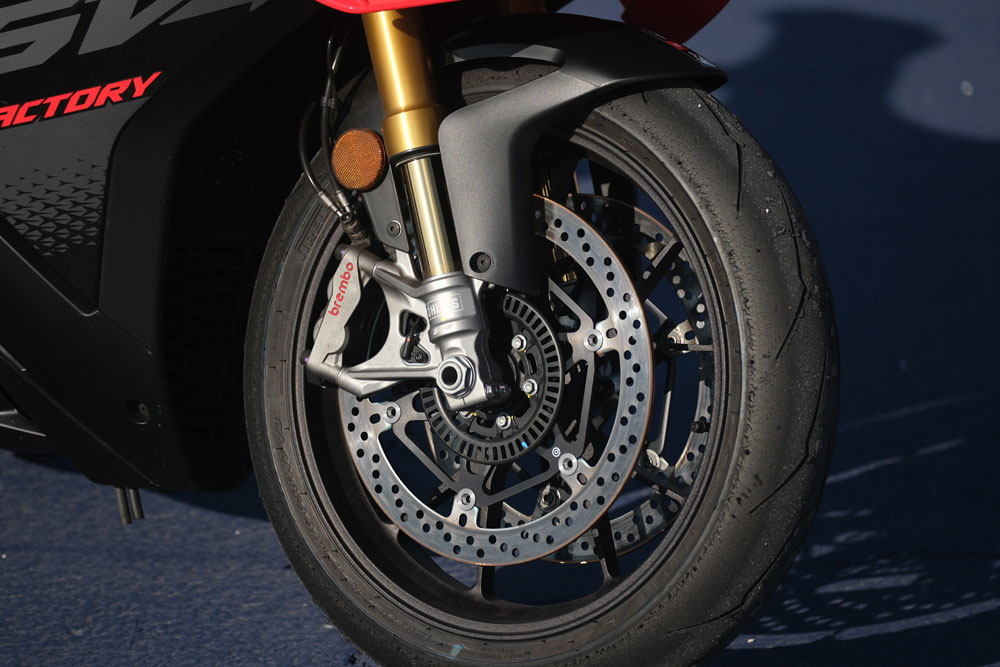
Braking performance is equally impressive. Aprilia has fitted the Hypure calipers first seen on the Panigale in 2024, and these offer stupendous stopping power with excellent lever feel, making it easier to modulate braking force precisely. Combined with the RSV4’s renowned stability, the Hypure brakes allow you to push deeper into the late-braking corner duels with confidence.
Part of the braking package must include the winglets. I’m no aero expert, but the amount of downforce on the front end at high speed certainly translates to better braking, as the front tire already has tremendous load on it before you manually exert more from squeezing the brake lever.
Aprilia was among the first manufacturers to introduce MotoGP-style winglets on a production bike at the end of the previous decade, and the concept has continued to evolve. For 2025/2026, the RSV4 features redesigned front winglets and a reshaped tail section that incorporates additional stegosaurus-style fins, as on Bez’s RS-GP MotoGP machine.
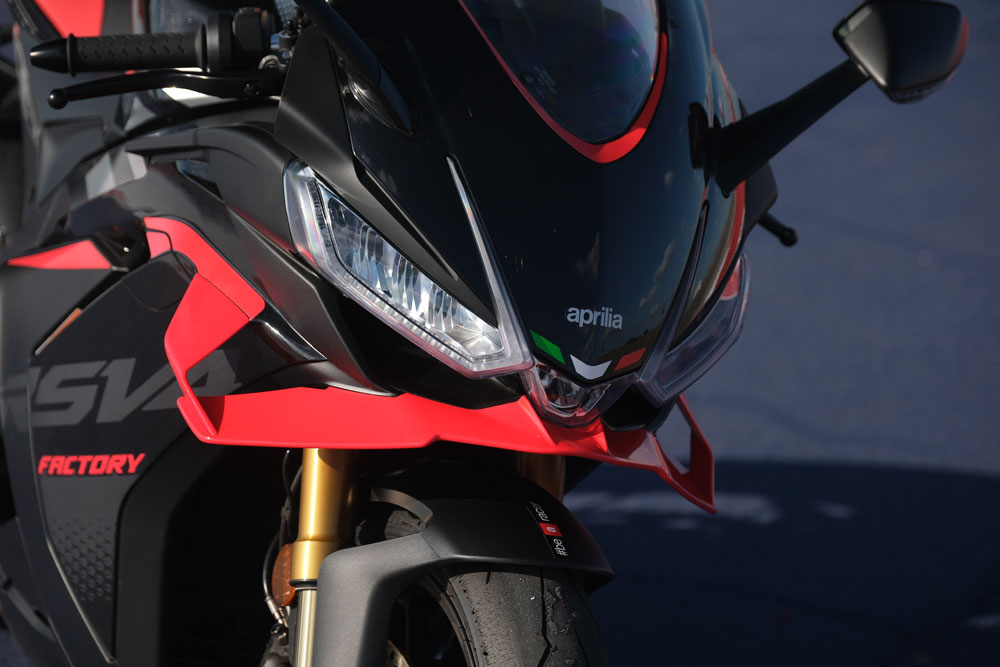
These changes are aimed at reducing drag and improving airflow efficiency, with claimed reductions in both straight-line resistance and lateral aerodynamic load.
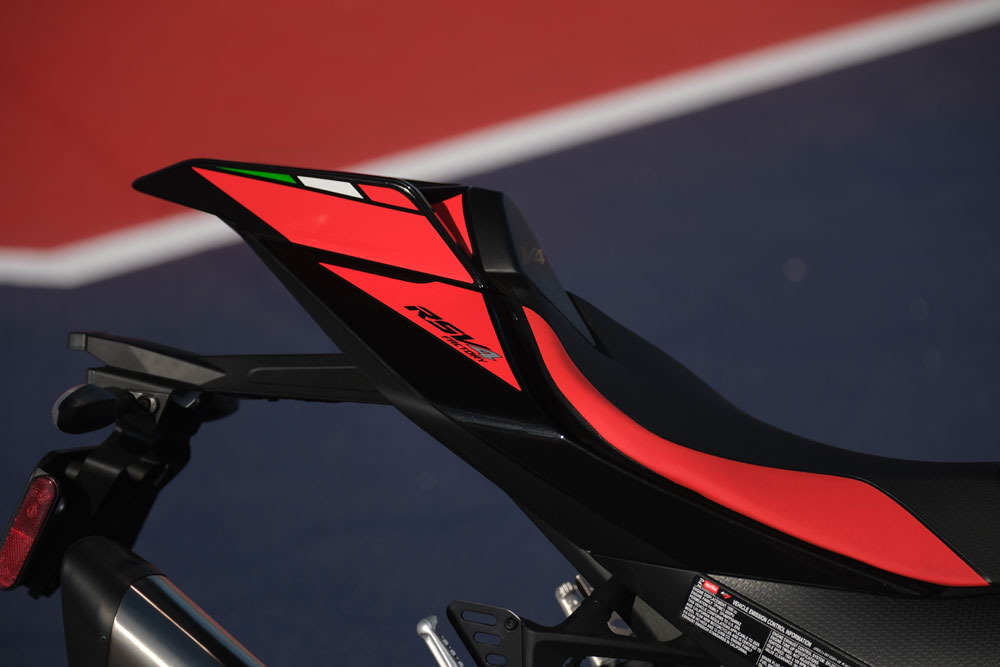
Updated bodywork sharpens the bike’s look and improves aero efficiency. The redesigned tail integrates all rear lighting into a single unit that’s easy to remove for track use.
While it’s difficult to isolate the exact contribution these aero upgrades have made, the overall package contributes to an extremely stable and planted motorcycle across the many high-speed sections to ride at Circuit of The Americas.
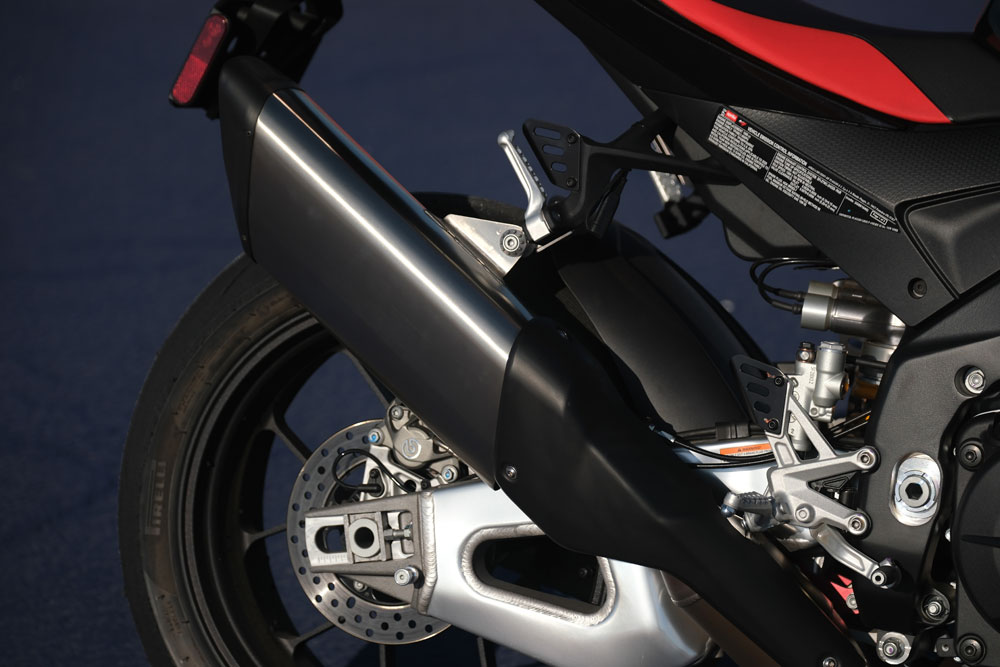
One interesting thing to note is that the RSV4 doesn’t get anywhere near as hot as it once did. Heat transfer from the engine has been improved with better airflow, new cooling fans, and revisions to the exhaust and catalytic converter. All this reduces the heat that eventually reaches the rider, which is a welcome revision on the racetrack.
The RSV4 Factory 1100 comes with cruise control and a pit-lane speed limiter, and there are minor cockpit updates to the display graphics, backlit controls, a lighter top triple clamp, and a lithium-ion battery.
It has always been a connoisseur’s sportsbike, and the 2026 version is even more so. It’s incredibly difficult to fault in a surface-level test such as this; perhaps some of its shortcomings would be more apparent on a month-long road test, but that’s for another time. Given the fact this bike is far cheaper than its Italian rival in the Panigale V4 S, and cheaper as well than the S 1000 RR and M 1000 RR from BMW, it’s a wonder I don’t see more of these bikes on the street. It is an incredible machine, one I can’t even begin to scratch the surface of, and the level of tech at your fingertips is now real high-end, superbike-team stuff.
Plus, it’s Italian, with a 217 hp Italian V4. Bow down to Aprilia’s superbike royalty.CN
2026 Aprilia RSV4 Factory 1100 Specifications
| MSRP | $26,499 |
| Engine | 65° longitudinal V-4, 4-stroke |
| Valvetrain | 4 valves per cylinder, DOHC |
| Displacement | 1099cc |
| Bore x stroke | 81.0mm x 53.3mm |
| Compression Ratio | 13.6:1 |
| Cooling System | Liquid |
| Max Power (claimed) | 217 hp @ 13,100 rpm |
| Max Torque (claimed) | 92.2 lb-ft @ 10,800 rpm |
| Fuel System | Electronic fuel injection system, 53mm throttle bodies |
| Exhaust | 3/2/2001 |
| Transmission | 6-speed, slipper clutch, quickshifter |
| Electronics | TFT dashboard w/ Race mode Backlit switch cubes; Aprilia MIA app; GPS and Lap Trigger; APRC system w/ 6-axis inertial platform; Engine Maps (AEM); Engine Brake (AEB); Cornering ABS (3 maps and Rear Wheel Lift-Up Mitigation); Traction Control (ATC); Aprilia Wheelie Control (AWC – adaptive and predictive); 6 Riding Modes; Aprilia Quick Shift (AQS); Cornering lights; Aprilia Cruise Control (ACC); Aprilia Launch Control (ALC); Aprilia Pit Limiter (APL); Aprilia Slide Control (ASC); Öhlins electronically controlled steering damper; Corner By Corner Engine + Suspension |
| Chassis | Adjustable twin spar aluminum frame w/ pressed and cast sheet elements |
| Front Suspension | Öhlins 43mm electronically controlled fork, fully adjustable |
| Rear Suspension | Öhlins electronically controlled monoshock, fully adjustable |
| Front-Wheel Travel | 4.9 in. |
| Rear-Wheel Travel | 4.5 in. |
| Front Brake | Dual 330mm floating discs, Brembo Hypure radial-mount monoblock calipers, cornering ABS |
| Rear Brake | Single 220mm disc; Brembo caliper w/ two 32mm separate pistons, cornering ABS |
| Front Tire | 120/70 ZR17 in. |
| Rear Tire | 200/55 ZR17 in. |
| Rake / Trail | 26.5° / 4.1 in. |
| Wheelbase | 56.5 in |
| Seat Height | 31.3 in. |
| Fuel Capacity | 4.76 gal |
| Weight (curb, claimed) | 449 lbs. |
Click here to read the 2026 Aprilia RSV4 Factory 1100 Review in the Cycle News Digital Edition Magazine.