“Across North America, we’re seeing a demand from riders who want a bike that provides an authentic link to the past riding experiences that made them fall in love with motorcycling, while still offering modern features for enhanced comfort and performance. They’re looking for machines that feel authentic, approachable and deeply personal,” says Royal Enfield’s Nathan Kolbe. And he says the machine that will do these things is the all-new Royal Enfield Classic 650.
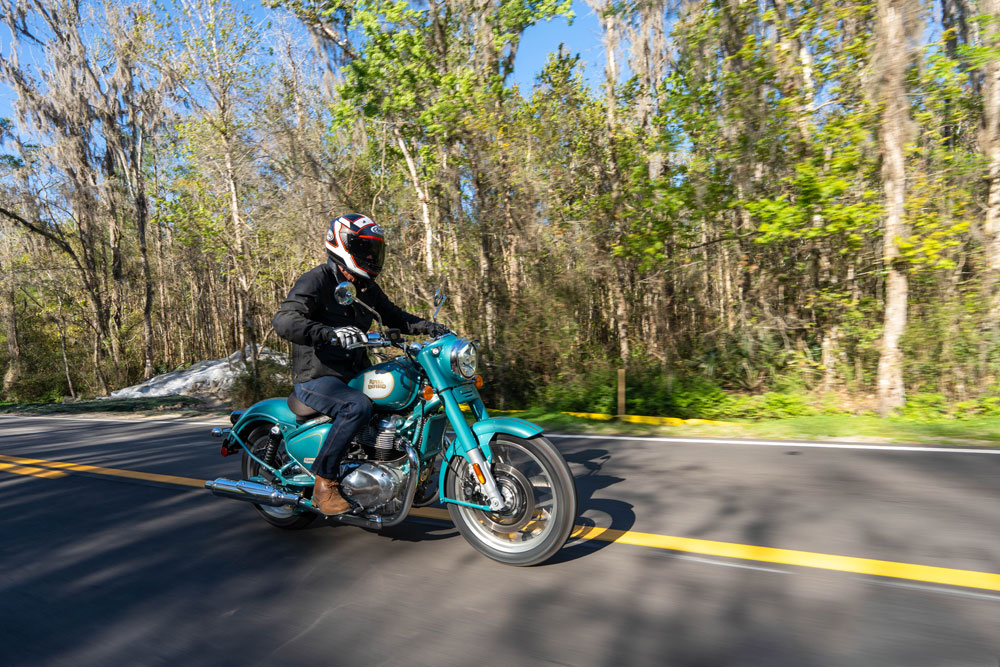
Technically, the Classic 650 isn’t “all-new.” It was launched worldwide last year, but, for whatever reason, not in North America. But that was last year.
Royal Enfield, which is celebrating its 125th anniversary, chose St. Augustine, Florida, the oldest city in the nation, to officially welcome the Classic 650 to North America. “Launching the Classic 650 here in St. Augustine, a place where history isn’t preserved behind glass, it’s lived every day, and this spirit mirrors what the Classic 650 represents: timeless design paired with modern performance that invites riders to slow down, savor the journey, and reconnect with the joy of pure motorcycling.”
The Classic 650 draws inspiration from the company’s first parallel-twin motorcycle, simply named the 500 Twin, unveiled in 1948. This bike was truly exceptional, not just for its engine but also for its rear suspension. Months earlier, Royal Enfield introduced the first motorcycle, a prototype trials bike, equipped with a swinging arm suspension system. Other manufacturers scoffed at it, claiming it wouldn’t work. Well, we all know what happened. The Royal Enfield 500 Twin, along with its younger sibling, the 350 Bullet, will always be known as the first production motorcycles to feature a swinging-arm rear suspension system. The 500 Twin later evolved into other parallel-twin models for Royal Enfield, such as the Super Meteor, Constellation, Shotgun and Interceptor (INT in the U.S.). Now, we have the Classic 650.
Not only does the Classic 650 borrow elements from the 500 Twin, but also from the company’s 350 Bullet model, Royal Enfield’s best-selling motorcycle worldwide and in the U.S. “The Classic 350 has been an extremely popular model here [the U.S.],” Kolbe says, “but by combining our iconic heritage design with the 650 Twin platform, we’ve built a motorcycle that bridges the gap between heritage and high-speed capability that we believe will also resonate extremely well with riders.” Especially in the U.S., with its wide-open spaces.
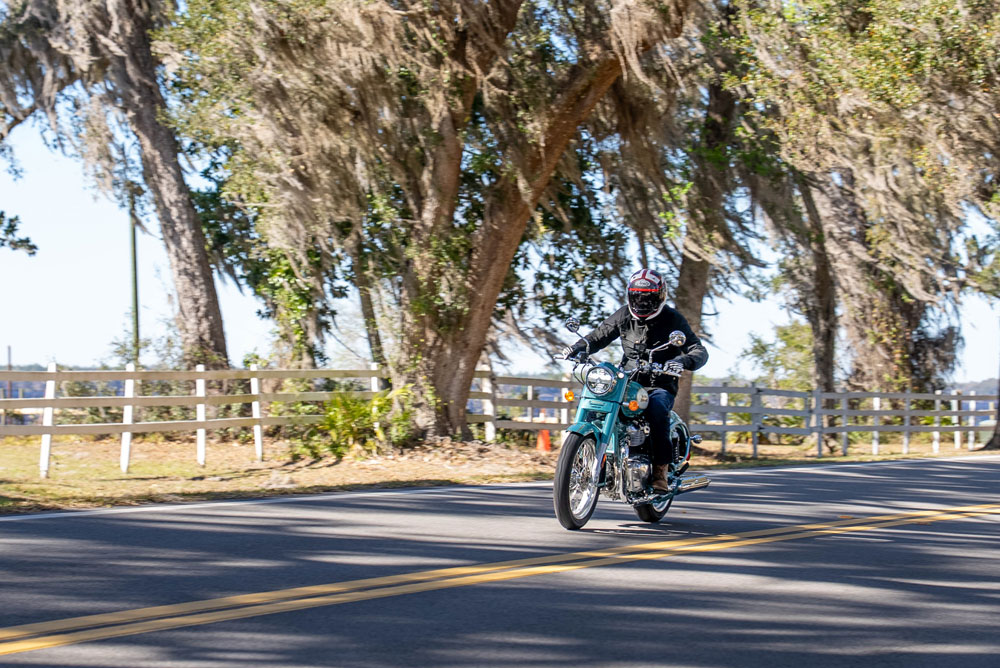
I’m presuming anyone interested in buying the Classic 650 is attracted more by its looks than by anything else. Its vintage, post-war style is what draws you in, not by how quickly it can get you from point A to point B or how sharply it can carve a canyon turn. It’s all about the look. But you also don’t want something that looks great parked outside the Outback Crab Shack but is something you dread riding home on. You still want some performance, and the more the better, of course. I’ll get straight to the point: the Classic 650 performs as well as it looks.
Nowhere in Royal Enfield’s pre-description verbiage of the Classic 650 is the word “cruiser” used, nor did I think of it as a cruiser when I first laid eyes on it. It’s simply a modern classic based on a pre-war-style motorcycle and that’s just how they looked, I thought. They didn’t have “cruisers” back then. But within the first few miles riding the Classic 650, I started to think, “This is a cruiser.” At least it feels that way with its low 31.5-inch seat height, somewhat long 58.1-inch wheelbase, semi-fat tires and stiff seat and suspension. The Classic 650 shares its mainframe with the Super Meteor and the Shotgun 650, featuring dual seats with an optional pillion seat and rack removal, using a single-bolt mechanism. My ride was pillion-less. The single seat is wide, firm, and I thought quite comfortable, despite limited padding.
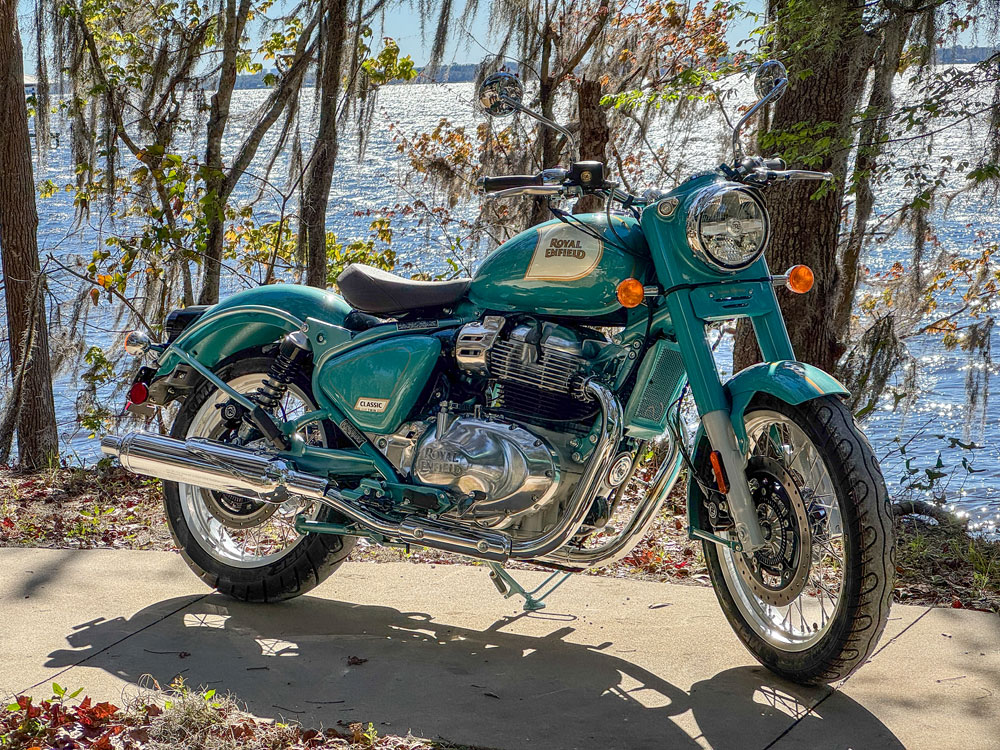
One of the things that didn’t feel cruiser at all to me was ergonomics. The sitting position is more straight-up-and-down, standard style, with the footpegs directly beneath you rather than forward, like on many typical cruisers, a style I never cared for. Luckily for me, the Classic 650 has a more neutral seating position, which means your spine isn’t an extension of the rear suspension like on traditional cruiser bikes. Overall, the Classic 650 is very comfortable and relaxed. I’m sure anyone of any size who throws a leg over it will agree.
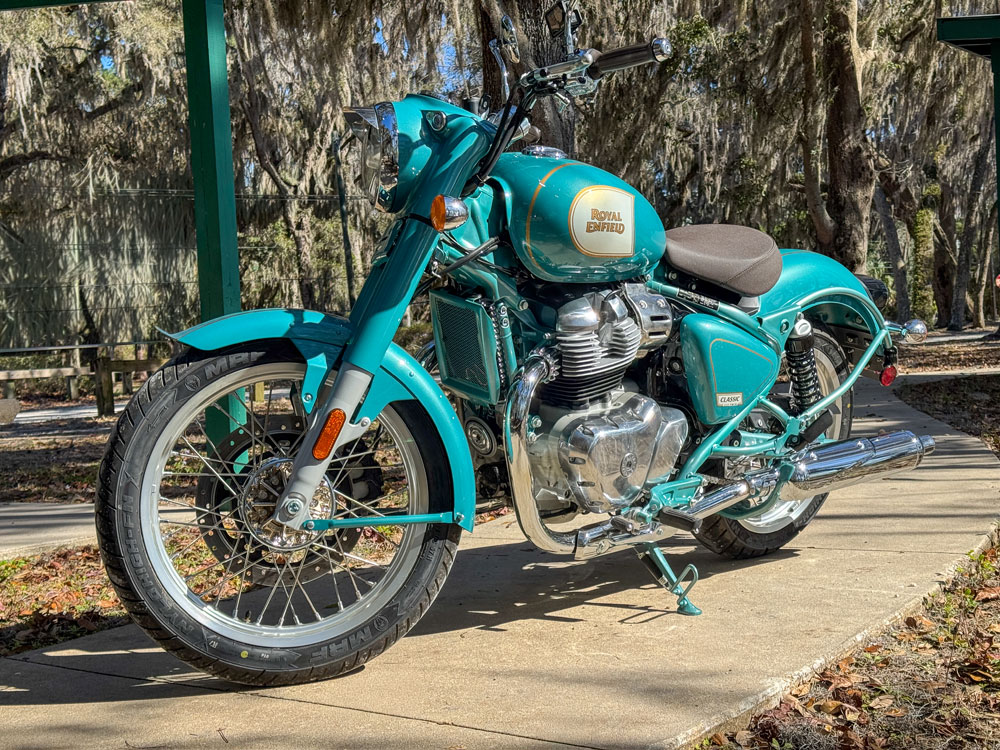
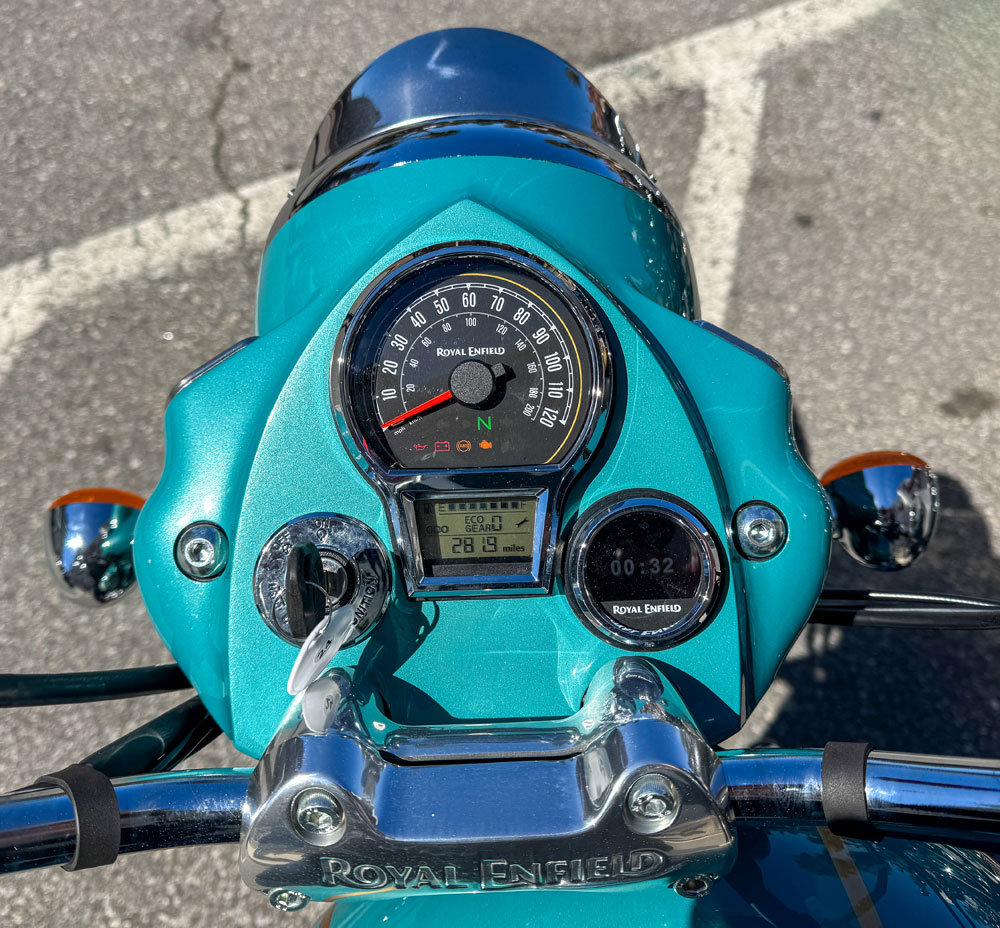
Adding to the “you’re on a cruiser” feel is the positioning of the instrument housing/headlight nacelle. It’s slightly lower and pushed forward a bit more than standard bikes. The Classic 650 is fitted with a large analog speedo and a modern-looking—small but readable—digital screen that displays a fuel gauge, gear-position indicator, clock, USB-C charging port and a Tripper turn-by-turn navigation pod with phone connectivity. The large round headlight is LED, and on each side are small running “tiger eyes” lights. That whole area of the bike looks very cruiser-ish.
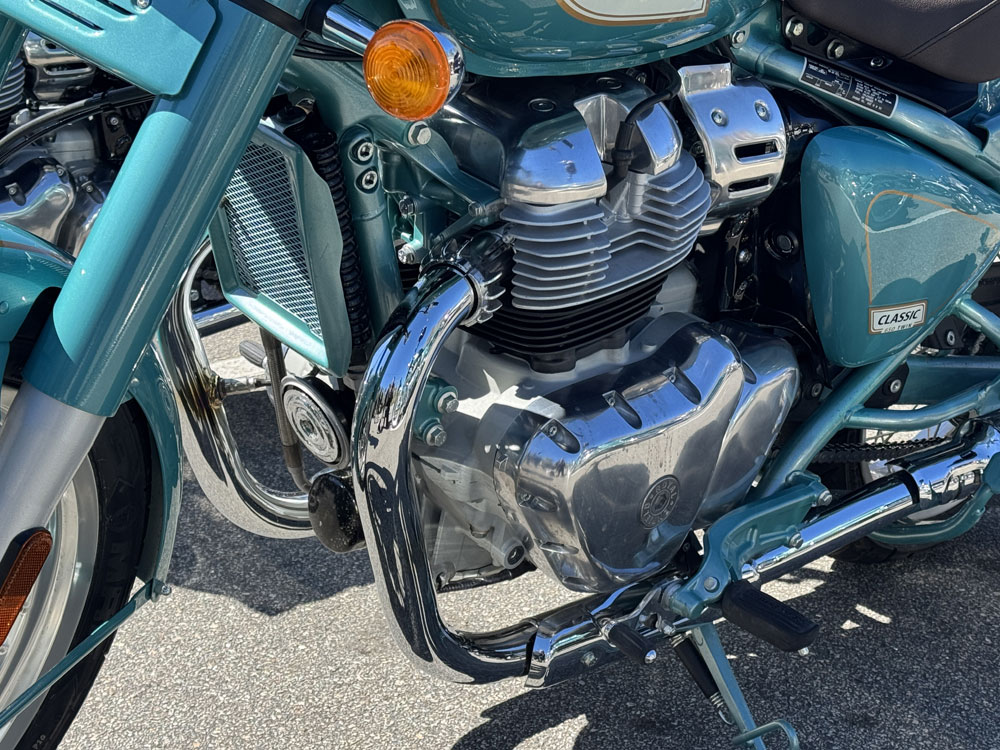
Performance-wise, what again makes you feel like you’re on a cruiser is the power. Its 648cc, SOHC, air/oil-cooled parallel-twin motor delivers good bottom- to mid-range torque that doesn’t really invite you to rev it, but you can if you want, with decent results. But the best way to get up to speed quickly is to roll on the throttle, shift early through its six gears, and let the torque do most of the work. Royal Enfield claims the Classic 650 delivers 47 horsepower at 7150 rpm and 38 lb-ft of torque at 5250 rpm, not earth-shattering numbers but enough to be a lot of fun. Plus, the Class 650, with its 270-degree crank arrangement, belts out a pleasant thumping tune from its dual exhausts, and vibration isn’t a thought until you reach high rpm, but you’re not going to be riding it there much, anyway.
There isn’t anything the engine doesn’t do at least well. Fuel delivery from its electronic fuel injection system is spot on, and the cable-actuated clutch works great with a light pull and good feel; however, the lever engagement is a little farther from the handlebars than I prefer. I give the Classic 650 five stars for shifting. It’s buttery smooth, has a short throw, and finding neutral is as simple as it gets. All motorcycles should shift like this.
Handling is top-notch, though riding in Florida is hardly a good testing ground for cornering prowess and ground clearance. What lazy, sweeping turns we did find, though, the Classic 650 performed nicely, requiring little coaxing to initiate the turn, and it holds its lines as it should, a lot of which is due to the fairly wide and flat handlebars that give you good leverage.
The overall ride on the large 100/90-19-inch front and 140/70-18-inch rear tires is very smooth. And slowing the 530-plus-pound bike down earns the brakes a B-plus thanks to its ABS-fitted front and rear discs, both featuring dual pistons.
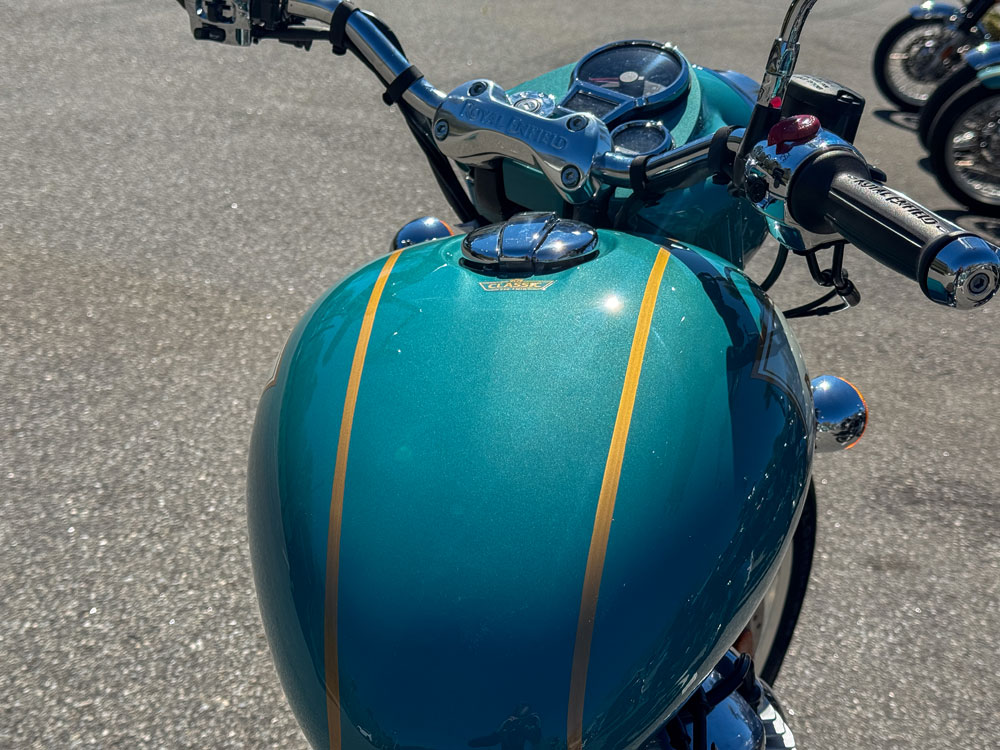
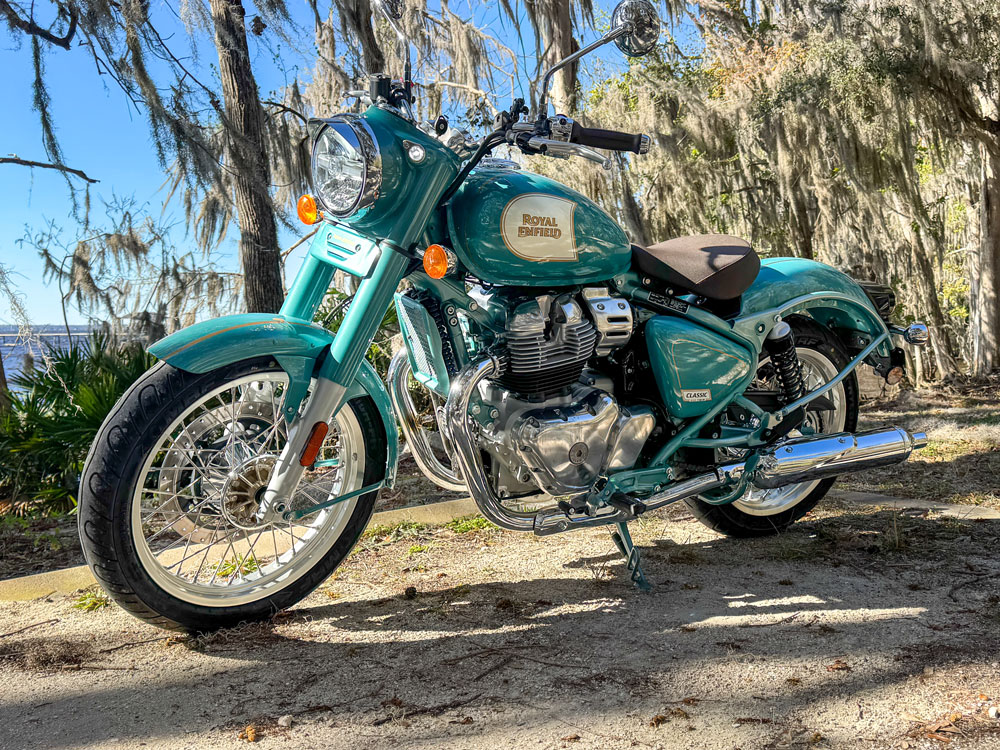
Like most of the India-made Royal Enfield motorcycles we’ve reviewed in the past, the Classic 650 looks and feels well built, and, from our experiences, we have good reason to believe it will be reliable. You can tell they paid close attention to detail, as evidenced by the hand-painted pinstriping on the fuel tank (on two of the three color options). Very cool.
One thing they could’ve done better is the kickstand’s positioning: the tab you use to push it down with your foot is right beneath the footpeg, making it hard to find and frustrating to use.
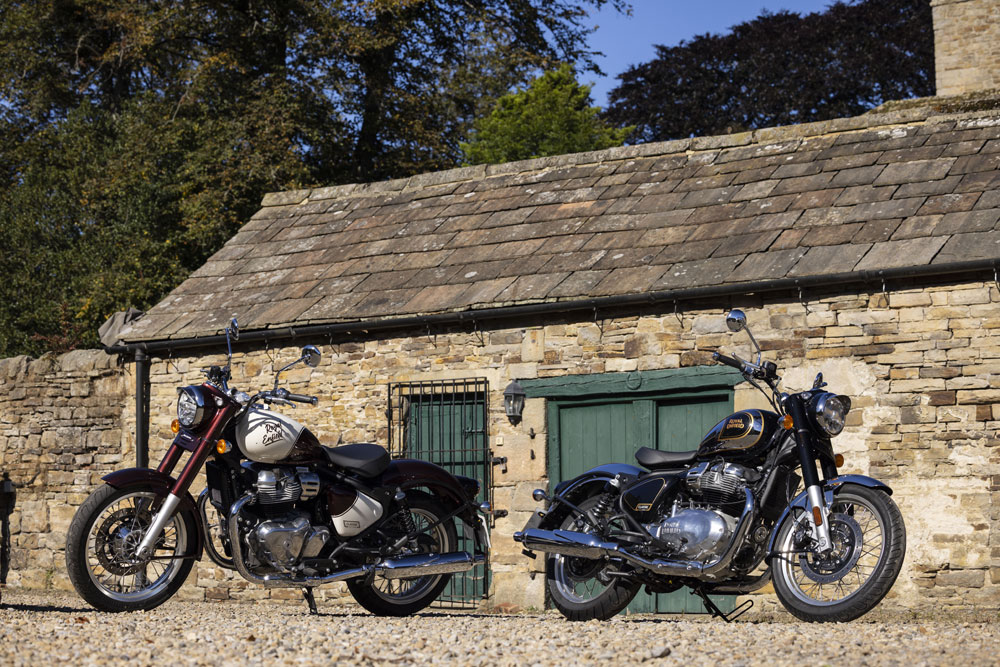
As mentioned, the Classic 650 is offered in three colorways: teal, black/chrome, and red/white; the red/white is the only one with a script logo on the tank. The teal and black/chrome versions feature the hand-painted pinstripes. Best of all, the Classic 650 is affordable, with an MSRP of $7499 across all color options.
The Royal Enfield Classic 650 highlights its style and truly captures what Kolbe described as a timeless design, combined with modern performance. This motorcycle’s look immediately draws you in, while its riding feel and build quality will keep you there. I like that, aside from its good looks, the Classic 650 has all the positive traits of a cruiser without the downsides. It doesn’t scream cruiser when you see it; it’s more comfortable than most cruisers; and it won’t drain your bank account to buy one.
Simply, the Classic 650 performs as well as it looks.CN
2026 Royal Enfield Classic 650 Specifications
| MSRP | $7499 |
| Engine Type | 4-stroke parallel-twin |
| Valvetrain | SOHC, 8 valves |
| Displacement | 648cc |
| Bore x Stroke | 78.0 x 67.8mm |
| Compression Ratio | 9.5:1 |
| Cooling System | Air/oil-cooled |
| Claimed Horsepower | 47 hp @ 7150 rpm |
| Claimed Torque | 38 lb-ft @ 5250 rpm |
| Fuel System | Electronic fuel injection |
| Starting System | Electric |
| Transmission | 6-speed constant mesh |
| Clutch | Wet, multiplate |
| Final Drive | Chain |
| Frame | Steel tubular spine |
| Front Suspension | 43mm telescopic fork |
| Rear Suspension | Twin shocks, preload adjustable |
| Front-Wheel Travel | 4.7 in. |
| Rear-Wheel Travel | 3.5 in. |
| Front Brake | 2-piston floating caliper, 320mm disc w/ ABS |
| Rear Brake | 2-piston floating caliper, 300mm disc w/ ABS |
| Front Wheel | 19 in. |
| Rear Wheel | 18 in. |
| Front Tire | 100/90-19 in. |
| Rear Tire | 140/70-18 in. |
| Wheelbase | 58.1 in. |
| Ground Clearance | 6.1 in. |
| Seat Height | 31.5 in. |
| Fuel Capacity | 3.9 gal. |
| Weight (wet, claimed) | 535 lbs. |
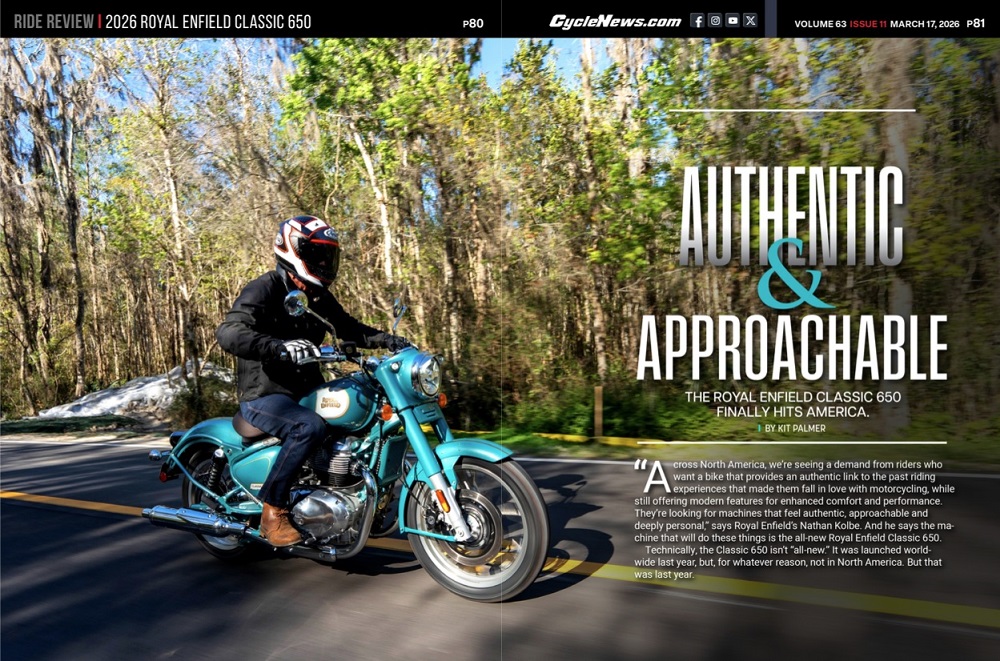
Click here to read the 2026 Royal Enfield Classic 650 Review in the Cycle News Digital Edition Magazine.