The sport touring game has never really been Kawasaki’s strong point but it’s not entirely their fault. Bikes like the Concours 14, Ninja 1000, and the stupendous H2 SX have all been solid performers (well, maybe not the H2, but it’s still by far the coolest), but they haven’t quite won the hearts and minds of the public in the same way Yamaha has with the Tracer or BMW with the S 1000 XR.

Photography by Justin Coffey
The Big K is firmly aware of this and has endeavored to revamp its lineup for 2025 with a new 1100cc motor residing in the Ninja SX and this $19,499 Versys 1100 SE LT, and they will (praise the lord) be bringing back the H2 SX for those who want a healthy dose of hyper-speed sports touring.
VIDEO | 2025 Kawasaki Versys 1100 SE LT First Ride Review

Kawasaki hasn’t gone full revolution with the new Versys motor, but the upgrade in capacity is significant. Punched out from 1043cc to the same 1099cc that resides in the Ninja 1100 SX, the new motor gets a 3mm longer stroke, redesigned intake funnels that are 1.7 inches longer, narrower intake ports, milder cam profiles with less lift and lighter Keihin throttle bodies that have the same 38mm diameter as before. Additionally, a heavier flywheel contributes to smoother power delivery at low rpm.

In your right hand now resides 133 horsepower at 9000 rpm, up from 120 horsepower in the 2024 Versys 1000, and 82.5 lb-ft of torque at 7600 rpm, but it depends on the riding mode. For that, you have Sport, Road, Rain or Rider, the latter being a fully manual setting that lets you set the power mode of Low or Full, plus the electronic suspension settings and traction control.
Low power mode gives you 75 percent of the available 133 horsepower but delivers it in a more metered response, while Full power mode will give you the full horsepower whack.
On the road, the Kawasaki engine is smooth as silk. The initial throttle response in Full power mode can be a touch abrupt, but not as bad as some of the competition, like the three-cylinder Yamaha Tracer 9 GT. Once underway, however, there are acres of beefy torque from 2000-7000 rpm. It pulls like a tractor, even allowing dead stop fourth gear rides away from stop signs while on test in Baja California, Mexico.
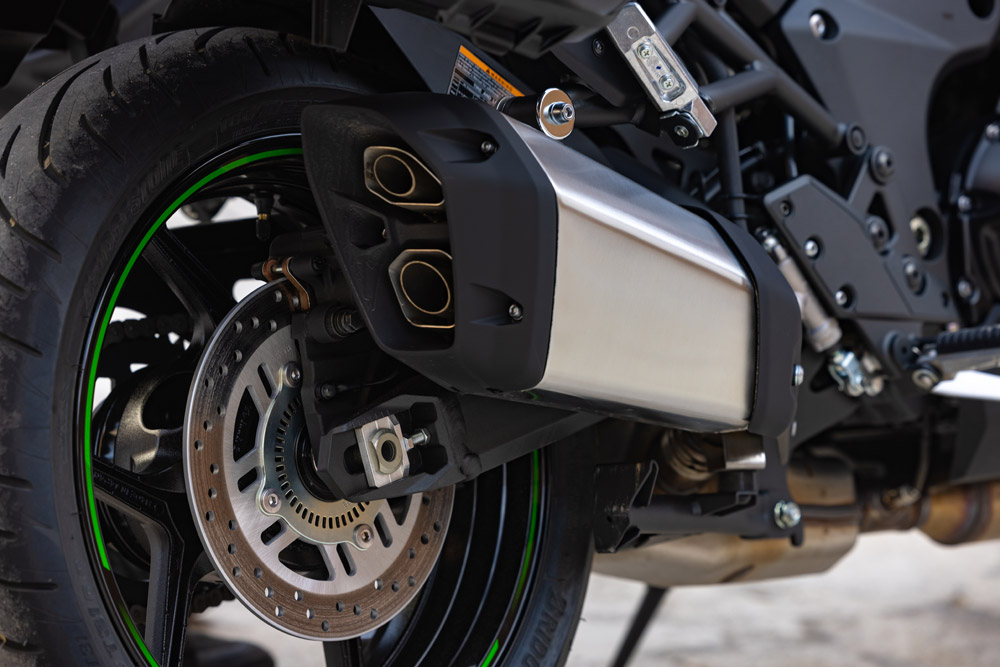
Kawasaki has done exceptionally well to isolate the vibrations from the 1099cc inline four-cylinder. Only when the revs reach north of 8000 rpm do any noticeable niggles creep into the handlebars and feet, but by then, you’re either searching for the next gear or doing 130 mph in top gear on the freeway.
Getting that go to the ground is a revised six-speed gearbox that has shorter ratios for first through fourth gears, with fifth and sixth gears taller for more sedate highway cruising. That means at around 65 mph, you’re doing almost bang on 4000 rpm, right in the torquey sweet spot.
Significantly, the Kawasaki Quick Shifter’s (KQS) operational range has been expanded and now functions from 1500 rpm and up, a reduction from the previous model’s 2500 rpm, to smooth out low-speed and -rpm gear shifting, like riding out of parking lots or away from traffic lights.

Kawasaki has made the quickshifter so smooth it almost feels boring. The shift in cog is about as close to imperceptible as mechanically possible for a production bike, which is great for quick, seamless gearshifts but gives the motor an almost vacuum cleaner feel to it. I can already hear Kawasaki screaming at me, asking what else it could do, but it’s a feeling more than a couple of testers had on the launch in Mexico.
The Versys 1100 runs the ubiquitous six-axis Bosch IMU that looks after cornering traction control, ABS and cornering lights, so you’re in good hands there. Traction control is one of three levels plus Off, which allows you (if you so choose) to loft up the front wheel when the feeling takes your fancy.
The Versys 1100 SE LT ABS features a five-piece cast aluminum frame and steel trellis subframe—the same as before—housing one of the biggest passenger seats I’ve ever seen and a possible payload being a very stout 485 pounds so you, the other half, and a bunch of gear in the standard fitment 28-liter side cases will be fine for a weekend away.

Once you’re loaded up, you’ll be glad that you’ve got the Kawasaki Electronically Controlled Suspension technology (KECS) underneath you. Although unchanged for 2025, it’s still worthy of a mention, given just how smooth the ride is at speed. You’re graced with a 43mm Showa fork and the Showa BFRC-lite rear shock, with the electronics changing damping characteristics every 10 milliseconds.
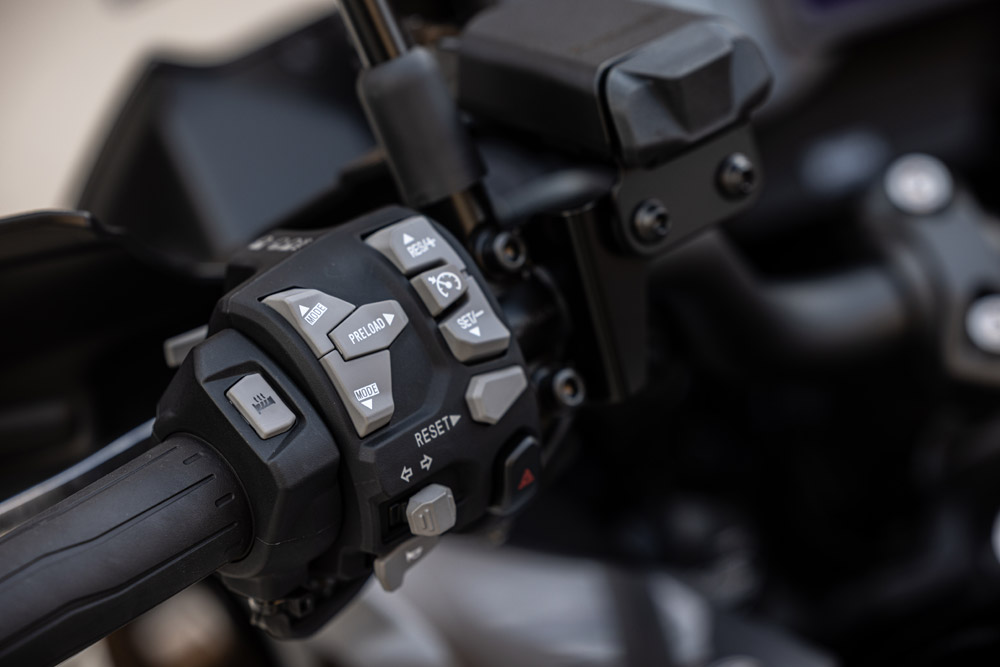
The electronics suite allows for preset preload modes of single rider/single rider with luggage/two riders/two riders with luggage, as per many of the top-line sport touring bikes in the category, and within these modes, the rider can fine-tune each level to plus or minus five (so 10 adjustments in total).
The fork and shock have sensors that continuously monitor stroke speed and compression, and these sensors send data to the KECS ECU every millisecond. Additionally, the IMU provides acceleration and deceleration data every 10 milliseconds, while the ECU supplies bike speed information at the same interval, ensuring precise real-time adjustments.
The system works extremely well and provides a smooth ride in most situations you’d find yourself in on a Versys 1100. The base Sport setting with preload ramped up to two riders was where I found most of the time spent. However, I did spend a few miles in the no-passenger and no-luggage setting just for investigation purposes. At that point, the Versys became a bit of a wallowing boat and was too springy and unsettled under hard on-and-off braking.
Over time that may get on your nerves, but probably not as much as the pain from the seat foam. I’m not sure what Kawasaki has done, but the seat is extremely uncomfortable after a few hours on board (a complaint that was not solely attributed to yours truly), and for a touring bike, it needs to be better. It’s the only real complaint I have, but it’s a big one when the bike’s M.O. is long-riding comfort.
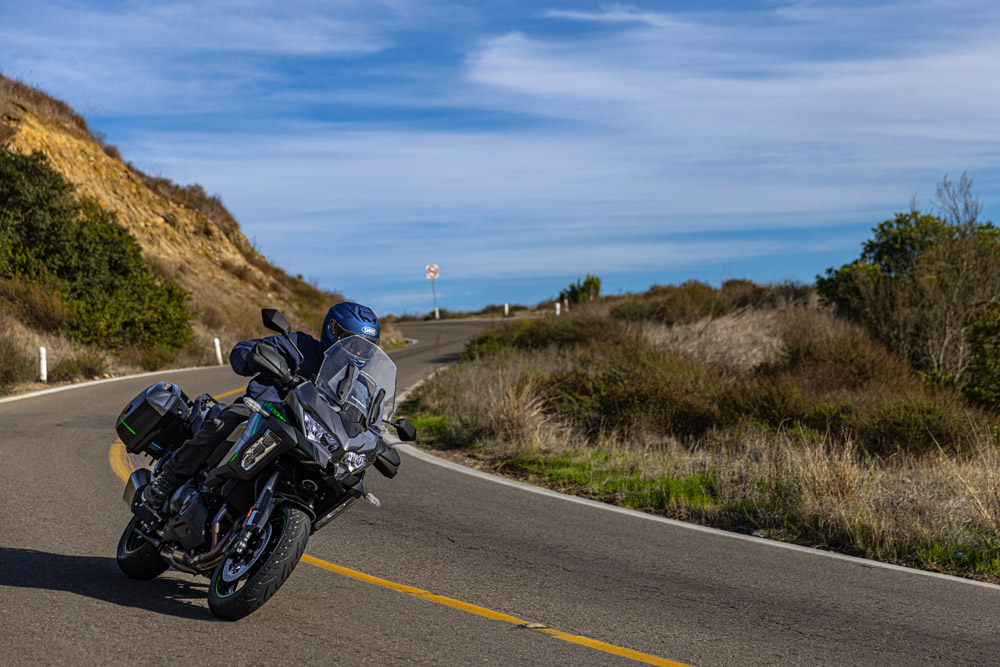
The 2025 Versys 1100 SE LT ABS retains the aggressive aesthetic of its predecessors, defined by sharp lines and a commanding stance. The styling remains largely unchanged, with its signature Metallic Graphite Gray and Metallic Diablo Black colorways still in place.
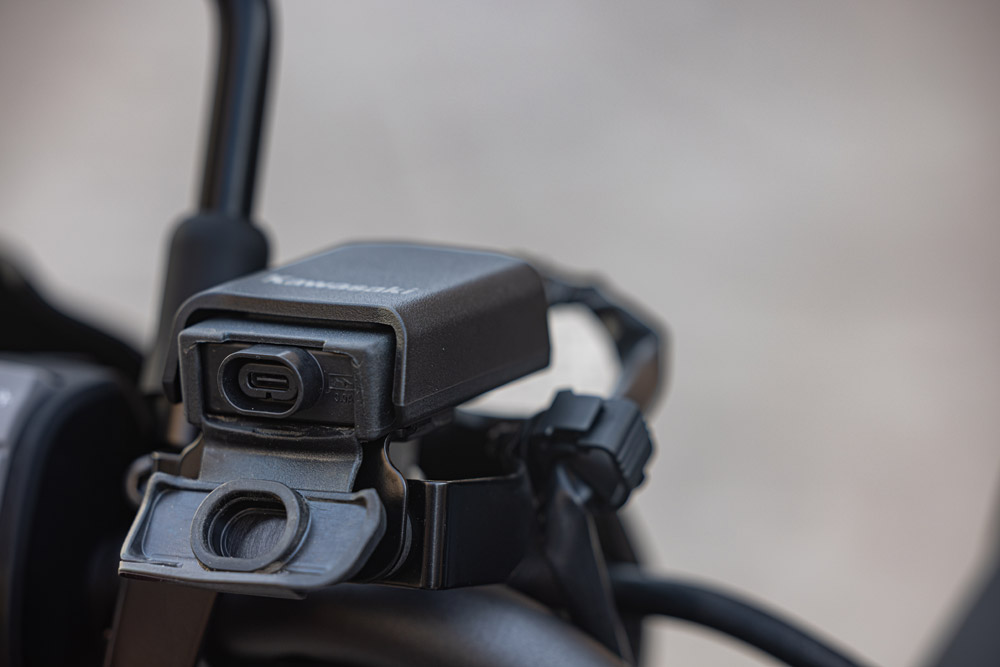
You’ve also got the inclusion of the Rideology app integration that allows riders to connect their smartphones to the bike via Bluetooth, providing access to ride data, vehicle settings, and notifications. Voice command (one that learns your accent) functionality has been introduced in the latest update, enabling hands-free operation of certain features. Although we didn’t get to try this option on the test as there’s a bit of messing around to get it all working, I’m sure riders who cover the kind of miles that the engineers had in mind for the Versys 1100 will find it more than helpful.
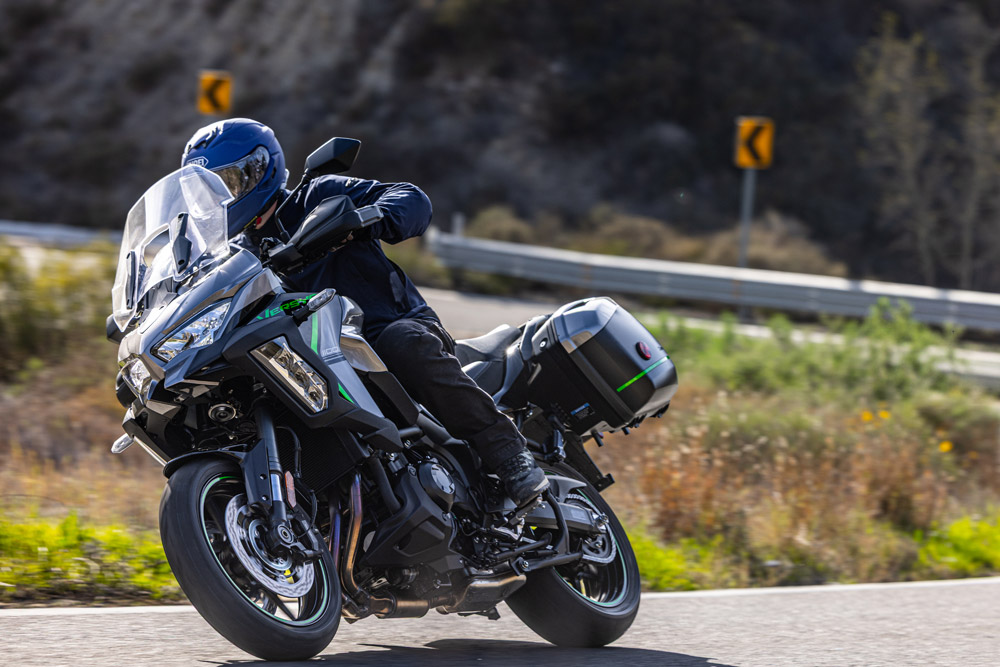
The 2025 Kawasaki Versys 1100 SE LT ABS will primarily go against the Yamaha Tracer 9 GT (2025 the Tracer 9 GT+ isn’t on Yamaha USA’s website anymore) and Suzuki GSX-S1000GX+, Japan’s premium sport-touring machines, seeing as Honda isn’t really playing here right now.
I’ll stop short of saying which one I prefer until I get them in a test together, but Kawasaki has placed itself pretty high in the price point compared to the $12,599 MSRP Yamaha (minus a number of optional features like a quickshifter and cruise control), although the Suzuki is only $1000 less at $18,599.
For that money, however, the Kawasaki gives everything you could want for your long-distance sport touring game except a top box (none of these bikes offer one as standard). You can pick one up in the Kawasaki aftermarket catalog, but the two 28-liter saddlebags come included.
That makes the Kawasaki not as harsh a value concept as it may seem at first. A quick look further up the chain at optioning up the $17,995 BMW S 1000 XR into the same spec as the Kawasaki yields a price of around $21,000, but this is just a ballpark figure for a bike far sportier than the Kawasaki.

Kawasaki may not have prioritized the sport touring game to the extent they probably should have in the past, but, in the Versys 1100 SE LT, they have a bike that offers everything the competition does and, in some cases, more. Which, for under $20K, isn’t something to sneeze at.CN

2025 Kawasaki Versys 1100 SE LT ABS Specifications
| MSRP | $19,499 |
| Engine | Inline 4-cylinder |
| Valvetrain | DOHC, 16-valve |
| Cooling system | Liquid |
| Displacement | 1099cc |
| Bore x stroke | 77.0 x 59.0mm |
| Compression Ratio | 11.8:1 |
| Fueling | Electronic fuel injection system w/38mm throttle bodies, Ride-by-Wire throttle |
| Exhaust | 4-2-1 |
| Transmission | 6-speed, chain drive |
| Clutch | Wet, multiplate slipper; hydraulic actuation |
| Chassis | Aluminum twin-tube |
| Front suspension | 43mm inverted Showa fork with KECS-controlled rebound and compression damping, manual spring preload adjustability and top-out springs |
| Rear suspension | Horizontal back-link, Showa BFRC-lite gas-charged shock with piggyback reservoir, KECS-controlled compression and rebound damping electronically-adjustable spring preload |
| Front-wheel travel | 5.9 in. |
| Rear-wheel travel | 5.9 in. |
| Front brake | Dual 310mm petal discs with radial-mount 4-piston monobloc calipers, Kawasaki Intelligent anti-lock Brake System (KIBS) |
| Rear brake | Single 260mm petal disc with 1-piston caliper, Kawasaki Intelligent anti-lock Brake System (KIBS) |
| Front tire | 120/70-17 in. |
| Rear tire | 180/55-17 in. |
| Rake | 27° |
| Trail | 4.0 in. |
| Wheelbase | 59.8 in. |
| Seat height | 33.1 in. |
| Fuel capacity | 5.5 gal |
| Weight (curb, claimed) | 571 lbs. |
Click here to read the 2025 Kawasaki Versys 1100 SE LT ABS Review in the Cycle News Digital Edition Magazine.
Click here for the latest Cycle News Dual Sport motorcycle reviews and news.
Click here for more Kawasaki motorcycle reviews and news.


