My god, this thing is stiff.
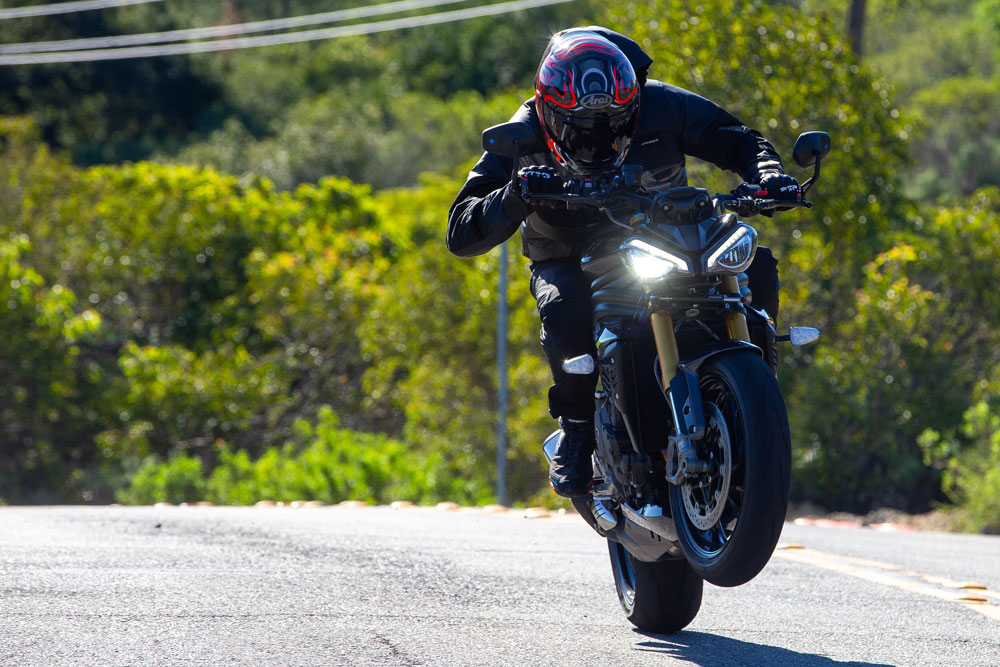
I’m thinking this as I roll down the 405 freeway in Southern California on the Triumph Speed Triple RS after picking it up from the dealer.
I’m in Sport mode, which, when combined with the more direct throttle response, gives a stiffer setting to the Öhlins SmartEC3.0 semi-active suspension than I think any road rider would ever need.
Photography by BrownDog Wilson
Part of the reason I feel it’s so stiff is that I’ve spent the last few months riding a plethora of midsized naked bikes that, in comparison to the Triumph, are like wet noodles in the suspension department.
The RS is the most purposeful, single-minded Speed Triple I’ve ever ridden (I am yet to throw a leg over the chart-topping Speed Triple RX). It’s about as close to a naked superbike as Triumph makes and goes against fellow heavy hitters like the BMW S 1000 R (or M 1000 RR if you really push the boat out), the Aprilia Tuono Factory, the KTM 1390 Super Duke and the poster boy, the Ducati Streetfighter V4 S. It is decidedly more motorcycle than anything the Japanese make, with the Yamaha MT-10 SP being about as close as they get to the Triumph.
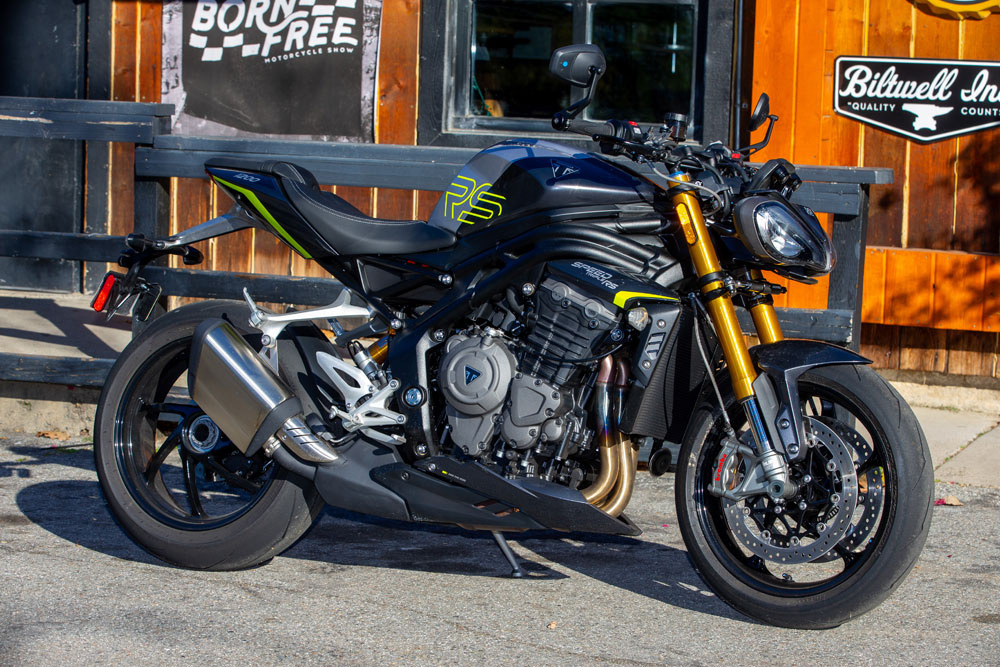
That’s because there’s been a distinct “them versus us” mentality from the Japanese and Euros with regard to the naked-bike class. The Euros are all about outright performance, the Japanese more in the everyday performance realm. The RS thus hoists Triumph right to the pointy end of the Euro performance pile. Hey, if you want slower, softer, simpler, go grab a Street Triple RS instead. This one’s for the big dogs.
At the center of the RS is Triumph’s 1160cc inline-triple, an engine that has quietly become one of the best all-around powerplants in the naked-bike category. It doesn’t rely on gimmicks or shock value but delivers an accessible, relentless drive that starts early in the rev range and builds smoothly, pulling hard through the midrange before stretching its legs up top. Triumph claims 180 horsepower and 94 lb-ft of torque for their triple, and although the numbers are indeed strong, it’s the way the engine makes its power that really matters.
Throttle response is nicely metered, regardless of the rider mode you’re in, and, being a Triumph, the fueling is typically lovely. Rolling on from low rpm produces a solid shove that makes short work of traffic, while aggressive riding rewards you with a muscular surge that never feels out of control. This is an engine you can ride lazily or brutally, and it works just as well either way. It might not have the over 200 hp claimed by its Euro neighbors to the south and east, but trust me, you don’t need it. The RS is more than fast enough for any situation I could throw at it.
The ride-by-wire system ties everything together neatly. There are five different riding modes of Rain, Road, Sport, Track and a configurable Rider mode, so finding your ideal throttle response is relatively easy.
As you can probably guess from my opening comments, Road mode is where I spent the most time while I had the RS. It provides the best mix of a smooth throttle response and acceleration without getting too snatchy at the twist grip. This is a factor the higher up you go, with Sport and Track modes not much use for the traffic-light GP, but they are fun if you’ve got an empty canyon road ahead of you.
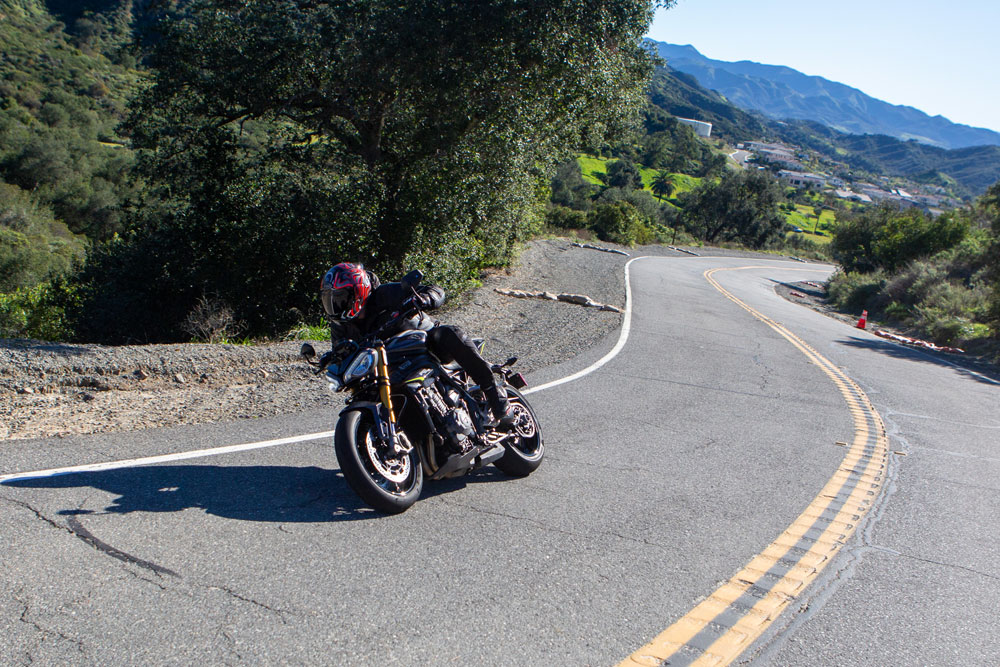
Select Track mode, and it’s game on. The throttle response is at its most direct; the suspension auto-corrects itself to the stiffest semi-active setting, and the only limits are those imposed by the government and your own willingness to push them. The only thing that separates the RS from a proper superbike at this point is the lack of a fairing and its one-piece handlebars.
As you’d expect for a bike costing just north of $21K, the electronics come with everything you’d want in a high-end ride: those riding modes are matched to a six-axis IMU that monitors cornering ABS and switchable traction control, and the Triumph up-and-down quickshifter. In the Track-only mode, you get Brake Slide Assist, which allows more front-wheel slip and more rear-wheel lift to maximize performance on track. There’s also wheelie control and engine-brake control, but where the RS really shines is in the fitment of the Öhlins SmartEC3 semi-active suspension.
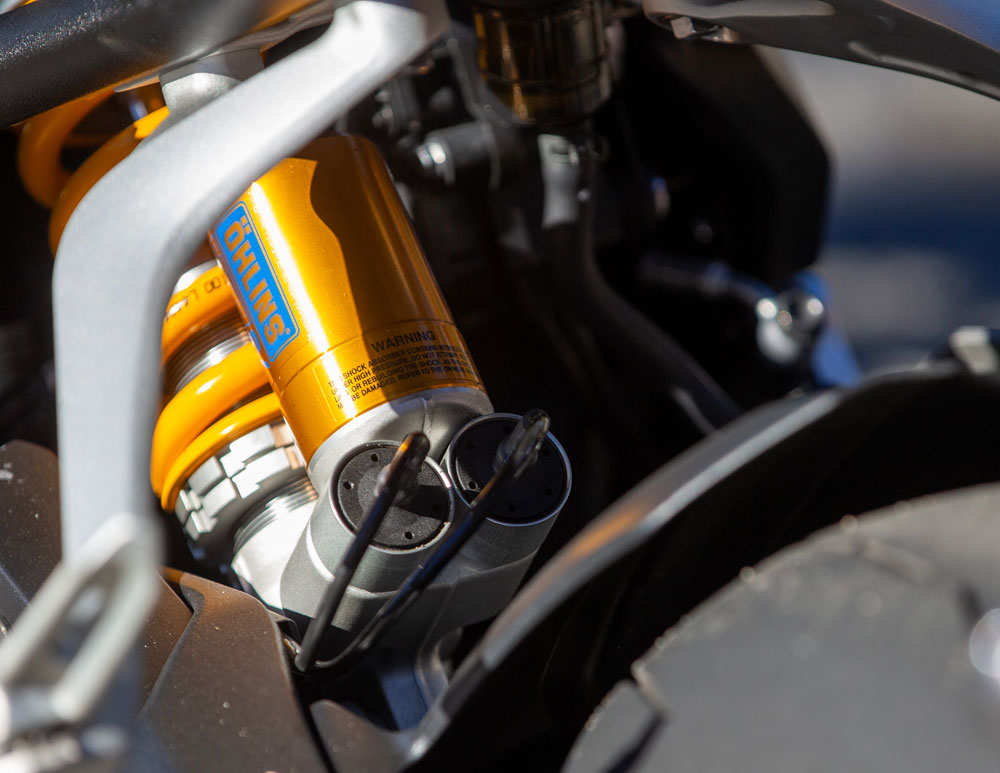
We’ve harped on in the past about how different ride modes give a bike different personalities, but looking back on some of those tests, we may have been a little ahead of ourselves. Put simply, the EC3 system really does turn the RS into one of a few different rides and fundamentally changes how the bike behaves across different roads and riding styles. The system continuously adjusts damping in the background, reacting to braking forces, throttle input and road surface in real time.
This is the same system (albeit tuned for the RS) that resides in the Ducati Panigale V4 S and Streetfighter V4 S, the Honda CBR1000RR-R SP, and the new Aprilia RSV4 Factory, so the RS is in fine company.
On rough pavement, tune the RS into Road mode, and the chassis remains composed and compliant, taking the sting out of square-edged bumps that would normally hurt it and you. Crank up to Sport mode, ride a little harder, and the suspension firms up seamlessly, offering excellent support without ever feeling wooden or artificial. The transition between comfort and control is smooth enough that you stop thinking about it entirely, which is exactly the point.
This is exactly how I felt after my first ride on the EC3 system on the Panigale in 2024. It is far and away the best electronic suspension system I’ve ever ridden, and on the Panigale, I’d have no issues fronting up to the grid in a superbike race with it.
The EC3’s adaptability gives the RS a wider operating window than most bikes in the class. It’s comfortable enough for long stints on the street, yet controlled and precise when ridden aggressively, which is a very difficult balance to strike.
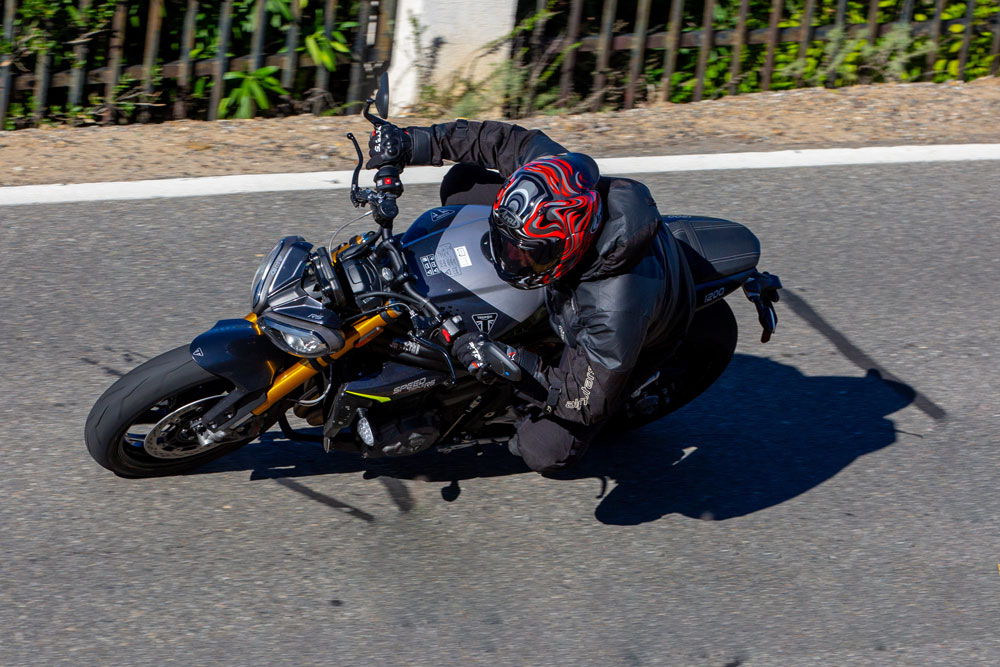
The chassis complements the suspension perfectly. The lightweight aluminum frame and revised geometry give the RS quick steering without sacrificing stability. Turn-in is decisively fast thanks to the fitment of Pirelli’s Supercorsa SPs, allowing the RS to hold its line easily as you feed the power back in. There’s no sense of nervousness at speed, and the RS feels planted even when pushed hard through fast, flowing corners.
You’re seated quite high on the chassis at 32.4 inches, so direction changes require minimal effort, and the RS never feels like it’s working against you. It’s an intuitive ride, one that encourages confidence rather than demanding it. In that realm, it’s decidedly more approachable than the Streetfighter V4 S, which, as the name suggests, has a fair bit of attitude to its character.
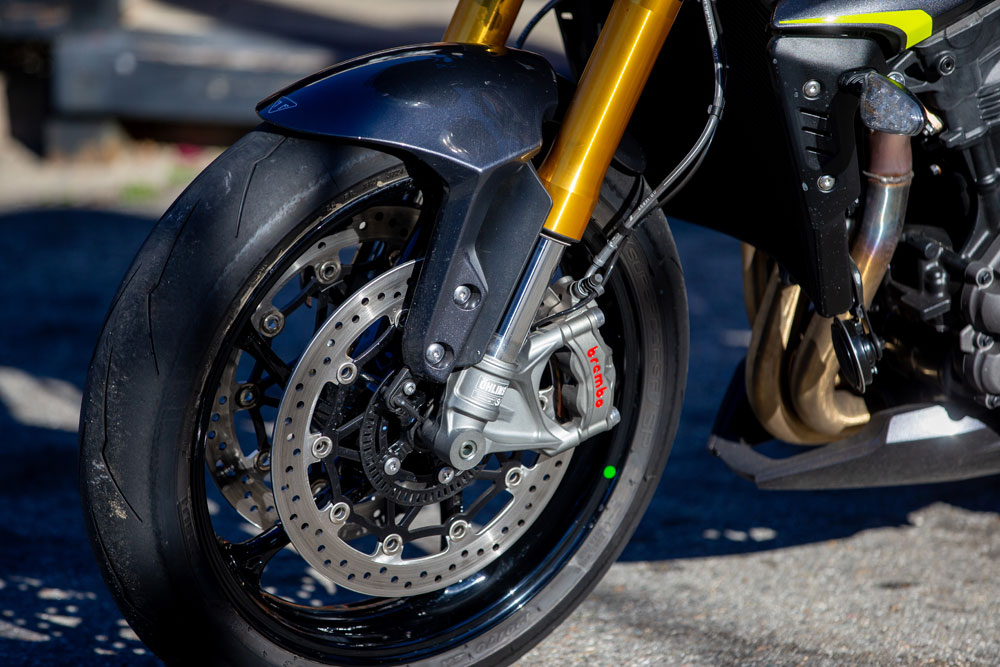
An unsurprising factor of the RS’s performance is in braking. Brembo Stylemas (not the new Hypure calipers found on the Panigale and Streetfighter), matched to a Brembo MCS master cylinder and 320mm discs, offer train-stopping levels of braking performance. You’ve got cornering ABS working in the background in any case, so if you lose the front-end, you’ve probably messed up rather badly. The brakes work so well they’re almost boring.
The electronics package is comprehensive but well executed. Traction control operates smoothly in the background, stepping in only when necessary and without upsetting the chassis. Wheelie control and engine-brake management add another layer of refinement, particularly when riding hard. Crucially, the rider aids didn’t feel like they were dictating the experience. They’re there if you need them, and mostly invisible when you don’t.
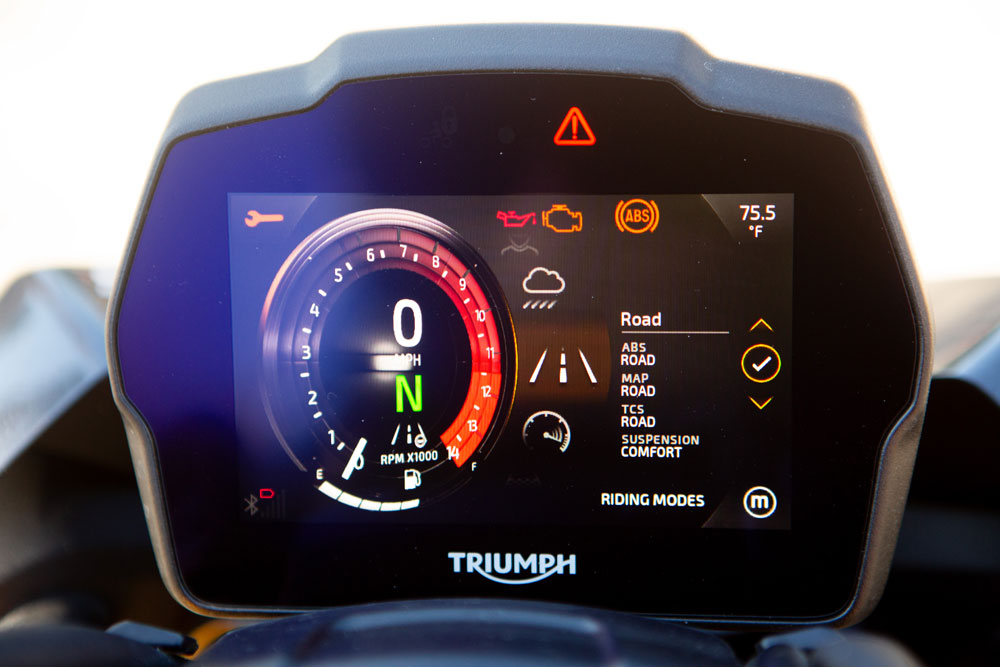
The TFT display gets the job done without fanfare. It’s clear and readable, with all the essential information easy to find at a glance, but it isn’t the prettiest of dashes. Menu navigation isn’t class-leading, and I’ll admit to never being fully comfortable with it when I had the RS in the garage. With the level of info at a rider’s fingertips and every manufacturer doing their dashes differently, it’s nearly impossible to make every rider happy. I’m sure with more time, I’d get the hang of the dash, but it was one of the weak points in the ride experience.
Ergonomically, the Speed Triple RS strikes a smart middle ground. The riding position is sporty without being extreme, placing the rider in a commanding stance that works well at both low and high speeds. The bars provide good leverage, making tight maneuvers easy while maintaining stability on faster roads. Seat comfort, however, could be better. It’s a hard cushion, and when you match it to the harder suspension settings, the ride isn’t that comfortable. If an RS ever found its way into a permanent spot in my garage, a trip to Saddlemen for a custom seat would be at the top of the priority list.
Wind protection is non-existent as expected, but the RS remains perfectly stable at highway speeds. There’s no excessive buffeting or wandering, and the chassis feels solid even when dealing with crosswinds or turbulent air. It’s not a touring bike, but it doesn’t punish you for longer rides, either.
The RS’s styling continues to walk the line between aggressive and restrained. The twin-headlight design remains unmistakably Speed Triple, updated with modern LED lighting that enhances both aesthetics and functionality. But the fit and finish on the RS is excellent. It looks like what it is: a flagship naked bike held to a high standard.
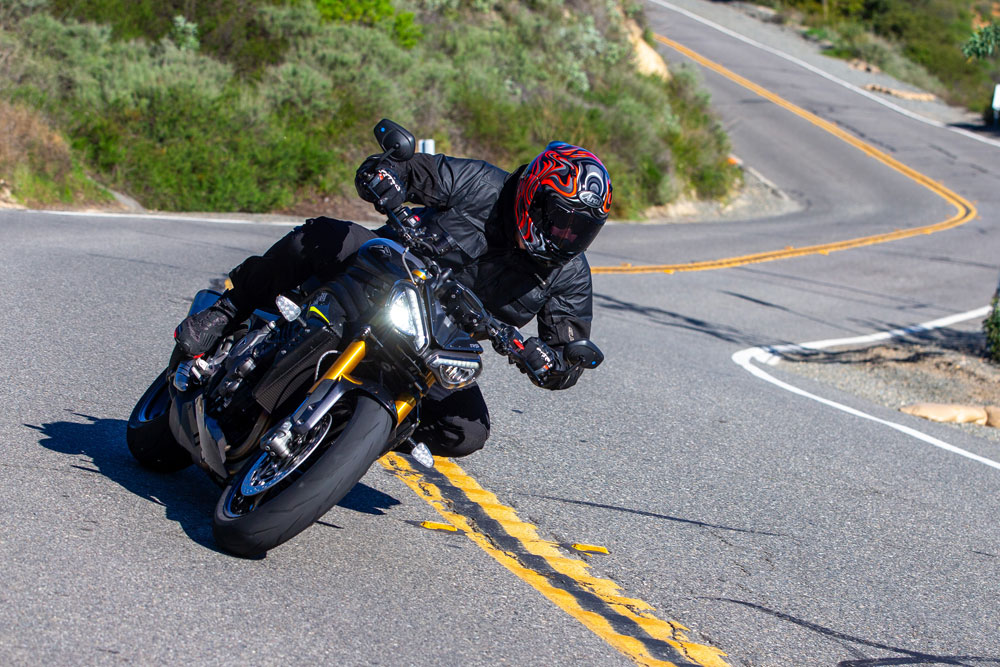
As an everyday ride, the RS is about as extreme a naked bike as I’d want these days, and it’s right at that edge of being a little too extreme. It’s easy enough to live with day to day thanks to its smooth and beefy engine, sparky suspension and relatively comfortable ergos, and at the same time, it has the performance and composure to deliver serious jollies when the road opens up. I’m just a touch sad I didn’t get to take the RS to the track.
The 2026 Triumph Speed Triple 1200 RS feels cohesive and deeply sorted. The model has been around for so long now, and it feels like it’s really matured in 2026.
It’s fast, refined and engaging, yet approachable and usable. That combination is harder to achieve than it looks, and Triumph deserves credit for getting it right.CN
VIDEO | 2026 Triumph Speed Triple 1200 RS First Ride

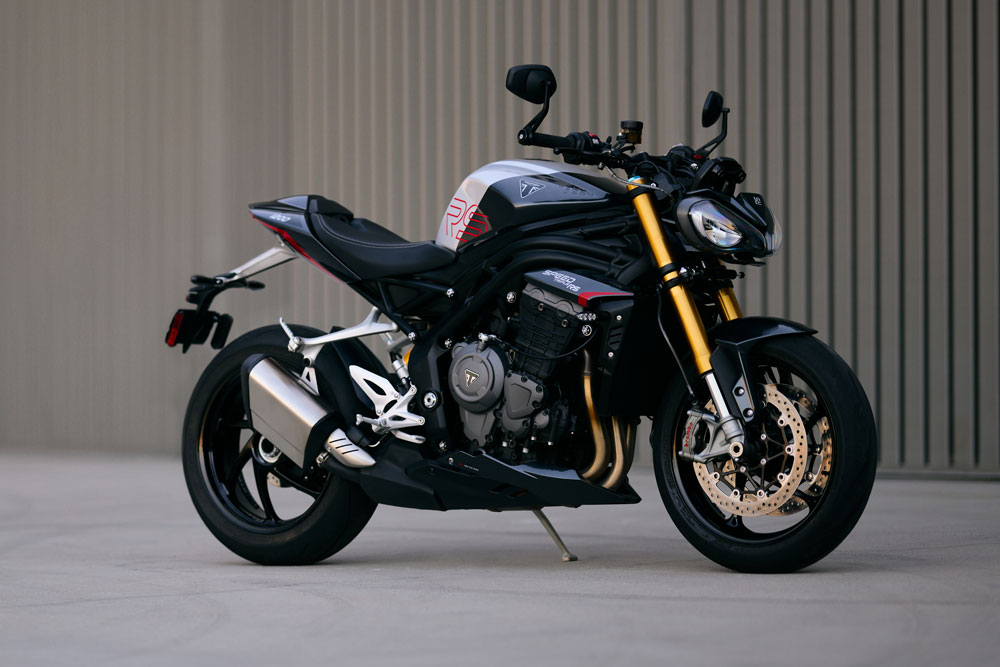
2026 Triumph Speed Triple 1200 RS Specifications
| MSRP | $21,095 |
| Engine | Inline three-cylinder, four-stroke |
| Valvetrain | DOHC, 12-valve |
| Cooling System | Liquid-cooled |
| Displacement | 1160cc |
| Bore x Stroke | 90 x 60.8mm |
| Compression Ratio | 13.2:1 |
| Max Power (claimed) | 180.5 hp @ 10,750rpm |
| Max Torque (claimed) | 94 lb-ft @ 8750 rpm |
| Fuel System | Bosch Multipoint sequential EFI; electronic throttle control, ride-by-wire |
| Exhaust | 3-1 |
| Transmission | 6-speed |
| Electronics | Rider Modes: Rain, Road, Sport, Track, plus two Rider modes. Cornering ABS, 4 throttle maps, 5 traction control, 4 engine-brake control, and 4 front-wheel lift control maps |
| Chassis | Aluminum twin spar, bolt-on aluminum rear subframe |
| Front Suspension | Öhlins SmartEC3 semi-active, 43mm NIX 30 inverted fork, fully adjustable |
| Rear Suspension | Öhlins SmartEC3 semi-active, TTX 36 twin-tube monoshock, fully adjustable |
| Front-Wheel Travel | 4.7 in. |
| Rear-Wheel Travel | 4.7 in. |
| Front Brake | Dual four-piston Brembo Stylema radial-mount calipers, 320mm discs w/ ABS |
| Rear Brake | 2-piston caliper, 220mm disc w/ABS |
| Front Tire | Pirelli Diablo Supercorsa SP V3, 120/70 ZR17 in. |
| Rear Tire | Pirelli Diablo Supercorsa SP V3, 190/55 ZR17 in. |
| Rake | 23.9° |
| Trail | 4.1 in. |
| Wheelbase | 56.4 in. |
| Seat Height | 32.4 in. |
| Fuel Capacity | 4.1 gal. |
| Weight (wet, claimed) | 438.7 lbs. |
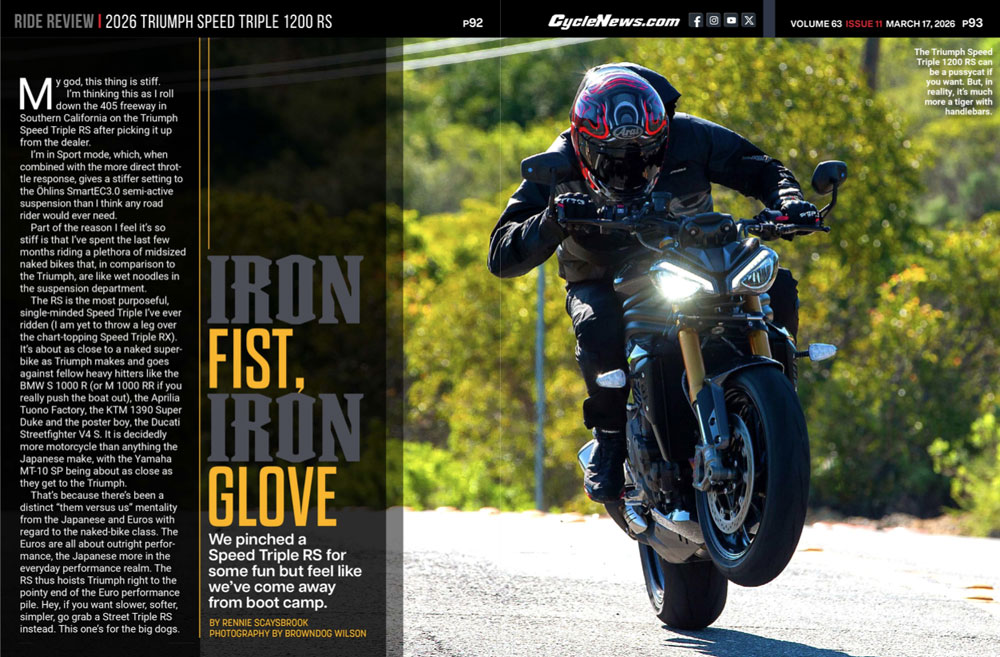
Click here to read the 2026 Triumph Speed Triple 1200 RS Review in the Cycle News Digital Edition Magazine.