Cycle News Archives
COLUMN
Privateers vs. Factory Racers
By Kent Taylor
Mankind’s seven ages of life were laid despairingly bare when William Shakespeare opined that “all the world’s a stage and all the men and women merely players. They have their exits and their entrances.” The infant in the nurse’s arms becomes the soldier, “sudden and quick in quarrel,” who eventually enters the end-of-life days of dotage, “sans teeth, sans eyes, sans taste, sans everything.”
The AMA’s 1983 road race season, were it a stage production, would’ve given the audience a broad range of performances from the racers and the motorcycles, with all ages of both bikes and men represented. There were rising stars and veterans whose careers were waning like last night’s full moon. Some of the machines on which they rode might’ve belonged on a museum floor, while others were fresh from the R&D board. As a subplot in this play, a feisty privateer combo teamed up to give the factory boys a taste of their own medicine.
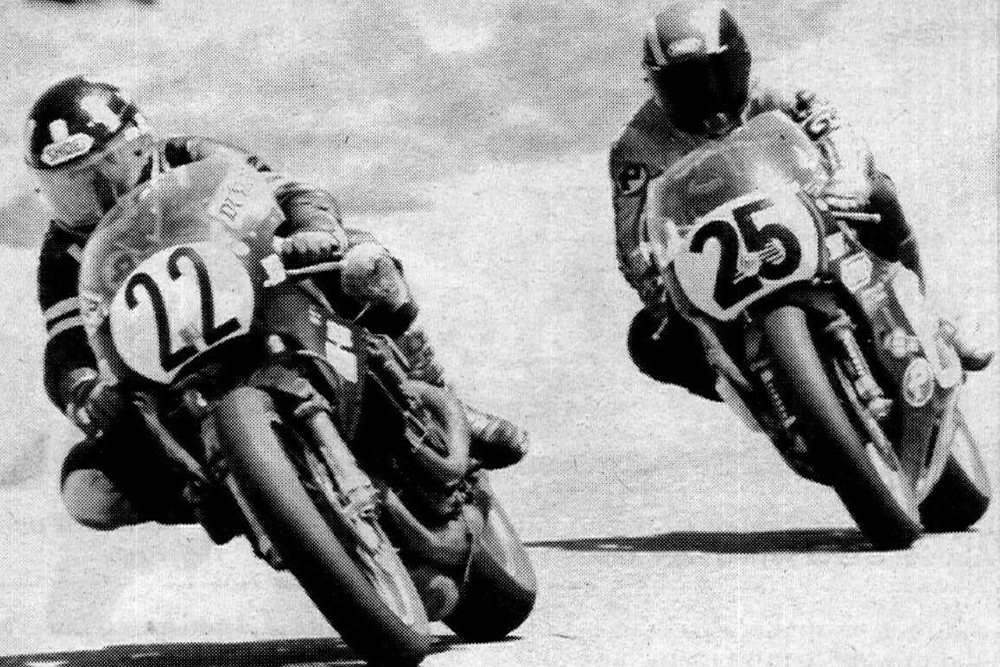
Racing’s Grand National Championship this season still included results from both dirt track and road racing events, but one wouldn’t have known it by looking at the current points standings and race-day results. The Grand National standings included many dirt trackers who were certainly competent road racers, like Jay Springsteen, Bubba Shobert and Gary Scott, yet none of whom would show up in the top 20 results this day. On the flipside, of the top finishers in the Laguna Seca final, Kenny Roberts, Eddie Lawson and David Aldana had plenty of experience as flat trackers, but, for various reasons, weren’t showing up in the Grand National points battle. In 1983, the race for the number-one plate was going to be decided by Class C competitors; the new, less-prestigious title of U.S. Road Racing Champion was also in play.
An impressive crowd of 70,000 fans showed up in Monterey that weekend to watch some of the best road racers in the world (who just happened to be Americans) do battle on the legendary racetrack. “A new format was instituted for this event,” wrote Cycle News, “with a timed qualifying session to select the fastest 25 riders for the feature event. The remainder of the 45-rider field raced in a 10-lap consolation race with its own $3000 purse.”
No doubt many of these fans showed up to see Roberts, a three-time World Champion and two-time AMA champion, work his magic at Laguna Seca, a track where he had notched several wins. Roberts would be riding his Yamaha OW69 square-four, the same bike that he had used to win at Daytona in March of that same year. “The King” qualified fastest, cutting a record lap that was nearly a full half-second faster than his Yamaha teammate, Eddie Lawson. Suzuki rider Randy Mamola was third fastest. The top three competitors were 500cc Grand Prix competitors, with the first stateside rider, Mike Baldwin, sitting fourth in qualifying. Baldwin, injured and riding to keep alive his hopes of the AMA Road Racing title, was onboard a Honda RS 500 and nearly two seconds slower per lap than Roberts.
The race would be run in two legs, just like a motocross race, with the combined results determining an overall. The pro-Roberts crowd must’ve let out a collective groan when Kenny’s race ended just a few feet after the start. The Yamaha’s tall gearing had been perfect for Daytona’s speedway, but the larger rear sprocket fitted for this road course resulted in an abrupt delivery of power so violent that it actually snapped the chain adjuster. The axle slid, the drive chain popped off, and Roberts was out of the first leg.
With the pre-race favorite out, it was next man up, with Lawson moving into second, where he began to pressure Mamola for the lead. It would take him 15 laps to find an opening and take over first—briefly. Three laps later, Mamola passed him back, and the two began a dogfight that would see them lap up to seventh-place man, David Aldana. Aldana had ridden a BSA to an AMA win 13 years earlier. Today, more than a decade after the demise of BSA, he was aboard Mamola’s backup Honda Grand Prix machine.
The first leg ended with Mamola holding off Lawson, with Mike Baldwin in a heroic effort (his surgically repaired wrist bringing him intense pain) bringing it home in third.
When the flag fell for the second leg, the Grand Prix stars were out in front and pulling away quickly, so much so that they even began to mock their stateside peers. First Roberts, then Mamola, pulled a wheelie on the long start straight. “They did it again at the end of the second lap,” wrote CN, “and as a result, Lawson streaked by both of them and into the lead.
“Later, when reporters asked about the wheelies and the power characteristics of the machine, Roberts quipped, ‘Riding one of these things is like flying an airplane through an outhouse. All you can do is point it.’ ”
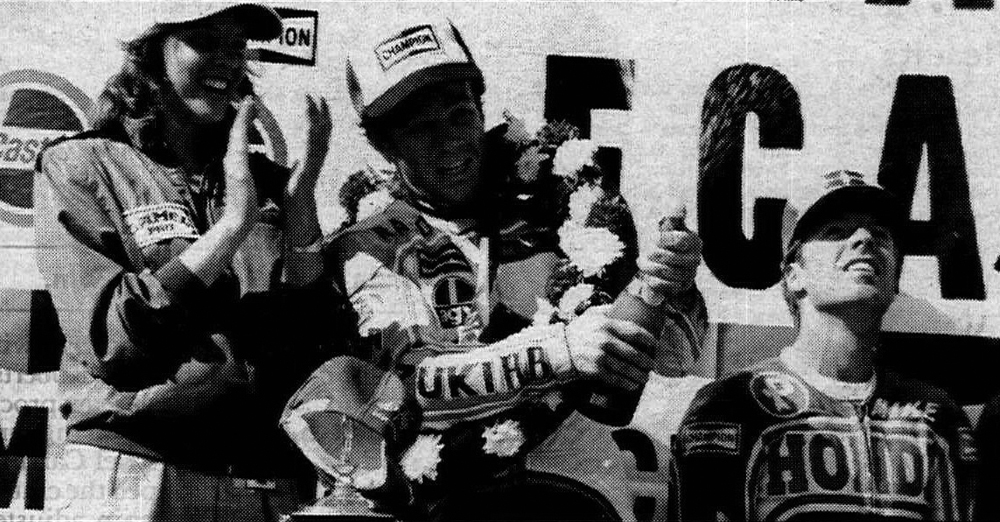
Keeping the motorcycle on two wheels appeared to be the right strategy for Eddie Lawson, who was pulling away from the pack. His 2-1 combo would’ve given him the overall win, but on lap 12, his Yamaha suffered the same chain-adjuster issue that had sidelined Roberts in the first leg. With Lawson out of the race, Roberts took the win over Mamola, whose 1-2 score gave him the overall win for the day.
Well behind the leaders, a couple of little-known racers were joining forces to beat the high-dollar factory teams at their own game. Miles Baldwin and Nicky Richichi, both privateer riders who were mounted on ’70s-era Yamaha TZ 750s, had made a pact. If Baldwin, who was in the running for the road-race title, came up on Richichi, who was not, Richichi would slow to allow Baldwin to slip by and secure precious points toward the title.
“We’re both privateers who don’t have a lot of support,” said Baldwin. “We have a lot in common, and we work to help each other.” Alas, not every stage production can perfectly follow the script, and it would ultimately be Mike, not Miles, Baldwin capturing the 1983 Road Racing Championship.
In the 1970s and ’80s, the progression of motorcycle road racing in America zigzagged across a map of technology and talent. Four-strokes gave way to two-strokes, and journeymen racers moved aside for full-time professionals. Forty-two years ago, there were exits and entrances of both men and motorcycles, all sharing the same stage at Laguna Seca. Merely players? Only in the eyes of those sans brains. CN
Click here to read the Archives Column in the Cycle News Digital Edition Magazine.
Subscribe to six decades of Cycle News Archive issues
Click here for all the latest Road Racing news.