Cycle News Archives
COLUMN
Brothers From The Same Mother
By Kent Taylor
There are some words in the world that just don’t translate very well from their mother tongue to English. The French, for example, use the phrase “jolie laide,” which literally translates to English as “pretty ugly.” But the French use it as a term of endearment, as in, “The mademoiselle resembled le Carrot Top, yet she possessed a jolie-laide charm that made her inexplicably desirable.” !
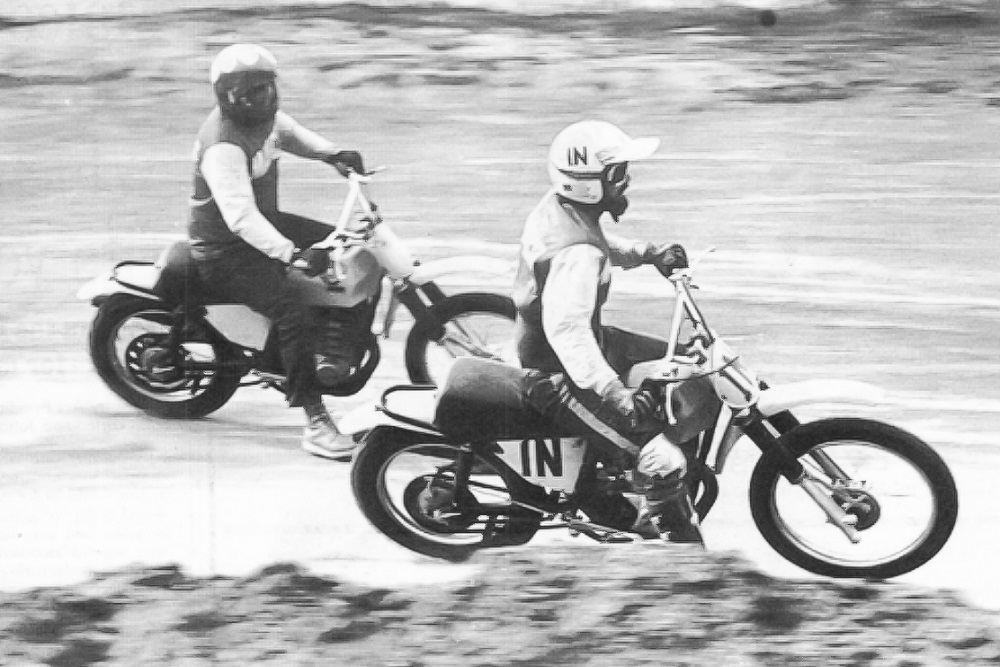
“Achtung” is the headline of the February 19, 1974, issue of Cycle News. More familiar to Americans, the word can mean everything from “attention” to “be cautious” to “danger.” The dirt test that followed featured two new Maicos, the 400cc and 450cc open-class MX warriors. Brothers from the same mother, separated by a few cubic centimeters and little else. Germany’s Irish twins, in a motorcycle way. Dangerously fast, so one must be cautious with throttle control. Please pay attention.
“Why would one of the smallest competition motorcycle factories in the world make two bikes that would compete against each other in sales and on the racetrack?” That was the opening line for the test, and the crew had a good point. A motorcycle manufacturer of the 21st century will often square off against itself, offering virtually the same powerplant across many different models. It was a different story in 1974. There was one Honda 750. One Kawasaki 500. One Rokon.
But there were two Maicos in the open class, separated by a few cubic centimeters and a few bucks. More alike than different, parking these Maicos with their long-as-a-crowbar sidestands was a brain teaser. Find seven differences? Nope. Check the specifications, and 10 of the 14 categories read “same.” Only the displacement, bore and stroke, claimed horsepower and price tags differentiate the two machines. Which one do you choose? Stand by!
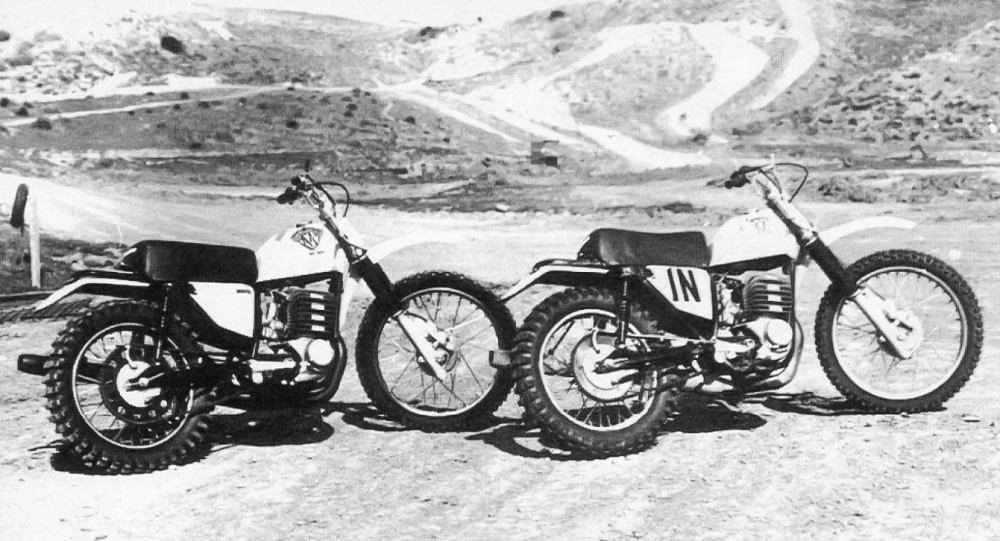
In the old days, motorcycle engineers were still searching for the magical formula for the correct frame geometry. Companies like Cheney, C&J and Boyd & Stelling were making aftermarket frames for many race bikes. There were aftermarket forks as well, and many Japanese machines were modded with these pricey parts. But for the Maico? Nein!
“The 500-class Maicos offer the best stock suspension of any motocross machine in the class,” wrote CN. “The performance of Maico front forks is already near-legendary. It really is that good…a front end that looks like no other. It also works like no other.” That crackerjack front fork, combined with the dependable Girling shocks in the rear, helped make these Maicos race-ready. Connecting the two ends was a frame that made aftermarket shopping unnecessary. “The Maicos also share the most forgiving, best-handling, stock chassis/swingarm combination in the business.”
Obviously, with the same chassis, the 400 and the 450 would share handling characteristics. The engines were going to separate these two machines, and the staffers found that the 400 was, in an odd way, the faster of the German brothers.
“This article is building up into a fantastic paradox: the 450 is probably the quickest thing around for motocross and has the same chassis and suspension.” Yet somehow “…the 400 is faster. You have to rev it more and keep it revved so, once you figure this out, you’re more likely to be near peak horsepower most of the time.” Conversely, “The 450 doesn’t require you to rev it at all to get going fast; it’s always there. It never comes on the pipe because it feels like it never falls off the pipe.”
The crew pointed out that Maico’s Grand Prix riders, Adolf Weil and Ake Jonsson, preferred the smaller machine. Here in the U.S., specifically California, one local rider saw it differently.
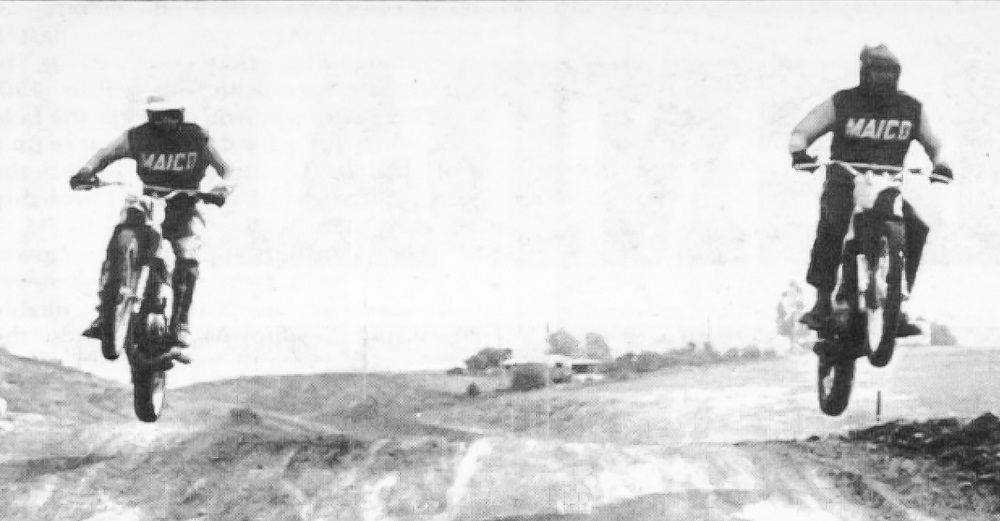
“I rode a Maico 450 and liked it a lot,” said longtime CMC star Val Tamietti. “It had a lot of torque. Then, they wanted me to ride the 400 instead of the 450. I never liked that bike, just because it didn’t have that bottom-end torque. The Maico worked well in hard-packed, blue-groove conditions, which is what I rode all the time, at places like Carlsbad and Saddleback.”
$1498 was the MSRP for the 400, and one more Ben Franklin would get you the 450 from your local Maico dealer. Eventually, the factory settled on just one open bike, though its displacement would vary from 440 to 450 to 490cc. There were many Maicos, and then there were none, as the company fell victim to bitter infighting and purposeful destruction.
But in 1974, Maicos were winning motocross races in the big-bike class, and they were doing it with a utilitarian style. “When you’re riding a Maico, your concern for the smoothness of the finish is non-existent. They are not show bikes; they are motocross racers.” Maicos are still popular mounts at vintage races. All these years later, a certain je ne sais quoi makes them “jolie laide” today.CN
Click here to read the Archives Column in the Cycle News Digital Edition Magazine.
Subscribe to six decades of Cycle News Archive issues