Cycle News In The Paddock
COLUMN
Track Idol | MotoGP’s New Reality TV
“If you don’t go forward, you take a step backwards.” Articulated by IRTA president Herve Poncharal, this was the three-strong mantra from the stage, as Dorna, the FIM and IRTA joined forces to announce a sea change in the World Championship.
The step forward?
A Saturday afternoon Sprint Race at every grand prix weekend, starting next year.
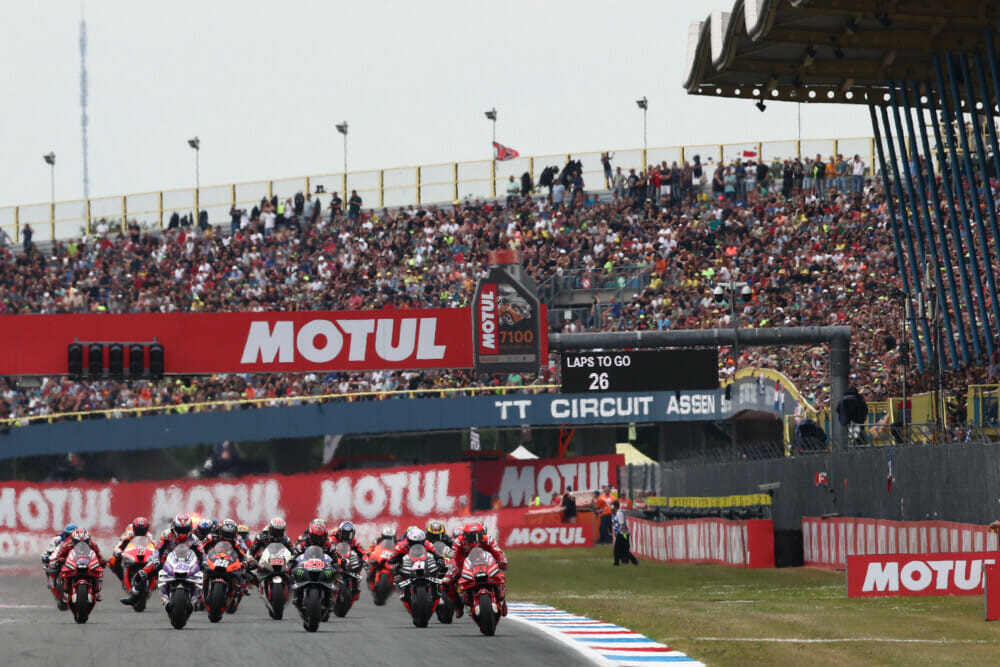
The need for this step? An accumulation of problems, some in themselves fairly minor, that have put MotoGP on the back foot, after a long spell of booming health.
Some are of Dorna’s own making—increasing paywalls for live TV coverage have hit viewing figures badly in important markets, while this year’s Amazon documentary intended to emulate F1’s super-popular “Drive to Survive” has flopped.
Others are circumstantial. Rossi’s departure has hurt. His merchandise still sells and yellow-clad fans are still at races, living in the past. Crowd numbers at Mugello’s Italian GP were 43,600-odd on race Sunday—40,000 down on 2019, 55,000 fewer than in 2017.
The absence of Marc Marquez has added to this effect, with the best in the world—Quartararo, Bagnaia and Bastianini—lacking the same sort of star quality.
Add processional racing with little overtaking and the phrase “perfect storm” comes to mind. Thus the decision for an extra Saturday race smacks of some desperation.
Actually an extra half race. The Sprint Race will run over half distance, and carrying half points.
Will it be half as popular?
Reactions inside the paddock were mixed. But some initial hostility softened overnight, with Fabio Quartararo one who, when he learned more details, went from calling it “stupid” to saying “I changed my mind.”
Those in favor, and there were more than just the three bosses at the conference table, were confident it would increase MotoGP’s appeal.
A step closer, said Dorna Chief Carmelo Ezpeleta, not only reinforcing MotoGP as the most exciting motor sport in the world, but also making it the most popular. A statement unlikely to have Formula 1 bosses biting their nails.
It would give TV stations something more important on Saturday afternoons, and swell ticket sales.
If racing success is measured only by these factors, then the enthusiasm of its promoters is understandable.
Likewise, the dismay of traditionalist detractors. For them, a shorter Saturday race dilutes the value of the pinnacle of motorcycle racing’s main event on Sunday. A matinee that undermines the big show.
Other objections raised the increased danger of double the number of races, especially racing starts, each year, and further loss of practice time for engineering development and rider skills (the race will take the place of one full practice session, so there is no extra distance or track time entailed).
More importantly, many suggested this was a sticking plaster on a broken bone—window-dressing that, instead of solving problems, is just another step in turning MotoGP into soap opera. Or reality TV show.
A sort of Strictly Come Racing or Track Idol … although without giving the fans a chance to vote on who will win.
To be sure, there are positive aspects to a high-intensity sprint—pure flat-out racing without having to save tires, energy or fuel. Could be a lot of fun.
The Sprint also offers a rider who suffers a crash or a mechanical problem the chance not to come away with zero points for the weekend. On the other hand, an injury could mean losing 37 (25 plus 12) points instead of just 25.
Similar things happen elsewhere. In WorldSBK, there’s the Sunday morning Superpole race, a ten-lap sprint, also carrying half points.
To be sure, there are positive aspects to a high-intensity sprint—pure flat-out racing without having to save tires, energy or fuel. Could be a lot of fun.
In Formula 1, at three races, 100km dashes—with no mandatory tire changes and pit stops, this is a refreshing change from the long and often convoluted tactical full races.
In both cases, these races determine grid positions.
This won’t happen here, thanks very much. Ezpeleta and his cohorts were at pains to stress that MotoGP had not taken its inspiration from Superbikes or F1.
If this smacks of arrogance—a charge that fits the bombastic Dorna chief rather well—it is not in a good way. Using a sprint race to determine grid positions might not actually be a bad idea at all. Especially if that is its main purpose, rather than carrying reduced championship points or a bogus GP win.
Riders already complain that the first three free practices are basically high-risk flat-out qualifying sessions rather than a chance to refine techniques and bike settings, since with overtaking so difficult where you start is often also where you finish. (Then again, how would you determine grid slots for the sprint?)
It is true that something needed to be done. Popular or not, this is just the first of a raft of promised changes, yet to be announced. Window-dressing has never been more timely. CN
Click here to read the In The Paddock Column in the Cycle News Digital Edition Magazine.
Click here for all the latest MotoGP news.