Cycle News In The Paddock
COLUMN
Unnecessarily Fast, or Unnecessarily Dangerous?
“The bigger they are, the harder they fall.” This truism comes from boxing but applies to all walks of life. Innovative MotoGP superstar Marc Marquez, however, adds a new twist.
“The faster they are, the more often they fall.”
It’s easy to make light of crashing when you crash as often as he does. He even joked at round one in Qatar that he obviously wasn’t back to his full form “because I only fell off once.”
His fifth crash of the new season, on the morning of the Indonesian GP, was far from humorous: a very fast and very brutal high side that left him visibly dazed and ruled him out of the race.
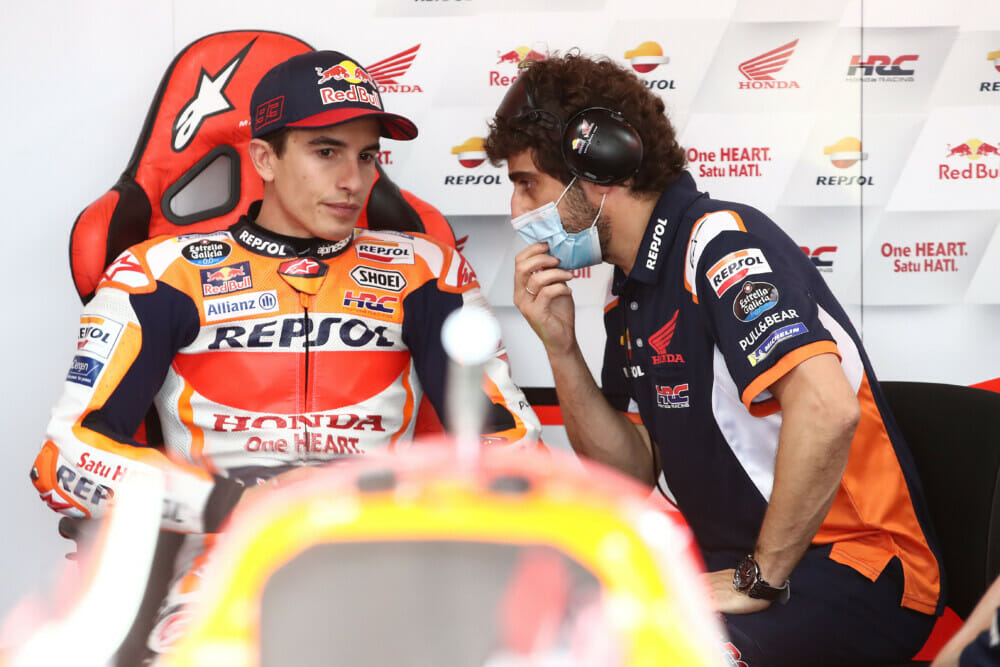
Photo by Gold & Goose / Courtesy of Red Bull Content Pool
Worse followed. The concussion diagnosed on the day became more complicated, with vision problems recurring on the flight home. Back in Spain and straight to the specialist, and he was diagnosed with a return of the double-vision syndrome that struck last year, ruling him out of two races and leading to a second successive winter of recuperation.
The same problem almost ended his career back in Moto2 days in 2011. The threat remains.
But why should a rider of such manifest genius crash so often? Five times in the first two races!
Pushing over the limit has always been his way of finding out exactly where it is, and he does it better than any other rider in history. So even after having missed a full 2020 season and much of 2021 after his seriously broken arm at Jerez, he could still make light of it. That was, after all, his first significant fracture in more than 10 years of GP racing and a huge number of falls.
Certainly, it didn’t change his crash-happy policy. Last year, Marc missed four of the 18 races, but still recorded more falls than any other rider—a resounding 26. More even than Kaito Toba’s 21 in Moto3, where riders are apparently so risk-prone— according to the panel of stewards, that they need constant disciplining because of dangerous riding.
Marc’s five so far already leads on numbers in 2022. And at Mandalika on Sunday morning his fourth fall of the weekend was a real high-speed heart-in-the-mouth bone-cruncher. An old-fashioned high-side reminiscent of the oft-tarnished golden age of unruly 500cc two-strokes and slip-grip tires.
But why should a rider of such manifest genius crash so often? Five times in the first two races!
Another headstrong crash, another episode of refusing to heed the warnings, raises an uncomfortable question. Just how long can this carry on? At what point does his inner voice change its tune?
Many years ago, I was castigated (indeed, never forgiven) for suggesting that Mick Doohan’s career-ending crash in practice at Jerez was the consequence of pushing too hard in iffy conditions when there was no tangible reward. The weather was due to improve the next day, and as a result, lap times would matter for qualifying.
Perhaps injudiciously, I wrote he had been going “unnecessarily fast.” He took exception, and the phrase that has haunted me ever since.
Yet the same phrase applied last Sunday. Nobody knew the race in the afternoon would be wet anyway, rendering dry-track time irrelevant. But even so, going for bragging rights in morning warm-up was both figuratively and literally pointless. Marc was already a close second-fastest. He crashed trying to go one better.
This on a weekend when it was abundantly clear that Michelin’s curve-ball hard rear tire meant all Honda riders were at a disadvantage that such heroics could mitigate only slightly, if at all.
But to Marquez (as to Doohan) the concept of “unnecessarily fast” simply doesn’t exist. To coin another phrase from the Australian super-star, when taxed with the fact that his dominance was stultifying: “What do you want me to do? Slow down?”
Marquez, likewise, no matter the agony he’s endured for the past two years, he’s not willing to accept any limits to his unstoppable urge to be fastest. Even in morning warm-up.
This is why we admire them. At the same time, nobody wants to have to pity them.
Contrast Marquez with Valentino Rossi, also precociously talented, but who prolonged his career almost indefinitely by taking the opposite approach, minimizing the risk.
At Brno several years ago, Marc survived the most extraordinary moment—the front skating away, the bike crashing, but the rider picking it up again onto its tires with his knee and elbow. A technique of crashing without crashing that would become increasingly familiar, even a trademark.
That afternoon I asked Rossi if he could achieve the same feat. He spoke analytically about Marc’s different body position and riding technique, then continued with a laugh, “I think it is better to don’t lose the front.”
Hopefully, Marc will be back. Hopefully the double-vision will dissipate. Will he now add some career-enhancing caution to his all-or-nothing approach?
Almost certainly not. Fingers crossed that his luck continues to hold.CN
Click here to read the In The Paddock Column in the Cycle News Digital Edition Magazine.
Click here for all the latest MotoGP news.

