Cycle News Archives
COLUMN
This Cycle News Archives Column is reprinted from August 20, 2008 issue. CN has hundreds of past Archives columns in our files, too many destined to be archives themselves. So, to prevent that from happening, in the future, we will be revisiting past Archives articles while still planning to keep fresh ones coming down the road -Editor.
The Anonymous Champion
Franco Uncini, the dark-horse champion of the 1982 500cc Grand Prix World Championship, was perhaps one of the least-known GP champs of his era. To Americans, he, and Marco Lucchinelli, who’d won the title the year before, were little more than the short Italian interval between “King Kenny” and “Fast Freddie.”
Uncini was a hero to many because he thumbed his nose at what he perceived as lowball offers by factory teams and ran his own GP effort funded by his wealthy family—who, incidentally, tried like hell to keep him from racing motorcycles in the first place. Yet, once they understood that young Franco was going to race no matter what, they got behind him 100 percent.
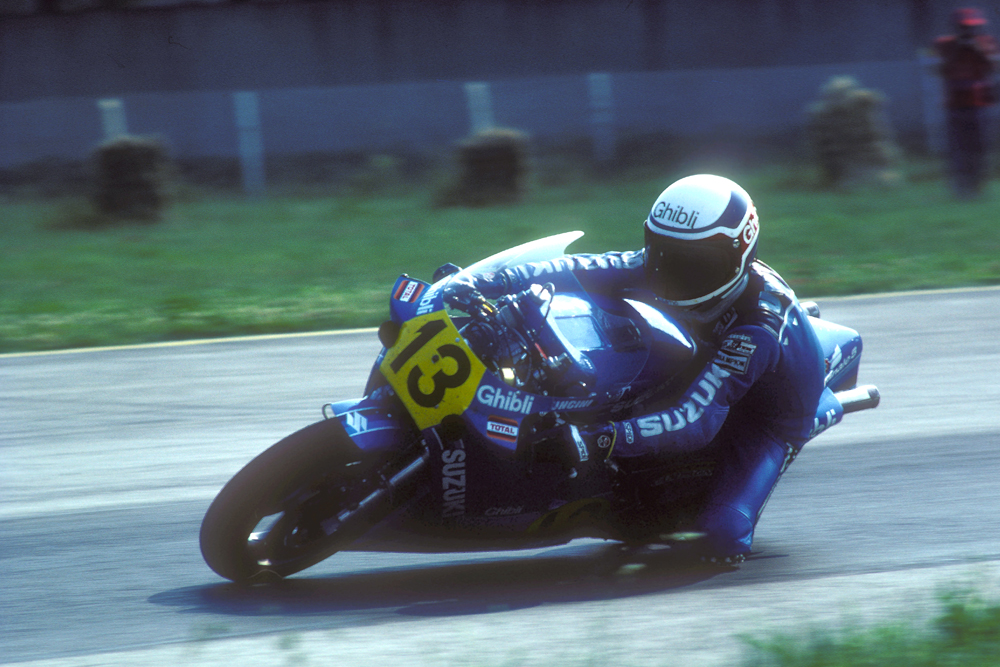
Even today, little is known about Uncini, and that’s a shame, because he had one of the most colorful, drama-filled careers in motorcycle Grand Prix racing. It’s ironic that Uncini was anonymous in America, especially considering he once road-raced as a factory Harley-Davidson rider, wearing the same black-and-orange leathers donned by Jay Springsteen and Corky Keener. Furthermore, Uncini survived two of the most gruesome crashes in GP history (one of them can be seen on YouTube if you’re not too squeamish). Also, he was the last Italian to win the world title before Valentino Rossi, and behind the scenes he quietly went about changing the face of motorcycle grand prix racing, helping to make the tracks infinitely safer for the generations of racers to follow.
From all accounts, Uncini had a nearly idyllic upbringing. His family owned an international electronics firm that produced electronic keyboards. Ennio Uncini enjoyed helping his sons Franco and Henry dive into whatever whimsical pastimes they decided to pursue, and there were many. Dad thought nothing of it when the boys took up go-kart racing; it was just another passing phase. Then Franco began to play around on two wheels. At first it was a 50cc scooter, at age 14. Then, a year later, it was a 125. And by the time he had his license, it was a 750cc Laverda, and Franco announced to the family he was going to race.
In bringing up their boys, Ennio and Antonia Uncini allowed them to pursue their wishes, but this was too much. Like any good parents, they protested, threatened, and even bribed Franco in an effort to change his mind, but when they realized he would not be deterred, the family backed him both emotionally and financially.
As it turned out, Franco was a natural on a motorcycle. At 19, he dazzled everyone with his performance on a Laverda SFC in Italian Production racing. After his first full season of racing, in 1975, Ducati offered Uncini a factory ride. A year later, in addition to his domestic racing duties, Uncini began to dabble in the Grand Prix. In 1976, riding a private Yamaha, he raced three times and scored two podium finishes in the 350cc class. So promising were his performances on the world stage that he fielded not one, but two factory offers for the 1977 season: One was with the Aermachi Harley-Davidson team, to be junior teammate to Italian racing hero Walter Villa; the other and considerably more prestigious offer was to be part of Roberto Gallina’s Suzuki quasi-factory squad in the 500cc class. Surprisingly, Uncini chose the Harley offer, perhaps recognizing that he needed more seasoning before moving to the premier class.
Franco did well on the Harley, especially the 250, on which he won at Imola and Brno and finished second in the world standings. Yet despite his growing achievements, Uncini had become unpopular in Italy. His 350 seized at the Salzburgring in Austria, and he went down while running at the front of the pack, starting a massive pileup that, largely due to incompetent corner marshalling, led to the death of Hans Stadelmann. Fans didn’t remember the fact that Uncini’s bike had seized, only that he was the rider who’d crashed and started the tragic chain reaction.
Then, at the end of the 250 season, in the Czech GP, Uncini was asked at the last minute to let his teammate Villa finish ahead of him. Villa was coming to the end of his career, and the team thought it would be a gracious gesture to allow him to go out on top. Uncini didn’t quite see it that way. He figured that Villa did not have a mathematical chance at winning the championship, so he saw no reason to let the veteran win. After a hard-fought race, Uncini beat Villa, but the press played it up as the ultimate form of selfishness on the part of Uncini. Young Franco had gone from Italy’s favorite son to its biggest villain in the span of one summer.
In 1978, Uncini rode for the Venezuelan Yamaha importer Venemotos, the team that rose to fame with Johnny Cecotto. The bikes were supposed to have direct factory support but didn’t, and they proved unreliable. Though he scored podiums in both the 250 and 350cc classes, good results were few and far between. Uncini was said to be withdrawn and dour. He spnt much of his time at the races alone, leaning on the team’s transporter and hiding behind mirrored sunglasses.
Uncini decided the only way for him to be happy was to race on his own team. He stepped up to the 500 class for the first time. His father bought him a custom Suzuki RG500 and, happy in the supportive atmosphere of his family team, Franco rode the wheels off his Suzuki: He scored eight top-10 finishes, including a podium at Yugoslavia. He finished the season ranked fifth, top privateer. Again the annual offer from Gallina Suzuki came, but the bid wasn’t what Uncini thought he deserved—especially considering he was just fine racing for Team Uncini, thank you very much. So that’s just what he did again in 1980, this time with even better results.
Along the way, the fans’ perception of Uncini slowly began to turn around. He was seen as the underdog taking on the big factory teams. In the paddock, Uncini also became a riders’ representative, and his tolerant, polite and studied input began to produce positive changes with track safety.
At the end of 1981, Roberto Gallina lost his World Champion Marco Lucchinelli to Honda. Gallina and Suzuki made a better offer to Uncini, and he finally accepted. The union proved perfect. After Roberts won the 1982 opener in Argentina, Uncini won in Austria. Roberts ran into Uncini in the paddock at Salzburgring and joked: “That was really good, Franco. Now cut it out. How can I beat you if you go that fast?”
“I don’t know,” Uncini smiled back. “I enjoyed it and may want to do it again.”
While rivals, Roberts and Uncini became fast friends; Uncini called Roberts the greatest racer he ever knew. The two traded wins at nearly every round in the first half of the season before Freddie Spencer stepped in to stop the two-rider domination.
Uncini was atop the victory podium at Silverstone when he was told that Roberts had crashed hard. Uncini rushed to the medical center, missing postrace functions, to check on his friend. When it was learned shortly afterward that Roberts would miss the rest of the season due to his hand injury, Uncini would accept no congratulations, not while his friend was in such agony.
Perhaps that is why the paddock was so grim after Uncini’s horrifying crash at Assen while trying to defend his title in 1983. In an accident so vividly caught on tape, Uncini highsided out of a tight right-hander, and then, as he attempted to run off the track, he was hit by Wayne Gardner, who had nowhere else to go. The impact tore Uncini’s helmet from his head, and he laid motionless, face down on the pavement, as riders rode past.
Uncini came close to dying that day at Assen. He resumed his racing career the next year, and it would go on for another three years, but even though he scored decent results, he never regained the form he had prior to the accident.
Uncini hung up his leathers after the 1985 season. He left the sport a hero in Italy and beyond.CN
Click here to read the Archives Column in the Cycle News Digital Edition Magazine.
Subscribe to nearly 50 years of Cycle News Archive issues
Click here for all the latest Road Racing news.

