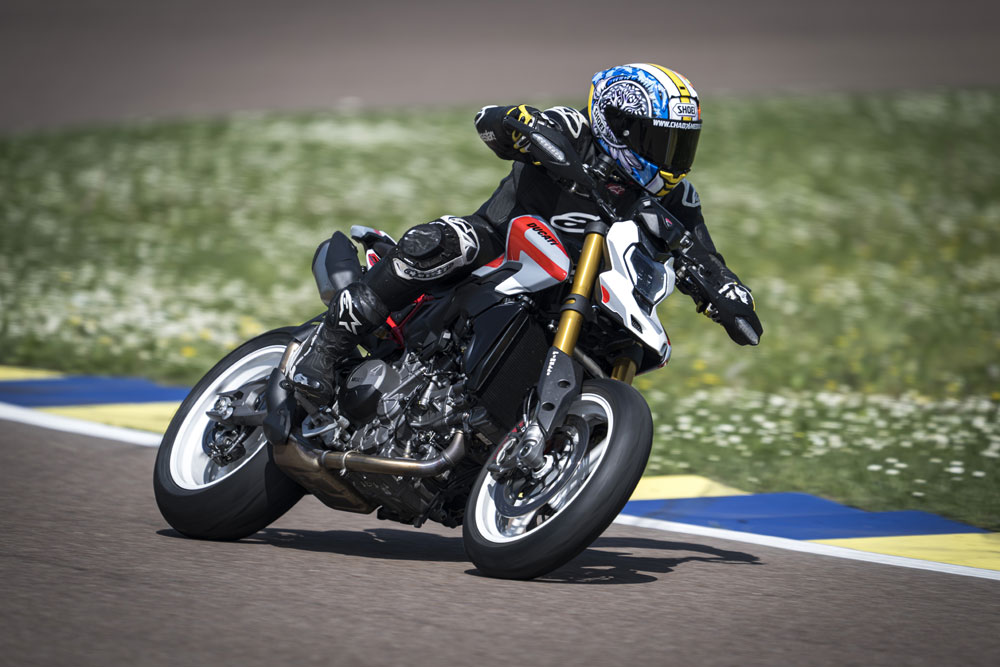
Ducati produces the most technically advanced and powerful Hypermotard yet, so Chad hopped over to the Autodromo di Modena in Italy for a spin.
By Adam “Chad” Child | Photography Alex Photo
Twenty years after we first caught sight of Ducati’s original Hypermotard prototype, we get this: 390 pounds and 120 horsepower of electronically harnessed mayhem. A machine so sharp in the turns and so willing to bend into shapes you never thought possible on a racetrack that, later, when its tires have cooled and a reflective beer is consumed, it makes you reassess what is possible for a street-legal motorcycle.
What’s even more remarkable about the 2026 Ducati Hypermotard V2 SP is that it hasn’t been honed to a razor-sharp edge by relentless competition with other manufacturers. In fact, the last time we looked, there were no other twin-cylinder machines anywhere near the supermoto market. It’s effectively competing against itself.
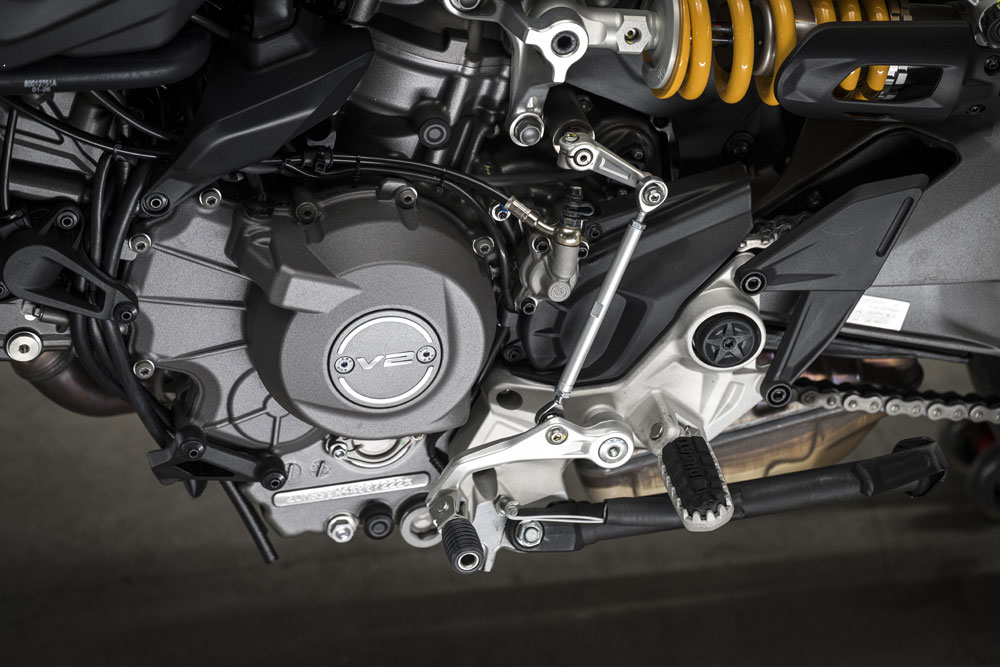
Naturally, the new bike arrives with a raft of Ducati’s MotoGP-derived lean-sensitive rider aids for the road and track, but the much-loved 937cc Testastretta V-twin is gone, replaced by the new, lighter and slimmer 890cc “V2,” already proven in the current-generation Monster, Multistrada, Panigale and Streetfighter.
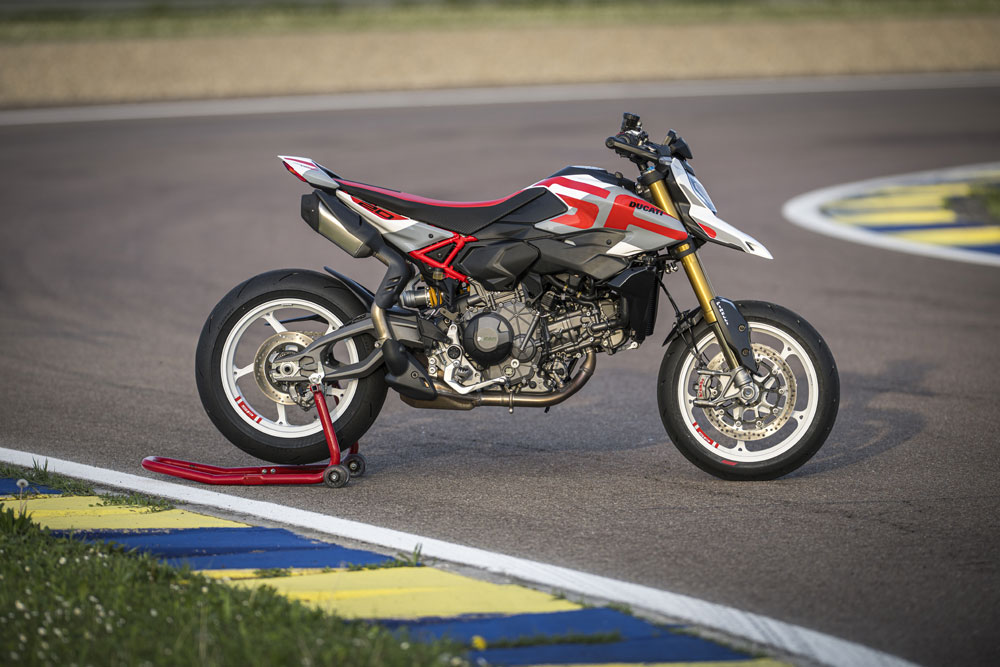
And it’s goodbye to the outgoing model’s signature steel trellis tubes and hello to Ducati’s impressively compact alloy monocoque frame. The overall weight saving is 31 pounds. Nice.
Two variants are available: the base Hypermotard V2 and the SP, the model on test, with fully adjustable Öhlins suspension, upgraded Brembo brakes and lightweight forged wheels.
The SP is priced at $20,995, while the base bike, with less sophisticated KYB suspension, cast wheels and lower-spec brakes, is priced at $16,995. With no direct supermoto competition, it’s hard to assess that price point. If we regard the SP simply as a fun-loving sports naked with around 120 bhp, it certainly looks like a pricey alternative to bikes such as the Triumph Street Triple 765 RX.
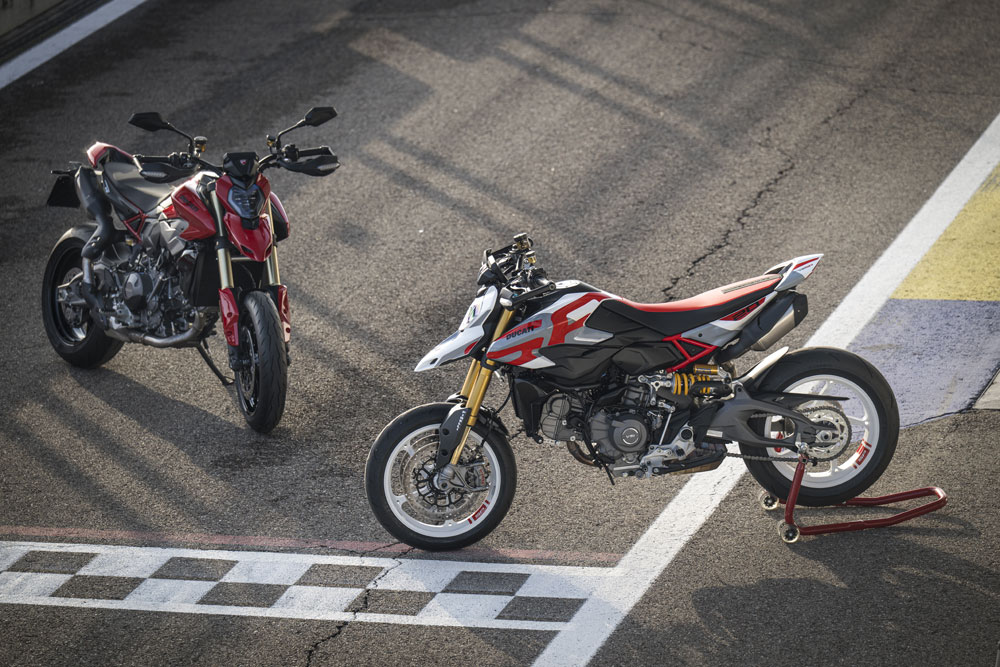
Track Testing The V2 SP | 2026 Ducati Hypermotard V2 SP Review
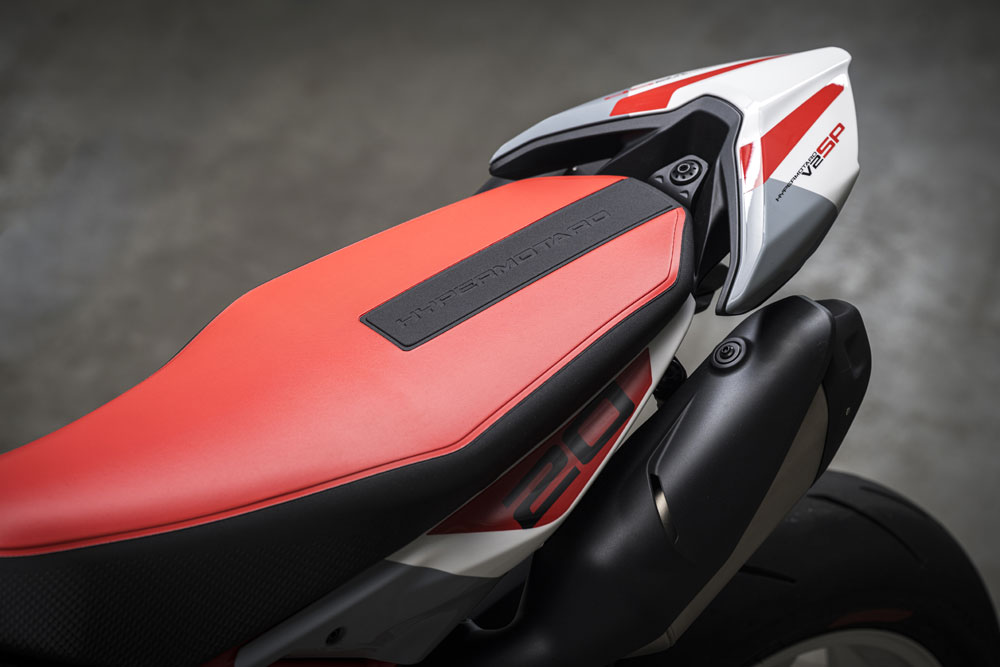
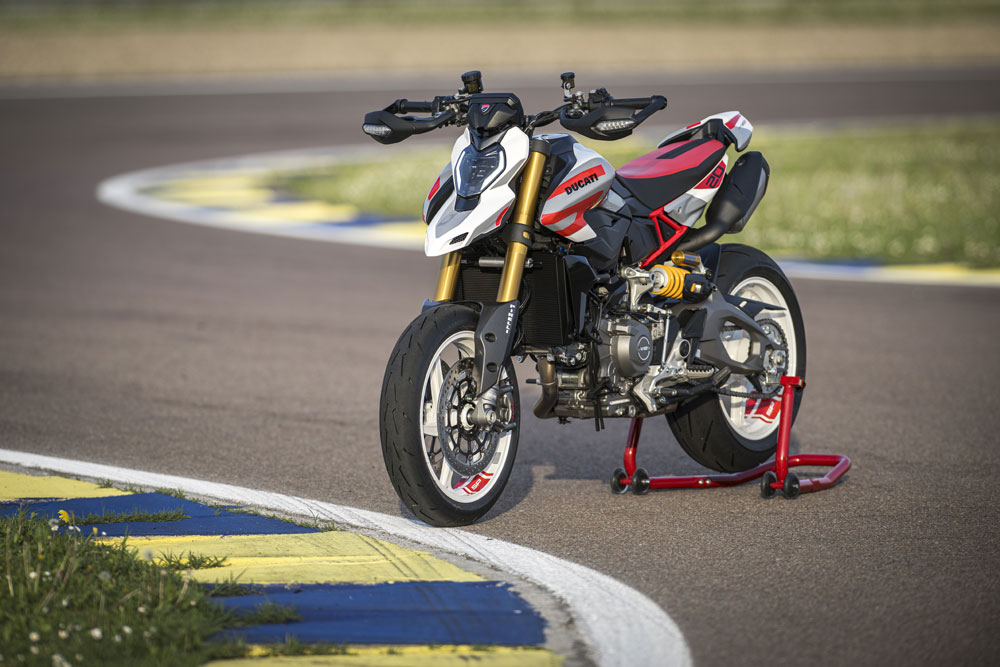
One thing that hasn’t changed much is the styling. The famous beak-nose up front and twin underseat exhausts at the back survive the overhaul, but the new bike features an aluminum monocoque frame, with the V2 deployed as a stressed element, which saves a claimed 10 pounds over the traditional trellis frame.
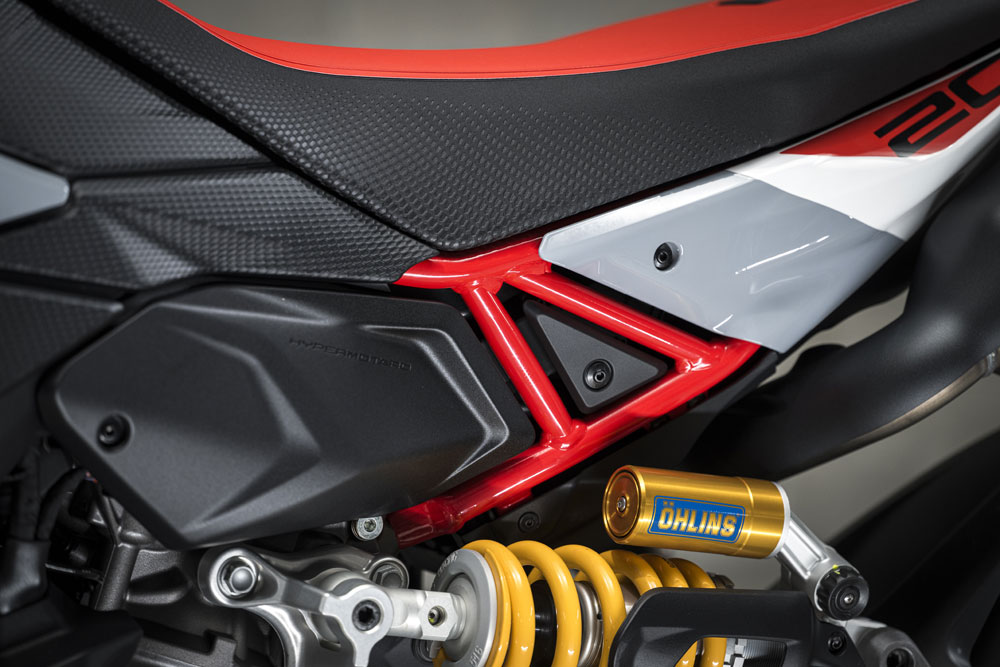
Pleasingly, there’s still a triangulated steel-tube subframe to satisfy the purists, although a new double-sided swingarm is likely to divide opinion, as it has on other Ducati V2 models that no longer feature a single-sided ’arm. Up close, the finish and detailing are, as they should be, absolutely on point.
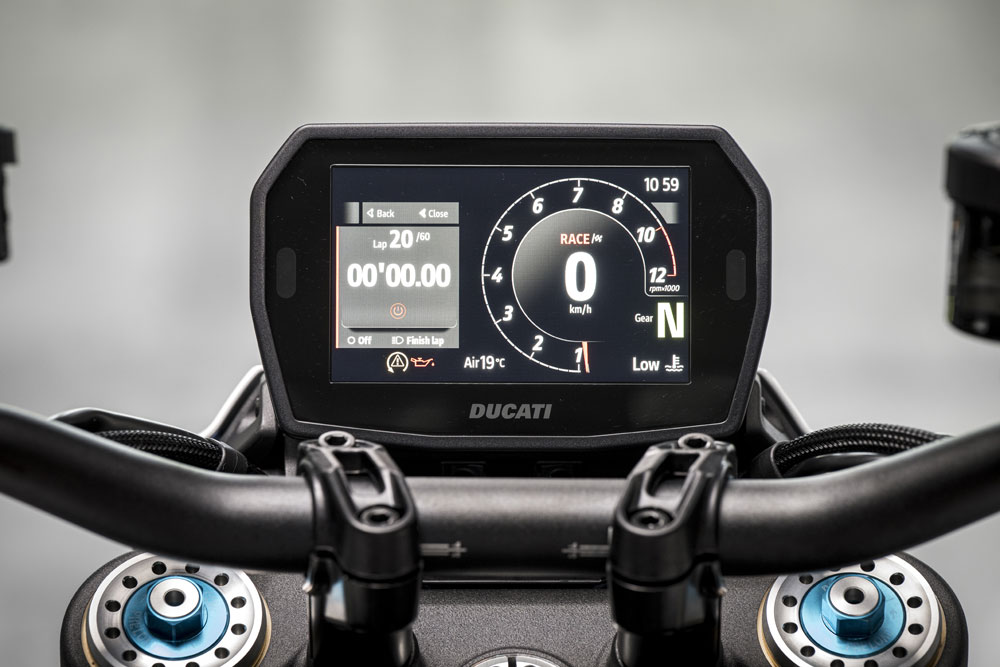
A new five-inch TFT dash runs three different displays: Road, Road Pro and Track. Road and Road Pro show road-relevant information like speed, gear, etc., whereas in Track mode, the rev counter and gear number are more prominent, with the active rider aids clearly displayed and providing real-time intervention.
Ducati’s big supermoto has never been particularly practical on the road—think zero wind protection, a small 3.3-gallon fuel tank and a tall, hard seat—so we weren’t overly surprised to find ourselves riding solely on a racetrack for this test.
But while it is no Multistrada, the new Hypermotard V2 is more practical than before, with wider service intervals (9000 miles for oil and 28,000 miles for a valve check) and a lower 34.6-inch seat. There’s also an optional 34-inch seat, and a suspension lowering kit drops the seat height to 33.5 inches.
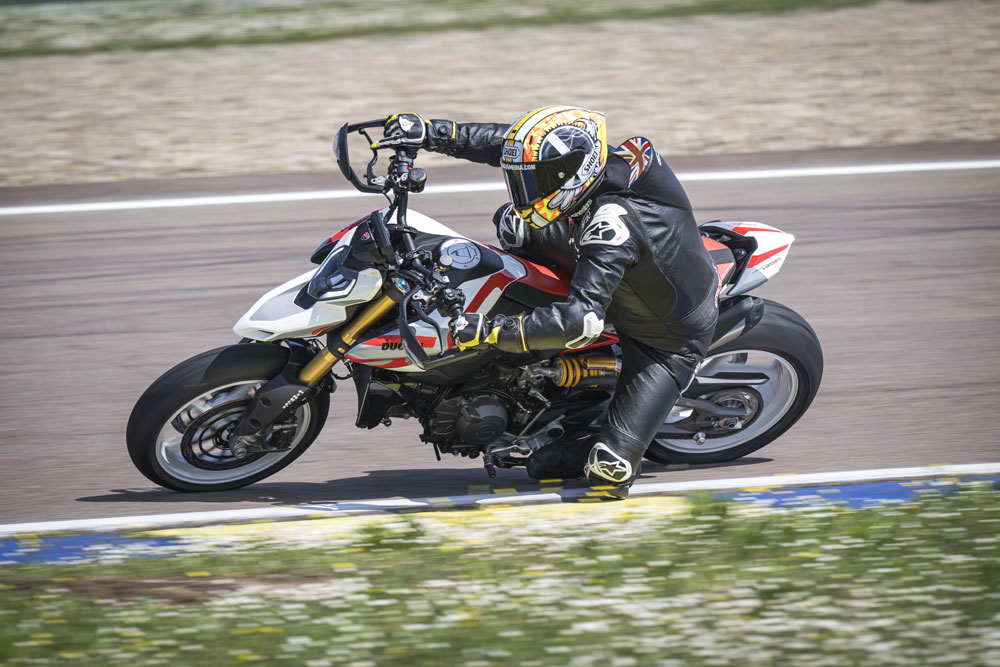
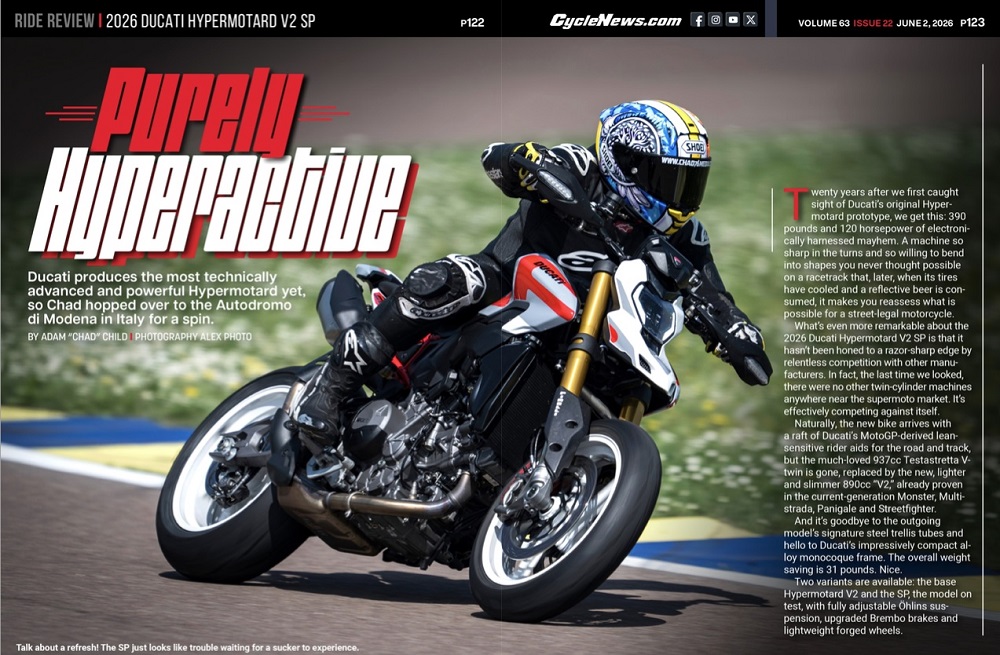
The old bike is famously light and flickable, but on track for the first few laps, the new one is clearly on another level. Apexes are not so much hit as atomized. You sit tall, arms spread on flat, wide bars, knees hugging the waisted tank, then simply look where you want to go… and you’re there.
The first and final thirds of the Modena circuit are all about long switchbacks and feel more like a large kart track than a conventional circuit. And the Hypermotard chewed them up and spat them out in a manner that would make many middleweight sport machines feel ponderous and unsure.
The speed with which the new model snaps from full lean to upright and down onto the other knee is almost beyond description. I certainly can’t think of another bike so agile, so direct and so assured, at least not in this larger 120-hp naked segment.
At Modena, the steering was, on occasion, almost too quick, turning the SP into the corner embarrassingly early. It will be interesting to test its high-speed stability on the road, but even clumsily landed, crossed-up wheelies (more on those later) didn’t provoke any head shakes or moments of drama. Incidentally, a Sachs steering damper comes standard on both models.
As a long-in-the-tooth TT and road racer, I rode the Hyper knee-out, slider, searching for the racetrack rather than the leg-out supermoto style, but based on the lap times some riders were posting, either technique will do. Given the SP is on the tall side (there’s 6.7 inches of suspension travel up front and 6.3 inches at the rear), it feels like you’re leaning a mighty long way over before a knee eventually contacts the racetrack. But even when your slider is firmly planted, the feedback from the standard Pirelli Diablo Rosso IV Corsa rubber is excellent.
Peak power for the V2 is claimed at 120 hp at 10,750 rpm, up from the 114 hp at 9000 rpm of the old Testastretta V-twin. Peak torque is slightly lower at 69 lb-ft, but it occurs 550 rpm higher in the rev range, at 8250 rpm. But, and it’s a large but, Ducati claims 80 percent of that torque is available between 4000 rpm and 11,000 rpm, and that 70 percent is available from just 3000 rpm.
That translates to instant drive out of turns, no matter where you are in the revs. The Hypermotard punched out of Modena’s second-gear final turn with brutal force, the wheelie control (DWC) holding the front wheel an inch or two above the track, perfectly controlled, as the bike was shoved forward.
A quoted 120 hp may not impress the social media experts, but the Hypermotard’s special blend of a stunning power-to-weight ratio, great mechanical grip, instant torque, a forensic feel and sophisticated rider aids allows you to get on those horses incredibly early.
The SP has four riding modes (Race, Sport, Road, and Wet), three power modes, switchable cornering ABS (four levels), Ducati Traction Control (eight levels and off), the aforementioned Ducati Wheelie Control (four levels and off), Engine Brake Control (three levels), and the Ducati pit-lane limiter and Power launch. Those rider aids do a lot of work on track, encouraging you to open the throttle harder and sooner each lap, and there’s more electronically enhanced fun to come when you hit the brakes.
At the end of Modena’s main straight, it’s back from fifth gear to second gear, and then, with your braking marker hit, a full-on grab of the ABS-assisted Brembo stoppers, this being the SP version, that means M50 monoblocs over the base bike’s M4.32, as well as a higher-spec master cylinder and 6.6 pounds less to haul up.
There are four ABS options to choose from, with two designed primarily for the track and two for the road. ABS 1 has the rear ABS and rear lift removed, and the system is no longer lean-sensitive. ABS 2 is also designed for the track, with both front and rear ABS active and lean-sensitive. ABS 2 also runs “slide by brake,” which allows the rider to back into turns with electronic control, a system we first saw on the single-cylinder Hypermotard 698.
Slide-by-brake allows less experienced supermoto-style riders to back-in relatively safely, as the system controls the rear wheel’s speed and lift and prevents it from locking up. You can apply the brakes as hard as you dare and turn toward the apex of the corner, while the system manages a controlled rear slide—up to a point. You still need to brake heavily and downshift quickly, but it’s a fun way to learn in relative safety.
I don’t think the Hypermotard is as easy to back-in as the 698, which is even lighter. The process is a little vague if you already know how to do it. But all levels of riders were having a blast at the test. And talking of fun, which, let’s face it, is at the heart of the Hypermotard brief, the bike will lift its front Pirelli in the first three gears on a blip of the throttle with the DWC switched off and even in fourth with some clutch and encouragement. Its lightness, wide spread of torque, and long seat result in one of the best wheelie bikes money can buy.
Criticisms? On the limit, the ’pegs did tickle the track from time to time, but the chassis felt so reassuringly positive that braking and turning on that long-travel suspension still filled me with confidence. I also missed a few gears, which I believe was due to an oversensitive cut-out on the quickshifter. We moved the gear selector a fraction, which largely rectified the problem, but if you’re heavy-footed, the gear selector is very sensitive and did cut the ignition once when I accidentally tapped the shifter.
Verdict | 2026 Ducati Hypermotard V2 SP Review
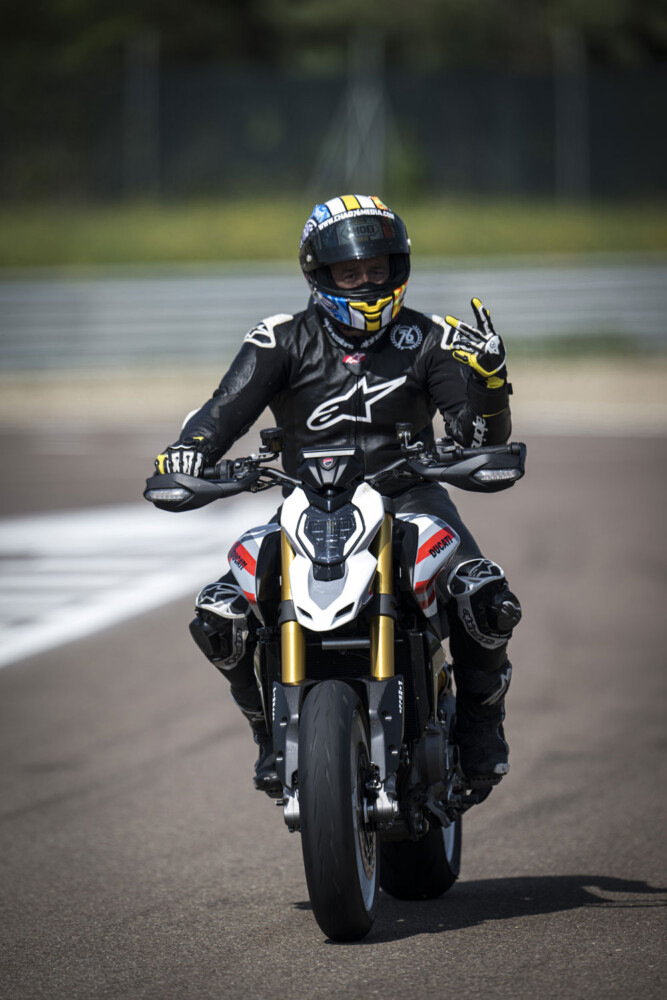
This bike is on another level. On a tight track, it’s so sharp into corners and so easy to drive out of them that it may well change your perception of what’s possible.
The really clever bit is that for 2026, Ducati has made it more accessible for everyone, with improved rider aids, more usable power, added lightness and even keener handling. Those rider aids will keep you safe on track and make you look good, too!
This was a track-only test of the Hypermotard SP, and we still need to ride both the standard model and the SP on the road to get the full picture. We can say, however, that many of the SP’s excellent track attributes should carry over, especially its liberating lack of bulk. It’s so easy to pilot around a twisty racetrack that carving up a mountain pass or navigating rush-hour traffic is likely to be just as effortless.
Rider aids that work on the track should also work on the road, and, of course, it will look good anywhere. What we can’t know is how comfortable and practical the new SP will be, especially compared to other naked 120-hp middleweights, which, in theory, should be more focused on real-world riding.CN
VIDEO | 2026 Ducati Hypermotard V2 SP First Ride

2026 Ducati Hypermotard V2 SP Specifications
| MSRP | $20,995 |
| Engine | 90-degree V-twin |
| Valvetrain | DOHC, 8 valves |
| Cooling System | Liquid |
| Displacement | 890cc |
| Bore x Stroke | 96.0 x 61.5mm |
| Compression Ratio | 13.1:1 |
| Transmission | Six-speed |
| Horsepower (claimed) | 120 hp @ 10,750 rpm |
| Torque (claimed) | 69 ft-lb @ 8250 rpm |
| Fuel System | Electronic fuel injection w/ 52mm throttle bodies, ride-by-wire throttle |
| Clutch | Wet, multiplate slipper w/ Ducati Quick Shift 2.0 (up/down), hydraulic actuation |
| Frame | Monocoque Aluminum |
| Front Suspension | 48mm inverted Öhlins fork, fully adjustable |
| Rear Suspension | Öhlins monoshock, fully adjustable |
| Front-Wheel Travel | 6.7 in. |
| Rear-Wheel Travel | 6.3 in. |
| Front Brake | Radial-mounted four-piston Brembo M50 monobloc calipers, dual 320mm discs with cornering ABS |
| Rear Brake | Twin-piston caliper, 245mm disc with cornering ABS |
| Front Wheel | Forged aluminum, 17 x 3.50 in. |
| Rear Wheel | Forged aluminum, 17 x 5.50 in. |
| Front Tire | Pirelli Diablo Rosso IV 120/70 ZR17 |
| Rear Tire | Pirelli Diablo Rosso IV Corsa 180/55 ZR17 |
| Rake / Trail | 26.0° / 4.3 in. |
| Wheelbase | 59.6 in. |
| Seat Height | 34.6 in. |
| Fuel Capacity | 3.3 gal. |
| Weight (dry, claimed) | 390 lbs. |
Click here to read the 2026 Ducati Hypermotard V2 SP Review in the Cycle News Digital Edition Magazine.