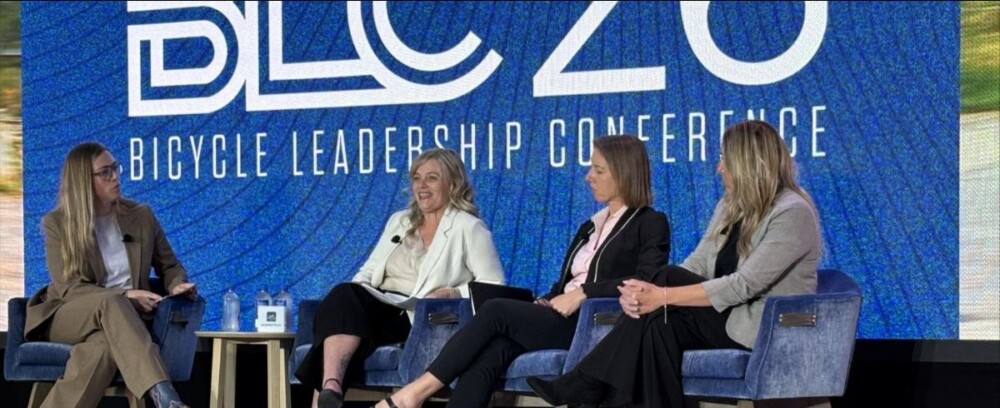
Christy LaCurelle, MIC President and CEO, joined policymakers and industry leaders at the Bicycle Leadership Conference to discuss eBikes.
This is a press release from the MIC…
(March 25, 2026) — Motorcycle Industry Council President and CEO Christy LaCurelle recently joined policymakers and industry leaders at the Bicycle Leadership Conference to discuss a growing issue affecting both bicycling and motorcycling: high-powered two-wheel vehicles, often referred to as eMotos, being marketed and sold as eBikes.
LaCurelle, who also serves as President and CEO of the Motorcycle Safety Foundation, Recreational Off-Highway Vehicle Association, and Specialty Vehicle Institute of America, took part in a session examining how the misclassification of eMotos is contributing to safety concerns, consumer confusion, and mounting regulatory pressure. She appeared alongside California State Senator Catherine Blakespear, PeopleForBikes Vice President of Government Relations Dr. Ash Lovell, and Marin County Bicycle Coalition Executive Director Tarrell Kullaway.
The issue has become increasingly prominent as more electric two-wheel products enter the market and traditional category lines become less clear in the public mind. While eBikes and eMotos may share certain visual or technological similarities, they are not the same. eBikes are pedal-equipped electric bicycles that fit within one of three recognized classes, while eMotos fall outside that framework, having either pedals or pegs and not cleanly fitting within the three recognized classes.
At the conference, the focus was on how high-powered (those exceeding 750 watts) eMotos are being presented to consumers and policymakers as if they belong in the eBike category, despite different performance characteristics, use cases, and safety considerations.
That misclassification can shape public perception, influence legislation and enforcement, and create challenges for riders, communities, and industry alike. It can also create friction for legitimate eBike riders and for the bicycle industry.
Following the session, LaCurelle emphasized that the rise of eMotos should be seen not only as a challenge, but also as an opportunity to welcome more people.
“The fact that people are riding eMotos is actually a big opportunity we’ve been given,” LaCurelle said. “More people are engaging with two-wheel mobility, and that’s something both of our industries should recognize. We’ve been asking for a broader audience, and now they’re here, just on a different kind of product.”
LaCurelle’s participation also reflected ongoing coordination between MIC, PeopleForBikes, and other trade associations as they track legislation, flag proposals that could affect adjacent sectors, and work to stay aligned on policy as new issues and opportunities emerge. That collaboration has already extended into safety education: MSF and PeopleForBikes worked together on the eBike eCourse to help address rising safety concerns as more new and inexperienced riders entered the eBike market.
“The path forward starts with safety, which is why the Motorcycle Safety Foundation worked alongside PeopleForBikes to create the online eBike eCourse,” LaCurelle continued. “We also need to clarify the distinction between eMotos and eBikes. Many people already regard eMotos as motorcycles, even though they don’t quite fit state or federal definitions. But the motorcycle industry is working toward a solution so that eMotos can be brought into the motorcycle category and appropriate regulations can be established around them.”
LaCurelle said the discussion was not limited to classification and regulation. It also touched on the work needed to support responsible participation.
“What does success in this area look like? It will ultimately come through education and expanding access to riding areas, such as developing more urban riding parks. Right now, there simply aren’t enough places for people to ride. Creating these outdoor recreation spaces not only helps improve safety, it also supports health and wellness in our communities.”
The session underscored how questions around classification, safety, and access are increasingly crossing lines within the broader two-wheel world.