Cycle News Archives
COLUMN
When Johnny Cecotto won the Daytona 200 in 1976.
By Kent Taylor
A certain Goodyear slick racing tire was one of the major players in the 1976 Daytona 200 story. When the race’s green flag dropped, this tire was eating so much asphalt that the front end of the Yamaha motorcycle on which it was mounted began reaching for blue sky, pawing the air like a spooked wild stallion. A few hours and 184 miles later, this same tire was looking more like a broken-down chuckwagon mare, pitifully close to the end of its life and questionable to finish the job it started.
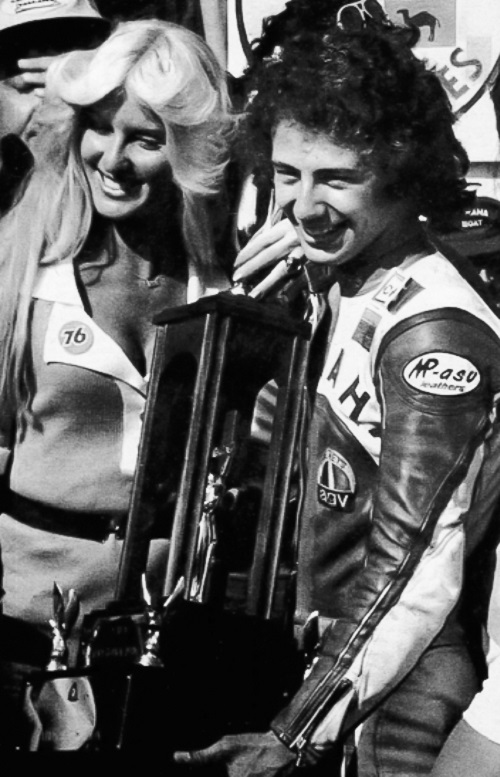
For some reason, still unknown 50 years later, this tire wasn’t replaced during the race. Its rider should’ve been brought in for a pit stop and a tire swap, but that didn’t happen, which means the tire should’ve failed, but that didn’t happen either, and that is why you aren’t reading about Kawasaki rider Gary Nixon’s victory at the 1976 Daytona 200 and are instead remembering the name of Johnny Cecotto, a World Champion whose short motorcycling career burned ever so brightly before flaming out far too quickly.
The Daytona 200 had become the personal property of Team Yamaha, though not necessarily of the bumblebee-black-and-yellow USA team. The previous four 200-milers had indeed been won by Yamaha riders, but only one, Gene Romero, was a full-time member of the American squad. Cecotto was sponsored by Venemotos CA, the importer for Yamaha motorcycles in Venezuela. He was a champion in his homeland but little known outside South America. That would change at the 1975 running of the 200, when he clawed his way from a back-row starting position to an eventual third place behind Romero and Steve Baker and just ahead of 15-time World Champion Giacomo Agostini.
A mechanical difficulty had put Cecotto at the rear of the pack in ’75. “I remember the frustration when they sent me to the back of the grid, but this gave me a big push! I was riding a customer’s bike, a Yamaha 700 against the works 750,” Cecotto recently said, “but my pace was unbelievable.”
The next year, 1976, he would be starting from his rightfully earned position, fourth from the inside on the front row. When the race began, it was Cecotto with the holeshot, but the ensuing wheelie show forced him to back off a crack, allowing several riders to slip past. Coming from the second row, privateer rider Pat Evans took the lead with Kenny Roberts, Baker and Hideo Kanaya, along with Cecotto, in pursuit.
Yamahas as far as the eye could see! When it was formally introduced in 1974, the four-cylinder two-stroke TZ700 was fast, but not so much faster than the competition. Nixon, on Suzuki, had beaten the Yamahas at Loudon and probably should’ve won Daytona that season as well, with only a late-race crash keeping him from atop the podium.
All of that would change by 1976, with other riders openly lamenting the horsepower gap between their race bikes and the Yamaha 750. Suzuki rider Barry Sheene said (with a lovely Cockney accent), “That bloody Kanaya has almost 17 mph on me, Suzuki. The only way I’ll win is if the 10 Yamahas in front of me break.”
Sheene and Nixon rode well in the race. Gregg Hansford held third for a while on the Kawasaki, and young Pat Hennen was running in the top five on his Suzuki. A handful of privateer riders, including Steve McLaughlin and Ron Pierce, were in the top 10.
But they all might as well have been in a separate race, a battle to see who would finish third, the best of the rest. Up front, Cecotto and Roberts had made the 1976 running of the Daytona 200 a two-man race, lapping the field up to 12th place by just the 20th lap. “Cecotto,” wrote CN, “had the lead with Roberts close enough behind to read the stickers on the back of the Venezuelan’s bike.”
By lap 26, only seven riders were still on the same lap with the Yamaha duo.
Roberts eventually carved out a seven-second lead on Cecotto, who was battling both mechanical and physical gremlins. The Yamaha’s expansion chamber now had a power-robbing hole in it, while Cecotto had somehow managed to twist his ankle on lap 20.
“I thought,” he said later, “about stopping” because of the pain.
With 16 laps remaining, the race was no longer solely in the riders’ hands. All eyes were focused on a man named John Smith, who was neither a racer nor even a race team manager. Smith was a technician for Goodyear, and when Team Yamaha saw Roberts gesturing wildly at his pit board, Smith “advised the Yamaha crew to replace the rear tire, with the same advice going for third-place Kanaya.”
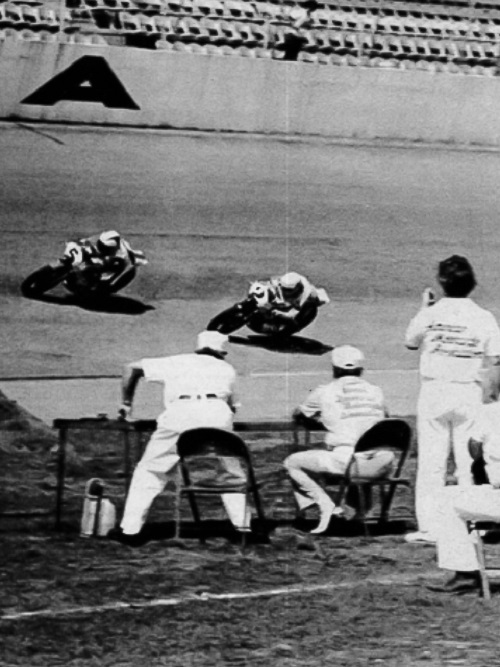
A bold decision not to pit for fresh rubber contributed to Cecotto’s victory.
In the Yamaha pits, two fully assembled wheel and tire assemblies were parked alongside the pit wall, waiting to be installed. But when Roberts pitted, he took on only fuel and a quick inspection, speeding off down pit row with the fresh rubber still leaning against the wall. His teammate Kanaya had come in for a change “on lap 40 with, reportedly, his special-compound Goodyear rear slick down to the cords.”
The decision not to outfit Roberts with the new tires proved to be a misstep, one that could’ve had far more tragic consequences. “His tire apparently went flat just as he was entering the chicane,” CN reported. “Kenny crashed into the sand banking on the outside of the turn, [and he] had to ride slowly through the grass to the pits with a flopping tire carcass slapping the ground.”
With 16 miles remaining, Johnny Cecotto’s crew was also notified that he should come in for a tire check, an inspection that almost certainly would’ve resulted in a time-sucking change of rubber. Somehow, that word was never relayed to him. Whether it was a misunderstanding or a message that couldn’t cross over the language barrier, Cecotto kept going. Kanaya’s tire change had dropped him to seventh, Roberts’ ordeal saw him slip to ninth, and a lengthy stop would’ve cost Cecotto significant time. Riding the same motorcycle on the same tires as his teammates, the Venezuelan rider somehow managed to nurse his Yamaha 750 to the finish line, one full lap ahead of second-place Gary Nixon.
“The tire was at the limit but still okay,” Cecotto remembers. “I managed to take it easier on the last laps! That victory was really fantastic, winning the race, which was considered the hardest bike race at that time. There were many Venezuelan people attending the race, and many also at the airport waiting for me when I went back to Caracas!”
In his relatively short career, Cecotto would add many more accolades to his racing resume, including a 350cc World Championship and a Formula 750 title. Injuries robbed him of the success that should have been his, but in 1976, nothing, including physical pain, mechanical woes or a fickle rear tire, would keep him from a spectacular Daytona 200 victory.
On a side note, I’d like to thank John Damen at www.johnnycecotto.com for his assistance with this article. CN
Click here to read the Archives Column in the Cycle News Digital Edition Magazine.
Subscribe to six decades of Cycle News Archive issues