Cycle News Archives
COLUMN
Yes, at one time, 50cc motorcycle racing was the happening thing.
By Kent Taylor
Weed eaters and a few kids’ motocross bikes are pretty much the only places where you can still find 50cc two-stroke engines these days, but just a few years ago, these tiny motorcycles had a big presence in motorcycle road racing, both here in the USA and overseas. While Spanish road racer Angel Nieto was winning World Championships on small-bore two-stroke motorcycles, a contingent of Californians were engaged in their own tiddler technology war, both in the garage and on the racetrack.
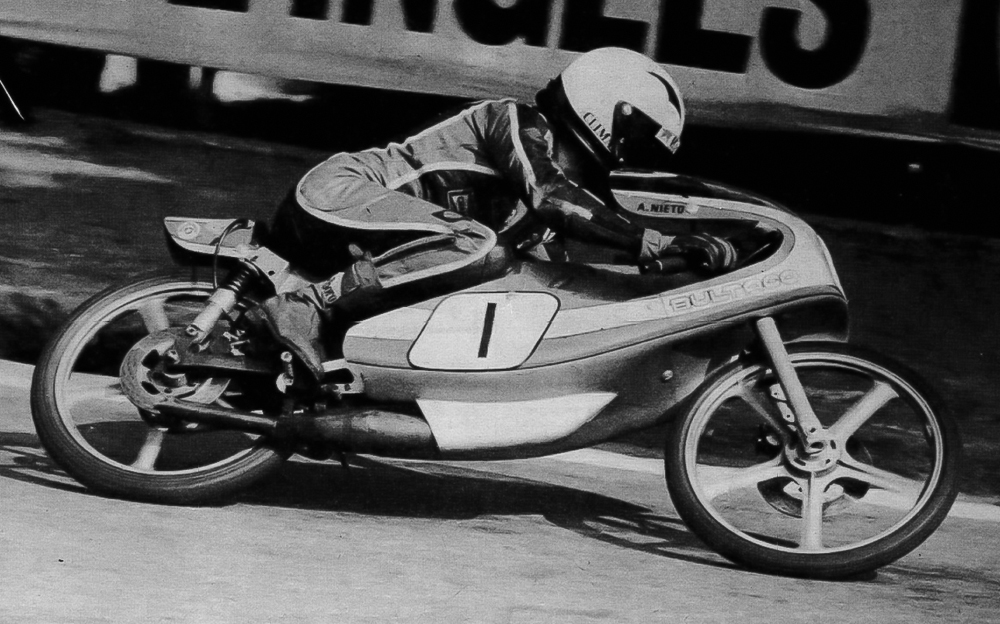
In April of 1976, Cycle News took an in-depth look at the state of 50cc road racing, which was experiencing a surge of sorts in California’s AFM series. Minicycle racers from the 1970s will remember the brand ItalJet, which produced some very speedy mini motocross machines. In 1975, California road-racing hot shoe Rudy Galindo rode one to the AFM Championship in that class. Just one year later, however, the ItalJets were middle-of-the-packers, thanks to some garage-engineered configurations that were squeezing every pretty pony out of other brands of these diminutive machines.
This class was attracting some heavy-hitters from the motorcycle world. Roger Davis was a dealer racing consultant for Yamaha International, specializing in working with Yamaha’s snowmobile dealers who were involved in competition.
“His garage at home in La Mirada, California,” wrote CN, “is stuffed with machinery built with the best secrets Davis could absorb in the Yamaha racing department.”
Davis’ 50cc motor was a five-speed engine with a special GYT (Genuine Yamaha Technology) cylinder that “was not generally available in this country.
“Davis built the bike’s CDI unit from both snowmobile and motorcycle parts. The carburetor is a side-change main jet model from a prototype Yamaha 100cc engine.”
What about the expansion chamber, one of the most important pieces of the two-cycle package? “Davis doesn’t like to talk about the pipe,” CN wrote. “The dimensions are top secrets left over from Yamaha’s late-1960 GP battles.”
All 50cc engine tricks under lock and key! The Knights Templar, standing inside Fort Knox with Cerebus on a leash, couldn’t have kept these racing secrets any safer!
Davis’s Yamaha racer (which, oddly enough, was housed in a Honda CR 110 road-racing chassis) might’ve been plenty trick and wouldn’t have been a championship contender if it weren’t for a skilled technician by the name of Franco Garavoglia. He was an engineer for Fiat who was building winning 50cc bikes in his garage with rider Bob Nolan dominating the class on the local scene.
“The general opinion is that the 50cc class is for little kids,” says Garavoglia, as he works in his garage at home in Lakewood, California. But if they knew the work it takes just to make a 50 fast.”
Garavoglia wasn’t beholden to any one brand. A look at his garage revealed three different machines: a Moto Villa, a Rimghini and a heavily modified Suzuki, which began life as a TS 50 Gaucho. The Gaucho was the small machine that Suzuki marketed “as the only 50 made that’s a real motorcycle.” The racing 50 piloted by Nolan featured a dry clutch, a redesigned five-speed transmission and an exotic expansion chamber of its own, which helped the Gaucho rev like a hummingbird on caffeine, a screaming 14,500 rpm. Chassis-wise, the Suzuki featured a hand-built swingarm, shortened forks and rearsets.
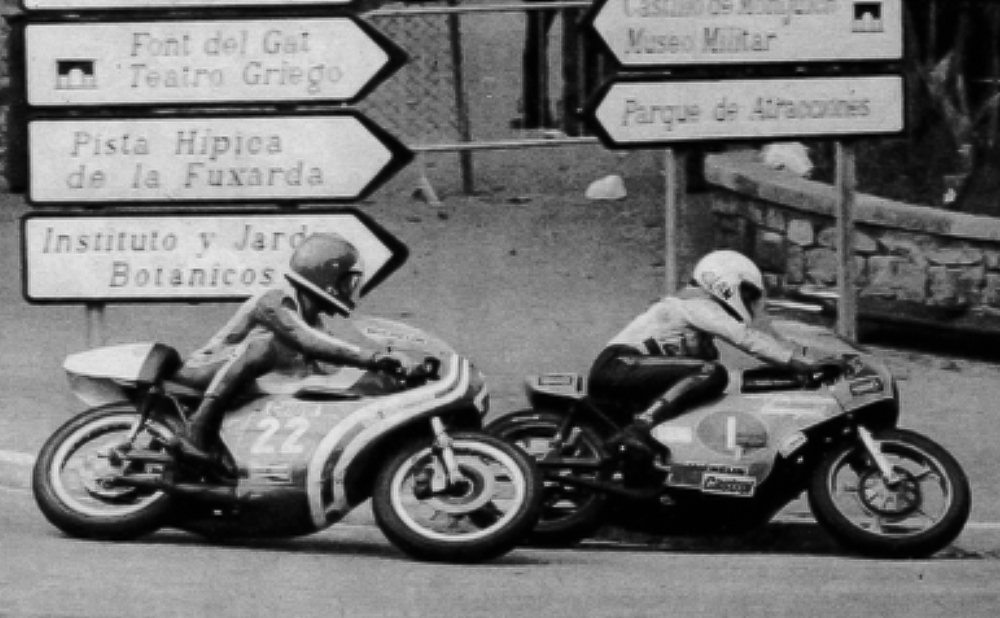
Garavoglia figured he had invested about $3000 in 1976 (equivalent to $17,000 in 2025) in the Suzuki, but alas, he was not satisfied with its performance. On a trip to Italy, he found the Moto Villa and the Rimghini, both of which had been official factory racers. Another $4500 later, the Italian race bikes were back in California in his garage. Each machine was a prototype bike, and it showed, but that is likely what Garavoglia found appealing, with CN writing that, “underneath the hideous paint that couldn’t hide rough welds and file marks, beyond the rubber bands holding on the Villa’s radiator, lived pure function.”
“The advantage of these bikes is that they are built for racing,” he said, and indeed, his bikes dominated the series, with Cycle News stating that his racers were a whopping 30 mph faster than the competition. At one race at Ontario Motor Speedway, the 50cc machines ran in conjunction with the 125-200cc class. Accustomed to being lapped by the bigger bikes, rider Bob Nolan not only rode the Moto Villa 50 to a class win but finished “within sight of John Chermak’s winning 200 Yamaha.”
In addition to the Moto Villa, the Rhimghini, the Suzuki and Roger Davis’ Yamaha, the class entries featured a 50cc Sachs with an engine built by two-stroke legend E.C. Birt and ridden by Jim Ahrens, who would go on to set six motorcycle land speed records at Bonneville. The remainder of the field was likely made up of ItalJets.
“The neat thing about the 50cc GP class,” CN wrote, “[is that] you can make it as cheap or as expensive as you want and still have someone to race with.” Size can matter, and while smaller isn’t necessarily better, it can still be a whole lot of fun.CN
Click here to read the Archives Column in the Cycle News Digital Edition Magazine.
Subscribe to six decades of Cycle News Archive issues

