Cycle News Archives
COLUMN
To finish first, one must first finish
By Kent Taylor
When Tom Petty told us 50 years ago that “It’s alright if you love me, it’s alright if you don’t,” he might’ve been singing an ode to the motocross bikes of that era. These were motorcycles that could run like rocket ships in one moto and then sputter and cough to an inexplicable death in the next. In today’s racing, DNFs are about as rare as a good rock song, but back when Tom Petty and The Heartbreakers released their debut album, mechanical failures on MX bikes were an every-race occurrence. It was a bemused three-time National Champion Tony DiStefano who, while thinking about modern race bikes purring away at idle, once stated that back in his time, “We were happy if we could just get them started.”
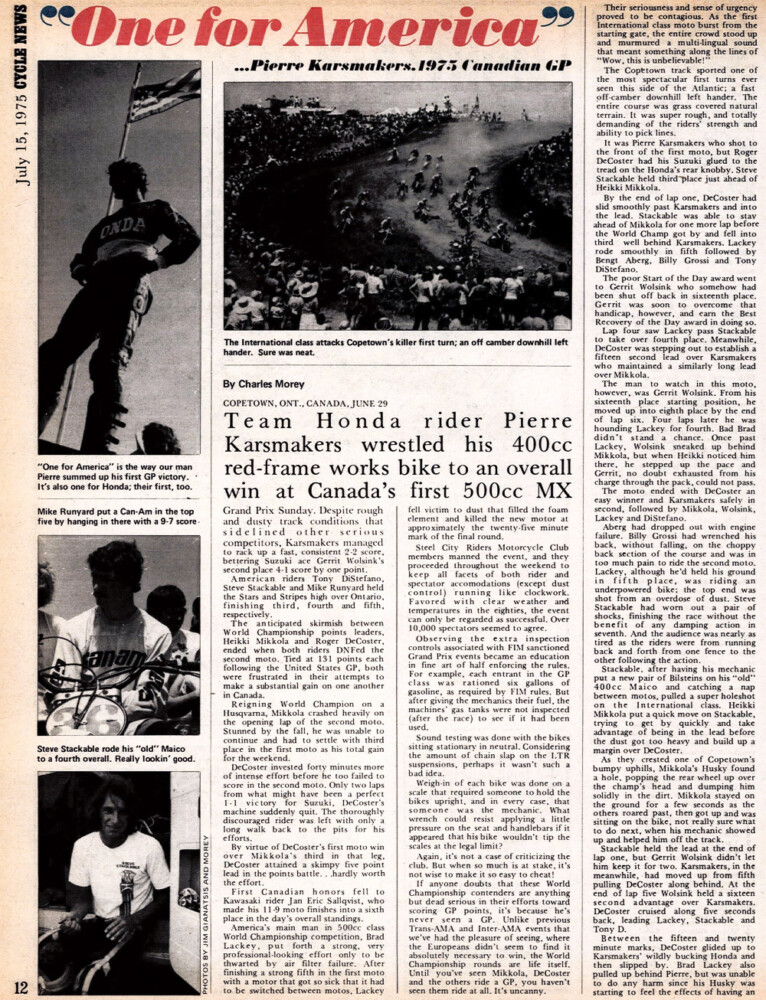
In 1975, the 500cc MX World Championship series paid its first-ever visit to Canada. The friendly neighbor to the north would host a round the weekend after the U.S. Grand Prix of Motocross, which was held at Carlsbad Raceway. The race, promoted by the Steel City Riders Motorcycle Club, was held at the Copetown track in Ontario.
Peanuts’ Snoopy would often begin his top-of-the-doghouse novels with the line “It was a dark and stormy night.” If he was writing as Joe Motocross, he could’ve modified the line to “It was a dry and dusty day.” The country experienced severe drought conditions in the mid-’70s, and nearly every summertime race event was held in chalky, choking dust, and the Canadian round served up more of the same to the European Grand Prix contenders and the Americans who made the trek.
That these finicky, hand-built race bikes were likely to self-destruct was no secret to anyone in the industry, and the FIM even stooped to accommodate their frailty, allowing competitors to count their 12 best moto finishes to their season total and throw out the rest. There were 24 motos that season; hence, a rider could (and possibly would) break down in half of the races. The eventual champion and his steed just needed to keep it together for 12 good rides.
In 1975, Roger DeCoster and his works Suzuki would take full advantage of the points-paying system. DeCoster’s North American adventure began with a moto win at Carlsbad, followed by a shock failure in moto two. In Canada, DeCoster would again win the first heat and was well on his way to victory in the second. The great Belgian, who had lost his 500cc crown to Husqvarna’s Heikki Mikkola in 1974, may have been at his very best in ’75.
“Roger DeCoster,” wrote Cycle News in their coverage of the event, “when riding at or near 100 percent of his ability, is nothing short of incredible. He had it wrapped up. Totally. Undisputably [sic]. Until the 40th minute, when the machine stopped running.
“It was later discovered that one of the electrical components had failed, cutting off the fire to the spark plug. What, one minute ago, had been a sure victory and 20-point lead over Mikkola suddenly was stolen from him after making him work for 40 long minutes.” Talk about a real heartbreaker!
There were other machines littering the side of the track that day, including the Husqvarnas of Americans Mike Hartwig and Brad Lackey. The riders had each scored an impressive top five finish in a moto, but their Swedish machines failed to finish both heats. Former World Champion Bengt Aberg, on a Bultaco, would also have one good ride and one DNF.
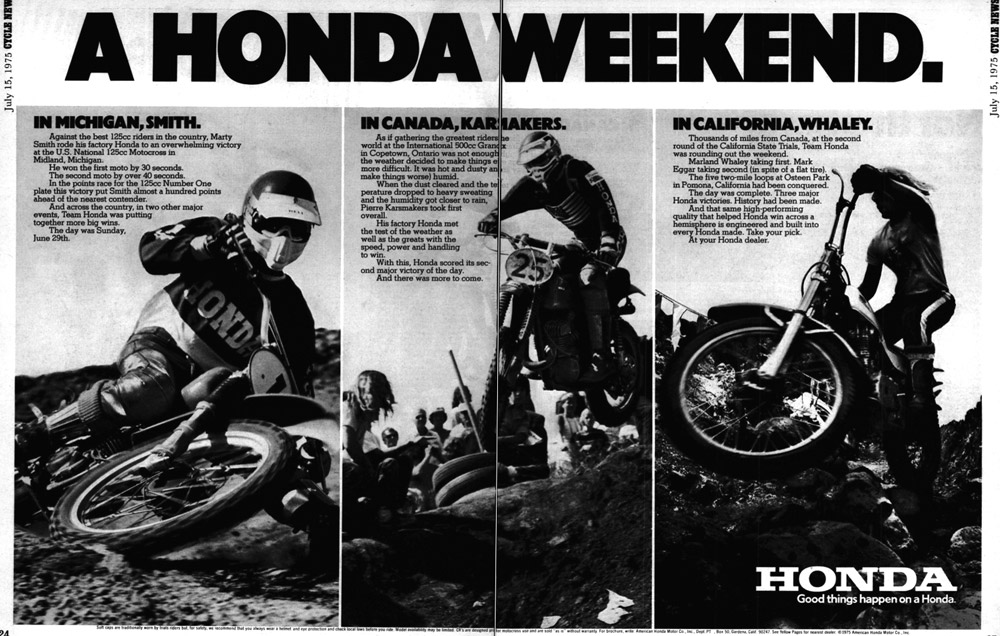
To finish first, one must first finish, and the winner this day was Pierre Karsmakers, who scored a consistent 2-2 for the overall victory. Carlsbad victor Gerrit Wolsink was second, with Suzuki teammate DiStefano in third. The first Canadian finisher was Kawasaki rider Jan-Eric Sallqvist in seventh.
It was Karsmakers’ and Honda’s first-ever win in Grand Prix motocross, which coincidentally marked the final race ever for the old Copetown Motocross track. City Hall is undefeated, and soon after the checkered flag fell, the Steel City Riders began the process of dismantling the track. Big jumps and groovy berms would soon be bulldozed over, and within 48 hours, the roosted dirt of the motocross gods would be entombed under the asphalt of a new road.
Roger DeCoster would go on to score a perfect “12” for the season, recapturing his World Championship. Race teams and engineers eventually hammered out the formula for making better motocross bikes, and the best 12 moto system was scrapped a few years later. Racers were now blessed with reliable machines with which to be runnin’ down a dream. CN
Click here to read the Archives Column in the Cycle News Digital Edition Magazine.
Subscribe to six decades of Cycle News Archive issues

