Cycle News Archives
COLUMN
A Race Won Before It Started
By Kent Taylor
“Every battle is won before it is ever fought.” – Sun Tzu
There is no fool like an old fool and in 1974, only the most romantic of old-timers would’ve given Italian manufacturer MV Agusta any chance of winning what was at the time motorcycling’s most prestigious championship, the 500cc World Road Racing title. The storied Italian marque had just lost the services of its many-time champion Giacomo Agostini to Yamaha and their new two-stroke OW-23 500cc racer. Agostini’s teammate was Finn Teuvo Lansivuori, while over at Suzuki, British superstar Barry Sheene was another serious threat on his own two-stroke Suzuki. Even though MV’s Phil Read had won the championship in 1973, the reign of Count Agusta and his beloved MV Agusta racing motorcycles was undoubtedly nearing an inevitable ending.
Seriously. What edge could the old sucking, squeezing, banging and blowing four-stroke MV possibly still hold over the faster and lighter two-strokes? Nothing at all!
“Sometimes,” said Cool Hand Luke, “nothing can be a real cool hand.”
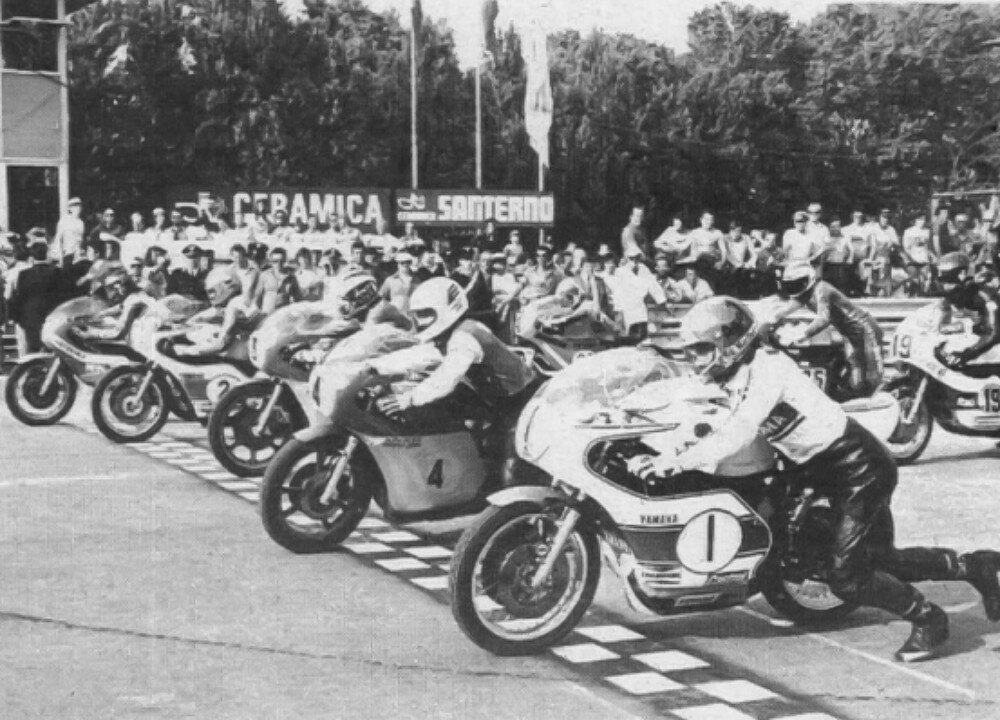
Cycle News estimated the crowd at the Grand Prix of Imola, held on May 19, 1974, to be 120,000 strong. They were there to see the battle between their beloved national hero Agostini on a Yamaha take on Read, who was riding their beloved national motorcycle brand. Imola was round four of the series, and the two longtime rivals came into the event tied in points, though standing only third in the series. Suzuki’s Barry Sheene was second, and they all were chasing a relative newcomer to the series named Gianfranco Bonera. Though he was 29 years old, Bonera was still relatively new to the sport. He had spent many years racing bicycles and had his professional motorcycle racing debut just three years earlier in 1971. His talent had caught the eye of the Harley-Davidson (Aermacchi) team, who invited him to join team rider Renzo Pasolini for a test session. Bonera posted several good finishes in the 1973 season, and in 1974, he was hired by MV Agusta to fill the spot left vacant by Agostini.
The 500cc riders officially bumped-started their bikes at 4:40 p.m., but this race had actually begun hours earlier in the day, when FIM race officials received a letter from the MV Agusta team, threatening to pull both Read and Bonera from the Grand Prix event. The Italian team strongly objected to the decision that had been made to shorten the race from 36 to 30 laps, a request that had been submitted by the Yamaha and Suzuki race teams. While the FIM jury had initially agreed, they were now pondering the ramifications of the absence of the popular MV Agusta team. Such a move would disappoint the fanatical Italian fans, to say the least. A possibly riotous situation was averted “when the Chief of Police pointed out that he and his men could not guarantee crowd control if the volatile customers were robbed of the awaited Yamaha versus MV battle.” Nobody should want a riot, and the FIM announced that the 36-lap race was back on.
“It’s a hackneyed expression,” wrote Cycle News, “but one could literally feel the tension. What a front row. Agostini, Lansivuori, Sheene, Read and Bonera. Anyone could win.” At the end of the first lap, it was Sheene out in front, with the tight pack from the front row right behind. By lap two, the race had become “a proverbial covered-by-a-blanket contest.” On lap three, Bonera, who had never won a Grand Prix event, had taken over second spot. On lap three, the Italian rider passed Sheene and moved into the lead.
Sheene struggled to stay close to Bonera, “but the MV rider was in brilliant form and began to pull away,” even setting a new lap record for 500cc bikes on lap number six. Bonera wasn’t the only racer who was eclipsing track records. Agostini matched that, then shaved off four-thousandths of a second to break the short-lived record time. Next man up to answer the challenge was Sheene, who then topped the official track record set by Kenny Roberts, who had done the deed on his TZ 750 the month before.
On lap 12, Ago slipped past his younger countryman and took the lead. Bonera stayed close, but the freakish pace set by the racers was now beginning to derail many of them. Phil Read had overshot a corner earlier in the race, and on lap 20, Sheene and his Suzuki went down at the entrance to the Imola chicane.
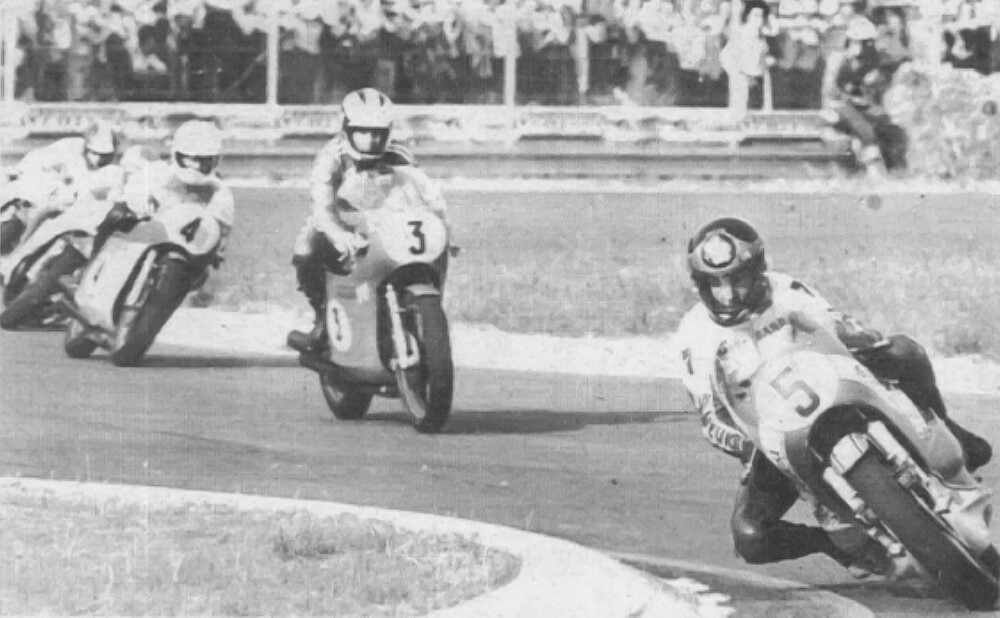
A race where “anyone could win” was now becoming a two-man battle, with Ago and Bonera outdistancing the rest of the pack. Agostini led, but Bonera shadowed him for the distance. They pushed each other to such a fierce pace that by the 31st go-round, the two Italians had lapped up to fourth place. Astonishingly, Agostini still had one more shattering run in reserve, setting one more track record on that same lap.
It was a grueling pace, one that had wrung much out of his Yamaha racer, including (and unfortunately for him) its most basic sustenance. On lap number 35, Ago, was in first place in his home country and within striking distance of lapping his archrival, Phil Read.
“The Yamaha coughed once,” Cycle News wrote, “and then droned to a standstill.” It was now clear why Yamaha had lobbied for a shortened race. The fuel tank on Agostini’s record-setting machine was empty, dry as a bone in the desert. Less than two laps remained.
If the Italians were heartbroken over Ago’s all-for-naught brilliance, they were equally as ecstatic for the victory earned by the little-known Gianfranco Bonera. Bonera had also come within feet of lapping his teammate, Read, “but diplomatically, the Italian eased off to win nearly one and a half minutes ahead of Lansivuori.”
Yamaha officials had pleaded for a 30-lap race. MV wanted a full 36. Had a fair compromise been reached, each team giving up three, the 33-lap contest would’ve produced a much-deserved victory for Giacomo Agostini. MV Agusta, however, would give nothing. And sometimes, nothing is a real cool hand. CN
Click here to read the Archives Column in the Cycle News Digital Edition Magazine.
Subscribe to six decades of Cycle News Archive issues