Cycle News In the Paddock
COLUMN
Explaining The Inexplicable
Long summer break was good. Going grand prix racing again, better. Especially when it is at Silverstone—not the world’s best track for spectators (atmospheric for sure, but the action is too far, too fast), but one of the very best for racing. Right up there with Phillip Island, Aragon and the late, lamented Brno.
Not least because its subtleties and speed make it unpredictable. The longest lap of the year and 18 corners of great variety are a heady mix. And the last eight British GPs there have had a different winner every time.
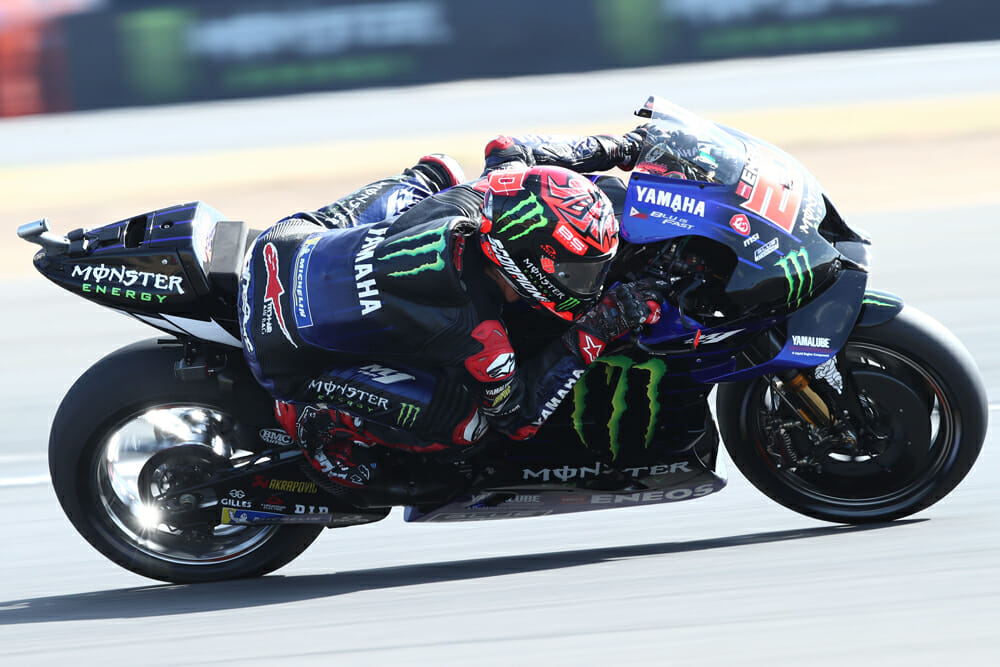
This year it was Bagnaia’s and Ducati’s turn. Slightly unexpectedly. Fabio Quartararo was invincible there last year, and although he did have a long-lap penalty to deal with, this is less severe at Silverstone than at (for example) Misano—1.5 seconds loss versus something closer to five (how can any of the FIM Stewards think that these penalties—so widely different from one track to the next—can be considered fair?)
Anyway, Fabio was expected to be able to make that up. He won by 2.6 seconds last year and hardly broke a sweat.
But the penalty, taken perforce early in the race with the pack still close, cost him four positions. That, in turn, put him in the Yamaha’s bad place—behind other bikes. When that happens, especially in hot weather (it was very hot), the R1 is in all kinds of trouble.
The explanation is simple enough. The tires overheat. And it’s more subtle than not only a factor of overheating rubber. The pressure goes up, the profile changes, and the edge-grip disappears.
The Yamahas are already well down on top speed—Quartararo was third-from-slowest through the speed trap at 205.8 mph, the top Ducati (Bastianini’s) clocked 211.6 mph. Its riders have to compensate with the sweet-handling bike’s sweeping lines and high corner speed. But when the grip goes, that goes with it.
Quartararo is already the only Yamaha rider able to qualify well enough to avoid getting mired in traffic, to have a chance to be competitive. In Britain, the next-best Yamaha was Morbidelli’s in a distant 15th. Dovizioso and Darryn Binder didn’t even make the points. Dovizioso, in fact, is so disillusioned with the unequal struggle that he decided during the break to resign after his home race at Misano, missing the last six rounds altogether.
Even the defending champion, however, once he has four bikes in front of him, cannot avoid the trap. “Overtaking is almost impossible,” he moaned after dropping back from second on lap one to a dispirited eighth at the end.
That, in turn, put him in the Yamaha’s bad place—behind other bikes. When that happens, especially in hot weather (it was very hot), the R1 is in all kinds of trouble.
At Silverstone, he had found a new way to fall into the trap. Instead of the front tire overheating, spoiling braking and turn-in, it was the rear.
Obviously, everybody’s tires suffer in the same way, hence the controversy over tire pressures, already “governed” by a rule that is apparently too difficult actually to be enforced. But not everybody’s race performance suffers in the same way. Notably not the pace of the Ducatis and now also the Aprilias.
It’s easy to draw the conclusion that this is because they are V4s, naturally more powerful and in some respects more agile (or less stable) than in-line fours, largely because of their shorter, stiffer crankshafts and narrower engine width.
Where a more stable in-line four can manage fast corner speeds, a V4 attacks them differently, braking harder, slower mid-corner then blasting out faster, having got in the in-line four’s way mid-corner.
Crucially this means loss of tire edge grip makes less difference to a V4.
Yet, as always with motorcycles, things tend to be a little more complicated and a bit less readily explained, because the Suzuki, whose engine is almost identical to the Yamaha’s, doesn’t suffer in the same way.
Just to prove the point and muddy the waters, Alex Rins was able not only to move from fifth on the first lap into the lead on the sixth at Silverstone, but to stay there for six laps. Although to be fair the effort took so much out of his tires that he eventually faded to seventh. Still one place ahead of Quartararo.
The end result of all this was most encouraging for the championship. Bagnaia’s win to Quartararo’s eighth cut the points deficit from 74 to 49 with eight races to go, four of which Bagnaia won last year. At the same time, the closest title challenger Aleix Espargaro, far from fit after a horrible slam-dunk highside the day before, lost just one point to the leader, finishing a close ninth after his last-lap overtaking attack was repulsed.
Whatever next? Austria’s simplistic Red Bull Ring, and then another seven more tracks.
Yes, racing is definitely better than being on holiday.CN
Click here to read the In The Paddock Column in the Cycle News Digital Edition Magazine.
Click here for all the latest MotoGP news.