Cycle News Archives
COLUMN
This Cycle News Archives Column is reprinted from March 10, 2010. CN has hundreds of past Archives columns in our files, too many destined to be archives themselves. So, to prevent that from happening, in the future, we will be revisiting past Archives articles while still planning to keep fresh ones coming down the road -Editor.
Memories Of Meadowlands
Many vintage aficionados consider the early 1960s as one of the most interesting times in American road racing. Flat track dominated the professional racing scene in this country in the years after World War II and Daytona and Laconia were typically the only road races. There was a bit of an anomaly in the mid-1950s when road racing had a surge at tracks like Dodge City (an airport course) and Windber, Pennsylvania (a city park), and Torrey Pines, California (an abandoned Army base and now site of a famous golf course), but through the late ’50s it was back to just Daytona and Laconia.
Sports-car enthusiasts began building road-race courses at a rapid rate in the late 1950s and early ’60 and a growing grassroots club road-racing scene led the AMA to dramatically increase it national road-race schedule in the 1960s.
One of the most interesting circuits to host AMA Road Race Nationals in the 1960s was Meadowdale International Raceway in Carpentersville, Illinois, about an hour northwest of Chicago. What made the 2.5-mile Meadowdale motorcycle course unique from other road-race circuits was the track’s infamous Monza Wall. The Monza Wall was inspired by the famous Italian circuit’s Wall turn. Meadowdale’s Monza turn was steep, and it got steeper the high you went. Coming out of the Monza Wall led to the front straight with large grandstands on the outside of the track and a four-story scoring and announcing tower overlooking the pits. The paddock was complete with covered pits with second-story spectator viewing area on top, all in whitewashed wood.
Anyone who talks about Meadowdale talks about the Monza Wall. Jody Nicholas, who won the first AMA National at the track in 1963, said, “If you went all the way to the top [of the Wall], you rode nearly perpendicular to the ground. The radius of the turn was about equivalent to what you’d expect on a Mile track, so it was much tighter and seemed steeper than Daytona.”
It was very likely the first time any of these riders had ridden a high-bank turn. The Daytona races went to the Speedway in 1961, but the banking wasn’t used there until ’64. Meadowdale probably played a part in convincing AMA officials that racing on banking was at least workable, giving them the confidence to go ahead with it at Daytona.
With its high-banked turn and three-quarter-mile-long front straight, Meadowdale, built in 1958, was a very fast circuit, with the motorcycles averaging over 80 mph on the 2.5-mile motorcycle configuration (the track had other options as well that lengthened it to as much as 3.3 miles) during the 150-mile Nationals.
Looking at Meadowdale’s Monza Wall for the first time left riders scratching their heads.
“It was a very hard track to figure out,” said Dick Mann, a two-time National winner at Meadowdale. “When we first went to the track, we looked at the Wall and didn’t want to ride on it. A lot of riders stayed near the bottom in the first couple practice laps, but eventually we got up the nerve to ride up there and found it was a much faster line. You’d ride about midway to three-quarters up the Wall and your bike’s suspension would be completely compressed from the G forces.”
The other interesting thing about that era in road racing was the diversity of motorcycles. You had Harley-Davidson KRs, BSA Gold Stars, Triumph 500 Twins, Matchless G50s and a few other brands such as Norton. All were allowed European-style fairings for the first time in 1963. Some teams went with them while others continued without fairings.
The diversity was even more evident in the 250cc class, which now ran at all road-race Nationals. There you had the new Aermacchi-built Harley-Davidson Sprint CRTT, Ducati Diana, Honda 250 Hawk, Yamaha TD1 and various Bultaco, Montesa and Parilla 250 racers. Yamaha was eager to give its TD1 a strong introduction into U.S. racing, and it came along just in time for the new road-race tracks that were now hosting AMA Nationals. Some of the top racers were given $500 per weekend just to race the Yamaha in the 250cc class.
Nicholas was hot coming into the Meadowdale debut in ’63. He’d won Laconia in June and was certainly one of the favorites at Meadowdale. Unbeknownst to anyone but Nicholas, he’d seriously tweaked his shoulder in a regional cushion-track flat track in Marion, Ohio, a couple of weeks before Meadowdale. He could barely lift his left arm at all, but fortunately the BSA and the Yamaha he’d ride in the National and 250 races, respectively, had low clip-on bars.
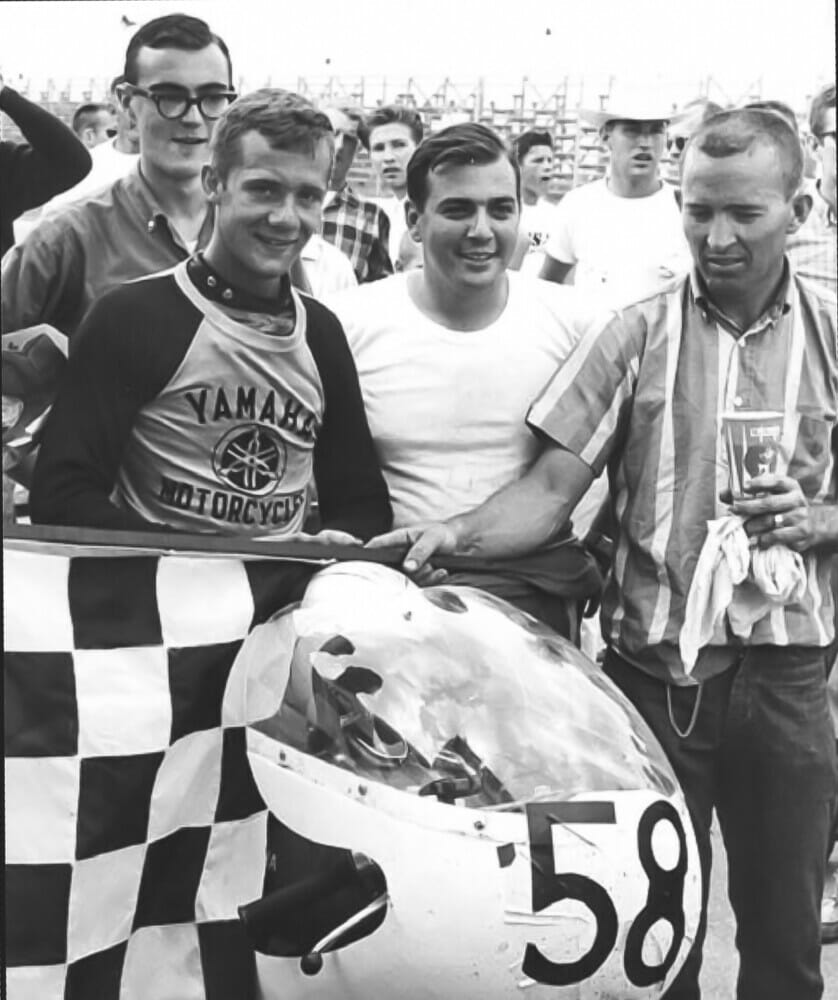
“I could get my arm up enough to put it on the bars, and, once I did that, I was good,” Nicholas remembers. “I lived in Nashville at the time and BSA paid me $100—which was worth a lot more then than it is now—to transport the BSAs from Nutley, New Jersey, to Chicago [Meadowdale]. Joe DiSimone, a dealer outside of Philadelphia, was helping me and he’d arranged for me to race that Yamaha TD1A.”
Nicholas won the 250cc race on the TD1A that day at Meadowdale, becoming the first rider to win a 250cc National on a Yamaha.
“I felt sort of guilty,” Nicolas said. “That little two-stroke was so fast compared to the Harley Sprints. [Gary] Nixon and [George] Roeder were on Sprints and I just walked away from them.” In the 150-Mile National, Nicholas didn’t have it so easy. Riding the unfaired BSA, he battled Dick Hammer, who was riding a Harley KR with a full fairing. The two battled wheel to wheel most of the way, with Nicolas nervous running the under-geared BSA up to 120 mph, singing the motor past redline to 8000 rpm in Hammer’s draft.
“That BSA only had a five-gallon tank versus the Harley’s big, hand-fabricated eight-gallon tanks,” he explained. “That pit stop cost me about 30 seconds, and I started chipping away at Dick’s lead, and I had it down to about 13 seconds with a few laps to go, but he had me covered.”
But the race took a sudden turn when Hammer ran off the track with two laps to go, his Harley having suffered a flat rear tire. He pulled in the pits, but his crew waved him on, and he limped home to second—slithering around with a completely flat tire.
Nicholas’ double marked the first time a rider won both the National and 250cc race on the same weekend. The Meadowdale race lasted for two more years. Mann won both the 1964 and ’65 races on Matchless racers. In ’64, Hammer had it won until a shift lever broke. In ’65 Lady Luck was with Mann again. Roeder was leading with a 20-second lead until his bike began sputtering on the final lap. Three turns from the checkered flag, Roeder’s Harley rolled to a stop and Mann zoomed by to win the final National held at Meadowdale.
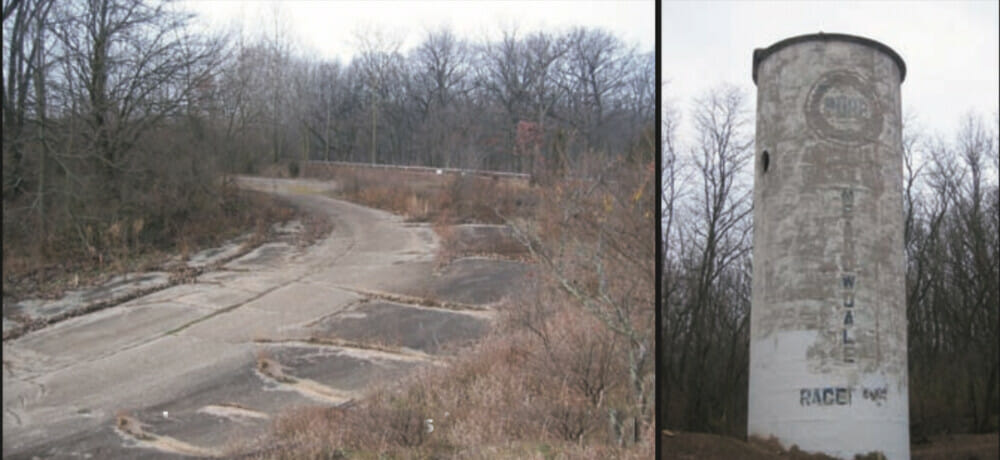
By the mid-1960s things were not going well financially with the circuit and at one point an unpaid contractor smashed his bulldozer through a guardrail in the middle of an SCCA race. Barely 10 years after the track was built it fell into disrepair and closed for good in 1969. Today Meadowdale’s grounds are a forest preserve and weed-infested remnants of the original pavement still exist. Walking the grounds, you can easily make out the course and some guardrail posts remain. The Monza Wall was leveled years ago and little of the infrastructure remains, expect for an old landmark—a grain silo with a faded Pure Gasoline logo painted on the top.
Meadowdale will always be remembered by those fearless riders who braved its steep Monza Wall and tracks like Meadowdale went a long way toward moving along the trend of European-style road racing in America. The sport quickly gained momentum, which eventually led to a separate AMA National Road Racing Championship by 1976. CN
Click here to read the Archives Column in the Cycle News Digital Edition Magazine.
Subscribe to nearly 50 years of Cycle News Archive issues
Click here for all the latest Road Racing news.