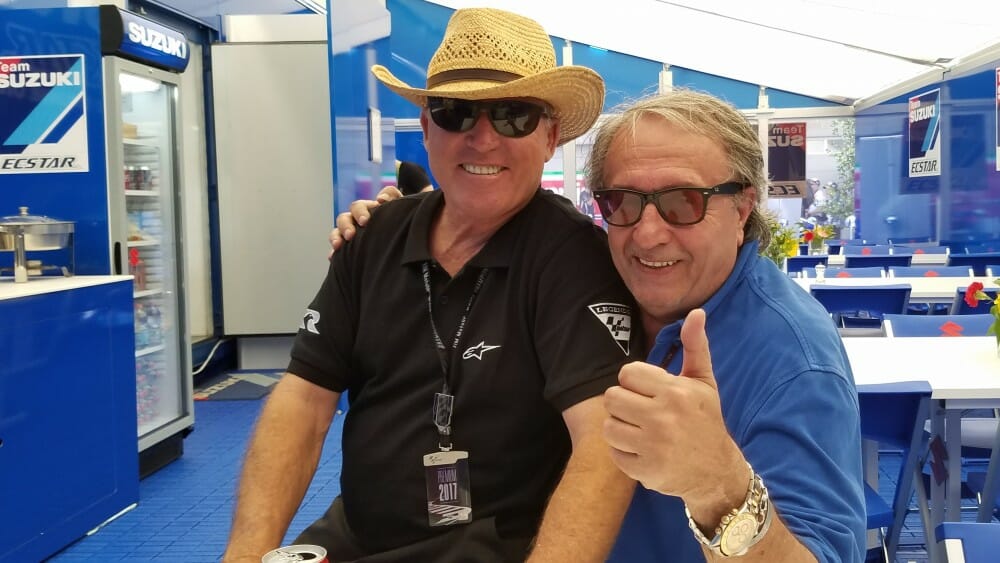
 Carlo Pernat horsing around with his friend Kenny Roberts at this year’s MotoGP at COTA. (Larry Lawrence photo)
A man who helped revive Ducati, signed Randy Mamola to Cagiva when he was at his peak, helped turn Aprilia into a GP powerhouse, gave Valentino Rossi his first ride and later managed the likes of Max Biaggi, Loris Capirossi, Marco Simoncelli and now Andrea Iannone. You might call this man a mover and shaker in the racing world, or you could just call him Carlo Pernat.
Pernat has been around the sport for decades. He can’t walk more than a few steps in the paddock without someone stopping him to say hello. Pernat is also one of the key individuals whose opinion those in power listen to. Yet perhaps even more importantly than being one of the major behind-the-scenes players in MotoGP, Pernat is happy for one reason – he followed his passions and as a result has lived a life being involved in the sport he loves.
While he’s been around racing all his life, including, as a kid of 8 or 9, seeing first hand many of the Italian racing greats like Renzo Pasolini and Giacomo Agostini, a good launching point to his story could be 1985. Pernat was on hand at a pivotal moment in Ducati history. At the time, he was with Cagiva, heading up that company’s racing programs, including off-road, motocross and road racing. Pernat takes up the story from there.
“In ’85 Ducati was broken,” he explains. “They were barely producing any motorcycles, maybe 100 per year. The owner was the Italian government. I was there with Claudio and Franco (Castiglioni) when the Cagiva Group bought Ducati. They saved Ducati. They developed a new Superbike and began racing and Ducati grew. If not for the Castiglionis, Ducati was dead.
“It was a beautiful period. The Castiglioni brothers sent me to open Ducati in North America. It was in Los Angeles… Torrance. And we launched with the Ducati Paso, bravo! In red or blue and white, it was an unbelievable. We began to sell a lot of motorcycles. It went very well and after six months I returned to Italy.”
From there Pernat was assigned to help advance Cagiva’s GP racing team. Randy Mamola had just finished runner up to Wayne Gardener in the 1987 500cc Grand Prix World Championship, so it seemed rather ambitious for less established team to go after him, but Pernat was undeterred and managed to sign Mamola to race the new Cagiva GP500 alongside Raymond Roche.
“It was a beautiful start,” Pernat recalls. “We made the first podium in Francorchamps (Belgium) in the wet. It was unbelievable for Cagiva to earn a podium in the first year of the motorcycle.”
In 1990 Pernat accepted a lucrative offer to go to head up Aprilia’s racing efforts. It was the start of perhaps Pernat’s most successful period. Aprilia not only won numerous world championships in the 125 and 250cc categories, Pernat also began a period of giving opportunities to riders who would go on to become some of the most talented GP riders of the era.
“I discovered Biaggi in ’90,” Pernat says. “I discovered Valentino in ’95. I remember his father Graziano, who was a personal friend, called me every day and say, ‘Carlo, you are my friend and you run Aprilia, come watch my son!’ I went to Misano to watch Valentino on a Cagiva 125 production bike. I remember he made some unbelievable lines. He could treat a motorcycle like a bicycle and he reminded me of Kevin Schwantz. I immediately got with Graziano and we signed Valentino to a three-year contract.
“At that time, I could imagine Valentino being a GP winner and perhaps even a world champion, but a nine-time champion? No, this I could not predict.”
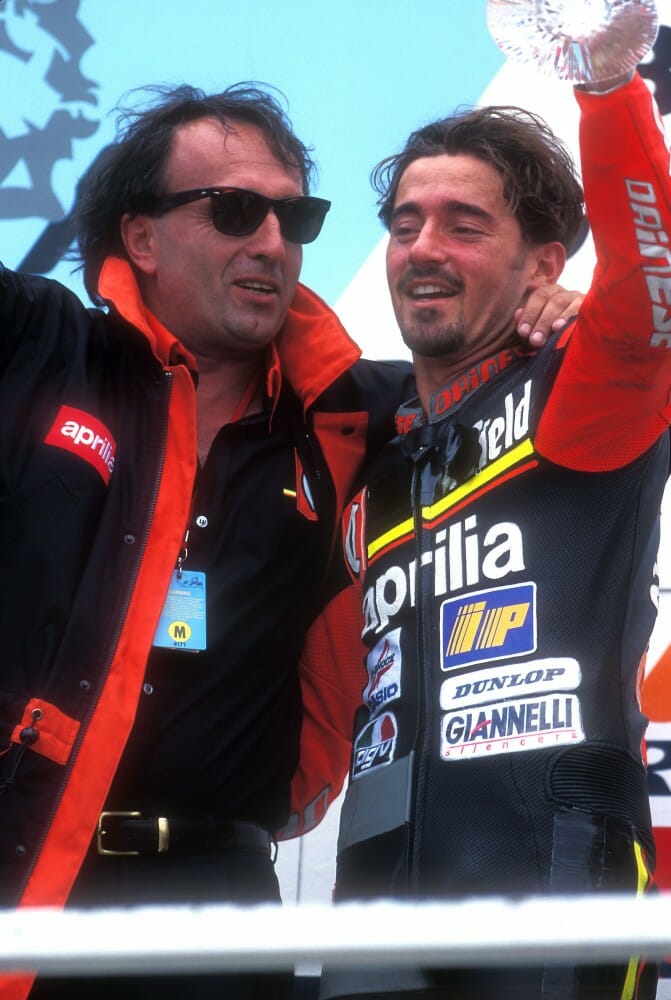
Carlo Pernat in the mid-1990s with one of the first riders he discovered, Max Biaggi. (Gold & Goose photo)
Like any good Italian, the other passion in Pernat’s life was football (or soccer as we Americans like to call it). He’d grown up a fan of his home Genova club. He took a job in the sport, but found he did not like the business atmosphere of soccer and left the sport after only a couple of years.
“That is when Loris (Capirossi) called me to ask if I would be his manager,” Pernat said. “I said, ‘OK, why not.’ And I worked with Loris until the end of his career.”
Having great success as manager for Capirossi led to others calling to ask if he would manage them as well. One of those was Marco Simoncelli’s father. Pernat worked with Simoncelli throughout his GP career. Today Pernat manages Andrea Iannone.
“I’ve worked with a lot of riders,” Pernat said. “And each one of them had very different personalities. It is not easy to be a manager because you have to work a lot from a psychological point of view. For sure you must be an expert in everything. I manage in 360 degrees – I work with the riders on their contracts, with their sponsors, the press, their communication, their marketing. I attend every time they are on the circuit starting with the tests.
“You must learn to understand the riders. It is not easy, but if you have a passion they can tell and you will become friends. If you are not friends, you cannot be their manager because you will make a mistake.”
Of all the things Pernat has accomplished in his career, he perhaps looks most fondly at his time as Sport Manager with Aprilia.
“We start from zero and we decide everything,” he says. “And then we start winning in 125 and 250. It was difficult because Honda was so strong, but finally we arrive at the top.”
But if he had to pick personalities who were his favorite to work with in the sport, it was without question the Castiglioni brothers.
“They had such a passion for motorcycling,” Pernat explains. “I will tell you a story about the younger brother Claudio. When the new bike was finished by the racing team and the office was closed, he telephoned the police in Varese. They stopped the traffic and he tested the bike on the streets of Varese. Unbelievable.”
While Pernat marvels at how far motorcycle racing as come in his lifetime, the one thing he does miss is the times when the owner of a company could make a decision in five minutes, based on passion for racing, and the company would go forward with that plan.
“Today there is some brainstorming sessions and then there are endless meetings with financial department, marketing department and the commercial department to get anything done. This is the reason back in those days Aprilia and Cagiva could win so quickly, because a decision could be made decisively by one owner.”
We are fortunate to still have a man like Pernat, who remembers and was a part of a simpler and some would say, more colorful day of GP racing.

