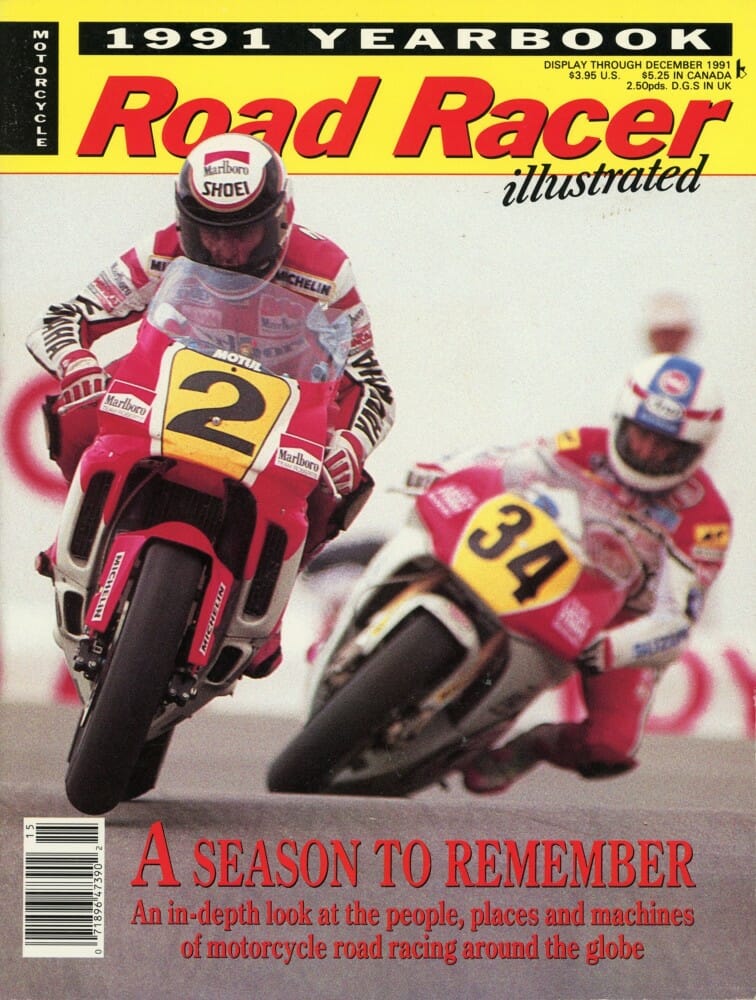
It’s been 20 years now since the last issue of Motorcycle Road Racer Illustrated rolled off the presses. The magazine, while relatively short-lived, set new standards on how the personalities of road racing were covered and was seminal in making the stories of the sport’s personalities the stars versus the more technical oriented, or lap-by-lap race coverage of previous generations, a legacy that continues to this day. And as the title implies, the magazine featured some of the best racing photography of the day and showed the photos large, sometimes spread across two pages, bringing to the forefront the spectacular imagery of motorcycle road racing.
Motorcycle Road Racer Illustrated was launched in 1988 and initially came out as a bi-monthly. Cycle News editor Paul Carruthers would also edit the publication with Brian Catterson serving as Associate Editor. The magazine also relied heavily on a strong bullpen of contributors, including Henny Ray Abrams, Alan Cathcart and Michael Scott. Ace photographers such as Abrams, Nick Cedar, Patrick Gosling, Bert Shepard, Tom Hnatiw, Rich Chenet, George Roberts and John Flory, among others, provided impactful images.
Since race coverage was the domain of sister publication Cycle News, MRRI focused on going more in depth with the riders, team owners and mechanics of the sport. This was one of the first times readers would be taken to Eddie Lawson or Wayne Rainey’s house and got a glimpse into their regular every-day lives away from racing.
There was Doug Polen or Miguel Duhamel swinging away at golf right outside their backdoor in the golfing communities where they lived. There was Scott Russell on the balcony of his high-rise condo overlooking downtown Atlanta. There was Wayne Gardener on his 46-foot speed boat docked in the harbor in Monaco. Or Kevin Schwantz blitzing around Texas Hill Country on his mountain bike. It was an insight into the lives of the racers fans had rarely seen before.
“Road Racer Illustrated was ahead of its time,” said veteran racing photographer Tom Riles. “In the other (motorcycle) magazines racing was the back of the book, mostly with tiny black and white images. And they might cover the race itself or a particular machine, but rarely did you get to know anything about the riders. I think Road Racer Illustrated came at a time when road racing was just starting to peak and they were on the forefront of that trend.”
MRRI Editor Paul Carruthers, who now heads up communications for MotoAmerica, agreed that the timing seemed right for a road racing glossy.
“When we first came out it was six times a year and after we didn’t get the advertising support we’d hoped for we made it an annual,” Carruthers recalls. “At the time road racing was at a pretty high point. There wasn’t a magazine like that, a glossy, full color magazine devoted to road racing in this country. There were several others around the world and obviously with my background (son of World Champion Kel Carruthers) I was aware of those magazines and I always thought that they were really cool, except they weren’t in English.
“Our idea was to create a magazine that focused on AMA Superbike racing, but also covered international racing. The whole idea was to have nice, big, glossy, four-color photos and different sort of articles that were more in depth and analytic than a normal race report because it came out a few months after the events.”
After a couple of years when the publication went from bi-monthly to an annual it was a wrap of that season’s road racing. It featured not only the stories, but graphs showing the finishes of each rider throughout the season in the various championships and as a result it became more that something people would want to hold onto as a reference.
“Not that many people remember it today, but then I’ll mention a feature we did and they’ll say, ‘Oh yeah I remember that.’ And they’ll be able to remember photos that were used and things like that.”
One other legacy MRRI left with the industry was the fact that Carruthers hired Brian Catterson to become Associate Editor. Catterson went on to have a prolific career in motorcycle journalism that included later becoming an editor at American Roadracing, executive editor at Cycle World and Editor in Chief at Motorcyclist.
“I’d been interviewing with Paul for six months,” Catterson remembers. “I’d sort of given up on it and a friend of mine and I were just about to open a business, we literally were about to sign a lease on a building, when Paul called me and asked me when I could start.”
Carruthers said his experience at MRRI, along with Cycle News, prepared him well for a life in moto-journalism.
“I was constantly interviewing, travelling, writing and editing other people’s stuff, so it was an intense period of training,” Catterson said. “I was proud of the stories we produced at Road Racer Illustrated. We tried to go more in depth than just about anyone else was doing at that point. When the bi-monthly ended and it went to an annual I was worried I was going to lose my job, but fortunately Cycle News was going gang busters and I started doing more race coverage for them.”
In November 1996 Cycle News Inc. quietly announced in a short item “In the Wind” that it was suspending publication of Motorcycle Road Racer Illustrated. After eight years the company cited cost of producing and distributing the magazine as being “no longer feasible.” Ironically the publication went defunct at about the very time that sport bikes sales began a decade-long boom, that would also see interest in the sport of road racing in America at an all-time high.
“Cycle News was the cash cow for the advertising staff at that time,” Carruthers points out. “And it was difficult maybe, to put the kind of time and effort into selling advertising for another title, when the returns weren’t as great.
Even though it was relatively short-lived, MRRI made an impact on the sport and certainly presented a new way motorcycle road racing could be covered.