The Yamaha YZF-R7 has always occupied an interesting space in the modern sportbike landscape. Since its introduction (don’t call it a reintroduction, as we all know the R7 of the late ’90s is the real one), its MT-07-derived engine and light, snappy chassis have provided a gateway into sportbike riding for newer riders while still offering a platform more experienced riders can enjoy.
Photography by Joseph Agustin
For 2026, however, Yamaha has taken another step forward, transforming the $9399 R7 from a relatively simple middleweight into a more sophisticated ride. With the addition of ride-by-wire throttle, a full electronics suite governed by a six-axis IMU, a new chassis and revised ergonomics, this is no mild update—it’s a fundamental evolution in the face of competition from both at home in Japan and in Europe.
At the heart of the R7 remains the familiar CP2 engine. The 689cc parallel-twin that has proven itself across the MT-07, Tracer 7 GT, Tenere 700 and XSR700, meaning Yamaha has indeed got lots of bang for its development buck. It retains the signature 270-degree crankshaft, delivering a claimed 73 horsepower at 8750 rpm and 50.2 lb-ft of torque at 6500 rpm, numbers that are unchanged from 2025.
For 2026, internal changes are subtle. A new, reshaped airbox with a now-straight-down draft duct gives smoother throttle response and more intake roar, and the new ride-by-wire throttle sharpens throttle response and smooths out closed-throttle transitions. The rider now has access to Rain, Street and Sport modes, two custom road modes and four custom track modes, so if you can’t find your ideal setting, go do something else.
The introduction of ride-by-wire is the biggest leap forward for the R7. It unlocks the full suite of electronics that brings the bike in line with the R9 and R1. Riders now have access to multiple riding modes, adjustable cornering traction control and ABS, slide control, and engine-brake management, all working in harmony through a six-axis IMU.
This transforms the R7’s personality. While the previous model relied almost entirely on rider input, the 2026 version adds an AI layer that enhances both performance and confidence. Or does it?
I’ve never been one for overly electrified systems on bikes with under 80-odd horsepower, but perhaps that’s where they’re needed the most. In its early years, the R7, despite lacking all the bells and whistles of something like the Aprilia RS660, gave plenty of control to the rider’s right hand without diluting the experience behind an electronic wall. But, hey, it’s progress, right?
Out on the road, the new R7’s multiple personalities are immediately noticeable. In its more conservative riding modes like Rain and Road, throttle response is softened and traction control is more intrusive (you can change these parameters within each mode you want), making the bike very forgiving.
Switch into the more aggressive modes, and the R7 sharpens considerably. Throttle response becomes immediate—more like the old bike—and you can loosen the traction control’s grip, so the little R7 begins to feel more alive. It’s no powerhouse, but the R7 engages in a way that rewards precision and commitment.
The IMU also brings cornering ABS into the equation, a feature that will be a selling point for new riders, as hard braking while leaned over should be a little less intimidating. It’s not something you consciously notice, but it’s there when you need it. On the mechanical side, the brakes are the same four-piston calipers gripping 298mm discs up front and a single-piston caliper biting on a 245mm disc out the back. Feel is reasonably good for the price point, especially since Yamaha hasn’t overly skimped on the master cylinder, allowing the rider to learn the intricacies of trail braking with the added safety net of cornering ABS.
Chassis-wise, the steel frame has undergone a major overhaul. A 12 percent increase in torsional, longitudinal and lateral stiffness is aimed to give the R7 more consistent track performance while still being compliant on the street, and a new swingarm, matched to a new linkage ratio with four percent less leverage and a higher pivot, has been developed to help provide more feel and grip while on the side of the tire.
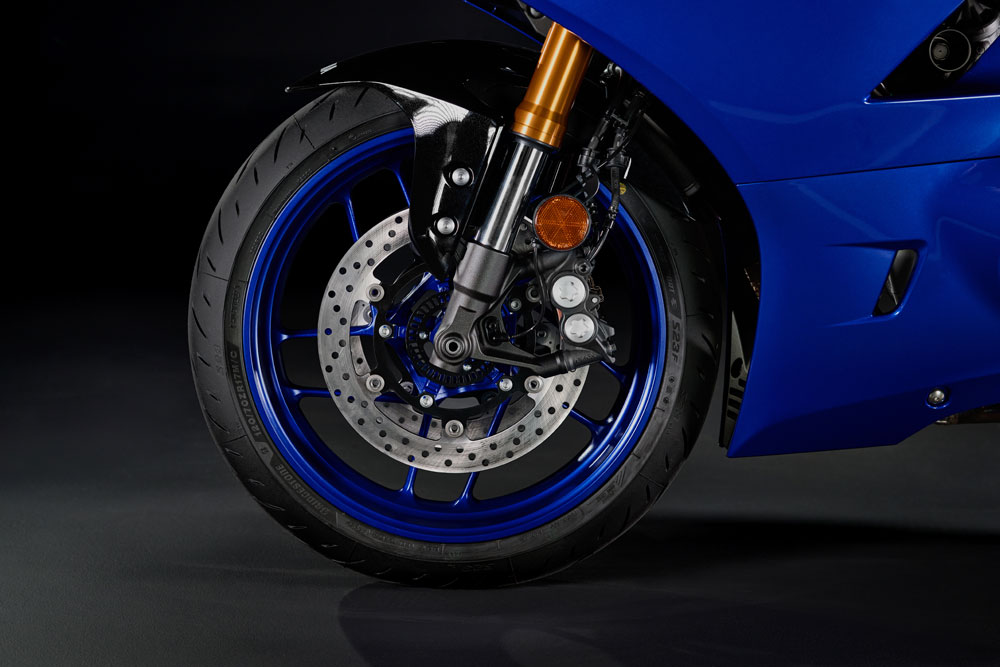
KYB has gone hard with the updates to their fully adjustable fork. The rods are changed from steel to aluminum, which netted an impressive 350-gram weight reduction, while the spring rate was reduced 0.5N/mm, with the low- to mid-speed damping increased.
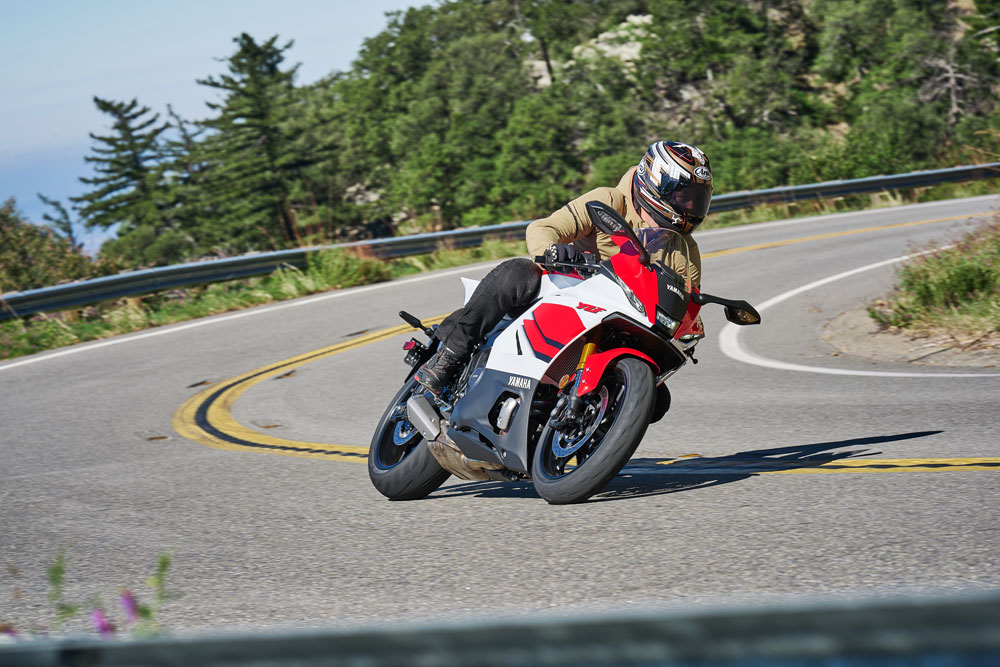
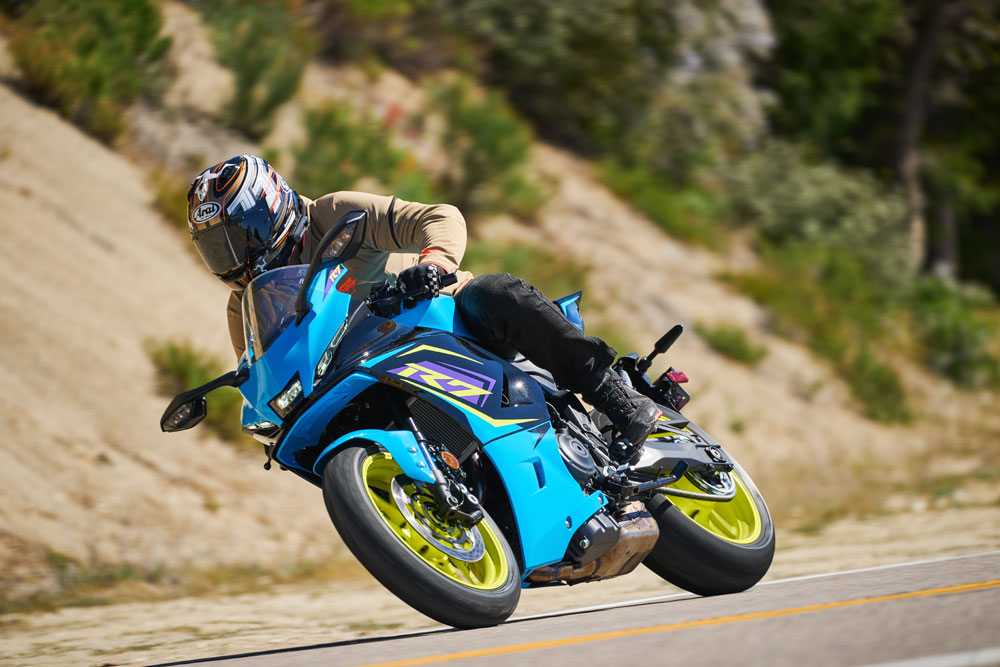
It’d been five years since I last rode an R7, so I can’t, hand on heart, tell you if those changes wrought have made any difference. However, in isolation, the 2026 R7 is a sharp little tool indeed for charging through your favorite twisties. It turns incredibly quickly, thanks in part to Yamaha’s fitment of Bridgestone’s excellent Battlax Hypersport S23 tire around its new, lighter 10-spoke aluminum wheels, but despite the R7’s turn of speed, it has a stability to it that belies its claimed 417-pound wet weight.
The result is a bike that feels more composed across a wider range of riding scenarios. On smooth tarmac, it’s precise and predictable, encouraging you to carry corner speed and focus on lines rather than acceleration. The R7 is a throwback to the two-stroke bikes of yore, like the Suzuki RGV250 and the Yamaha TZR250, bikes that required you to really ride them and make the most of their ability to rip through corners and embarrass riders on bikes four times their size.
On less-than-perfect roads, it keeps its composure, absorbing bumps without unsettling the chassis. However, it’s not exactly comfortable. This is a pure sportbike, after all, and you’ll feel all the weight on your wrists after half an hour onboard. This is despite Yamaha moving the handlebars 8.4mm back, 3.6mm higher, and the clip-ons being 12mm longer; there’s a fatter but 10mm shorter fuel tank that’s up one liter in capacity to help the rider grip it better during braking and cornering, along with a 5mm lower but wider seat to help shorter riders reach the pavement. It remains very much a supersport in terms of rider triangle, and if you can handle a head-down, ass-up riding style like this for long periods, more power to you.
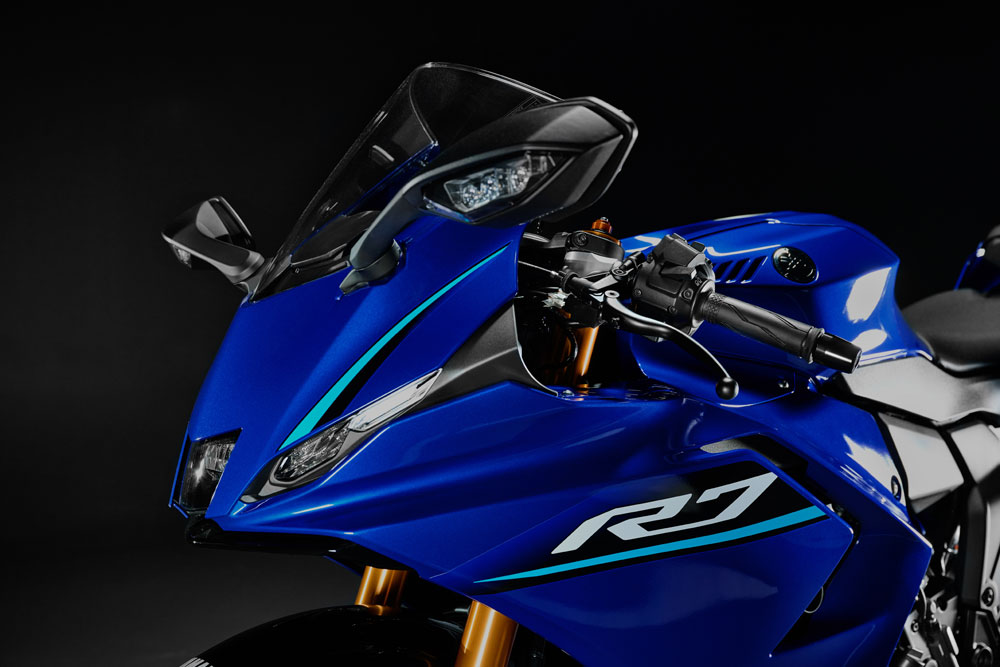
Visually, the 2026 R7 doesn’t stray too far from its predecessor, but there are enough changes to give it a fresher, more modern appearance. Integrated indicators with the mirrors clean up the side of the bike somewhat, but the 2026 version is still very close to the old model in terms of looks. The design remains unmistakably Yamaha, with a clear lineage to its larger supersport siblings.
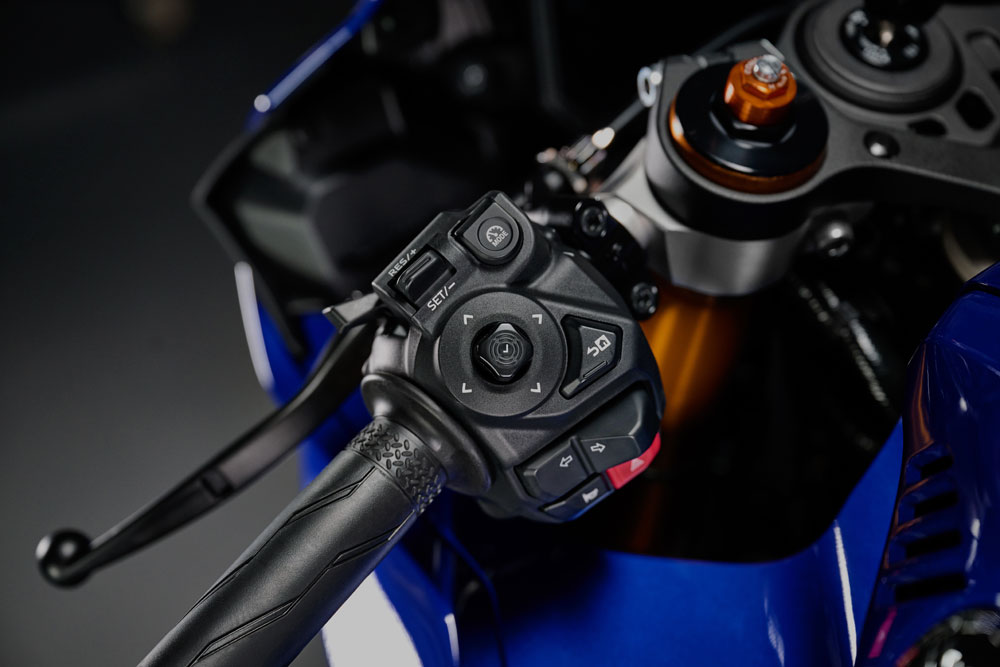
The cockpit sees a more significant update thanks to the fitment of the IMU and all the gizmos within it. As standard fitment, the R7 has those (you ready?) eight possible ride modes, cornering traction control and ABS, wheelie control, brake control, up-and-down quickshifter, engine-brake management, back-slip regulator and launch control. Plus, there’s cruise control, a traffic speed limiter (think of it like a pit-lane speed limiter where you select the speed and no matter what you do at the handlebar, it won’t go faster), phone connectivity and turn-by-turn navigation and data logging via the new Yamaha Y-TRAC app so you can figure out everything from gear and throttle position to pitch angle and TC intervening at your next track day.
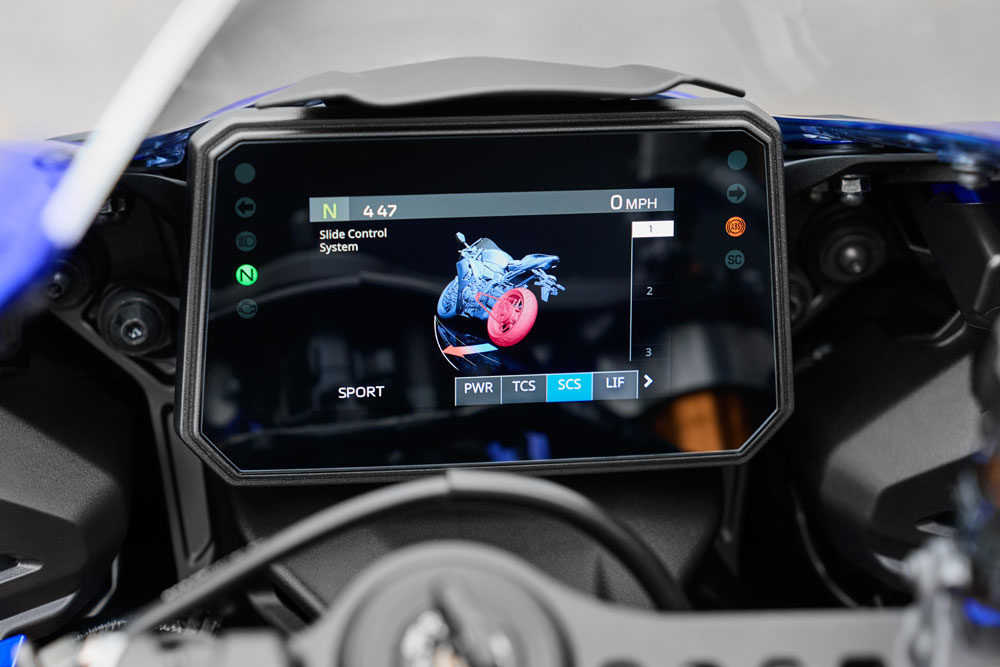
This level of tech is pretty remarkable for an entry-level sportbike and is on par with what guys who race supersport at a decent level have.
It’s impressive how cohesive it feels as a package. The addition of electronics could easily have disrupted the bike’s simplicity, but instead, it enhances it. It still feels like an R7—engaging, approachable and rewarding—but with an added layer of sophistication.
Track riders will love this level of tech, but they’ll need an instruction manual on how to access all the bits and how to understand them. I used a similar system at the 2024 Panigale launch, and it is mind-blowing how lost you can get in the electronic maze, but the proof comes when you see your lap times drop consistently due to your increased understanding of what you’re doing and what your bike is doing beneath you.
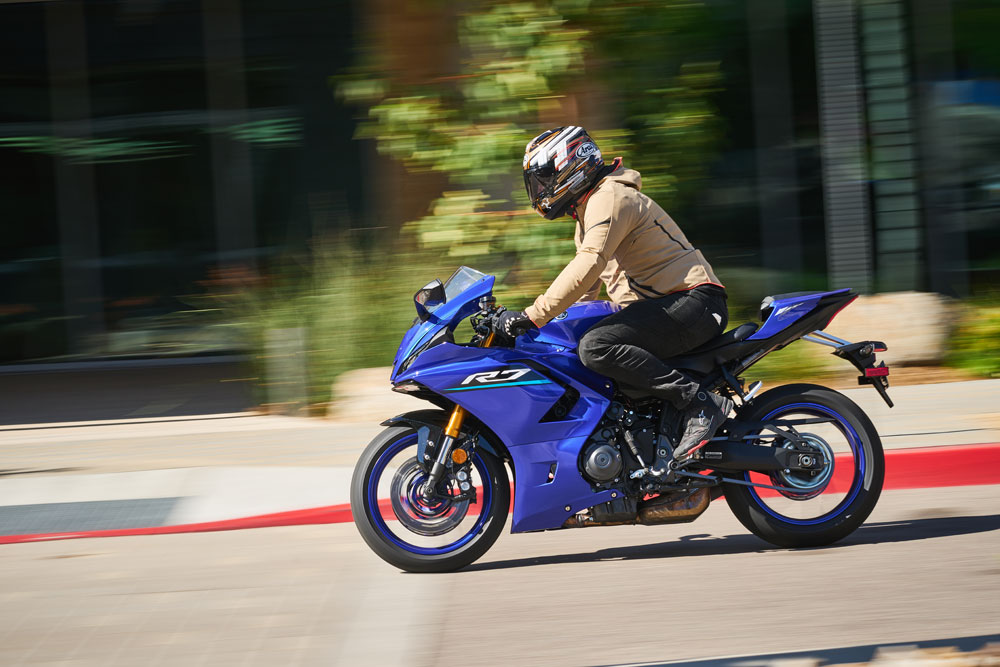
There’s also something to be said for the R7’s relative accessibility. In an era where performance figures continue to climb, it’s refreshing to ride a bike that emphasizes connection over outright speed. The R7 remains a bike that encourages you to become a better rider, rather than relying on sheer power to mask mistakes, again, just like those old 250cc two-stroke motorcycles of the last century.
Of course, it’s not without its limitations. Riders seeking top-end performance will find the engine lacking compared to inline-four competitors. The parallel-twin’s strengths lie in its midrange and usability, not its ability to deliver blistering acceleration at high rpm.
The 2026 Yamaha YZF-R7 represents a significant step forward for the model. By embracing modern electronics and refining key aspects of the bike, Yamaha has created a machine that feels more complete, more versatile, and more capable than ever before. It retains the qualities that made the original R7 appealing while addressing its shortcomings in a serious way.
It doesn’t try to be everything to everyone, but what it does—being a no-excuses sportbike for the newer crowd—it does exceptionally well.CN
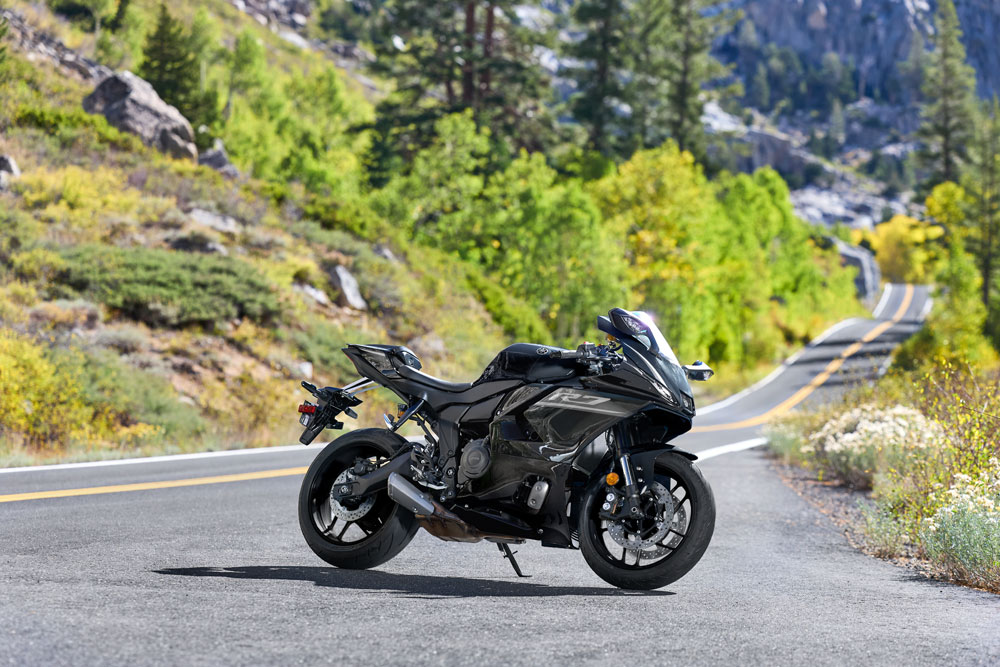
2026 Yamaha YZF-R7 Specifications
| MSRP | $9399 |
| Engine | Parallel-twin |
| Valvetrain | 8-valve, DOHC |
| Displacement | 689cc |
| Bore x Stroke | 80.0mm x 68.6mm |
| Cooling System | Liquid |
| Compression Ratio | 11.5:1 |
| Transmission/Final Drive | 6-speed / chain drive |
| Horsepower (claimed) | 72.4 hp @ 8750 rpm |
| Torque (claimed) | 50.2 lb-ft @ 6500 rpm |
| Fuel System | Fuel injection, Y-CCT ride-by-wire |
| Clutch | Wet, multi-plate |
| Engine Management/Ignition | 6-axis IMU, Yamaha Ride Control (YRC) |
| Frame | Diamond-type steel |
| Front Suspension | 41mm USD forks, adjustable preload, rebound and compression |
| Rear Suspension | Link-type monoshock, adjustable preload and rebound |
| Front-Wheel Travel | 5.1 in. |
| Rear-Wheel Travel | 5.1 in. |
| Front Brake | 4-piston radial-mount Advics calipers, dual 298mm discs w/ ABS |
| Rear Brake | 1-piston Nissin caliper, 245mm disc w/ ABS (switchable) |
| Front Tire | Battlax Hypersport S23, 120/70 ZR17 in. |
| Rear Tire | Battlax Hypersport S23, 180/55 ZR17 in. |
| Rake | 24° |
| Trail | 3.6 in. |
| Wheelbase | 54.9 in. |
| Ground Clearance | 5.3 in. |
| Seat Height | 32.7 in. |
| Fuel Capacity | 3.7 gal. |
| Weight (wet, claimed) | 417 lbs. |
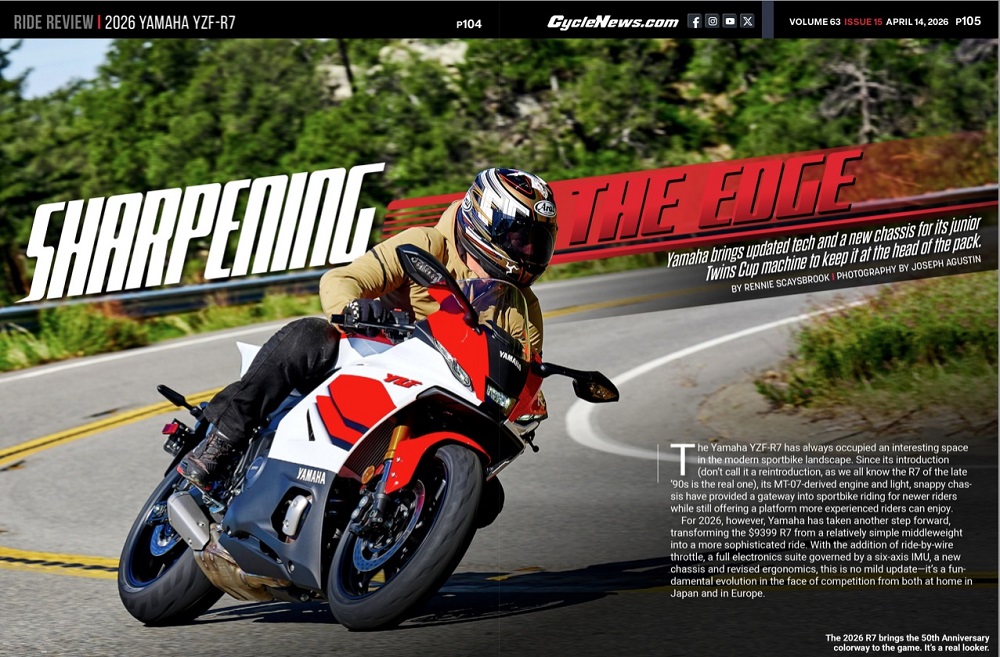
Click here to read the 2026 Yamaha YZF-R7 Review in the Cycle News Digital Edition Magazine.