Cycle News Archives
COLUMN
Ahead of Its Time
By Kent Taylor
Traversable wormholes, those mysterious passageways that will allow time travel for humankind, may already be with us, and one of the top beneficiaries will be the motorcycling industry. Say what? Yep, the Doctor Whos of the two-wheeled industry are busy at work in a future world, and the proof is right there on your screen where a certain American motorcycle company is showcasing a sport bike that, in the world of mass production, doesn’t even really exist. These Time Lords are watching and waiting for our reactions, observations, compliments and criticisms. When they have the data they need, they will return to the present, when said motorcycle will either be green-lighted into production or dropped into the abyss to dwell with rotary-engined street bikes, four-cylinder two-strokes, motorcycles with two front wheels, and a few imagined cycles that went “bang” before they took their first “suck.”
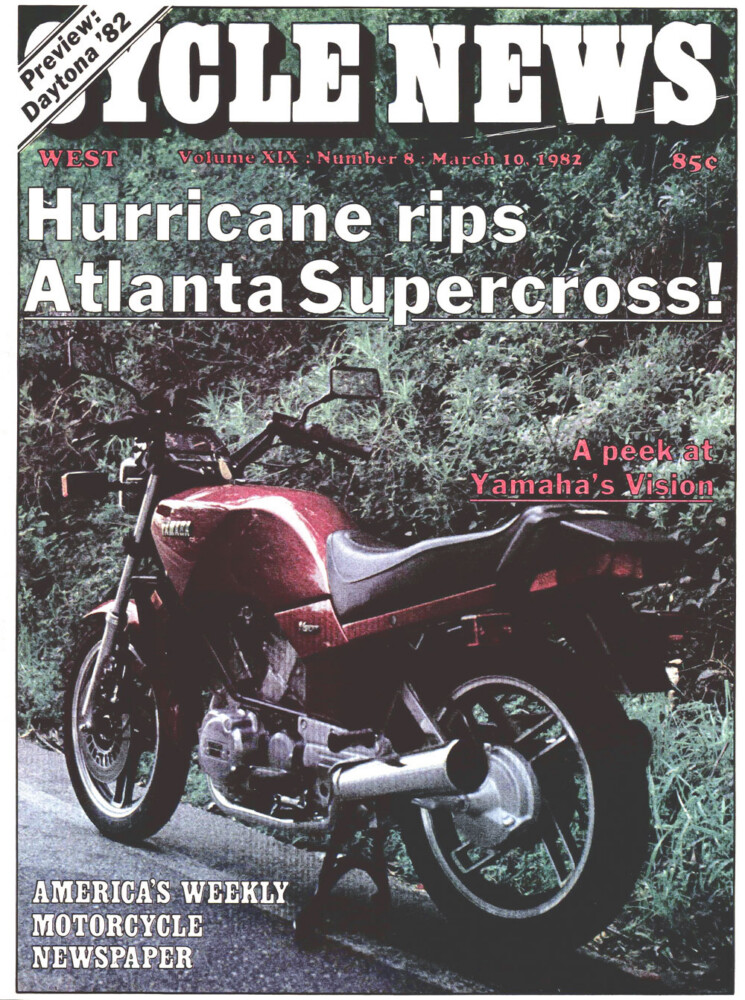
Such soothsaying was not possible in the good old days (which are defined as any time before yesterday), when motorcycle manufacturers were foisting onto the public bikes that they thought we needed. Someone, somewhere in the building thought that there must be a market for a middleweight, liquid-cooled V-twin. Introducing the Yamaha XV 550 Vision.
Cycle News road-tested the Yamaha Vision in the March 10, 1982, issue and waited just a few sentences before making it clear that the Yamaha 550 was sticking its toe into a pool of feisty sharks. “[The Yamaha] came from the drawing board into one of the coldest and hardest of motorcycling’s worlds,” wrote CN. “The 550cc displacement class is virtually filled with the finest machines in history. All are light, fast, handsome and can carve corners like a chef does a fine roast.”
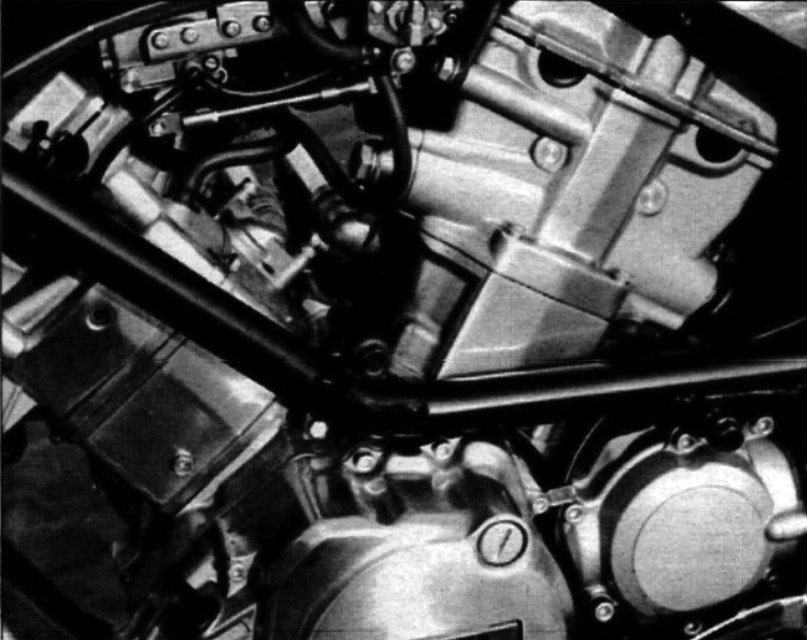
The meat of the Vision was its V-twin engine, which Cycle News heralded as “the neatest motor ever to rest in the tubes of a medium-size frame. Wide, smooth power and lots of it, is the Vision’s forte.” Four valves per head handled the intaking and the exhausting, the latter of which exited into two pipes from each cylinder. Four became two again under the engine case. A five-speed transmission clunked a bit, but the staff didn’t gripe much.
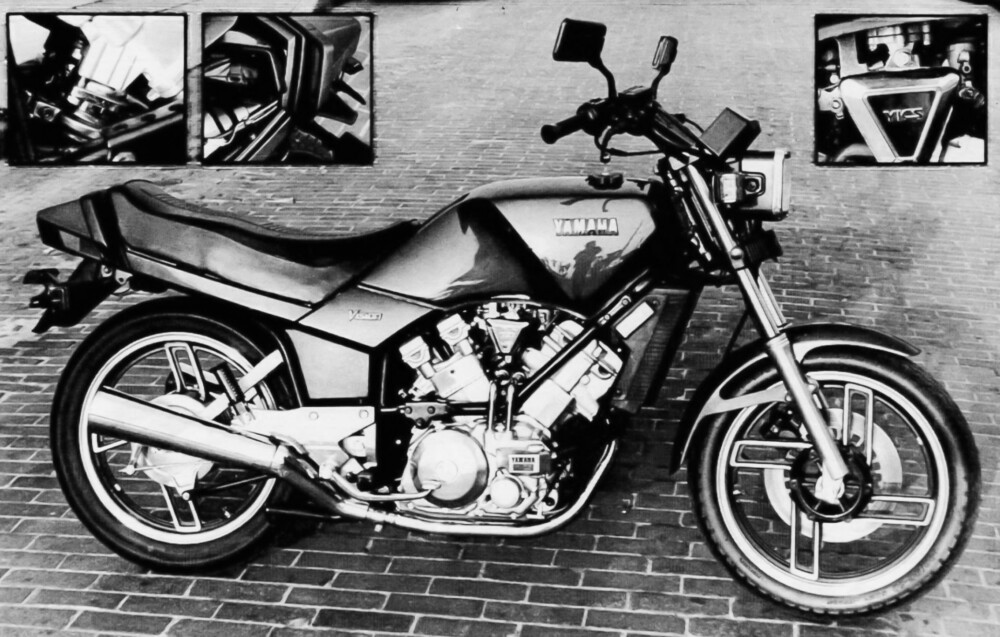
The Vision looked markedly different from its competitors in 1982, and Yamaha accentuated this with its odd front fork/axle placement. The Yamaha had a trailing-axle design. Think of a Maico with its legs mounted backward. “Yamaha claims this design was utilized to move the forks out in order to clear the radiator and still retain quick steering,” CN said. Looks can kill, but the Vision’s oddball front suspenders didn’t seem to impact its handling, as the staffers noted that there was more than enough offset in the triple clamp and the 550 was “definitely a quick-steering motorcycle.”
Time to ride! The Yamaha was well laid out, with controls falling neatly into the rider’s hands. “Yamaha,” said CN, “gets an A in ergonomics with this one.” The seat felt firm, but even after 200-mile days, the test crew reported no discomfort. The liquid-cooling helped keep the engine noise to a minimum. Vibration? The staffers found, even at speed, the view in the mirrors was as clear as a mountain morning.
In 2026, motorcycles are usually tested in accordance with the manufacturer’s intent. Panigales aren’t evaluated as touring bikes, Gold Wings don’t get taken to the drag strip. But in 1982, most magazine types wanted to make like the Eagles and “take it to the limit.” Predictably, they gave the Yamaha Vision a ride in the canyons, living life in the fast lane. The Yamaha did not respond with a peaceful, easy feeling.
“When the Vision is pushed hard, it becomes very hard to carve a smooth arc through a turn,” the CN staff said. “The mono shock back-end kicks over sharp bumps; this would not be so bad except for the overly soft forks. Neither end is air or damping adjustable, and this could be a fatal flaw in the market Yamaha is aiming for.” The beatdown continued with the staff concluding that “without adjustable suspension or a way to change gearing, the bike will not work as a racing tool.”
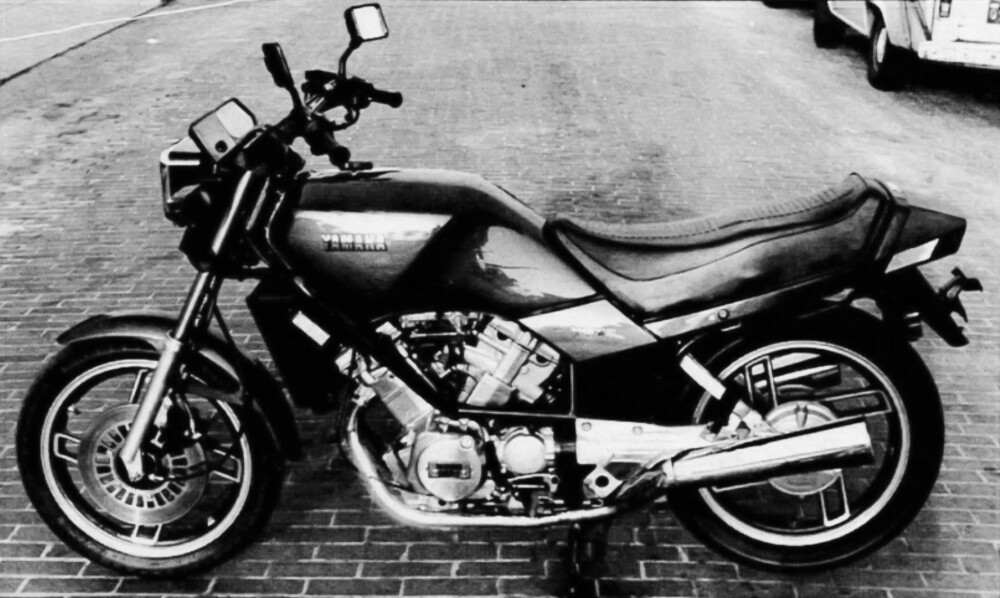
Indeed, shaft drive at that time did not allow for easy change in gearing, and the neat little Vision, which the staff admitted was “fun to ride,” was placed at the back of the pack of the 550cc class at that time. Kawasaki’s GPz 550 and Yamaha’s own inline-four 550 Seca were both cheaper than the Vision and better racers, too. The Yamaha Vision sat like the wallflower at the high school dance, the manufacturer eventually enticing suitors with price supports to get them off of the dealers’ floors. They even fitted later models with a touring fairing, a perhaps not-so-subtle reminder to all that this was a motorcycle for pleasure cruising and not a race bike.
All for naught, as the Vision vanished from the Yamaha lineup after a very brief run. “We’re all stories in the end,” said Doctor Who. The Vision was a good character, a mannerly motorcycle surrounded by scofflaws. In a different book, in a different time, it might’ve been a bestseller.CN
Click here to read the Archives Column in the Cycle News Digital Edition Magazine.
Subscribe to six decades of Cycle News Archive issues