Cycle News In The Paddock
COLUMN
Time to Enjoy the End of an Era
It’s a strange MotoGP season to come, the last year of the 1000s. And that is something of a worry.
From 2027, a new generation takes over: smaller, slower, cheaper. And better?
Maybe it’s a pessimistic comparison, but a similar change earlier in the reign of the big MotoGP four-strokes didn’t work out too well at all.
That was in 2007, when the original 990cc monsters were dumped in the history bin. Their sin was not only being too fast, but getting faster too fast, if you’ll forgive the tortured wording. There seemed no end in the rapidly increasing top speeds, as engineers got to grips with the possibilities.
Faced with the choice of either expanding run-off areas to the point that spectators might as well be in the next state or finding a way to stop top speeds climbing, the decision was taken—drop the engine size to 800cc.
Seemed like a good idea. Take away 20 percent of the cubic capacity, and the outer reaches of top speed would go with it, no?
That turned out to be vaguely true; take a snapshot at Qatar, with its kilometer-long straight. Dani Pedrosa’s factory 990cc Honda RC211V clocked 205 mph (330.2 km/h) in 2006; the next year Stoner’s 800cc Ducati ran a relatively measly 202 mph (324.7 km/h). But here’s the thing. Pole lap time was actually marginally faster. In 2006, Stoner’s satellite LCR Honda team ran 1’55.683. Rossi’s 2007 pole on a Yamaha was 1’55.002, better than half a second faster.
(Mugello, by the way, the more usual yardstick for top speed comparisons, ruled itself out because qualifying was damp in 2007.)
Apart from again proving the long-understood axiom that top speed is not the most important aspect of bike racing, this revealed that while the quantity of the power may have been affected, the change in its nature was more significant.
Engineers had taken the opportunity offered by smaller engine internals to build extremely high-revving short-stroke motors. This led to a generation of bikes that, with similar power but lower torque and less able to spin the rear wheel, offered riders less scope for different riding techniques. The bikes were more exacting to ride, and while higher corner speeds made for good lap times, creative riding was much less possible, and overtaking opportunities were much fewer.
These tactical regulatory errors were in turn consigned to history with the switch to 1000cc engines in 2012.
A crucial difference between the 800s and the new 1000s was a limit to maximum bore size. This made as much, if not more, difference than the extra capacity. Ultra-short-stroke engines with super-high rev limits, as seen in F1 cars, were kicked out of the bike paddock.
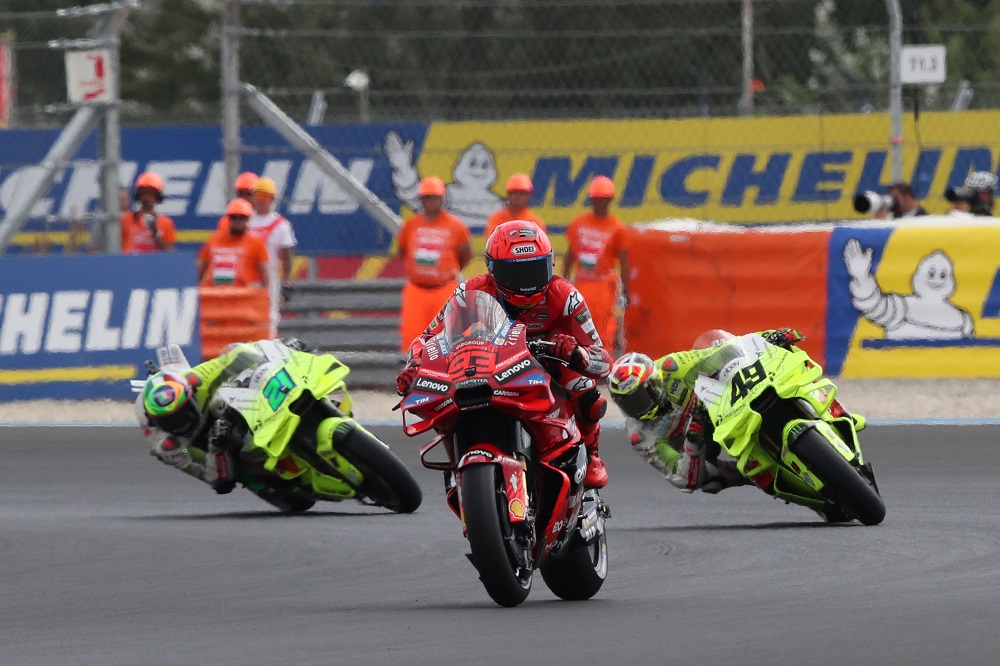
The change was most welcome and initially very successful, leading to the longest-lived MotoGP generation, lasting 15 years. But by the end of it, different technical advances, in aerodynamics and variable ride-height devices, had reawakened some of the same gremlins. While racing was close, overtaking had become relatively difficult, but for a very small handful of genius riders—Marc Marquez the prime example.
In 2027, the 1000s will be forgotten. The new generation, still four-cylinders by decree, drops to 850cc; and the maximum bore size from 81mm to 75mm, a 7.4 percent bore reduction compared with 15 percent capacity drop. This should be effective in preventing screaming high revs.
At the same time, variations in ride height are banned—both the holeshot devices that squat front and rear off the start line and the secondary rider-controlled systems that drop the rear on corner exit (Ducati had started to develop similar systems for the front, but they were banned while still in the cradle).
And aerodynamics will be considerably limited, narrower fairings with shorter noses; and a limit to the proliferation of secondary aero on the seat.
What will it mean for the riders, for the engineers? And for the spectators?
This is the concern. While the rule changes directly address difficult overtaking, the aspect that works against exciting racing and exaggerates the different abilities of the riders, what about the unintended consequences? What rendered the 800s so unpopular?
These almost go with the territory. Those writing the rules may be full of good intentions, but those charged with obeying them have a different agenda. Rival engineers view rules as things to be circumvented in the search for advantage. Ducati’s Luigi Dall’Igna is a past master: just to take one among many examples, look at how he designed a scoop ostensibly intended to cool the rear tire, but which actually introduced aerodynamic downforce in a way the rules specifically intended to avoid.
It remains to be seen, of course.
Meanwhile, the best advice is to enjoy the last of the 1000s to the max. We will not see their like again.CN
Click here to read the In The Paddock Column in the Cycle News Digital Edition Magazine.
Click here for all the latest MotoGP news.

