Cycle News In The Paddock
COLUMN
MotoGP’s Passing Parade
Many are the reasons given for an aspect that some think is spoiling MotoGP—an extreme difficulty in overtaking. It’s said to be too difficult for riders to pass. The litany is heard to various degrees from all levels.
Funnily enough, many of those reasons are the same as those praised for making the racing closer than ever, for yielding a number of different winners.
Different sides of the same coin.
On the broadest scale, there is the similarity of the motorcycles. So many of the most fundamental elements are mandated—one size fits all. Regulations stipulate four cylinders with a maximum bore size of 81mm; six gears and no twin-clutch systems, exotic materials banned.
The basic parameters of power are fixed, and detail developments likewise held in check, with engine design frozen through the season, with homologated engines also sealed. Any notion of racing as a field of technical development is hopelessly old-fashioned.
Then there’s a limited number of engines—updated in May to take account of the longer calendar. Previously it was seven per rider, nine for concession teams. Now an extra engine is allowed if there are 19 races, although only available for the 19th race. There is also a maximum 5.8 gallons of fuel. These restrictions limit revs and horsepower. Most crucially control electronics level things still further.
Control tires offer very limited choices and dictate similar race tactics.
But there are other dynamic issues.
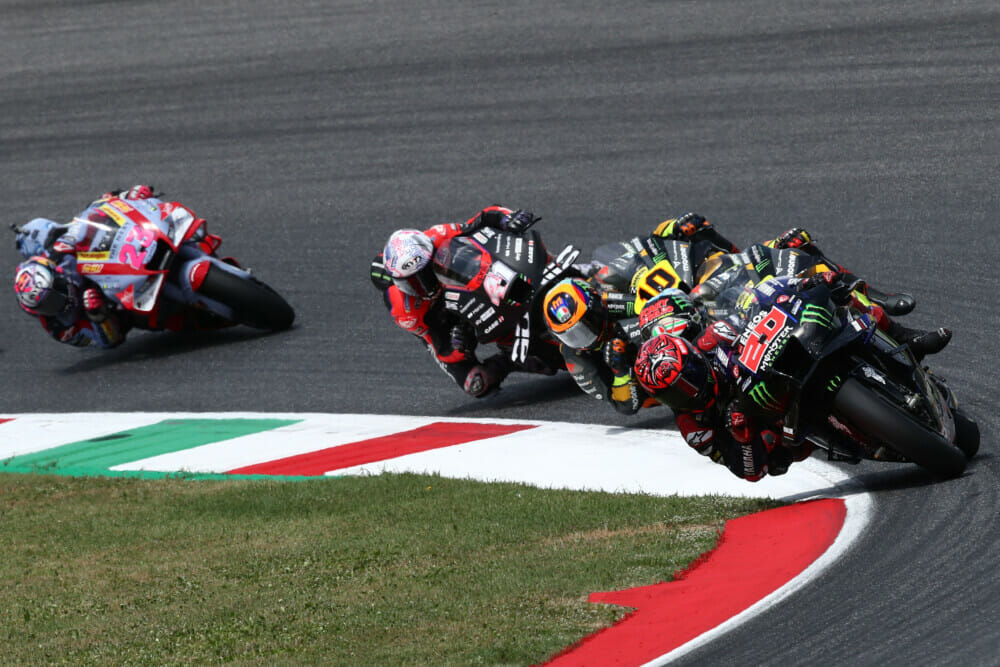
One concerns aerodynamics, the biggest development of the past five years or so. These too are governed by strict regulations and frozen development, but that is by the way. The effect on overtaking is inherited from F1 cars: the more effective the wings the more turbulent the air they leave behind. “Dirty air,” they call it.
As a result, the aerodynamics of the bike behind are less effective; the downforce suffers, and advantages in controlling wheelies and keeping the front planted are reduced. He has less of a motorbike than the guy up front.
Drafting is also more difficult. In the past a rider could slipstream up close to gain extra speed, then duck out of the draft to overtake. Not anymore. With these wings, he is buffeted about uncomfortably, even dangerously.
The second is even more specific and concerns front tire pressure.
Following closely means your front wheel is not in a clean stream of cooling air. The tire heats up and the pressure rises. This changes it from the ideal profile, robbing grip and predictability. Once again, the guy you are trying to overtake has all the advantages, while you have to drop back to try and cool the tire again.
In the past a rider could slipstream up close to gain extra speed, then duck out of the draft to overtake. Not anymore.
Fabio Quartararo is a particular victim, as the only Yamaha rider up at the sharp end. The M1 relies on corner speed to compensate for relatively poor acceleration, so when his front grip goes AWOL, he is doubly disadvantaged.
This means a big poser for riders and crew chiefs.
If you can lead away, then you need the tire pressure on the high side to be able to stay up front. But stuck behind, your high pressure will betray you, by getting higher still.
But if you choose a lower pressure then lead away, you are in danger of breaking the rules.
This is exactly what happened to Pecco Bagnaia at Jerez, the epitome of a processional race with minimal overtaking. Although qualified on pole, he gambled by starting the race with the front below the specified minimum 1.9 bar (1.7 for rears).
In fact, he did beat Quartararo into the first corner and led from there to the end. As a result, his tire pressure never did rise to above the minimum, and he was in breach of the rules. Accusations of cheating followed, but it was something of a technicality. There is a gentleman’s agreement that this particular rule is not enforced.
Bagnaia loudly declaimed that if he had been cheating, then every other rider had been guilty of it at some time or another: MotoGP tech director Danny Aldridge blamed different pressure measuring devices, and decreed standardized equipment from next year. And other riders and teams, understanding the issue, largely kept schtum, while entreating Michelin to come up with a tire with more tolerance.
In the meantime, is the matter of overtaking difficulty over-rated?
Not every rider suffers.
An ad hoc survey of the championship top 15 totals places gained/lost from grid-position to flag: Brad Binder, Sunday rider supreme, leads the way with 35 places gained. Maverick Vinales, notoriously a poor qualifier but strong racer, is close behind; Miguel Oliveira—race winner in Indonesia—has 32. By contrast, Quartararo languishes on six, Jack Miller sits on zero.
Perhaps Binder and co. haven’t been listening. CN
Click here to read the In The Paddock Column in the Cycle News Digital Edition Magazine.
Click here for all the latest MotoGP news.