Take a tour of the new Ducati Museum, where art, engineering and history meet.
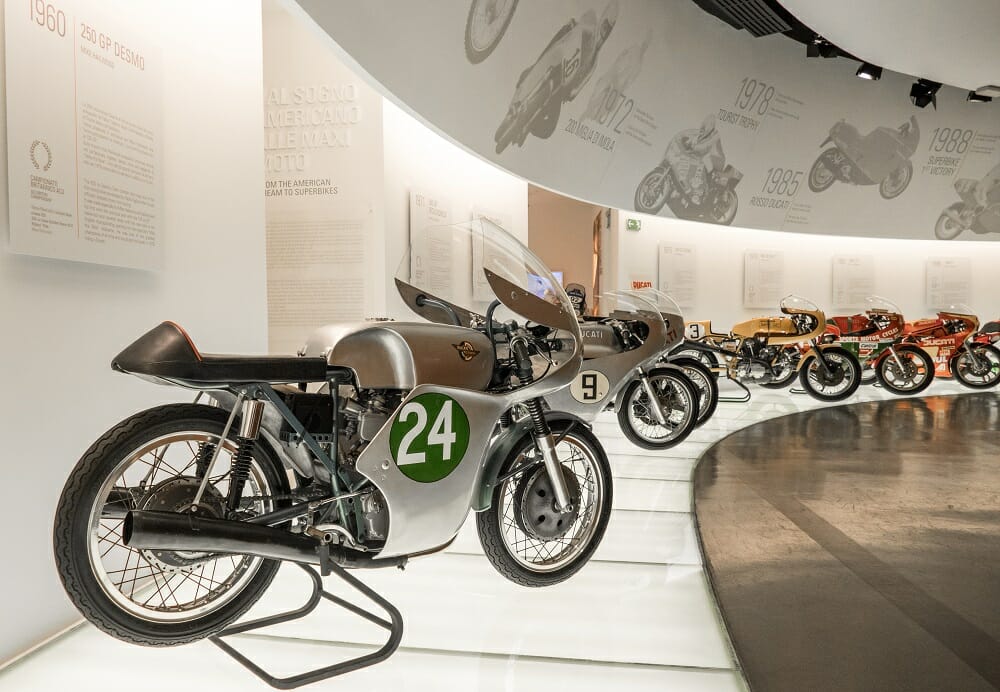
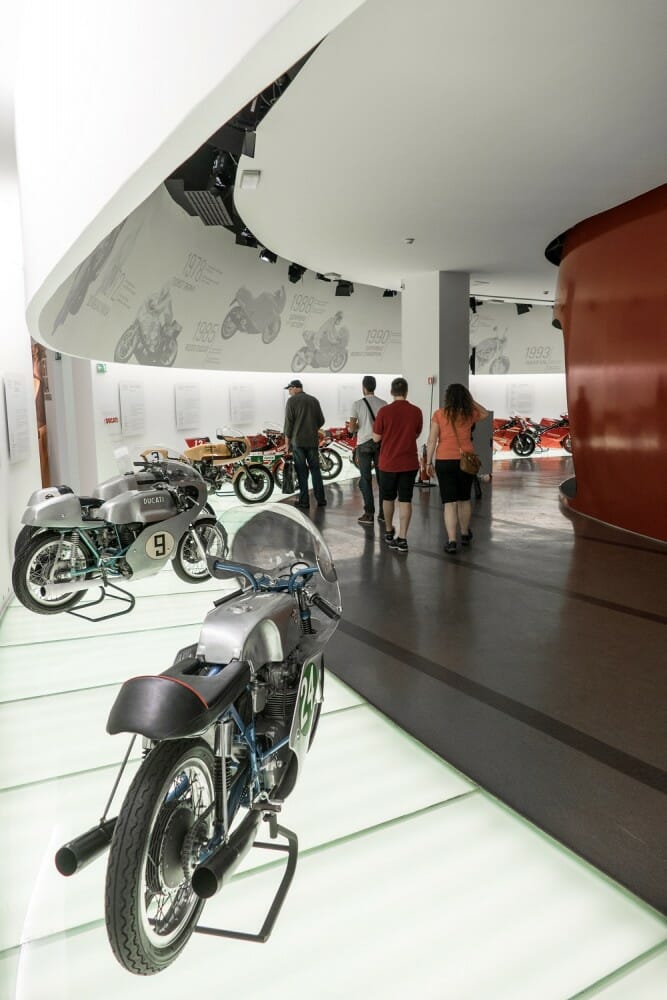
The curving display of race bikes greets you as you walk into the Ducati Museum. Various singles begin the lineup, which continues through bevel-drive V-twins ridden by legends like Paul Smart and Mike Hailwood, and it runs all the way around to a Troy Bayliss superbike and Casey Stoner’s MotoGP machine. These are some of the key motorcycles that proved Ducati’s engineering genius.
The contrast hits you immediately when you walk into the new Ducati Museum after doing the tour through the company’s factory in Bologna, Italy. You’ve just come from the unstoppable rush of a colorful, industrial complex to the subdued hush and stark decor of a gallery—a gallery full of motorcycles as art. It stops you in your tracks, and when you get moving again you’re slower and more thoughtful.
The very thoughtful design of the museum’s layout, lighting and displays highlight the machines and don’t prevent you from getting as close as you want, so you can get a good, detailed look at everything. You certainly don’t feel any urge to rush through.
The museum features road and race bikes from the company’s earliest days, as well as relics of its very first years when it established itself by making radio parts more than 90 years ago.
After strolling into the reception area and past the desk, you go through a doorway and see a seemingly endless series of race bikes disappearing out of sight around a curved wall. Their illusion of procession draws you inside. To your left, a smaller room lit bright white hosts individual displays of the very earliest bikes. They stand out clearly, restored to perfect condition and shining against the white walls behind them. Most are flanked and backed by written information, video screens and artistically designed backgrounds.
I pored over the displays, reading the history and watching the videos. I reckon everyone, bar the most well-read “Ducatisti,” will learn something new.
From bikes that were winning when singles ruled, through Paul Smart’s green-frame V-twin racer all the way up to the world championship winning bikes of Troy Bayliss and Casey Stoner, there’s so much to drool over. As much as I loved the one-off engineering details of each race bike, the street bikes held even more appeal for me.
The immaculate 851 superbike brought back memories. It was the very first test bike I ever rode as a cadet at a motorcycle magazine. That was an eye-opening experience for a young guy who’d grown up on skinny 18- and 19-inch wheels!
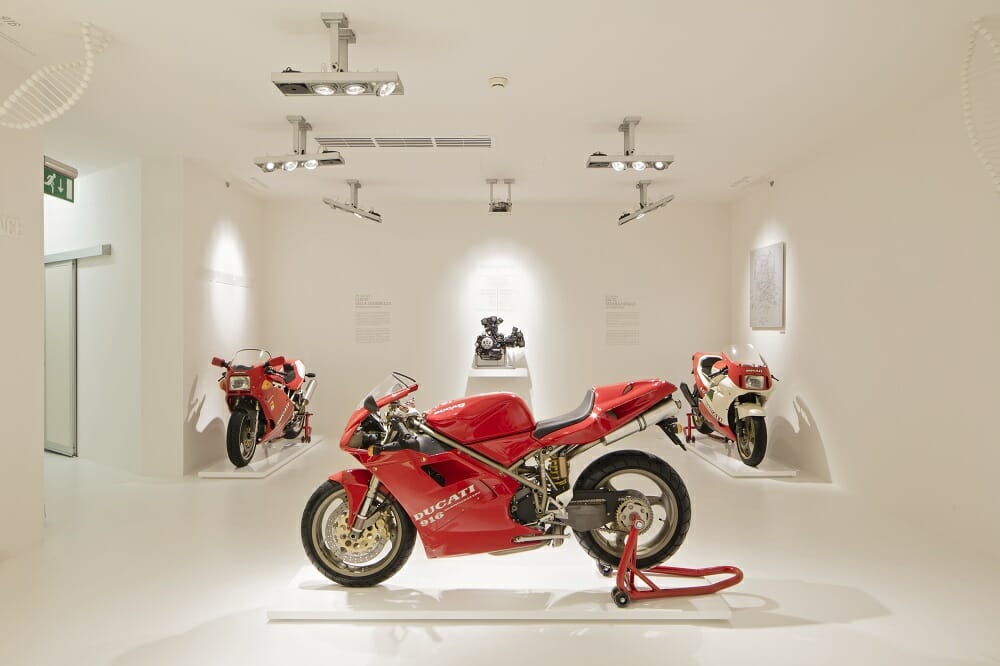
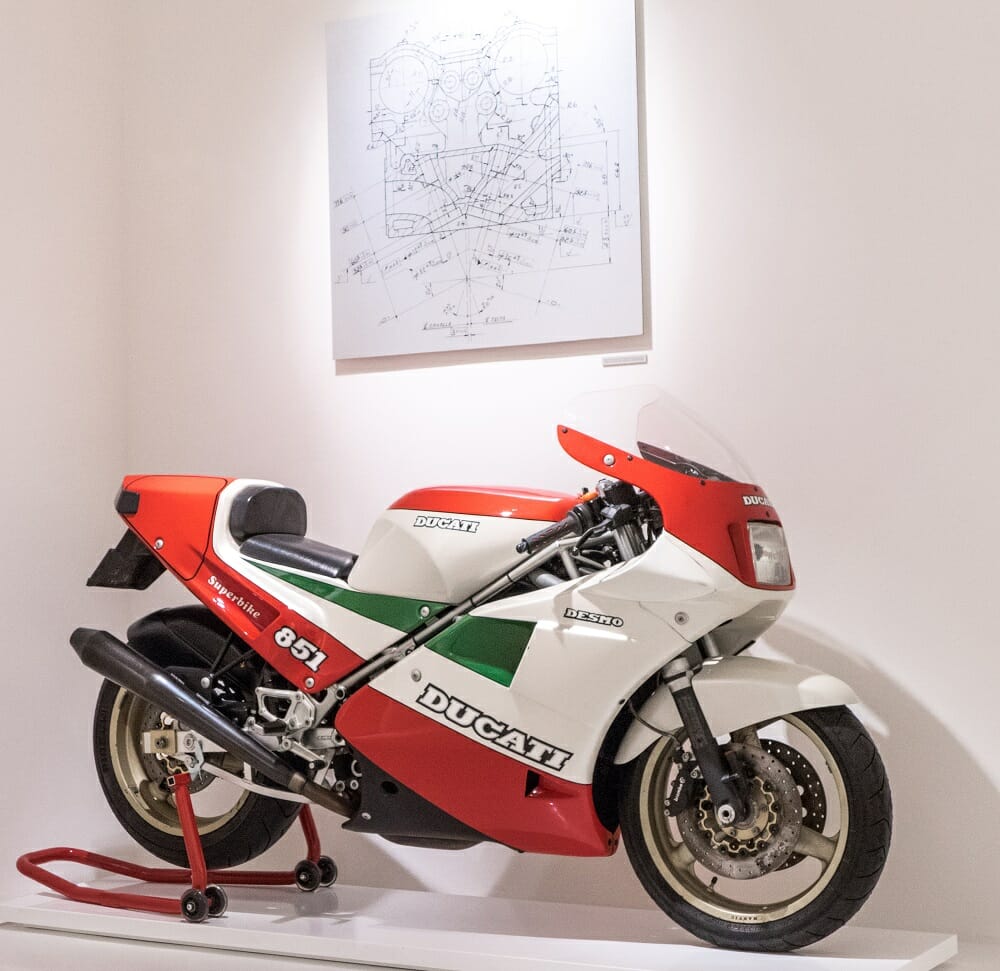
The late 1980s to early 1990s was a crucial time period for Ducati. The 851 (right) not only modernized the Ducati V-twin with liquid cooling, four-valve heads and electronic fuel injection, it lifted them to world superbike success and put the company back in the spotlight. Meanwhile, the air-cooled Pantah engines were still an essential part of the equation, and while power wasn’t great, the platform lent itself to handling enhancements. The innovative Superlight (left) was, according to Ducati, 20 years ahead of its time in using carbon-fiber parts, magnesium rims and other weight-saving devices. Both, however, are overshadowed in history, as well as the room, by the incredible 916.
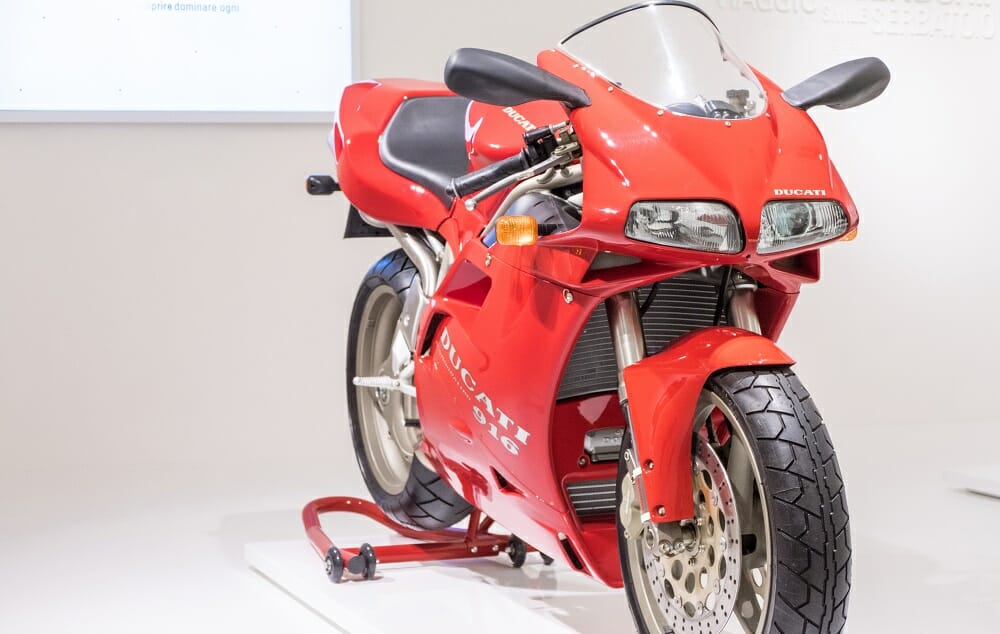
Standing beside the luscious 916 in the museum, I remembered the thrill of being at the international launch of the model, and knowing that this was a bike that would change motorcycling. I was astounded at how much better it was than anything else on the road at the time. It’s still one of the best-looking motorcycles ever built.
If any bike deserves pride of place in the Ducati Museum, it’s the 916. It is a fixed point in motorcycling history, one that stands out clear and bright. It seemed to gather together everything that Ducati had done before 1994 and present it as a finished, perfected package that accelerated the company into the major success that has followed. Sure, there have been financial difficulties, but Ducati is Italian, after all. Look at the diversity of models, the market success, the engineering, the racing prowess and the outstanding loyalty of the ever-growing Ducatisti—without the genius of 916 designers Massimo Tamburini and Massimo Bordi, Ducati may never have quite built the momentum to carry to it to where it is now.
Remembering these older superbikes made me reflect on the fact that I could feel the same unmistakable Ducati DNA in the Multistrada Enduro I’d just spent four weeks on touring southeastern Europe. Ducati has remained true to its roots without neglecting the technological change needed to stay at the sharp end of our sport. The museum certainly highlights this achievement.
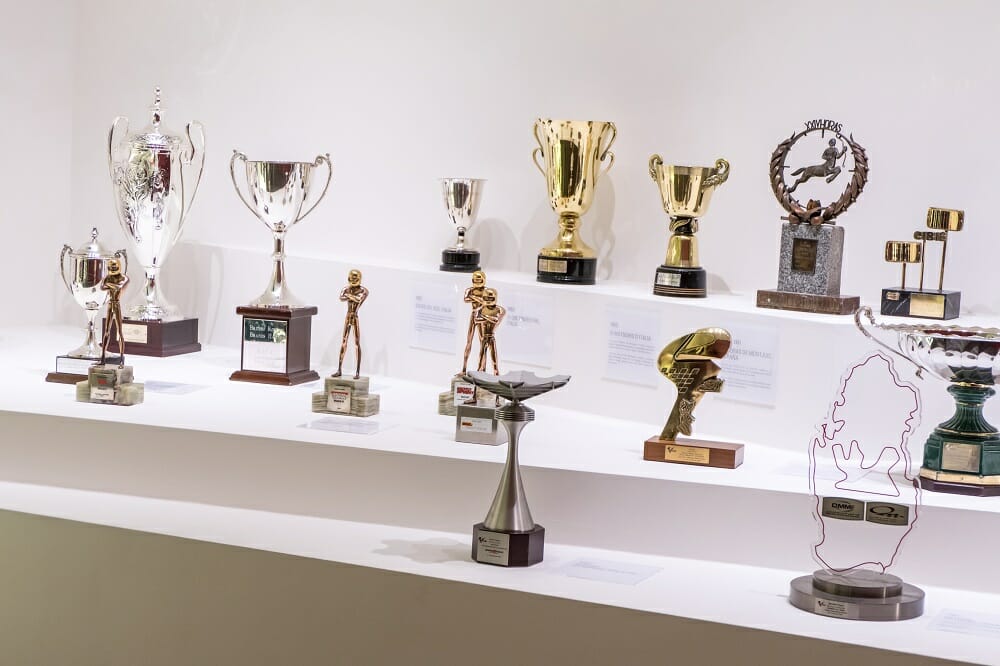
Further around there are trophies, racers’ leathers and other bits of memorabilia to finish off the experience. If you were to waltz through the museum, you’d be in and out of the relatively humble space in a couple of minutes. But if you take your time to savor it all, you could spend two hours.
It helps that there are no ropes or barriers. I had too much respect to lay even a finger on any of the bikes but there was nothing else to stop me. I could eyeball every angle and each part as closely as I liked.
Ducati’s website features a virtual tour of the museum, which gives you a complete and quite detailed “walk” through. But if you’re in Italy you have to see the real thing. There’s no substitute.
It’s small but full, and as much an art gallery as it is a museum. CN
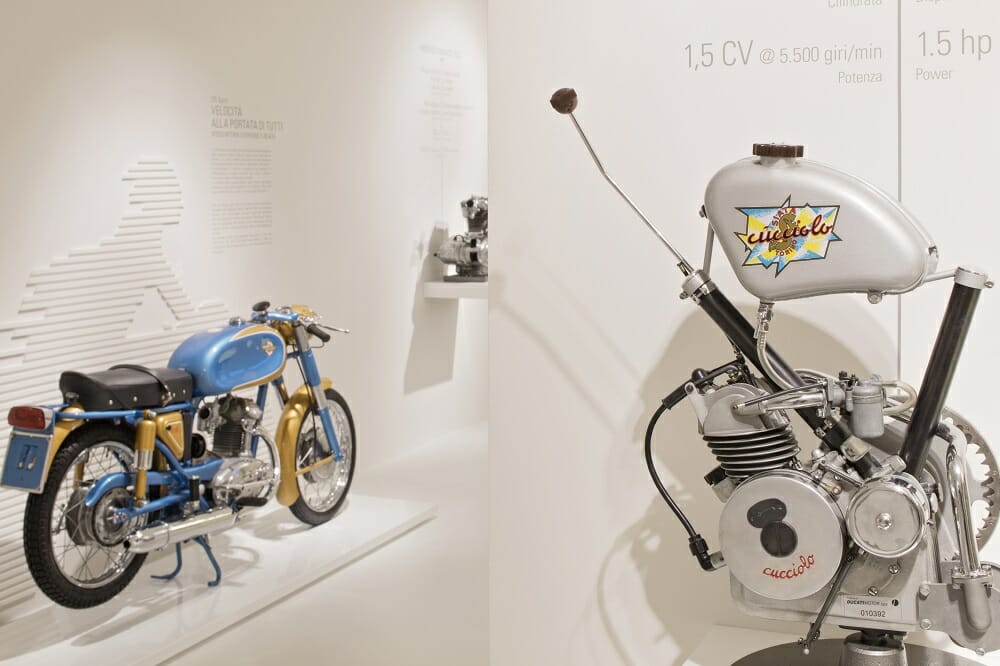
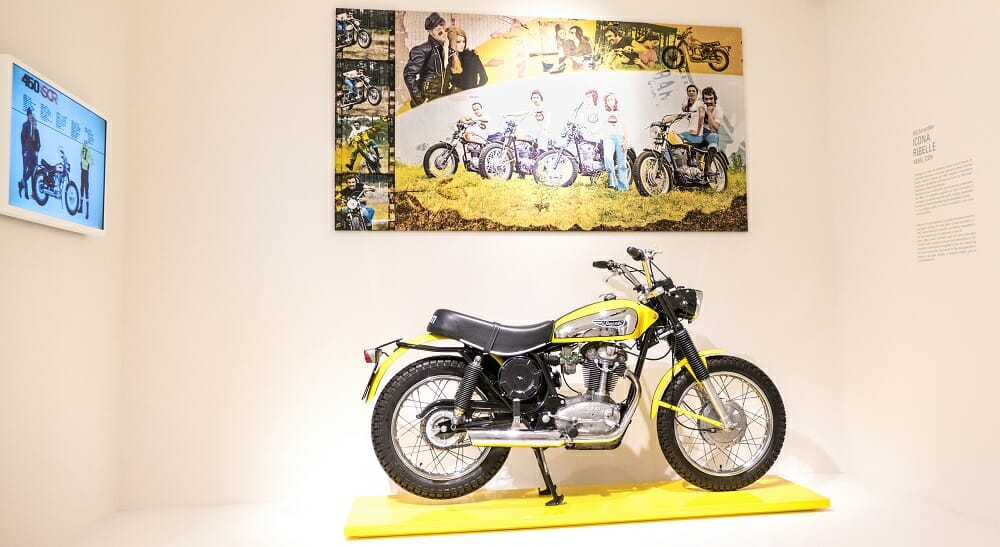
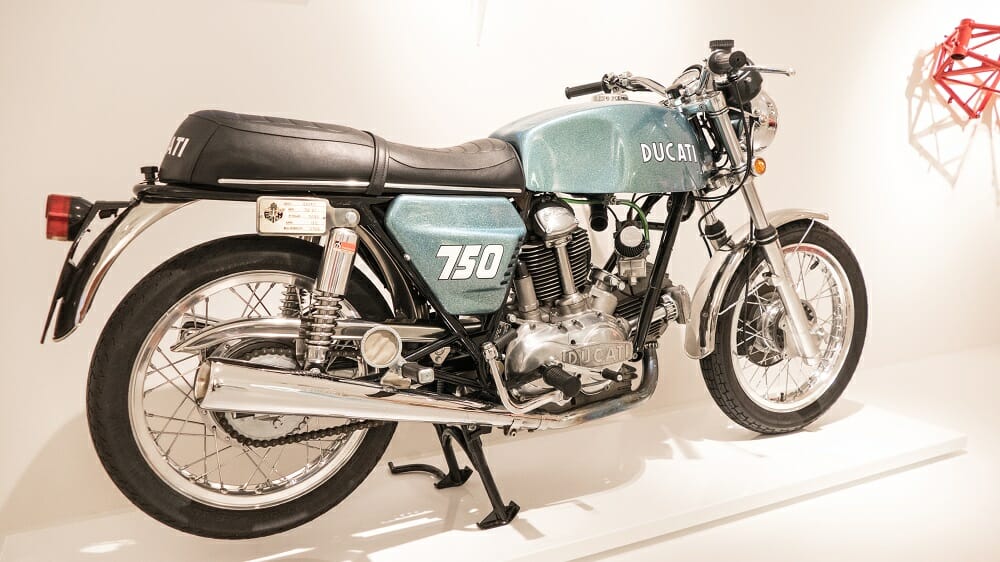
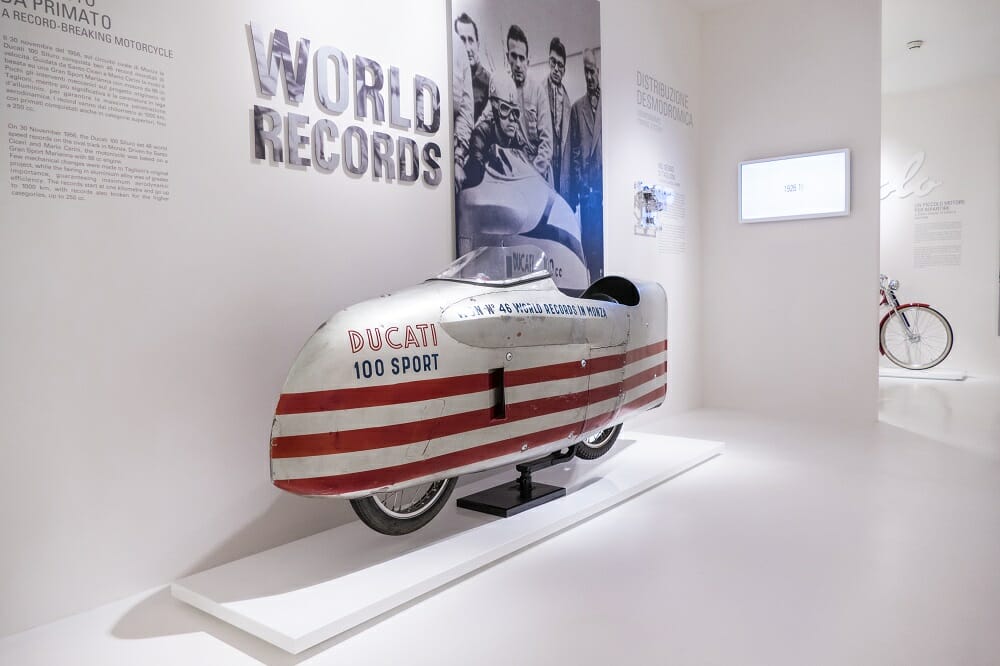
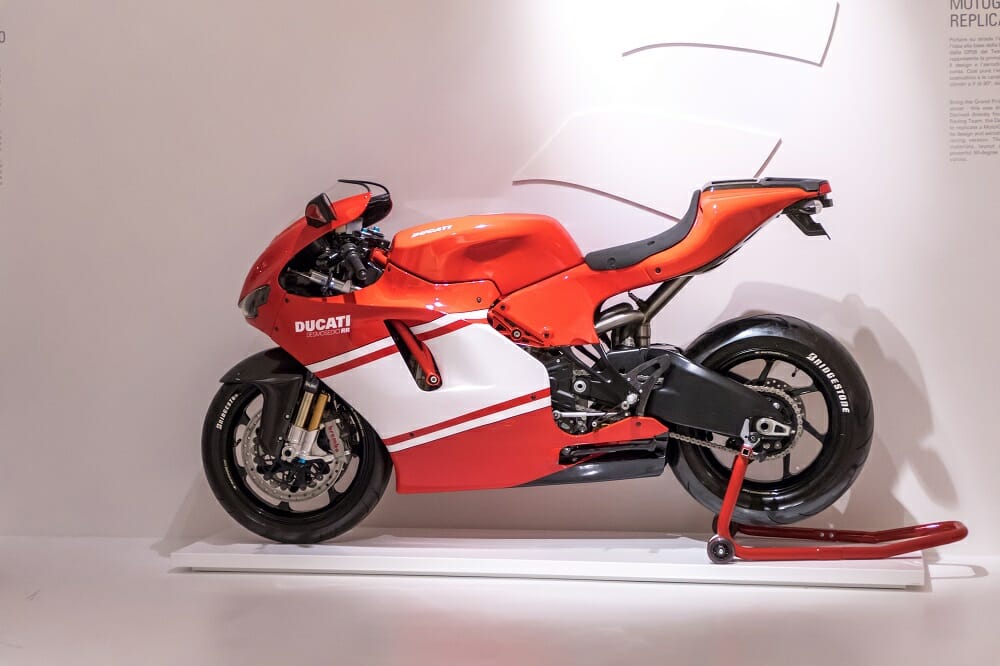
The Cucciolo engine and fuel tank started Ducati’s path into motorcycling. This little kit provided Italian bicycle riders with a humble, functional power plant and it helped get the war-damaged country mobile again in the late 1940s. Ducati soon followed up with its first full motorcycle, the 60, but things really got going in the 1950s after Fabio Taglioni brought his engineering ideas to the company. Taglioni became a legend of motorcycle design, and the 125 Sport (left) is part of his legacy.The Scrambler 450 was a bike for its time, and it sold its bevel-driven head off after hitting the market in 1962. The display celebrates the bike as well as the culture that both led to its introduction and lapped it up at the time. As cute as ever, it’s no wonder it inspired the modern, equally successful Ducati Scrambler models.When was the last time you saw this pristine an example of Ducati’s first superbike, the 750GT? After Fabio Taglioni created this machine, Ducati didn’t look back. The earliest V-twin had spring-controlled valves, but Taglioni quickly added desmodromic operation—a system that opened and closed the valves mechanically. Ducati still uses desmo valves to this day. Meanwhile, bevel-drive Ducatis are among the most collectible bikes in the world, and the early round-case models like this are right up there.The 851 Tricolore is the great-granddad of all current Ducati superbikes, though its own roots were in the humble Pantah models introduced in the late 1970s. FIM World Superbike regulations allowed the twin-cylinder Ducati a capacity advantage over the 750cc four-cylinder bikes that’d dominated racing for so long, but Ducati only needed a fraction of the potential 250cc difference to beat the Japanese. Perhaps the only flaw in the design was the use of 16-inch wheels, which were dropped in favor of 17s for the next model.With its streamlined aluminum body, Ducati’s 98cc Siluro set 46 world speed records in a single whirlwind of racing around an oval track in Monza in 1956. Taglioni’s little engine had minimal tweaks, according to Ducati, before raising the bar in the record books one by one. First: fastest kilometer for a 100cc bike. Eventually: fastest 1000km for a 100cc bike. But it was also a giant killer, breaking records in classes up to 250cc. Admittedly, this was a frenzied era of re-setting records that hadn’t really been contested since before World War II, but this was still a remarkable achievement for both performance and reliability.Ducati broke with convention when it launched the very rare, very expensive Desmosedici RR. Here was a road-going sport bike that was as close as you could possibly get to being a fully-fledged MotoGP bike, complete with the angriest 990cc V4 around. I was in Italy soon after its release, walking along a main road in coastal Rimini, when an ear-splitting howl drowned the din of Italian traffic. I wheeled around in time to see a Desmosedici RR holding its front wheel 18 inches in the air as it flew through the chaos. It flashed past and raced into the distance. All of Rimini applauded. At that moment I understood Italians a little better.Road races, grand prix, tourist trophies, championships, bikes of the year, people’s choice… Ducati is not alone among manufacturers in being driven to win, and the museum’s display of a small portion of the trophies earned by the marque is a good reminder of the company’s winning history. Victory in the Italian Motogiro in the 1950s is as cherished as winning the MotoGP championship in the modern day.
Come for a quick tour of the incredible Ducati museum in Bologna, Italy, with Cycle News contributor, Mick Matheson.