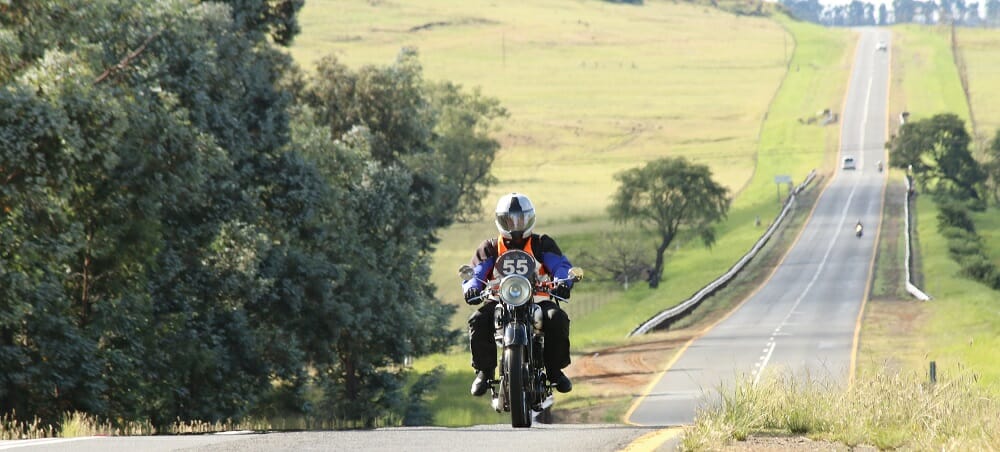
Gone but not forgotten. Vintage-bike enthusiasts relive what was once a popular public-roads road race in South Africa in the Durban-to-Johannesburg Rally. Our MotoGP correspondent Michael Scott gives it a whirl.
Photography by GideonPhotography.co.za
“I’stut-tut!” The word is Zulu, and means “motorcycle.” At the D-J Rally, the onomatopoeia comes alive. It is exactly the sound emitted by a single-cylinder Velocette—or BSA, Norton or Triumph, etc. And a lone Swiss-made Motosacoche.
For two days each year in early March, that sound echoes off the krantzes of the Drakensberg Mountains and putters onward across the Highveld. It’s the D-J. And it’s unique.
D-J stands for Durban-to-Johannesburg, and the annual rally commemorates a completely crazy 400-mile public roads race, that ran from 1913 until 1936, until finally sanctity prevailed in the form of state intervention after (amazingly) the first fatal accident.
But the D-J was not to be forgotten.
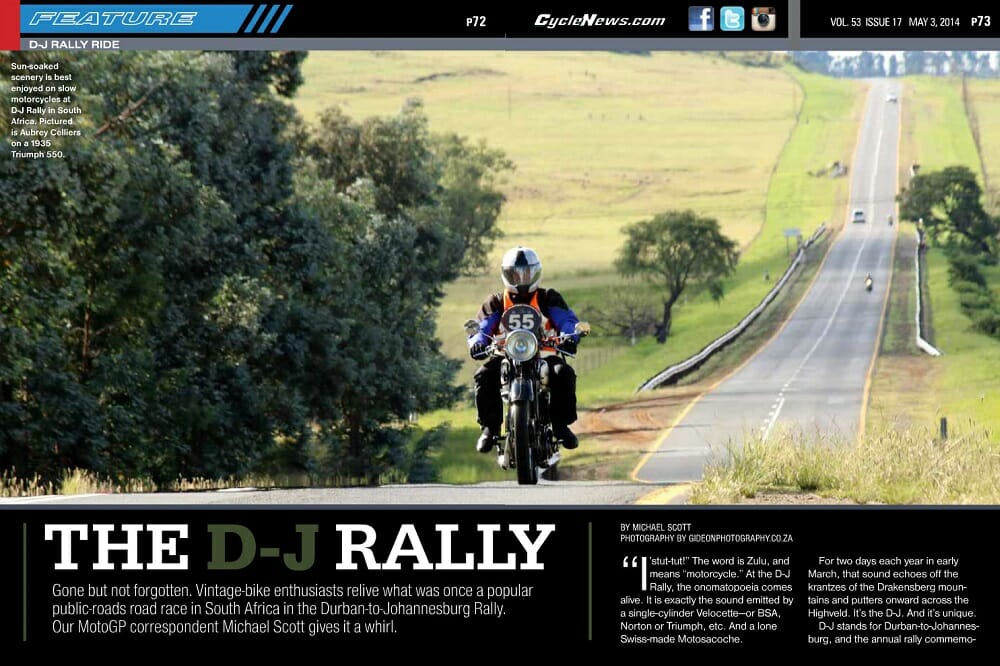
In 1970 the event was revived, now a regularity rally rather than a flat-out blinder, but open only to bikes that would have been eligible for the real thing—in other words built before the end of 1936.
The race was originally held in the opposite direction, down to the sea, over three grueling days, on mainly unpaved farm tracks. As machines and conditions improved, this was cut to two days and the destinations swapped, so that the finish was in the wealthy city of gold. The Schlesinger Vase, a gigantic and ornate silver trophy reflecting the prosperity was the prize given to the winner. This floating trophy, more than a three-feet tall, is still used today.
The fastest ever time for the 400 miles was set in 1935 by Chick Harris—an astonishing six hours, 31 minutes and 29 seconds, averaging better than 60 mph. Most of the flat-out journey was still on dirt roads, though by now the opening and closing of farm gates was less of a hindrance.
The original D-J made even the Isle of Man TT look relatively namby-pamby, going round and round the same prepared circuit. The 1913 TT covered just 264 miles. Was there anything as tough in the world back then?
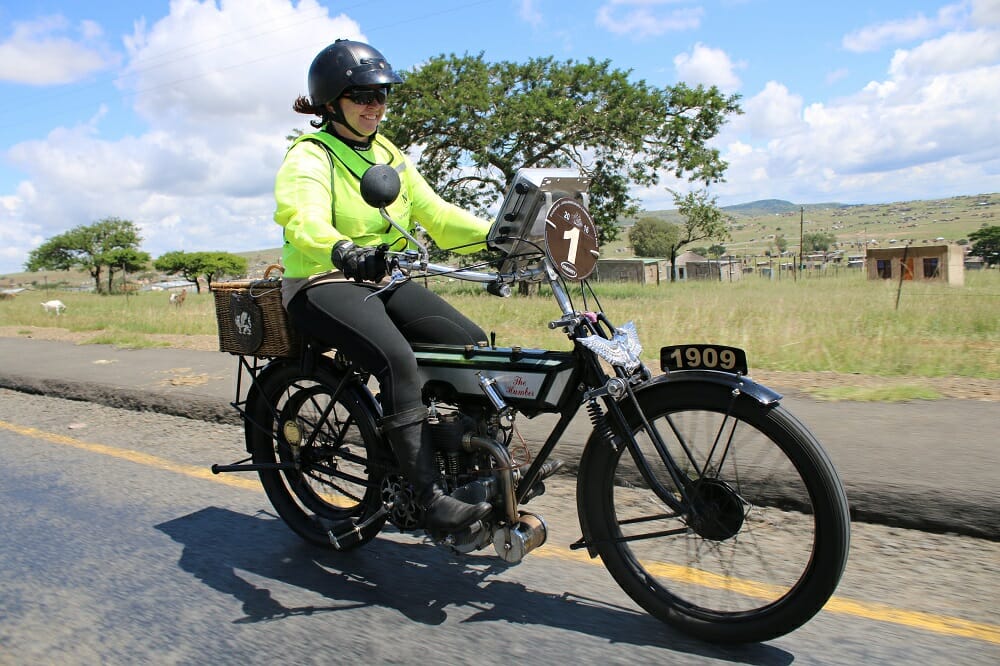
In the same way, the commemorative rally makes the annual 60-mile veteran London-to-Brighton run look a little less daunting, although admittedly that is for much older machines. But there is regularly at least one pre-1910 bike on the entry list. Sadly, on the 2016 event run during March, this 1909 Humber caught fire at the top of the long climb up Laing’s Nek. Rider Samantha Anderson jumped off safely as the bike burned out under the shadow of Majuba Hill, the site of the epic battleground in the Boer War in 1881.
There are hills aplenty on the route. It starts just inland of the port city of Durban, then climbs a series of deeply valleyed escarpments. Laing’s Nek (5500 feet) is the final ascent before slogging across the flatter Highveld to the finish, at the Classic Motorcycle Club among the Jo’burg mine dumps. The first day spans 216 miles to an overnight stop at Newcastle, the second 183 miles to the Johannesburg finish.
There were 62 finishers out of 90 entrants.
First-time winner Ralph Pitchford chuffed all the way on one of the older machines, a 1926 Triumph Model P “flat tank”—a side-valve 494cc single in a flimsy cycle frame.
“Next year I want something with more power to help me get up the hills,” he said. He dropped just 230 seconds out of a possible maximum of 7800.
Second-placed Gavin Walton (1936 AJS Model 9) had 25 more, with Tony Lyons-Lewis (1928 Norton CS1 OHC) on 270. The oldest motorcycle to finish was Hans Coertse’s 1913 Matchless. Cal Crutchlow’s father Dek was one of a handful of foreign entries.
There were gutsy stories aplenty. Many of the hard-luck variety.
Veteran favorite Kevin Robertson (79)—seven-time winner—was out of contention on day one, when his 1936 Velocette MSS had a rare roadside stop, “of course in a timed section.” He pressed on, with more trouble on day two, to finish 48th.
Graham Bowles (1930 Zenith Special) won the True Grit award after riding more than 25 miles on a flat back tire to finish the first day. He still finished 38th.
Martin Kaiser (1935 Sunbeam M9) lost his rear sub-frame on a rough patch, cable-tied it back on, then stripped it off at the next control to finish with half a bike, a sort of vintage “bobber.”
Foul weather afflicted many bikes before the start. Some were trailered to Durban from Jo’burg in a flooding downpour after ingested water into vital parts. Magneto rebuilds were a major feature of set-up day, but for Michael Shield, who had come from Australia to ride a 1935 Velocette in memory of his racer father, water got into the oil and when he started the engine it stripped the oil-pump gears. With the start time drawing near, a concerted effort managed to trace replacement gears some 25 miles away. Shield made the start, and the finish.
The hard-luck award went to Samantha Anderson after her fiery exit. The venerable Humber will be rebuilt, probably in time for next year’s event.
But this is my story, for I have ridden the event for the past two years, thanks to the generosity of the South African biking community. And it is a blast. Especially since I finished both times. Largely thanks to two great bikes that kept going all the way.
My first steed was a 1935 BMW R12—a side-valve 750 flat twin, and it was all thanks to Simon Fourie, a philosopher, philanthropist, flat-out merchant and old friend. Fourie is a major figure in South African motorcycling, still racing himself at 70, and editor/publisher of the seriously unique Bike SA magazine.
Ebullient personality aside, Fourie is famous for all sorts of reasons. One was the time he used his K0 Honda 750’s sneaky electric starter to beat the visiting Giacomo Agostini’s factory MV Agusta into the first corner at Roy Hesketh circuit, only to spoil it by running straight on. Another is for entering the gruelling dirt roads Roof of Africa marathon (across the mountains of Lesotho) on the same completely unsuitable machine. He almost completed the first of two days before collapsing exhausted in the middle of the road.
The BMW R12 is a classic version of the air-cooled flat-twin breed, and one of the bikes that helped Hitler lose the war, not through any shortcomings of its own. It’s worth recording that three BMWs entered the 2015 DJ: another side-valve R12, and the much more exotic twin-cam overhead-valve R5. And three BMWs finished it. It was much the same in 2016.
Side valves apart, the R12 was surprisingly modern in some respects; a beautiful low-slung hunk of gleaming black enamel and white pinstripes, with flared mudguards, footboards and a heel-operated rear brake strong enough to lock the wheel. Pioneering telescopic front forks provide some suspension at that end, while a large sprung seat insulates the rider from the pain felt by the hard-tail rear. A pressed-steel frame keeps the wheels apart; levers projecting from the bar ends operate clutch and (rather notional) front brake in the normal way, the reverse-hinged layout not only keeping cables tucked out of site within the bars, but providing better leverage, with the stronger fingers having the greatest mechanical advantage.
The major difference from a modern was the four-speed gear-change, operated with a car-style H-pattern (first to the left and forward, and so on). It proved easy to operate, though slow and inevitably clunky on downshifts. With your right hand off the throttle, you can’t blip. As Gawie Nienaber, riding another R12, explained: “At least you know you’re in gear.”
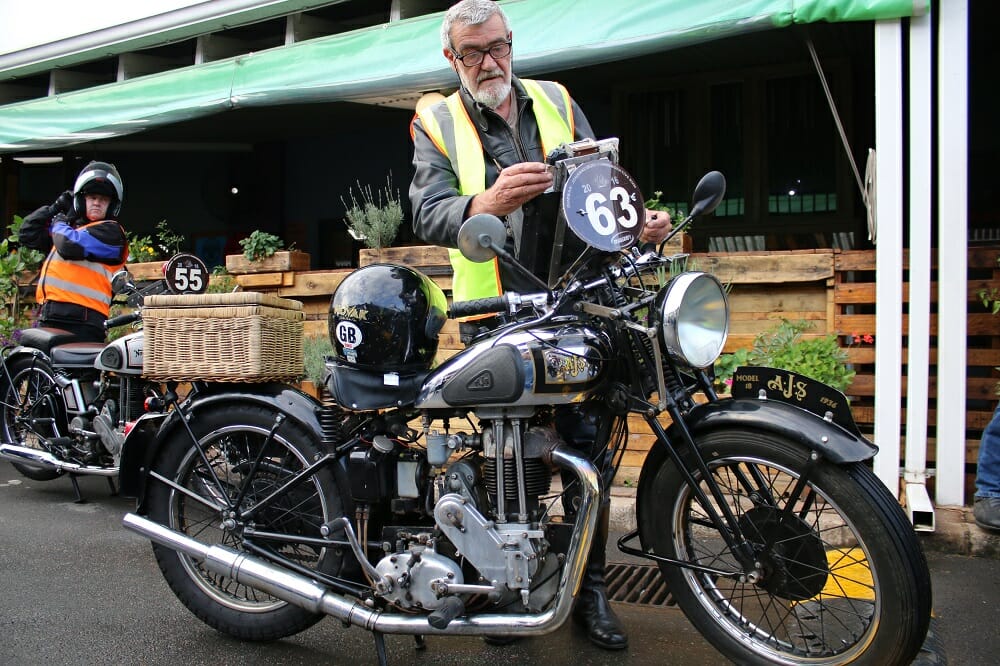
It was the generosity of Clerk of the Course Ian Holmes that put me on the entry list in 2016. The bike was a really sweet little 1936 AJS Model 18, not as smooth and comfortable as the BM, but with overhead valves and a sportier chassis much more lively and responsive at swinging through the passes. It threw a fit on the day before the rally, and I spent most the day fruitlessly pumping the kick-starter. By 5:30 a.m. the next morning, Dave Harris (formerly a Yamaha factory technical department guru for Africa) had located a wobbly clip on the carburetor float that was causing the flooding. Thereafter, it didn’t skip a beat.
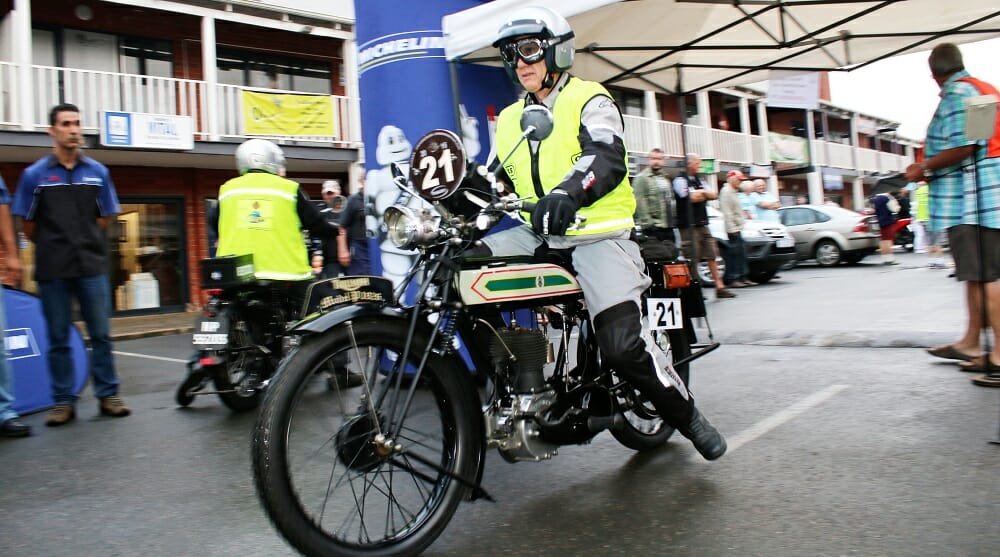
Compared with the BM, the AJ reflected a different design ethos, typical of the British bike industry that thrived so strongly between the wars. It was smaller, lighter, and everything was much more familiar. No smooth casings concealed its workings; the pushrod-operated valve gear was out in the open. It’s advisable to give it a squirt of lube every so often. Likewise to top up the oil-bath chain primary drive and keep an eye on the oil level in the underseat tank.
For all the oil you put in, the AJ always gives some back, visible when you park for any length of time. Just like all the other British bikes. “They don’t leak,” said Holmes. “They just like to mark their spot.”
It also had a foot gear-change, to my relief, but it was a very early version and not refined. The pedal, on the right, had long travel, and the easiest way to lift it for downshift was to take your foot of the pegs and used your heel.
The crudity of the era was reflected also in the un-damped girder forks, with short travel and a clangy ride. But the pedigree was also clear—you had to pick your line carefully over any bumps, but the AJ followed your commands accurately and willingly. A nice bike.
As a typical regularity run, the DJ is all about maintaining average speeds, varying from 15 mph to 35 mph, through the controlled section. Some are barely six miles in length, others much longer—the longest42 miles, with 15 changes of speed.
Three stopwatches are on the rally dash. Beneath, a roller strip carries the route and pace notes, in a box that conceals the instruments. One you set running as you are counted off at the start, and try to match it to the pace notes, which display cumulative time each day. The others are spare, for extra timing duties. It is easy to get muddled with the pace notes. Not that they help much. Legends of marker points are few and far between on the timed sections; and the landmarks willfully vague. For example: “Tree.” Or, “Bridge.” Or, “Overhead wires.” Tree? I was passing through a forest the first time it suggested I should be ticking that one off.
With bikes starting at one-minute intervals, and in different speed groups, you can’t use anybody else as a marker. As a rally virgin, I was glad of any tips, like counting the white lines passed in a measured time interval, say 30 seconds. If you know how many lines per mile, you can then compute your speed. Sometimes there are even helpful mileage posts. But road maintenance in the new South Africa does not meet high standards, nor are the white lines very reliable.
In 2016, for the first time, on-board trackers plugged into computers at the finish stages took the place of manned marshal posts at unexpected places. It meant there were less people to wave to, but no human error.
The other entries are a nostalgic dazzle.
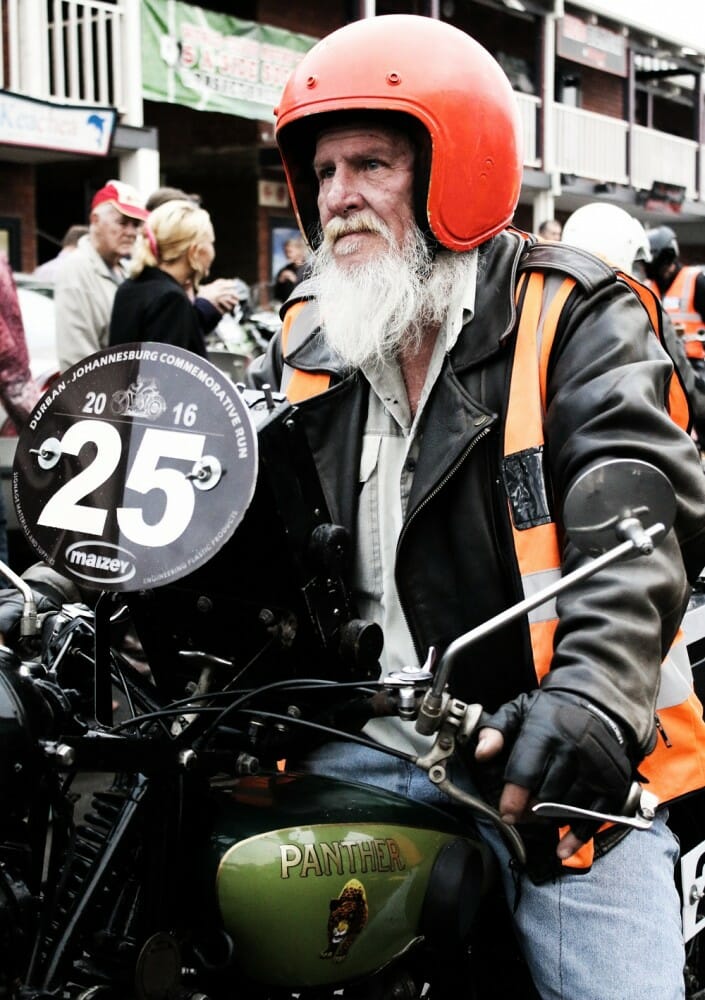
The 2015 list was typical: 26 different makes, mainly British and mostly singles … easier to estimate your speed when you can count the firing strokes. Most numerous were BSA, Velocette, Ariel and Sunbeam, in that order, and between them making up almost half the entry. Norton, Triumph and AJS were strongly represented; handfuls of Royal Enfields, Panthers, Indians and Zeniths swelled the numbers. There were a couple of Harleys, and some real rarities, including a single Motosachoche and a New Henley among the remaining Rudges, Zundapps, OK Supremes and Matchlesses etc. And a gorgeous 1936 DKW 500 two-stroke twin, that suffered dynamo failure and failed to make it off the start line.
The oldest bike of all was that clutchless pedal-operated single-gear belt-drive 1909 Humber of Samantha Anderson. She had taken up mountain biking to get fit enough to help it up the hills.
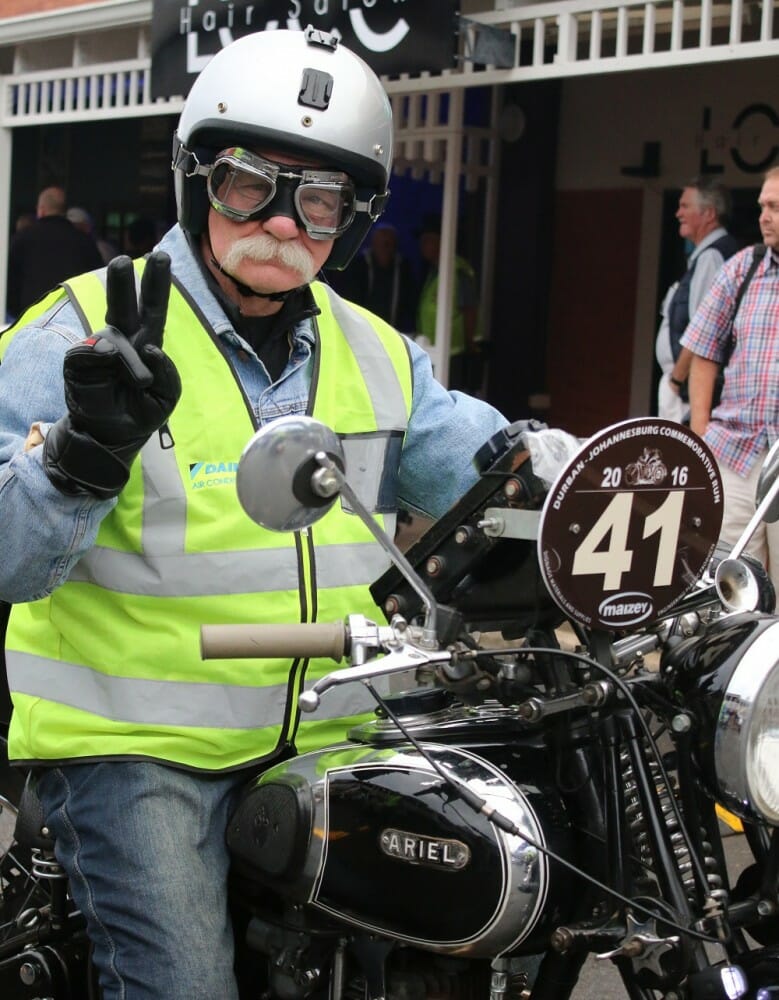
And the competitors? A gathering of granddads, leavened by a smattering of youngsters, including a couple still in their 20s. The oldest rider in 2015 was one Henry Kirton who at a very chipper 82 had yet to turn three when his 1930 Ariel left the production line. In 2016 it was 80-year-old Neville Smith (’36 Ariel Red Hunter). Both made the finish. Company in which (in my advancing years, and along with Cal Crutchlow’s dad Dek) I could feel comfortable, and even sprightly. Adventure before dementia. You know it makes sense.
The rally starts some 20 miles inland from Durban, where it becomes convenient to join the Old Main Road, and follow the authentic route. Back when it first started it was mainly a very rudimentary dirt track, including farm gates and stream crossings, now it is (in many stretches) a deteriorating secondary road long since replaced by freeways, while on day two in Gauteng Province (the former Transvaal) long stretches of repairs feature extensive stop-and-go sections where only one-way traffic is allowed, entailing waits of up to 20 minutes. This forced the organizers to abandon some previously timed sections, but gave overstressed old engines and riders a chance to get their breath back, in time for the next session of kick-starting.
Bonhomie prevailed at the prize-giving the next day. Anyone who got one of the finishers’ medals could be proud. In all sorts of conditions on ancient motorbikes ridden by people who are old enough to know better, getting to the end of this unique event was some sort of accomplishment. As unique in its way as the Isle of Man TT.