If you were to sit down with a few friends and attempt to list the most important street-legal motorcycles of the last 30 years, where would you start? Yamaha YZF-R1? Honda Fireblade, maybe? Or perhaps, here, the Ducati Monster +.
By Adam Child | Photography by Alex Photo
This is, after all, the motorcycle that dragged Ducati back from the abyss back in 1992. Without it, you could argue, there would have been no 916, no Panigales, Multistradas, Hypermotards, etc. It is also the machine that pretty much reinvented and reinvigorated the no-nonsense, no-fairing streetbike. The original air-cooled Desmo V-twin was as straightforward as it was boisterously good fun.
And here we are in 2026 with the latest, fifth-generation Monster. There have been countless models over the years—some entry-level, others track animals, with most falling somewhere in between—but once again, the focus is clearly on the street. On providing a spirited and straightforward ride on the roads we travel every day.
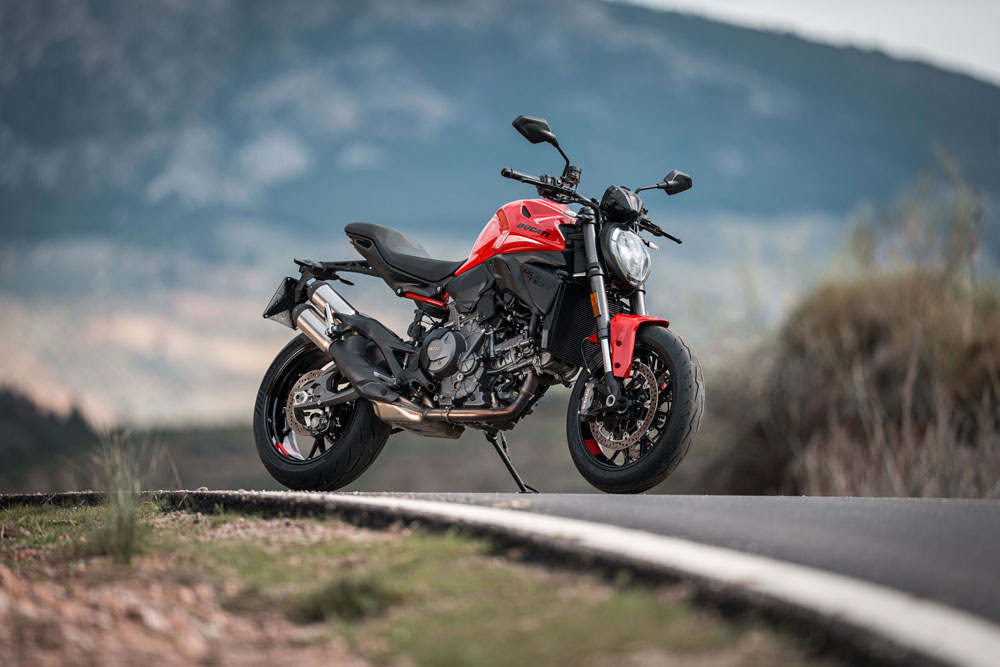
Admittedly, that original formula of rugged air-cooled simplicity and trellis frame (taken from the 900 SS, as memory serves) has long disappeared from the mix. And for the first time in the Monster’s 30-year history, its valves are spring-operated rather than Desmodromic, as Ducati’s all-purpose V2 replaces the long-running Testastretta V-twin.
The V2 now features in various models, including the Multistrada V2, Panigale V2, Streetfighter V2 and the upcoming Hypermotard. Its conventional valvetrain may offend the Desmo faithful, but it’s still a 90-degree V-twin and, at just 120 pounds, incredibly light as well as compact.
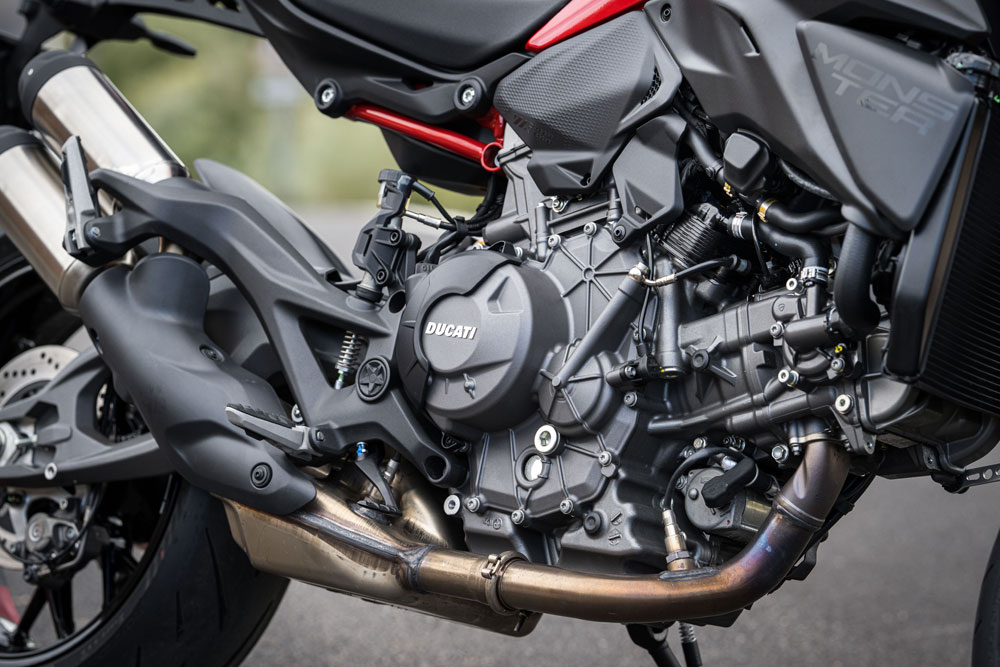
Ducati has allotted the Monster + the less sporty version, which churns out a claimed 111 horsepower at 9000 rpm and 67 lb-ft at 7250 rpm, leaving it fractionally down on top-end performance compared to its sportier Streetfighter sibling.
Ducati’s variable valve timing system (Intake Variable Timing) brings flexibility right across the rev range, while the highly refined DQS 2.0 up-and-down quickshifter is a standard fitment. Service intervals, meanwhile, go out to 27,000 miles for a valve clearance check, while an oil change is scheduled every two years/9000 miles.
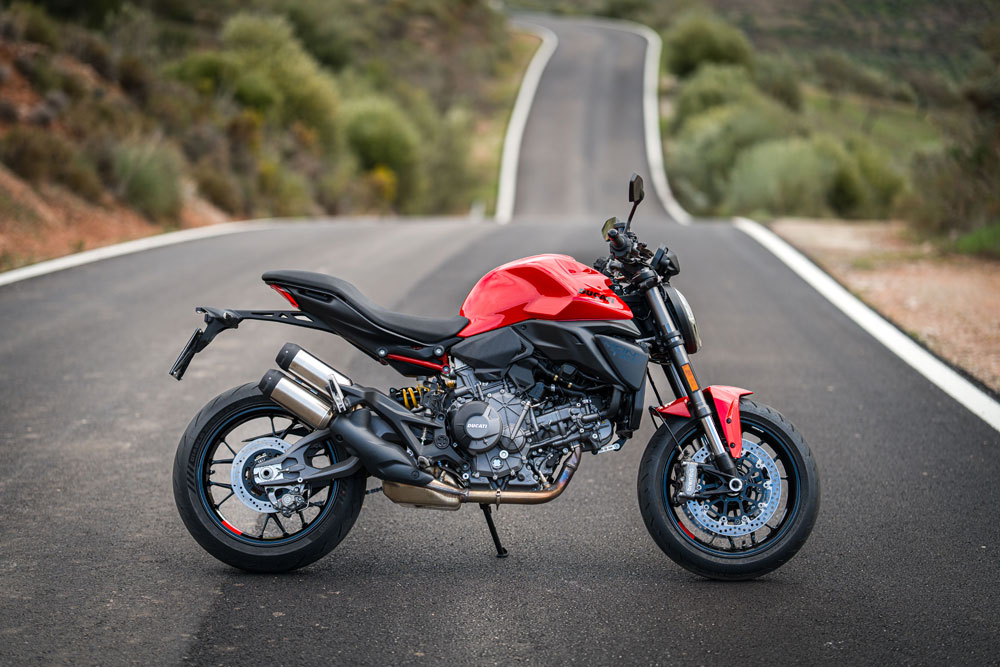
With the V2 comes Ducati’s ubiquitous and minimalist aluminum monocoque chassis along with a without-fuel weight of just 385.8 pounds, some nine pounds lighter than the outgoing Testastretta-powered bike.
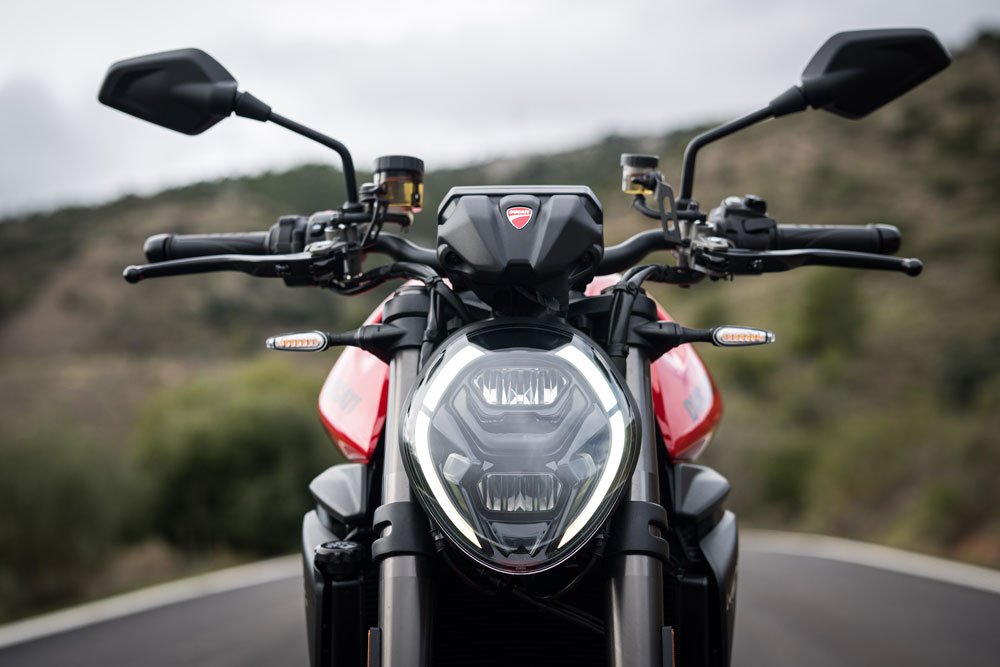
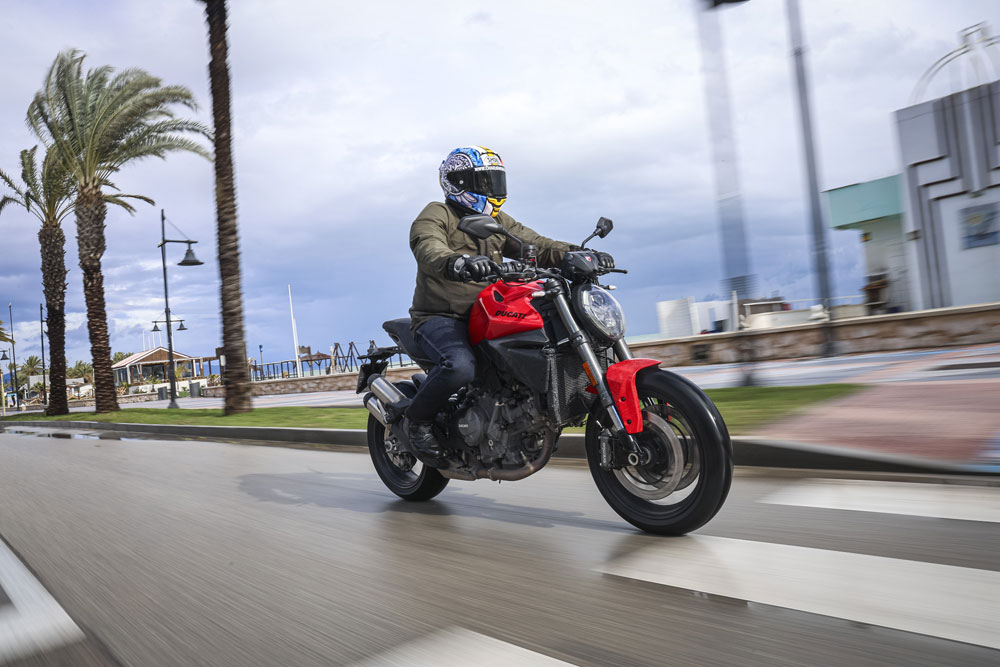
The new Monster + is as naked as the day it was born, too. Its big single headlight may be LED, but it remains true to its 1992 origins of Miguel Galluzzi’s Monster design, and its distinctively muscular tank of old also lives on in a more modern form (albeit with a modest 3.7-gallon capacity). As you approach it, the bike looks light on its wheels. Up for a good time, too. Just as a Monster should.
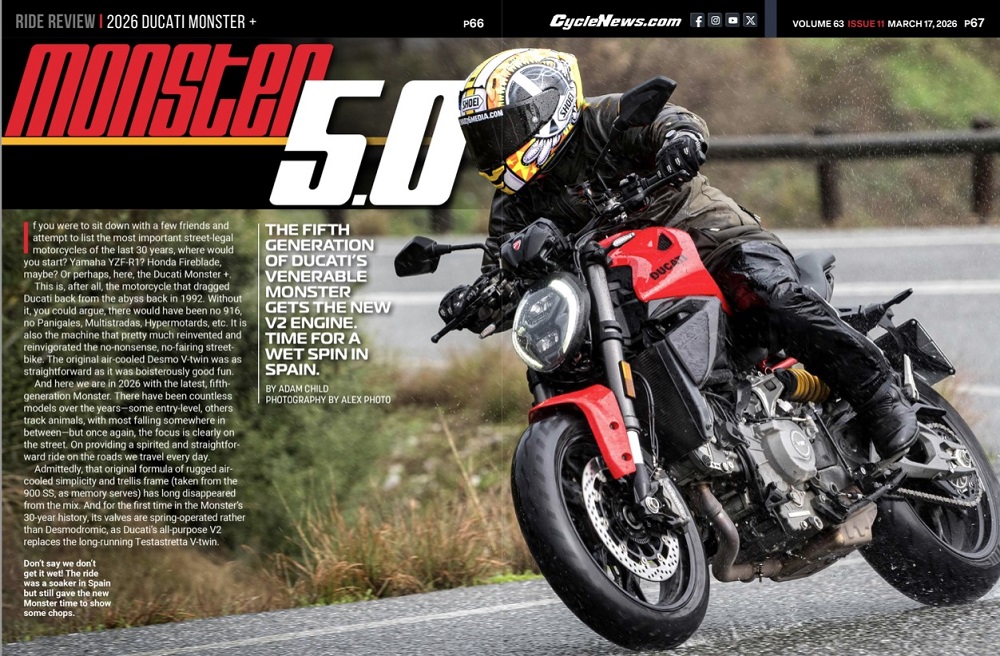
Unfortunately, Cycle News’ test in Southern Spain was hit by torrential rain that flooded roads and threatened to shut everything down. So, fun riding was in short supply. But we still managed to venture out, at least to get a flavor of the 2026 Monster +.
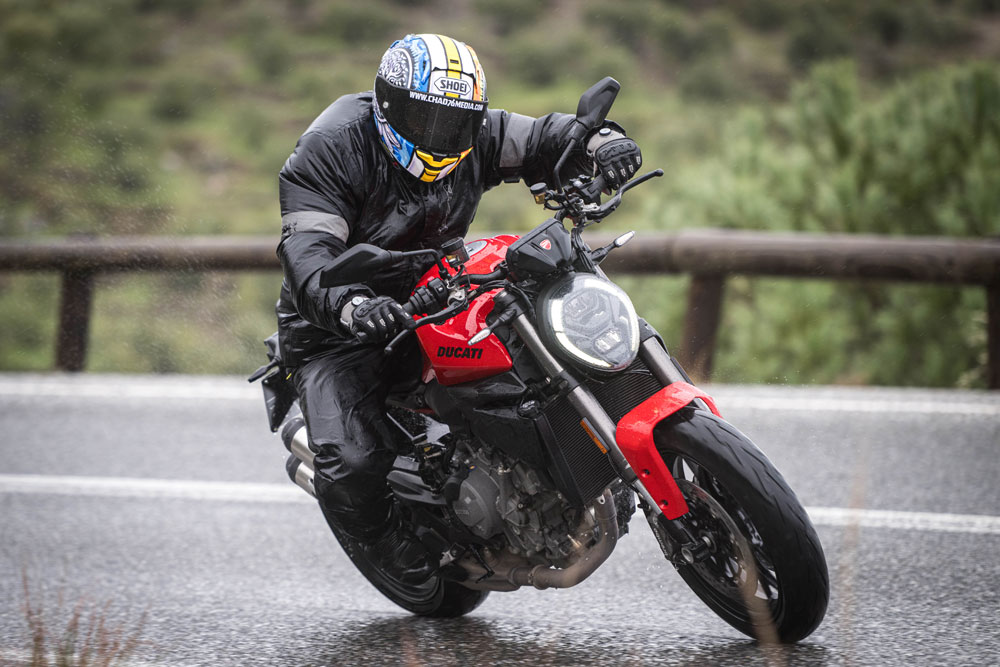
Riding the Monster +
Priced at $13,995 in the USA, the new Monster + carries a premium price tag for the class and is 10-20 percent more expensive than nakeds such as Yamaha’s MT-09 and Triumph’s new Trident 800. This is despite the Showa suspension being nonadjustable except for spring preload on the rear, and the brakes running lower-spec M4.32 calipers than the sharper M50 items found on the Streetfighter V2.
On board, you’re greeted by a new 5.5-inch color dash and the same neat and navigable switchgear shared with Ducati’s other V2s. Traditional one-piece bars shape you into a relaxed and neutral stance. There are now four power modes and four riding modes to choose from: Sport, Road, Urban and Wet, with the latter two limiting peak power to 95 hp.
These are easy to change on the move via a momentarily closed throttle, and each can be customized to suit your riding preferences. You could, for example, have the full stable of 111 horses in Wet mode rather than the prescribed 95, or remove the traction control and wheelie control in Sport mode. The extensive raft of rider aids features cornering ABS, Ducati Traction Control, Ducati Wheelie Control, engine-brake control and that Ducati quickshifter, which can be deactivated. All your settings remain saved, which is a welcome bonus.
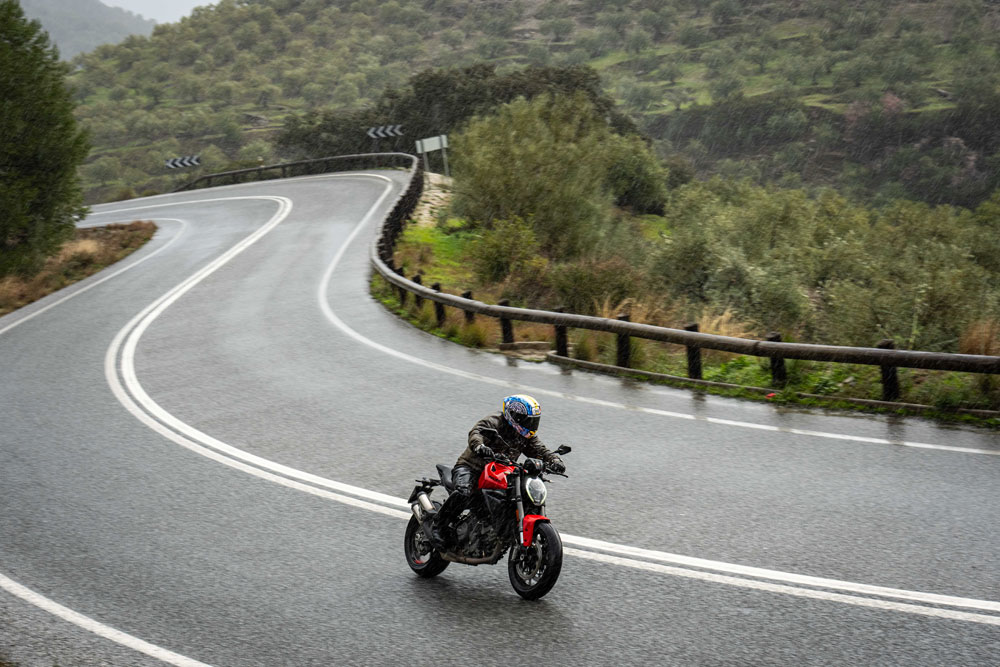
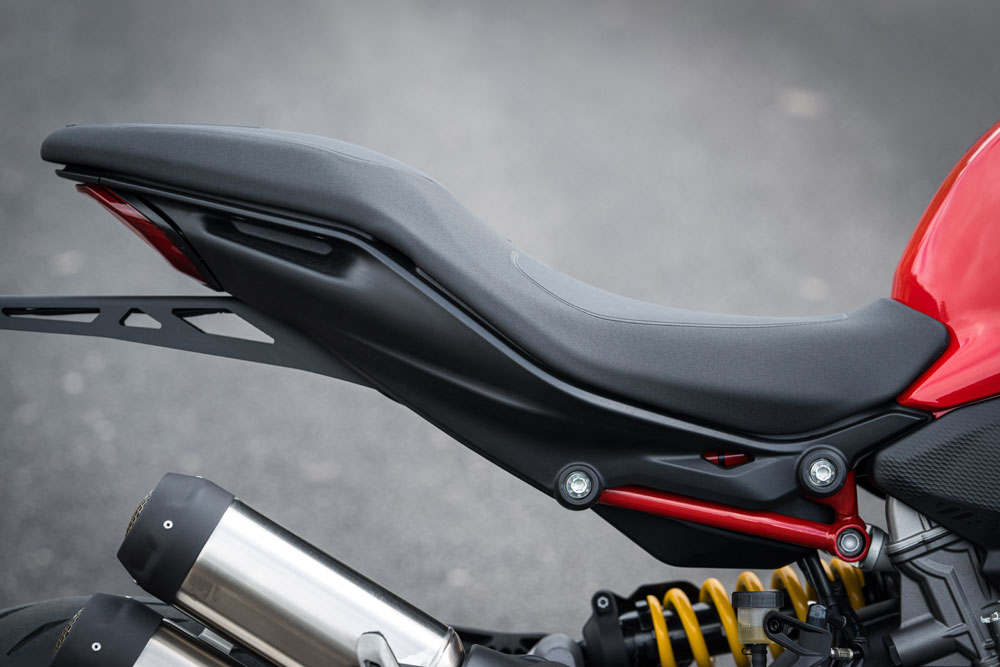
In a bid to appeal to both experienced riders and newer, shorter folk, Ducati has made the Monster + as easy to ride as possible. At just 385.8 pounds, it feels especially light at a standstill, while there’s plenty of steering lock for intricate maneuvers. Seat height is 32 inches, which is just under a quarter of an inch (5mm) lower than the previous Monster.
According to Ducati, the inner leg curve has been reduced by seven-tenths of an inch, while the official accessories catalog offers an even lower seat—by another seven-tenths of an inch—and a suspension lowering kit that removes another three-quarters of an inch, giving a theoretical seat height of just 30.5 inches. I’m 5-foot-7 and could easily get both feet firmly planted on the road on both sides of the standard seat.
The first section of our test ride was on the busy and slippery streets of Malaga. Monsters are as popular in town as in the country for good reason, and the new bike excels in the cutthroat chaos of rush hour traffic. It’s keen, clean and so easy-going you understand why Ducati feels there’s no need for an entry-level Monster these days.
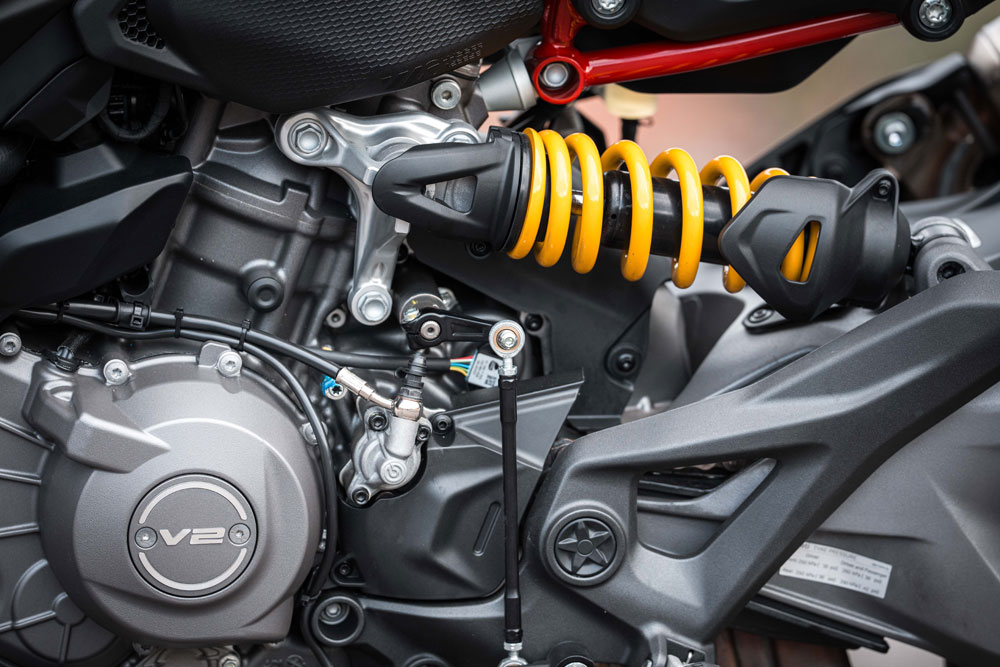
In Urban mode, the fueling is all but perfect and a far cry from the low-rpm lumpiness of the original Desmo. In fact, some 70 percent of the V2’s torque is available at 3000 rpm, and 80 percent between 4000 rpm and 10,000 rpm, thanks in part to Intake Variable Timing (IVT), and pickup from a closed throttle is instant without being overly sharp, while drive is as linear as it is lively.
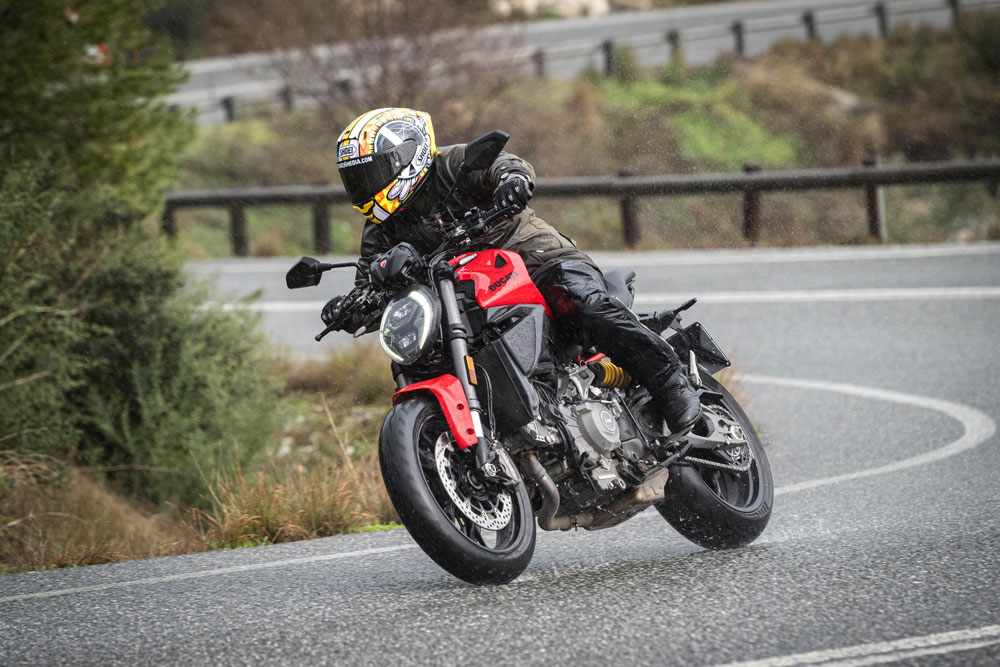
As we headed out of the city and into the sierras, the rain came down, and we rode into a cloud. Not ideal. Suddenly, the absence of a fairing didn’t seem quite so optimal. I opted for Road mode, but as we hit the first flooded road, I dialed in Wet mode. One of the beauties of the new Monster + is that you can easily change and experiment with the modes on the move, so you react and tailor the setup to the road ahead rather than leaving things as they are and just pressing on.
Both Urban and Wet have similar power curves and are restricted to 95 horsepower, but in Wet mode, the rider aids are at the maximum level of intervention, whereas in Urban, they are reduced a fraction.
With maximum electronic backup, I decided to push on, and the Monster + gave great feedback on treacherous asphalt. The all-round Pirelli Diablo Rosso IV tires also deserve praise for working well in both the wet and dry, and for warming up quickly.
The Monster’s base setup is plush and forgiving—certainly not as racey as some previous models. The bike steers very naturally. You’re never forcing or fighting things, and when we encountered a road punctuated by countless switchbacks, the Monster slowed, turned and drove out again with light-footed efficiency and zero drama.
When the traction control was activated, the intervention was smooth and the re-introduction equally sophisticated, noticeably more refined than that of most middleweight nakeds.
In the wet, I prefer lots of engine braking, giving the front brakes less to do, and the opposite in the dry, so having the ability to change this characteristic is another plus point.
As noted, the 2026 Monster gets Brembo calipers up front, with lower-spec four-piston M4.32 calipers, unlike the M50s found on its naked sibling, the Streetfighter V2. Discs are 320mm in diameter up front, while a single 245mm disc with a two-piston caliper looks after the rear wheel, and cornering ABS is standard.
The setup works well, but it will be interesting to see how both the stoppers and Showa suspension, which has limited suspension adjustment at the rear and none at the front, perform when the pace heats up. In the rain, when precision and feel were the main priorities, both were excellent.
Verdict | 2026 Ducati Monster + Review
Overall, the new Monster is as distinctively stylish, desirable and easy to ride as it has ever been. Smaller and less experienced riders will relish its blend of a low seat, a smooth engine (especially in Urban and Wet modes) and easy agility. Its slightly less powerful version of the new V2 powerplant may not punch out big numbers, but it is precise, responsive and smooth right across the rev range. There’s traction everywhere and superb electronic riders working in the background. Open the throttle with meaning, and the Monster + accelerates with crisp and linear urgency. It is quick when it wants to be.
Obviously, our verdict is a qualified one. How the Monster + will handle in the hills on a bright sunny day in summer remains for now an unknown, though we have an idea. But we can say that, despite the weather’s limitations on this review, the Monster + was still fun. And that’s a serious compliment, particularly as the bike gives virtually no protection from the elements. CN
2026 Ducati Monster + Specifications
| MSRP | $13,995 |
| Engine | 4-stroke, 90-degree V-twin, liquid-cooled |
| Displacement | 890cc |
| Valvetrain | 8-valve, conventional spring-operated |
| Bore x Stroke | 96 x 61.5mm |
| Compression Ratio | 13.2:1 |
| Transmission | 6-speed w/ Ducati Quick Shift up/down |
| Final Drive | Chain |
| Exhaust | 2-1-2 |
| Horsepower (claimed) | 111 hp @ 9000 rpm |
| Torque (claimed) | 67 lb-ft @ 7250 rpm |
| Clutch | Wet, multi-plate, slip and assist |
| Rider Aids | Four riding modes, four power modes, Ducati Traction Control (0-8), Ducati Wheelie Control (0-4), Engine Brake Control (3 levels), Cornering ABS (3 levels) |
| Engine Management | Ride-by-wire |
| Frame | Aluminum monocoque |
| Front Suspension | Showa 43mm inverted fork, non-adj. |
| Rear Suspension | Monoshock, preload adjustable |
| Front-Wheel Travel | 5.1 in. |
| Rear-Wheel Travel | 5.7 in. |
| Front Brake | Dual 320mm disc, 4-piston radial Brembo M4.32 calipers, cornering ABS |
| Rear Brake | Single 245mm disc, 2-piston caliper, cornering ABS |
| Front Wheel | 3.5 x 17 in. |
| Rear Wheel | 5.5 x 17 in. |
| Front Tire | Pirelli Diablo Rosso IV 120 70 x 17 in. |
| Rear Tire | Pirelli Diablo Rosso IV 180 x 55 17 in. |
| Rake | 23.3° |
| Trail | 3.6 in. |
| Wheelbase | 58.7 in. |
| Seat Height | 32.0 in. |
| Fuel Capacity | 3.7 gal. |
| Weight (dry, claimed) | 386 lbs. |
Click here to read the 2026 Ducati Monster + Review in the Cycle News Digital Edition Magazine.