Cycle News Archives
COLUMN
Still Jammin’
By Kent Taylor
In last week’s issue of Cycle News, Archives reflected on the famous Houston Astrodome hosting the AMA’s top dirt track racers in the 1972 TT and Short Track competition. The Astrodome welcomed all types of motorcycle racing, and for several years, the ’Dome was home to AMA Supercross, as well. In 1976, the newly named Supercross series (Cycle News called it “Astro-cross” in its 1974 coverage of the event) stopped by to race in the eighth wonder of the world.
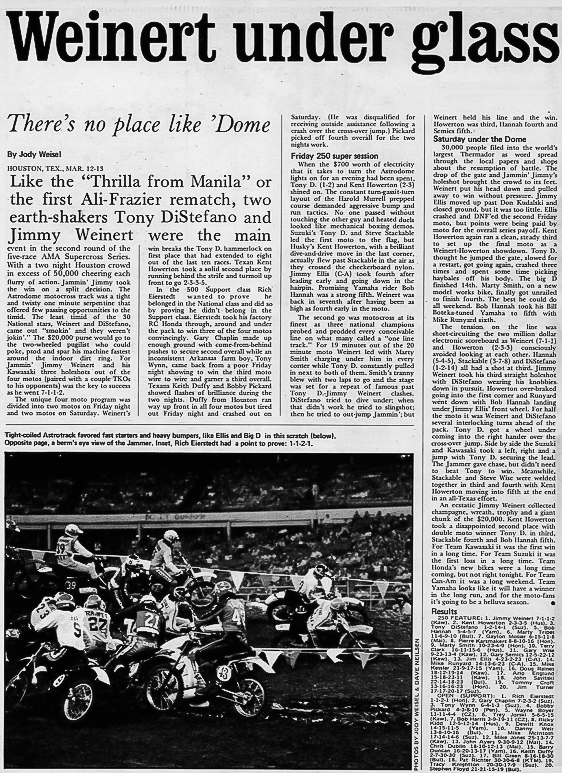
Race-day formats for Supercross and motocross were as fluid as five-weight fork oil in the 1970s. Three motos? Two motos? What was the best format for determining who was the best rider on the track that day? Today’s Supercross stars battle their way through heats for a one-moto final, except for a few Triple Crown events to mix things up, but in 1976, the AMA experimented with an unusual four-moto program. Two motos on Friday, two more on Saturday, with all finishes counting toward overall positions.
Cycle News estimated the crowd at 80,000 for the two nights of racing, and those fans were treated to some knuckle-bustin’ Texas bar bangin’ on a track that CN called a “tight and twisty one-minute serpentine that offered few passing opportunities to the timid.”
Like dirt tracking in 1972, Pro Motocross racing was undergoing a metamorphosis of its own in 1976. Early ’70s stars like Mark Blackwell, Gary Jones, Mike Runyard and others had either disappeared or were fading fast from the scene. Youngsters like Marty Smith, Tony DiStefano and Bob Hannah were the new young cats on the prowl. There was still, however, one old lion in the jungle: Team Kawasaki rider Jim Weinert remained one of the sport’s fastest and most consistent riders, as well as one of the oldest racers on the track.
In 2026, AMA Supercross is being dominated by veterans. Youngsters born in this century are eating roost from seasoned pros who, while not quite eligible for the early bird special at Denny’s, are still all on the wiser side of 30. Thanks to 21st-century training techniques, healthy food choices or just good genes, some of the best riders in the sport are even old enough to remember two-strokes.
A half-century ago, however, motocross was a young buck’s game. Smith, DiStefano and Hannah had yet to reach their 20th birthdays at the time of the Houston race. At age 24, Jim Weinert was considered a graybeard in the dirt.
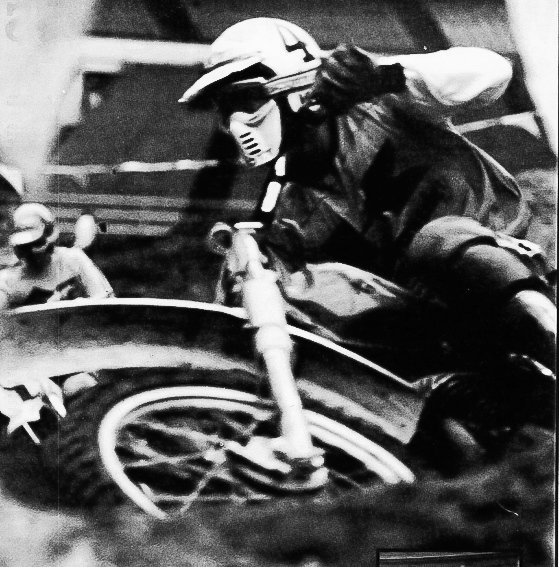
“The Jammer,” it seemed, had been around forever, but as Indiana Jones told Marion Ravenwood “It’s not the years, honey. It’s the mileage.” By 1976, he had already won two AMA 500cc National Championships, a Trans-AMA victory, and had four factory rides—with two teams. Weinert went from Yamaha to Kawasaki, where he won his first title, then back to Yamaha, where he successfully defended it, only to lose his job through no fault of his own.
Many years after his career ended, Weinert was finally able to tell the story. “Bill Buchka, who was my mechanic at Yamaha, wanted to go to Europe in 1976. At the end of ’75, he told them that they were going to send us there or we weren’t re-signing.”
“I didn’t even want to go to Europe,” Weinert says, in a worked-up, New Yorker’s voice of defiance. “I didn’t even know about this. So, when I finally talked to Yamaha, they said they were moving on. They said, ‘Maybe we can give you a production bike for 1976.’”
Decades had passed since that encounter, but the animation in Weinert’s voice brings it back around, and the words still sting. His response to Yamaha’s somewhat disingenuous offer was “No thank you.” Or something like that.
Weinert had already gone from yellow to green once before, and he found the doors were open for him one more time at Kawasaki. Could the old man of motocross, switching rides for the third time in four years, fend off the pretenders to the throne at Houston?
The answer would come quickly: negative. Though he had briefly circulated in fourth place, Weinert and his Kawasaki had faded to seventh by the end of the first moto. Suzuki rider Tony DiStefano had taken the win, with Husky rider Kent Howerton in second, and it appeared as if one of these two would stand atop the victory podium, along with Can-Am rider Jimmy Ellis, who also showed winning speed. What do you get for seventh place? Maybe a Kewpie doll?
But when the gate fell for Friday night’s second moto, there was Weinert’s number-four Kawasaki battling for the lead. DiStefano, the 250cc champion and Smith, number one on the 125s, spent the next 20 minutes looking for a way around the 500cc king, to no avail, and Weinert took the win.
He would pick up where he left off when the racing returned on Saturday night, leading the first moto from start to finish for an easy victory over Ellis. The overall, however, was still Tony DiStefano’s to lose. Which is exactly what he did.
“Tony D thought he jumped the gate,” CN wrote, “[and] slowed for a restart.” But no restart was called, and the Suzuki rider would then proceed to crash three times during a frenzied ride to get back to the front, eventually finishing 14th. He would get it back together for a win in the final moto, with Weinert playing it safe for second. The Jammer’s 7-1-1-2 topped DiStefano’s 1-2-14-1.
Weinert would go on to capture the 1976 Supercross Championship and win many more races before calling it a career in 1980 at the wizened age of 28. Today, he operates the Jimmy Weinert Motocross Training Facility in Jones County, North Carolina. New riders are learning how to jam—from the original Jammer himself! CN
Click here to read the Archives Column in the Cycle News Digital Edition Magazine.
Subscribe to six decades of Cycle News Archive issues