It’s a mystery to me why there’s only one manufacturer left that produces a 200cc two-stroke off-roader for the U.S. market, or any market that I’m aware of, for that matter. I guess when you think about it, there have only been a few that have dipped their toes into the 200cc waters over the years. Kawasaki, with its beloved KDX200, and KTM, with its various 200s, quickly come to mind. Going further back, there was the Yamaha IT200, and I’ll even include the Suzuki PE175. All of these “small-bore” off-roader two-strokes offered excellent performance for their intended use and were quite popular—especially the KDX200—during their heydays. Yet all of them have faded into history. I never understood that. They were just so good and a blast to ride! Why did they disappear? KTM was the last to hold on to its 200, discontinuing it for the 2017 model year and replacing it with the 150 XC-W, which is still in production.
Photography by Jesse Ziegler
When KTM exited the 200 class, Beta saw an opportunity and quickly stepped in to fill the void, introducing a 200cc off-road bike in 2019 that was a direct derivative of Beta’s at-the-time all-new 125RR. Since 2019, the Beta 200 has received several updates, the latest to its chassis last year. This year, the 200 features further enhancements, including a larger-diameter rear axle and an updated front-brake caliper taken straight from Beta’s 450 RX motocross bike.
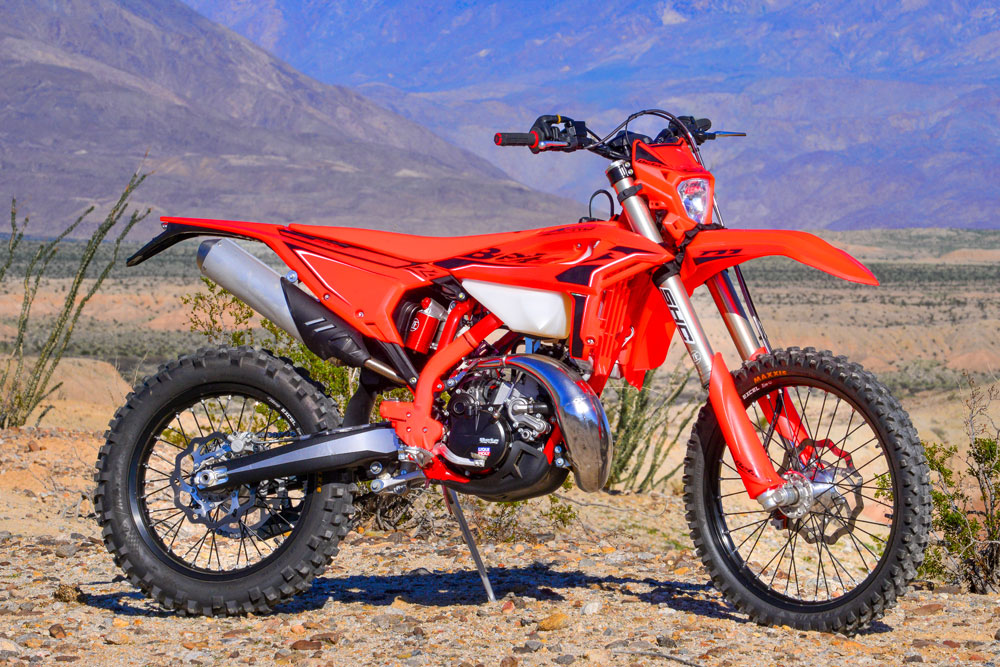
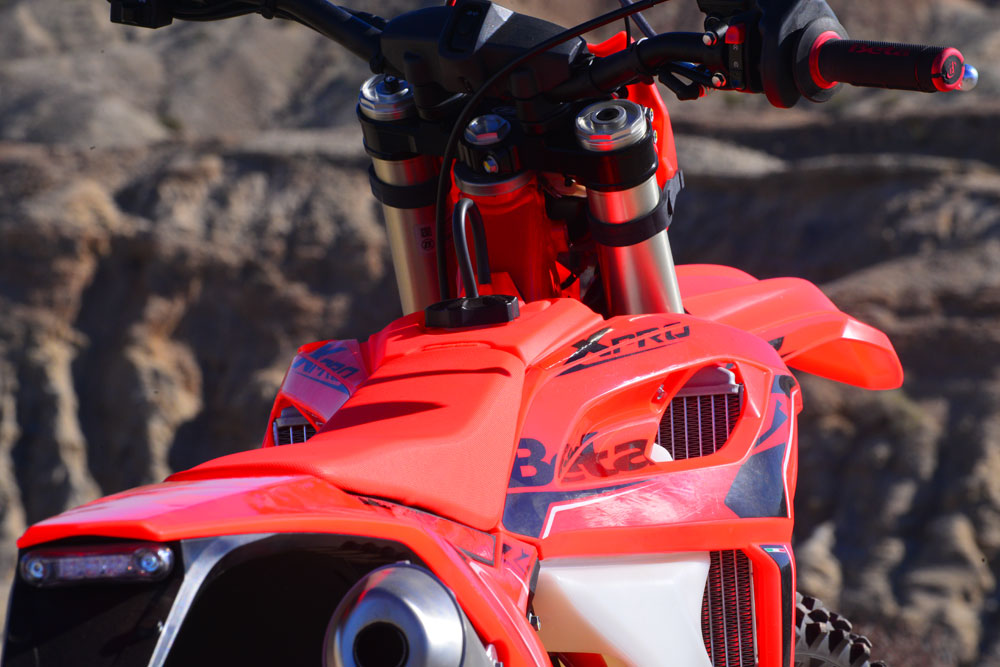
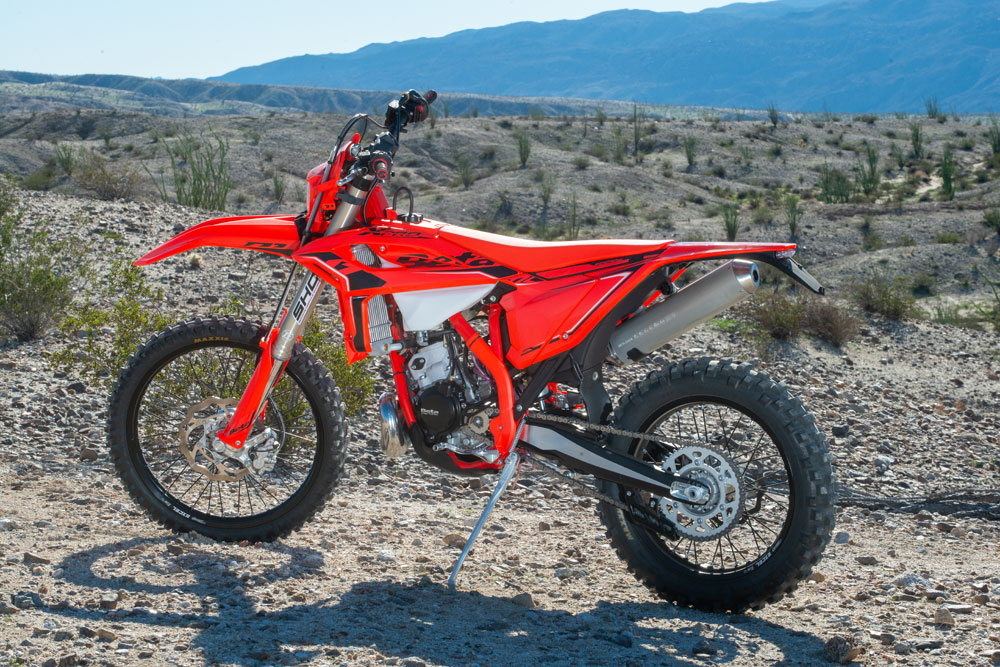
Beta offers the 200 in two varieties, the RR X-Pro, which we’re reviewing here, and RR Race. The Race is tuned with, you guessed it, racing in mind; the X-Pro is tuned more for the serious trail rider who races occasionally. The main difference between the two is their suspensions. The X-Pro is fitted with the latest Sachs suspension, while the Race is fitted with KYB suspension. Both are fully adjustable, though the KYB units offer slightly more wheel travel and are considered better performers for higher-speed, more aggressive riding. The X-Pro also yields a one-inch lower seat height at 36.4 inches. Another big difference between the X-Pro and Race models is engine lubrication: the X-Pro is fitted with a more convenient oil-injection system, while the Race uses a more reliable, lighter premix system. You also get a few upgrades with the Race that you don’t with the X-Pro, like a front-axle grab handle, aluminum footpegs, a bi-metal rear sprocket and handguards. The Race also has more pretty-looking anodized parts and snazzier graphics. The Race is a little lighter than the X-Pro, 207 pounds compared to 214 pounds (dry, claimed). However, the X-Pro is fitted with a front rescue strap that the Race does not have. Beta expects the X-Pro buyer to do more extreme enduro riding than the Race buyer, who is thinking GNCC.
The only difference remaining between the 200 RR X-Pro and the Race is the price. You’ll pay $600 more for the KYB-fitted Race model than for the X-Pro, costing $10,790 versus $10,190.
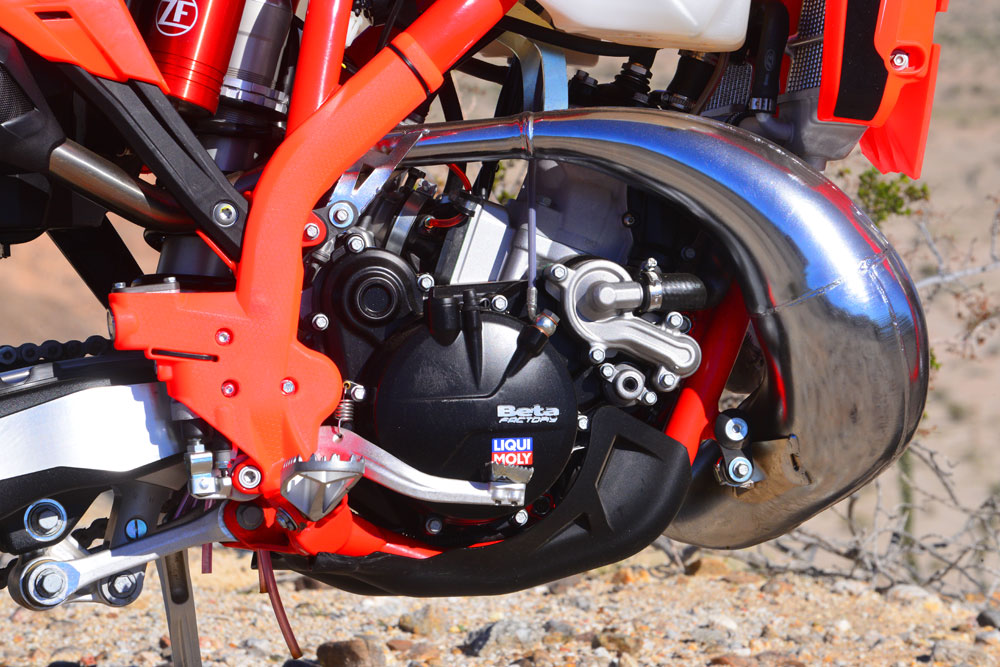
The 200 and 125 RR X-Pro are closely related, of course, but have a few key differences, like how they start. The 200 uses electric starting, while the 125 uses kickstarting. The 200’s larger displacement results from a 62mm x 63mm (190.2cc) bore and stroke, compared to the 125’s 54mm x 54.5mm (124.8cc). Additionally, the 125 is premixed and weighs seven pounds less than the 200 at 207 pounds (dry, claimed).
Twisting The Day Away | 2026 Beta 200 RR X-Pro Review
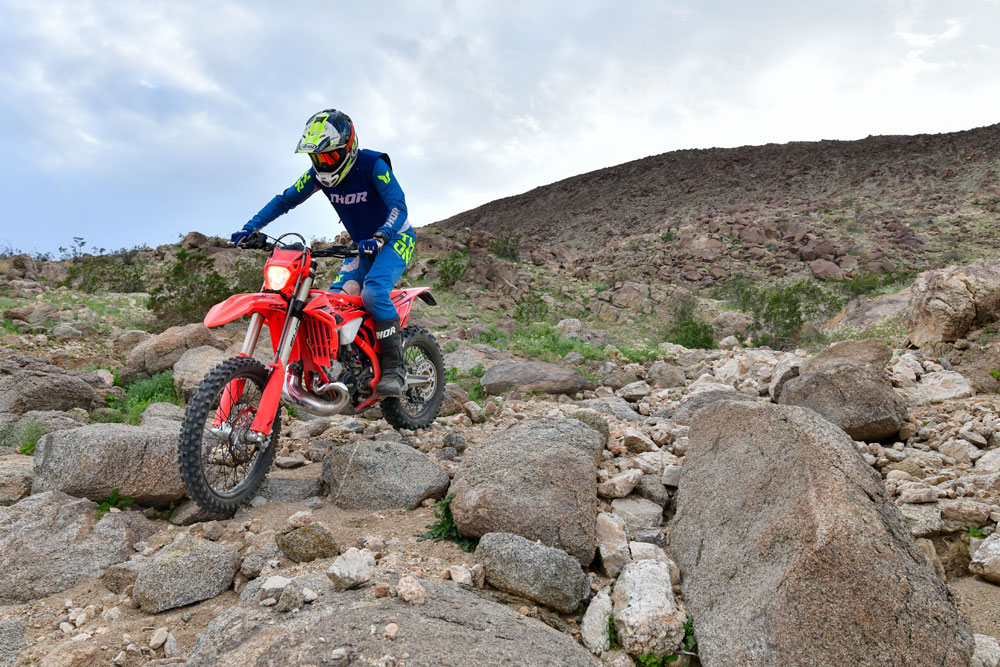
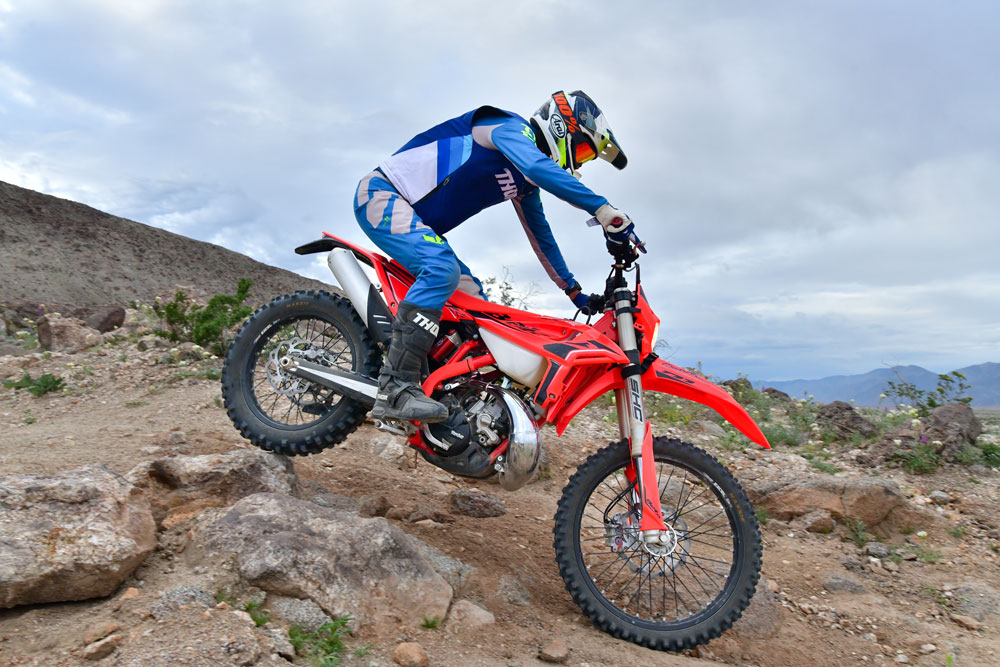
It’s not surprising that the 200 shares many traits with a 125 two-stroke, more so than a 250 two-stroke. Like a 125, it revs quickly and likes to be revved, which are two things we love most about riding 125s. What we don’t like about riding 125s is the penalty for letting them “fall off the pipe.” They tend to lack bottom-end and torque, but the RR 200 X-Pro doesn’t. On the contrary. The Beta is a tractor and is nearly impossible to stall, like a 300 but without the excess power. There’s hardly a price to pay when the “Rs” drop too low on the 200; you just crack the throttle, maybe slip the clutch a little, and keep going. It’ll pull you up anything, like rocky, loose uphills, and across challenging rock gardens. When things get ultra-technical, the 200’s super-light-pull clutch lets you easily feed in power for those tricky situations, and I never felt a hint of fading from the clutch.
Our Beta 200 RR X-Pro came with a one-tooth smaller countershaft option that I never felt the need to try; stalling was never an issue for me, and I felt that the bike’s slightly tall gearing still pulled nicely off the bottom while offering sufficient speed on top. The 200 is plenty fast yet is far more manageable than a typical high-performance 125cc two-stroke. Way more forgiving.
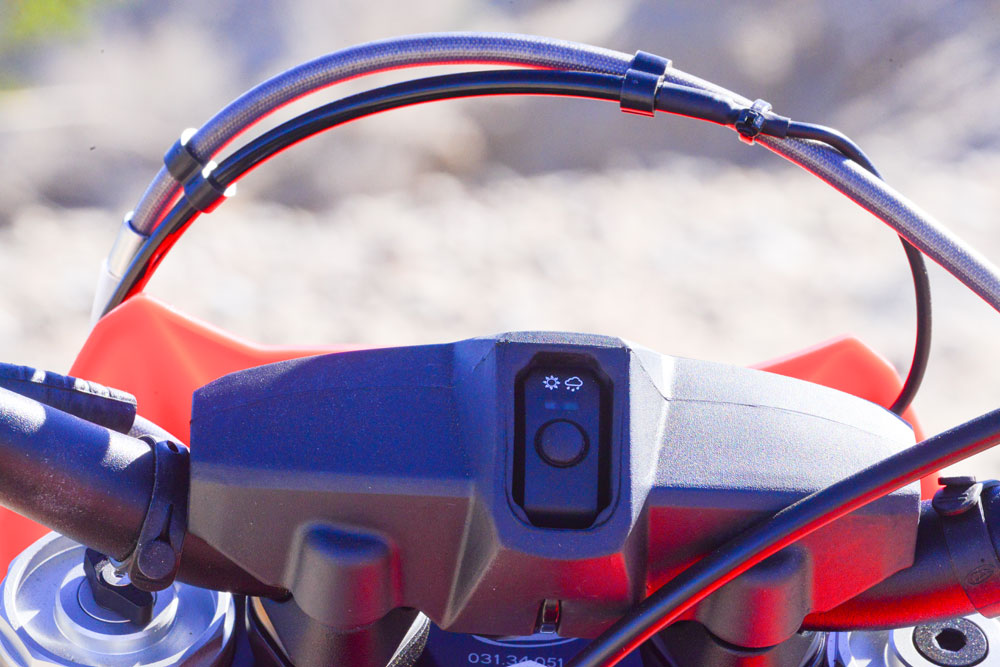
The Beta is fitted with an “engine map” button on the handlebars that alters ignition timing for different terrain. There are two positions. The standard position is depicted by a sun, and the other by a rain cloud, which mellows the power delivery. It’s very noticeable, and you won’t use it but in the very most extreme, traction-less conditions, like on a hockey rink.
All of Beta’s X-Pro two-strokes are equipped with Keihin PWK 36mm carburetors, and the 200 runs so well that you can see why Beta hasn’t jumped on the fuel-injection train yet.
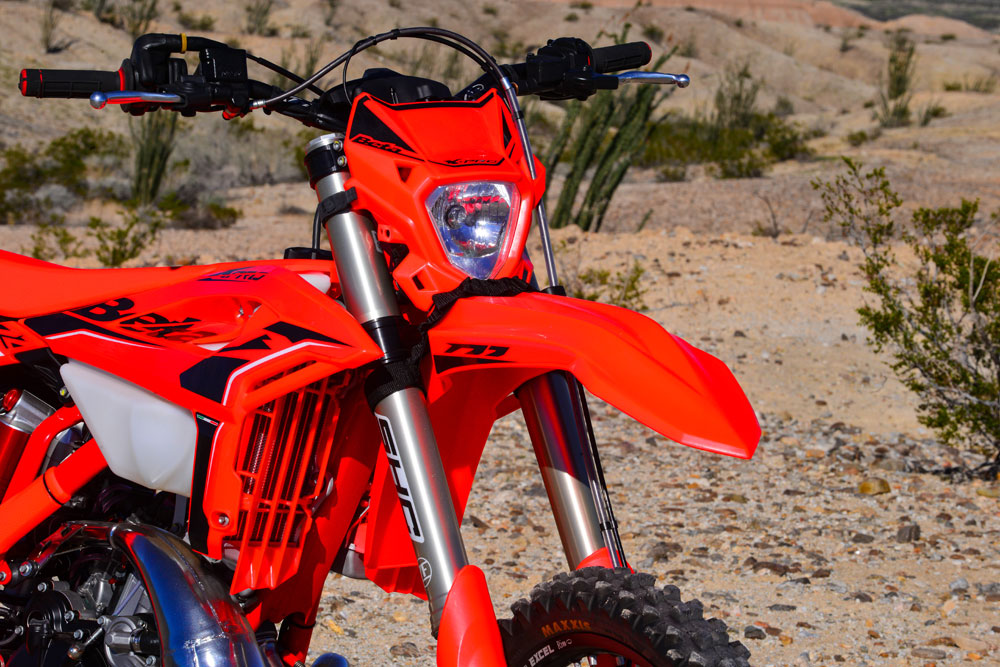
The Beta’s Sachs suspension is excellent for technical off-road riding. It’s well-sprung for my 170 pounds (in street clothes) and offers a planted, plush feel at both ends. Up front is a Sachs ZF SHC (Single Hydraulic Chamber / Separate Function & Clicker) 48mm open-cartridge fork that combines spring and rebound damping in one leg (right) and compression damping in the other (left). The fork was designed for aggressive trail riding and performs as expected. The shock, which is fully adjustable, also feels just right. The rear end does a great job absorbing smaller bumps, rocks, and holes, while maintaining control over high-speed whoops. The 200 isn’t a couch, though; you feel almost every bump at slow speeds.
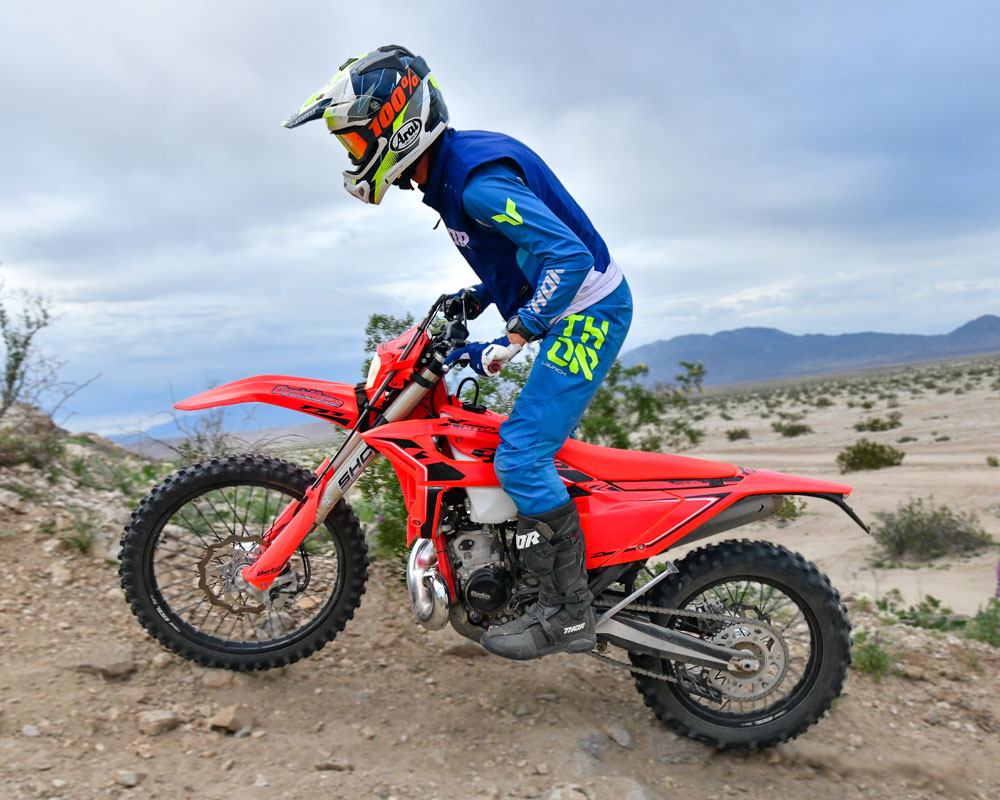
But probably the best part of the 200 RR X-Pro is how it feels between your legs. Even though it weighs only 14 pounds less than its 250 and 300 RR X-Pro two-stroke siblings, it feels like 20 pounds. It feels so light and maneuverable that it makes you think you’re invincible. “Yeah, I can climb that.” “Yeah, I can go down that.” “Yeah, I can ride over all those rocks.” And nine times out of 10, you can. Excellent ergonomics, a slim layout, and a firm, narrow seat also contribute to this feeling. And so do the Maxxis Enduro knobbies that perform well on a variety of terrain.
However, the 200 has limitations, like how far you can ride it on a full tank. Despite its relatively large 2.5-gallon fuel tank, it only gets about 30 miles per tank. I ran it dry twice, once at 29 miles and once at 32 miles. I didn’t test how long it would last on reserve; Beta claims 10 to 15 miles.
The Beta is easy to live with. I love not having to mix fuel and oil, and the air filter is simple to access, with no tools. Same with the oil-injection reservoir; just pop off the seat, again, no tools necessary, and fill ’er up, which you don’t have to do very often. After more than two tanks of fuel, the oil level on our bike is still just below the top. Just in case, the Beta does have a low-oil warning light with plenty of leeway. Also, as of yet, nothing has broken or come loose, and the plastic still looks good. I feel it’s safe to say these days that Betas are well built at their family-owned factory in Rignano sull’Arno, Italy.
Gold Medal | 2026 Beta 200 RR X-Pro Review
The 2026 Beta 200 RR X-Pro is a wonderful motorcycle that makes off-road riding seem easy and makes you feel like a hero. However, it’s not for everyone. It is a “smaller” motorcycle that likes to be ridden on the aggressive side every time you throw a leg over the seat, and things happen quickly on it. As I said, it’s not a couch; instead, it’s a very responsive and snappy off-roader that keeps you on your toes, but in a good way. It doesn’t play tricks on you, other than tempting you to attempt a tricky trail that you might not have even considered on any other, larger-displacement motorcycle.
When I sat down to write this review, my goal was to use this one word exactly once, and here it is—fun. If I hadn’t set that goal, I probably would’ve used it in every other sentence because it’s the perfect word to describe the 2026 Beta 200 RR X-Pro… fun. D’oh! CN
VIDEO | 2026 Beta 200 RR X-Pro Cycle News Ride Review

2026 Beta 200 RR X-Pro Specifications
| MSRP | $10,190 |
| Engine Type | 2-stroke, single |
| Displacement | 190.2cc |
| Cooling System | Liquid |
| Bore x Stroke | 62mm x 63mm |
| Compression Ratio | 13.65:1 |
| Exhaust Valve | Beta Progressive Valve (BPV) |
| Ignition | AC-CDI Kokusan |
| Lubrication | Electronic oil injection |
| Fueling | Keihin PWK 36mm |
| Clutch | Wet multi-disc |
| Transmission | 6-speed |
| Final Drive | O-ring chain |
| Frame | Molybdenum steel, double-cradle |
| Front Suspension | Sach SHC, 48mm, w/ single spring, fully adj. |
| Rear Suspension | Sachs, single shock, fully adj. |
| Front-Wheel Travel | 11.6 in. |
| Rear-Wheel Travel | 11.4 in. |
| Front Brake | Single 260mm disc, floating |
| Rear Brake | Single 240mm disc |
| Front Wheel | 21 in. |
| Rear Wheel | 18 in. |
| Tires | Maxxis Enduro |
| Wheelbase | 58.1 in. |
| Seat Height | 36.6 in. |
| Ground Clearance | 12.7 in. |
| Weight (dry, claimed) | 214 lbs. |
| Place of Manufacture | Rignano sull’Arno, Italy |
Click here to read the 2026 Beta 200 RR X-Pro Review in the Cycle News Digital Edition Magazine.
Click here for all the latest Off-Road Racing news.
Click here for more Beta motorcycle reviews and news.