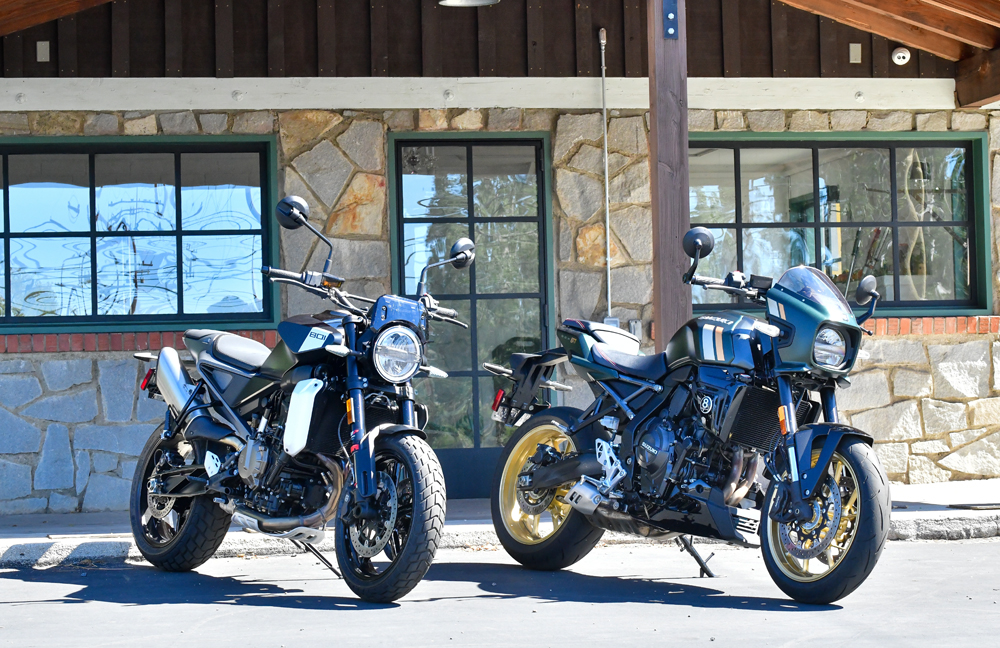
Suzuki’s GSX-8TT has proven quite the hit at Cycle News, so while we had it in the garage, we thought we’d go a little left field and pitch it against the Husqvarna Svartpilen 801. The results may surprise you.
Photography by Kit Palmer
The Suzuki GSX-8TT has had more miles under its wheels since I’ve had it in the garage than many other test bikes in 2025 due to that lovely parallel-twin motor, soft but compliant suspension, a near-perfectly comfortable rider triangle, and looks that hark back to Wes Cooley’s glory years on the GS1000.
Like the Moto Guzzi V7 Sport I had before it, the TT is a bike I just like looking at, which in turn makes me want to ride it, which makes me want to look at it again, and so the cycle continues.
However, it’s not perfect, especially when it comes to price. At $11,149, it’s nearly $1000 more than the $10,499 Husqvarna Svartpilen 801, a bike I’ll admit I wouldn’t have thought to pit against the TT, but the more I rode it, the more this comparison began to make sense.
The Svartpilen is the wrong bike to put against the TT, right? Its knobby-ish tires and scrambler ethos are not really in the same ballpark as the TT’s pure tarmac demeanor, but the performance of the former and the features it packs would argue otherwise.
Let’s have a bit of a spec sheet GP to see what’s up.
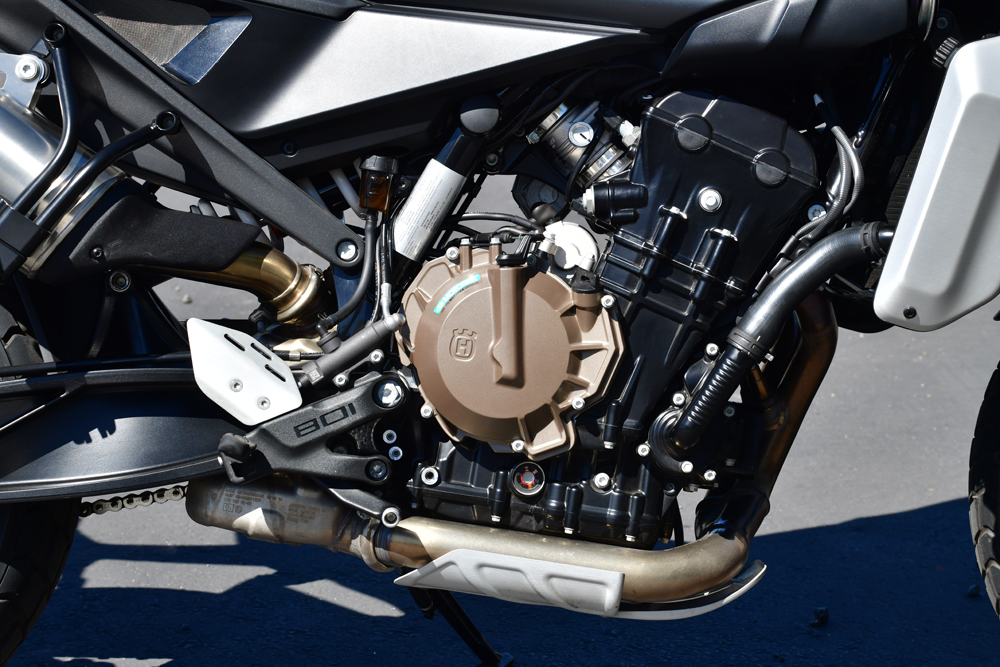
The Suzuki runs 776cc capacity compared to the Svartpilen’s 799cc, both of which come from parallel-twin four-stroke lumps, although the Husky has a clear advantage in horsepower with a claimed 105 ponies compared to the Suzuki’s claimed 80 horsepower. The Austrian/Swedish 801 also holds a lead when it comes to torque, with a claimed 64 lb-ft to the Japanese Suzuki’s 57 lb-ft.
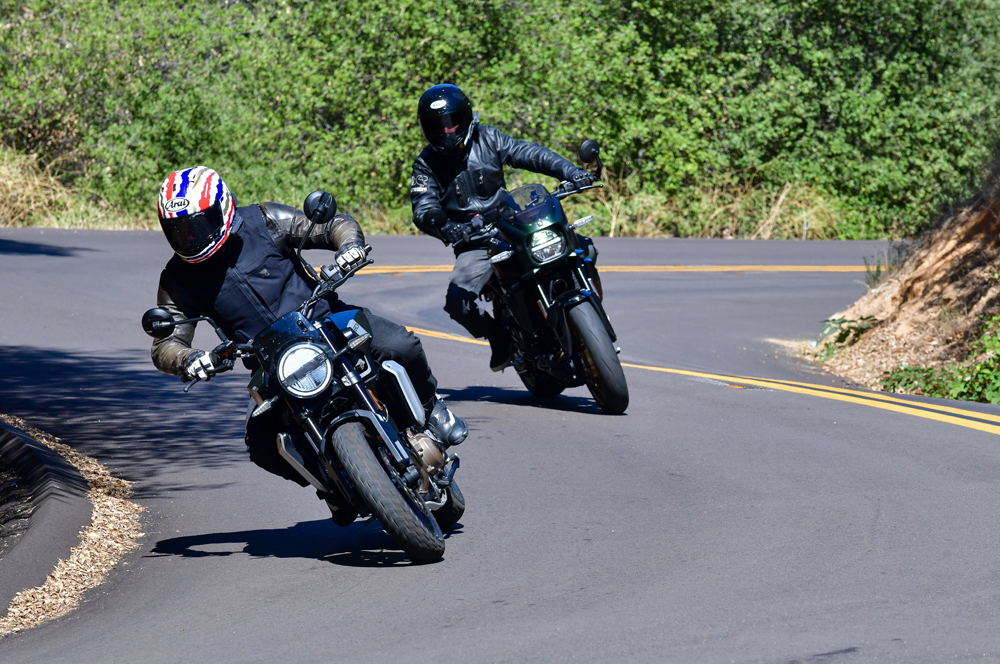
While not a big advantage, the feel at the handlebar is quite pronounced. The Husqvarna’s engine is faster revving and more playful than the Suzuki, which takes a bit of time to get going but delivers what it has in a smoother fashion compared to the Husky.
The Husqvarna’s higher-horsepower numbers really begin to show around 5000 rpm, where the European will leap ahead of the Japanese in third and fourth gear as speeds increase.
At low traffic speeds, the softer power delivery of the Suzuki is more enjoyable than the Husqvarna, which always feels a bit like a dog pulling on its leash. This is the same engine that has been used in two of our favorite bikes at Cycle News, the KTM 790 Adventure and Duke, both of which like a good rev to get the most performance. The Suzuki, on the other hand, is more gentlemanly in how it delivers its performance, a style that will likely favor a larger portion of potential buyers out there.
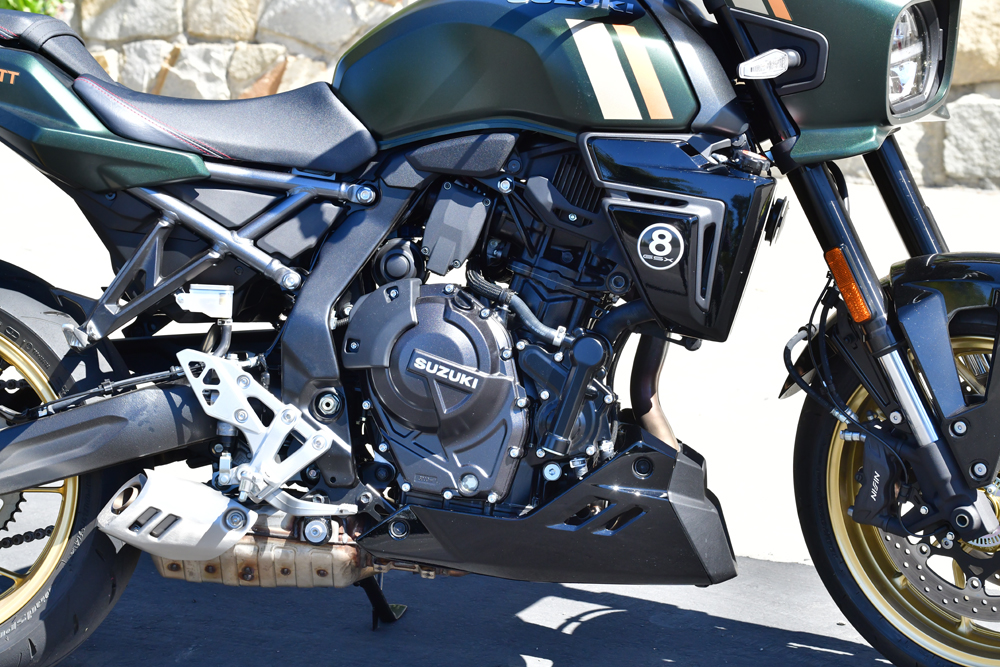
Both bikes come with variable riding modes, the Suzuki running the old A/B/C modes and the Svartpilen running the same in Rain, Road and Sport, basic traction control and ABS, and the Husqvarna’s optional Dynamic Pack will give you 10-level traction control, five-level anti-wheelie, Motor Slip Regulation, and a quickshifter.
The Suzuki, on the other hand, will give you the quickshifter as part of the base package, three-stage plus off traction control, ABS, and that’s it.
However, the Husqvarna runs a six-axis IMU, which gives you access to cornering ABS and traction control, putting it a step ahead of the non-IMU’d Suzuki.
It really depends on whether the extra stuff you can get for the Husky as aftermarket purchases is worth it to you, given its ride style. Having all that extra tech is a good thing, in my book, especially as it allows you to explore the limits of the engine. The Suzuki’s tech pack isn’t groundbreaking, but it doesn’t really need to be.
Both bikes, however, are remiss for not having cruise control or even the option of fitting it, especially on the higher-priced Suzuki, as it’s so comfortable you could easily go touring on it, and a bit of freeway comfort never goes astray.
As for day-long comfort, the Suzuki has the win, hands down. A near perfectly upright rider triangle means you have next to no weight on your wrists, and it allows you to smash out the miles with consummate ease, even if the seat becomes a little hard after about an hour on board.
The Husqvarna is racier in its ride position, with wider, MX-style handlebars and a firmer seat that encourages you to load up that front tire that really doesn’t seem like the kind of front tire you want to be loading up.
That sounds odd, I know, but let me explain.
The Husqvarna’s semi-off-road Pirelli MT 60 RS rubber was designed primarily as a scrambler hoop, but the Italians know most of these bikes will never see a dirt road in their lives, so on-road performance needs to be paramount.
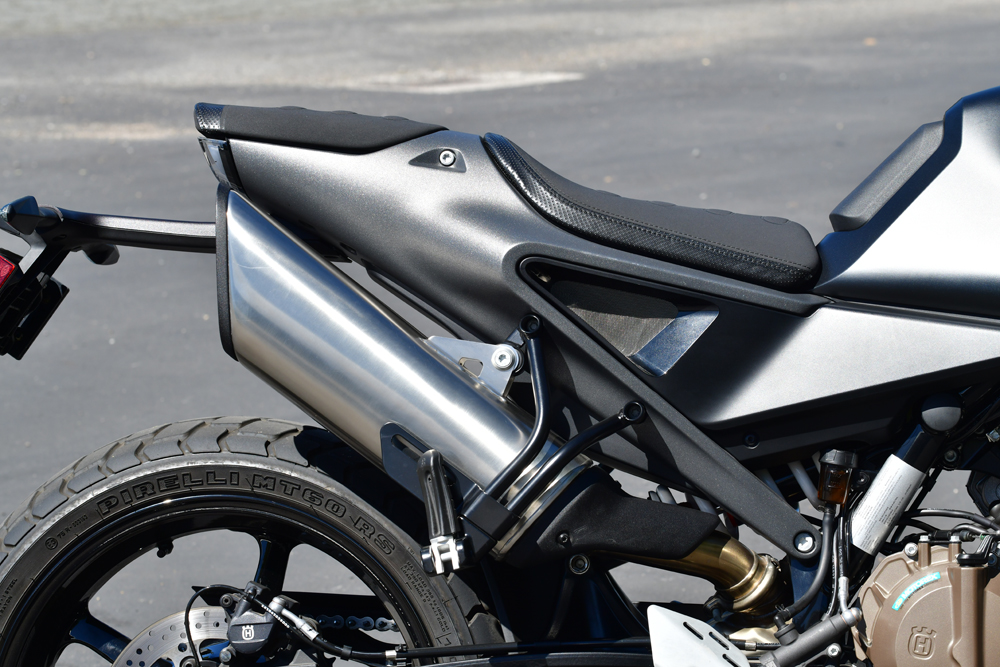
You can get away with some pretty extreme liberties on the front-end of the Svartpilen even with this rubber fitted, which is helped by a higher-spec WP fork than the Suzuki’s 41mm fork from KYB.
The Svartpilen runs a 43mm WP Apex fork that’s fully adjustable, giving the rider a more solid feel under heavy braking and during initial turning. The Suzuki’s nonadjustable front-end offers a more comfortable ride at low, traffic-light speed, but once out in the twisties and with the speed increased, it will plunge to the bottom of its shorter stroke quicker, which translates to a ride not quite as composed as the Husqvarna’s.
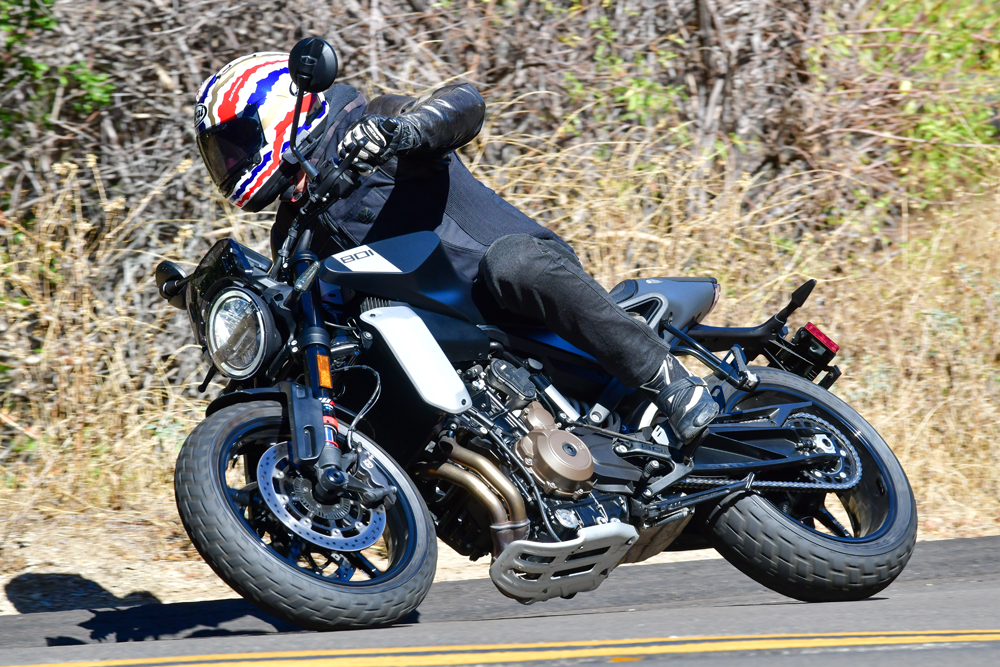
The Suzuki isn’t as nimble as the Husqvarna; its weight penalty of a claimed 50 pounds really hurts it when the road starts to get twisty. The Husqvarna’s snappy agility is great fun here, and it translates into an easier bike to maneuver in traffic, though it’s not as comfortable as the Suzuki.
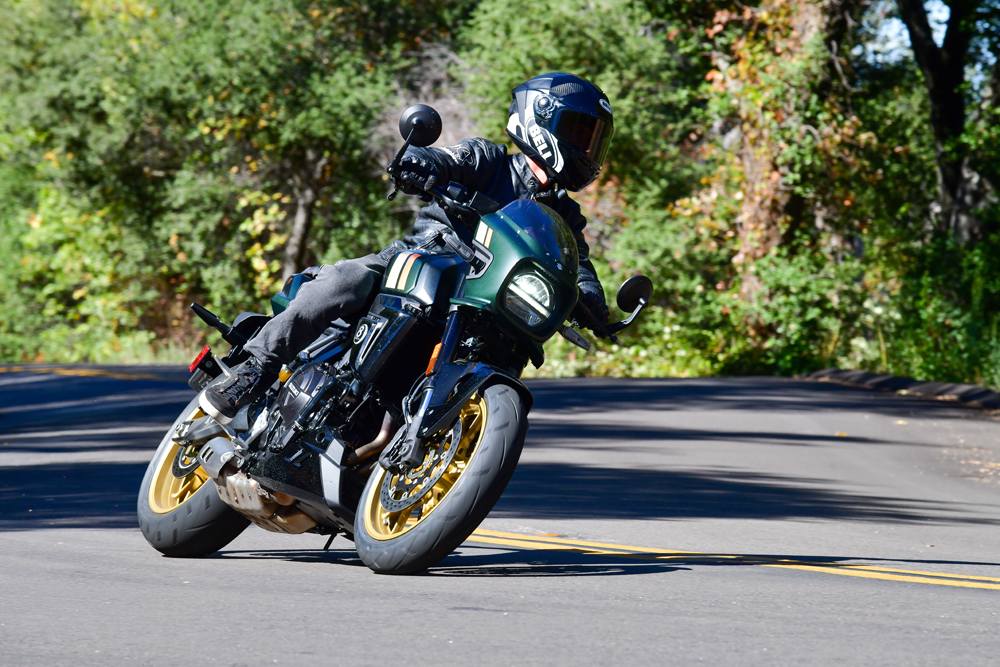
Braking is pretty even across the board. Both bikes run four-piston monobloc calipers, but the Husqvarna’s IMU gives you access to cornering ABS, which allows deeper, harder braking at higher lean angles than the Suzuki, which tends to kick in its lower-grade ABS a little early when the lever is squeezed hard. The Suzuki is helped in this regard with Dunlop’s Roadsport 2 rubber at its disposal, but the braking package is a step behind the Husqvarna’s.
Adjustment of the Husqvarna’s electronics package is easy thanks to the parent company KTM’s insistence long ago of using images rather than just words, so you know exactly what parameter you’re adjusting via the five-inch TFT dash.
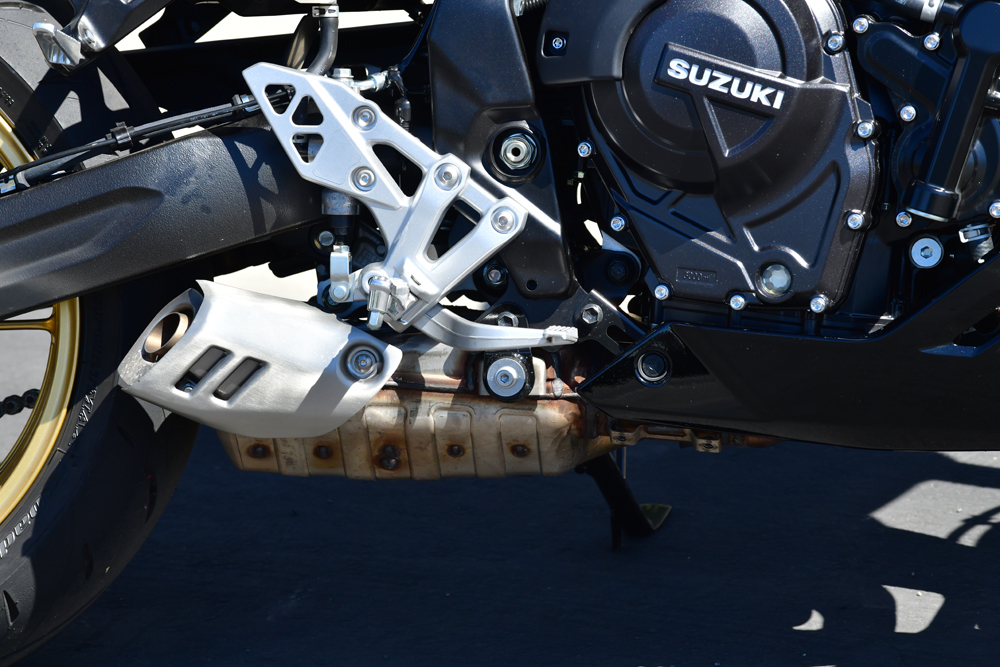
The Suzuki runs the same-size TFT dash, and while it isn’t as pretty as the Husky’s, it is probably the easiest to use of any midsize Japanese street bike available today. You can run turn-by-turn navigation on the Ride Husqvarna Motorcycles app, while the Suzuki has no built-in provision for maps, so you’ll need to either mount your phone on the one-piece handlebar or run a dedicated GPS unit to figure out where you’re going.
In comparing the Svartpilen 801 and the TT, both are capable, modern road bikes—but they serve different rider needs. The Svartpilen 801 leans more into performance with its 799cc engine, a sharper, more front-end-biased chassis setup, a greater range of electronic adjustment in ride modes, cornering ABS, smartphone connectivity, and lighter curb weight. The Husqvarna is built for the rider who wants punchy throttle response from the faster-revving twin, agile handling, and tech to match.
Meanwhile, the GSX‑8TT offers a more balanced (read: Japanese) approach. Its 776cc twin, 41 mm KYB fork, and simpler (but still modern) electronics deliver a more usable bike from day to day, but is it the most exciting?
If you value the most tech, sharper design lines, and a sportier feel, the Svartpilen 801 is your pick. If you favor a more versatile, approachable road bike with retro‑inspired styling and modern niceties thrown in, the GSX‑8TT holds strong appeal.
Both bikes deliver good value for money, but if I’m putting my money down, fun is the main factor for me, so I’m going (much to my surprise) for the Svartpilen, even with its funny-looking tires.CN
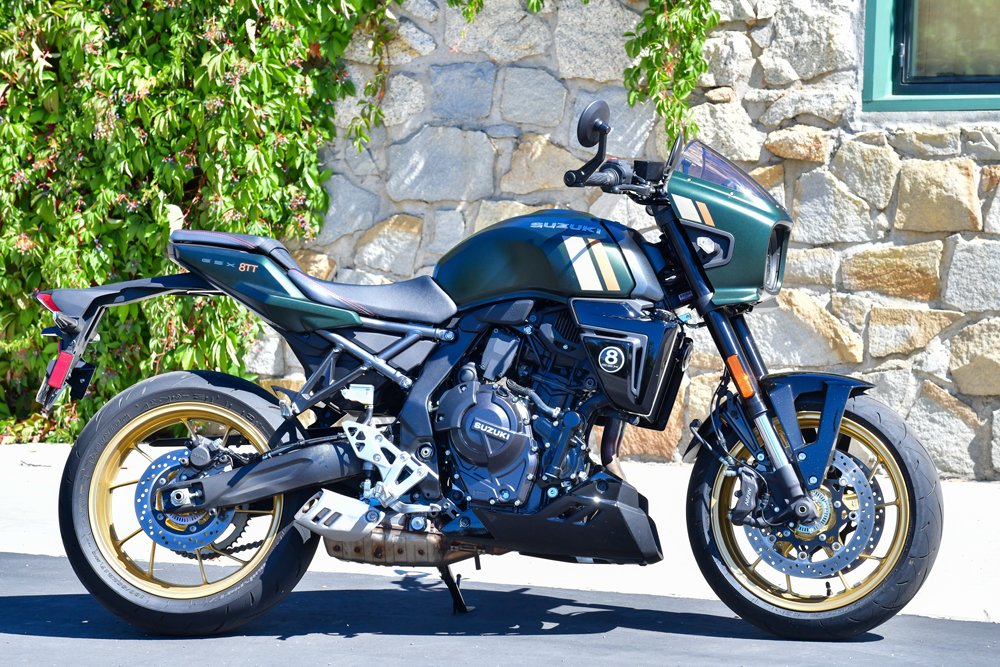
2026 Suzuki GSX-8TT Specifications
| MSRP | $11,149 |
| Engine | Parallel-twin |
| Cooling system | Liquid |
| Valvetrain | DOHC, 8-valve |
| Displacement | 776cc |
| Bore x stroke | 84 x 70mm |
| Fueling | Electronic fuel-injection, 42mm throttle body |
| Compression ratio | 12.8:1 |
| Exhaust | 2-1 |
| Transmission | 6-speed |
| Clutch | Wet, multi-plate, slip and assist |
| Electronics | Three riding modes, ABS, traction control |
| Chassis | Tubular steel |
| Front suspension | Inverted forks, nonadjustable |
| Rear suspension | Showa monoshock, adjustable preload |
| Front brake | Twin 320mm discs, Nissin 4-piston radial monobloc calipers |
| Rear brake | Single 240mm disc, Nissin single-piston caliper |
| Front tire | 120/70ZR17M/C (58W) |
| Rear tire | 180/55ZR17M/C (73W) |
| Rake | 25° |
| Trail | 4.1 in. |
| Wheelbase | 57.7 in. |
| Seat height | 31.9 in. |
| Fuel capacity | 4.3 gal. |
| Weight (claimed, curb) | 445 lbs. |
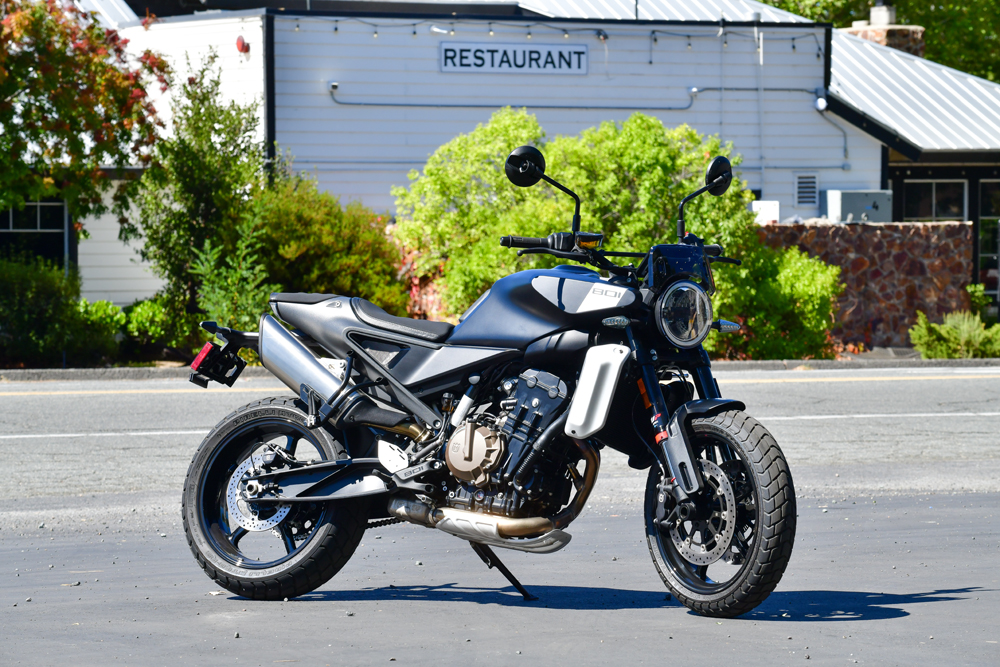
2025 Husqvarna Svartpilen 801 Specifications
| MSRP | $10,499 |
| Engine | Parallel-twin |
| Cooling system | Liquid |
| Valvetrain | DOHC, 8-valve |
| Displacement | 779cc |
| Bore x stroke | 88 x 65.7mm |
| Fueling | Electronic fuel-injection, 46mm throttle body |
| Compression ratio | 13.5:1 |
| Exhaust | 2-1 |
| Transmission | 6-speed |
| Clutch | Wet, multi-plate, slip and assist |
| Chassis | Tubular steel |
| Front suspension | WP Apex 43mm USD fork, fully adjustable |
| Rear suspension | WP Apex monoshock, preload and rebound adjustable |
| Front brake | Twin 300mm discs, ByBre 4-piston radial monobloc calipers |
| Rear brake | Single 240mm disc, twin-piston caliper |
| Front tire | 120/70ZR17 |
| Rear tire | 180/55ZR17 |
| Rake | 24.1° |
| Trail | 3.9 in. |
| Wheelbase | 58 in. |
| Seat height | 31.7 in. |
| Fuel capacity | 3.7 gal. |
| Weight (claimed, curb) | 421 lbs. |
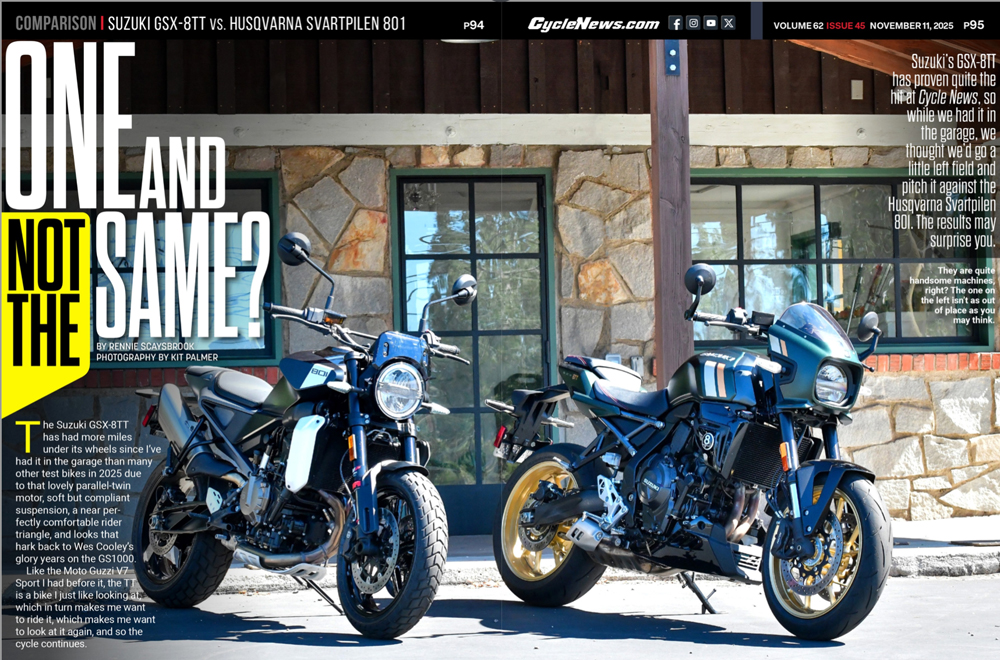
Click here to read the 2026 Suzuki GSX-8TT vs. 2025 Husqvarna Svartpilen 801 in the Cycle News Digital Edition Magazine.
Click here for the latest Cycle News Sportbike motorcycle reviews and news.
Click here for more Husqvarna motorcycle reviews and news.
Click here for more Suzuki motorcycle reviews and news.

