The age of homologation race specials is well and truly here, and BMW has been locked in this horsepower arms race with archrivals Ducati ever since the first M 1000 RR landed in 2022.
Photography by Alex Photo
Over the years, the M has been gradually more refined, to the point where it lured Toprak Razgatlioglu to climb aboard and use a version to walk the 2024 WorldSBK title.
This year, the M has come in for a few nips and tucks, but it’s not a full revolution to the 2024 model. Under the skin sits BMW’s 999cc inline four-cylinder ShiftCam motor, with the U.S. version pumping out a claimed 205 hp (which is the same horsepower number we had 12 months ago). However, Europe gets 214 horsepower thanks to its different emissions laws.
Inside the motor, however, there are plenty of updates. Starting at the top, throttle body diameter has increased from 48mm to 52mm; the revised cylinder head now houses oval-shaped intake and exhaust ports that have necessitated new pistons; the valves are now full-length titanium with the seat angle reduced from 45° to 40°; and compression has been bumped up from 13.5:1 to 14.5:1. Oh, and you now get a full titanium exhaust with oval-shaped headers to match the new exhaust ports.

The go from the breathed upon motor is accessed by a new M Quick‑Action Throttle with its twist grip rotation reduced from 72° to 58°, meaning more horsepower gets to the rear tire faster and with less effort from your right wrist.
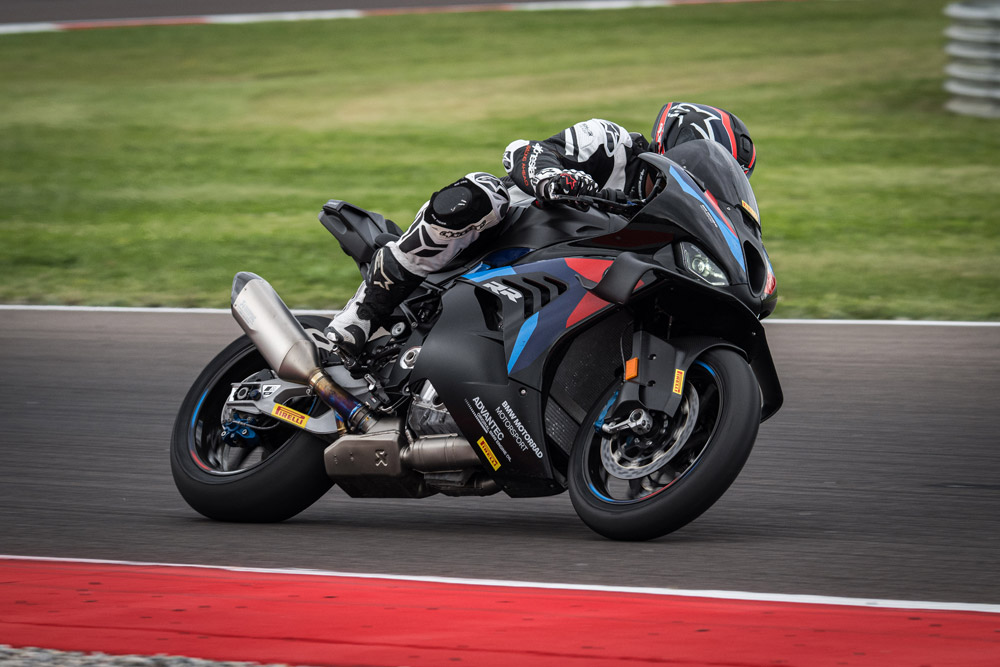
A 15-minute stint of the Cremona Circuit that just hosted the Italian WorldSBK round about an hour and a half’s drive southeast of Milan isn’t a huge amount of time to sample the goods, I’ll grant you, but it is enough to give you an idea of the performance.
And it’s for sure enough time to leave a rider quite stunned at just how good production superbikes—especially ones that cost this much—really are.
The acceleration from the BMW’s inline four-cylinder is as immense as it is user-friendly. Well over 200 horsepower (we rode the 214 horsepower European version at Cremona) shouldn’t be that easy to ride. However, the BMW delivered its forward momentum so smoothly and with such force, you could’ve been forgiven for thinking you were channeling the skills of Toprak Razgatlioglu, who was watching from the pit wall, and no doubt shaking his head in disapproval.
The drive is metered by revised electronics—yes, you get the usual six-axis IMU and every conceivable rider aid—but there’ve been some improvements.
Within the Dynamic Traction Control algorithm, the Slide Control now uses a steering angle sensor to give the rider greater control when lighting up the back tire on acceleration. While not a groundbreaking innovation (you can thank Yamaha for debuting Slide Control way back in 2015 on that year’s YZF-R1), it allows the rider to absolutely hammer the quick-action throttle and control the drift on corner exits without the power getting electronically castrated. Your big black line on the Cremona tarmac on the corner exits signifies the system works.
The increased compression and larger throttle bodies help give you access to the engine’s beefier midrange. From 6000 rpm to 10,000 rpm, the forward drive is relentless, but it retains this friendly delivery, which is in stark contrast to the earlier editions of the S 1000 RR I’ve tested over the years, which were known to deliver much peakier performance that necessitated you to ride higher up in the rev range than some of the competition.
This, in turn, would give the rear tire a harder time when you’re trying to pump out consistent lap times. This new M 1000 RR is a world away from those earlier BMW superbikes, so much more refined but with so much more performance on offer.
And, oh good lord, that induction roar is just so damn good. As the revs reach north of 9000 rpm, the BMW sounds like it could suck small children into the airbox. This, combined with the wailing exhaust noise, makes the inline-four almost sound like a big-block V8 as you start seeing the digital tacho heading into the five-digit rev range. It is a mechanical symphony you and your right wrist conduct.
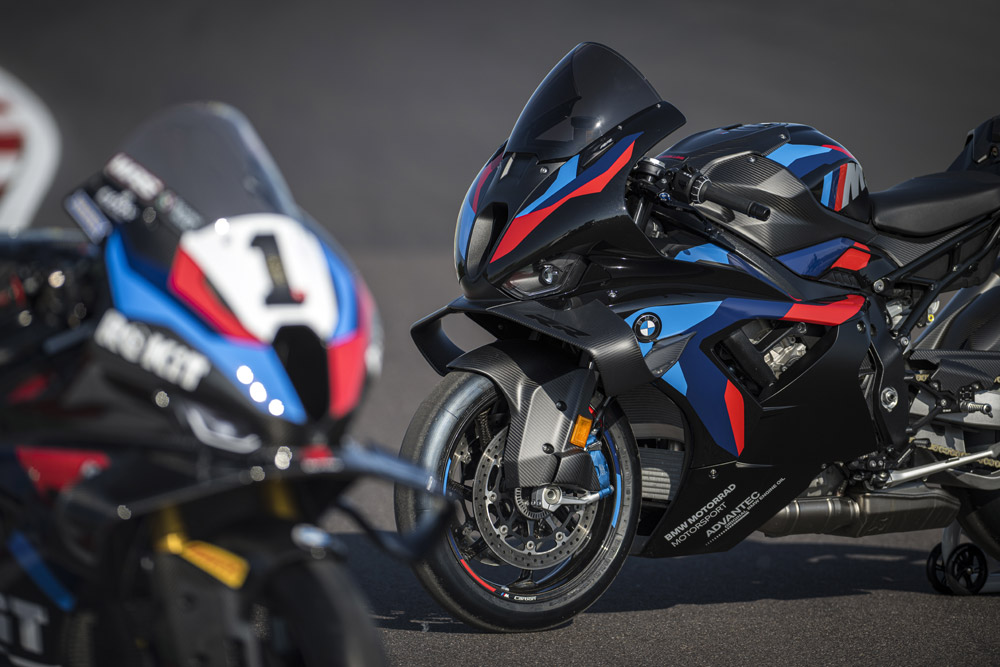
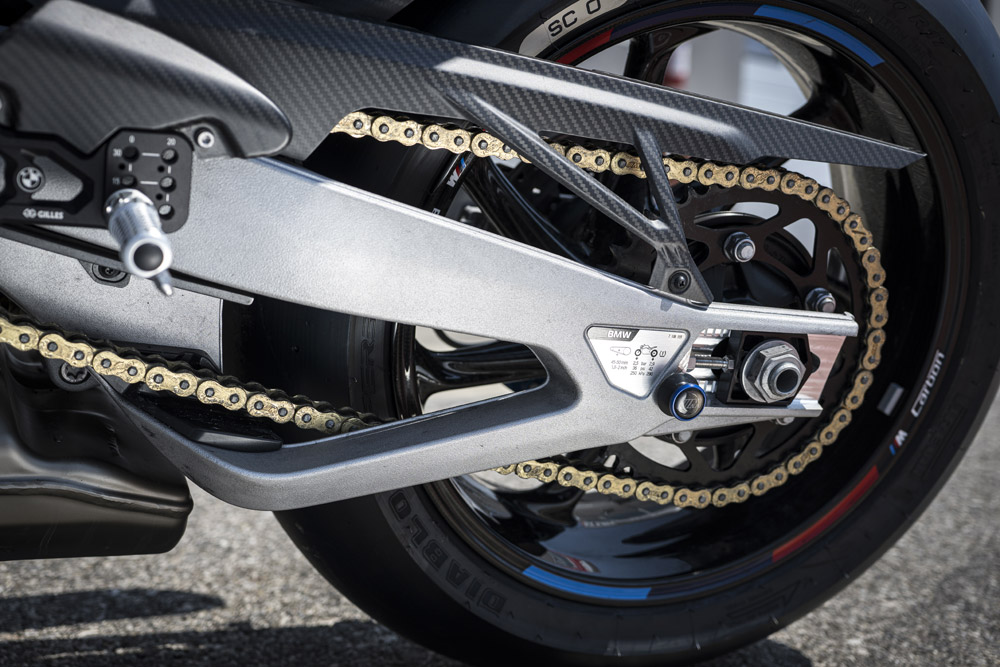
As acceleration increases, so too does the downforce, and BMW has paid close attention to increasing it in 2025. New for this year are the revised plastic front fairing and 3.0 side winglets that deliver oodles of high-speed stability (although, at Cremona, we had use of the carbon-fiber fairings as part of the optional M Competition Package that also comes with carbon-fiber wheels, an anodized swingarm, passenger kit, and GPS lap trigger).
At 93 mph, you get 4.2 lb extra downforce, which increases to 11.5 lb more at 155 mph. At the top-end of the speed scale, downforce has increased by 33 percent over the 2024 model to 66.1 lb at 186 mph. The M feels like it’s glued to the tarmac at that speed, but it still retains that lightness in the chassis that makes you feel like you could place the bike anywhere you like on the track.
The 2025 M gets a revised chassis with increased steering-head stiffness and a relocated left-upper engine mount to give improved chassis rigidity, allowing the M to hold its line better and improve turn-in behavior.
It’s slightly above my pay grade to tell you if this has worked or not, as I did not ride the 2024 M, so a direct comparison is not possible, but what I can tell you is the front-end has a remarkably tactile feel, especially when hard on the brakes when slowing from Cremona’s three-quarter-mile back straight, and when negotiating the left-right-left switchbacks that lead you onto the front straight.
The front is graced with a 45mm Marzocchi fork and Marzocchi monoshock, both of which are set up rather taught as a base setting. This should come as no surprise given the M’s track-biased ethos, and given we only had a quick 15-minute session on it at Cremona, we didn’t mess with the stock settings. After all, we had the main course, Toprak’s factory bike, ready and waiting for us in the pits. Read that test HERE.
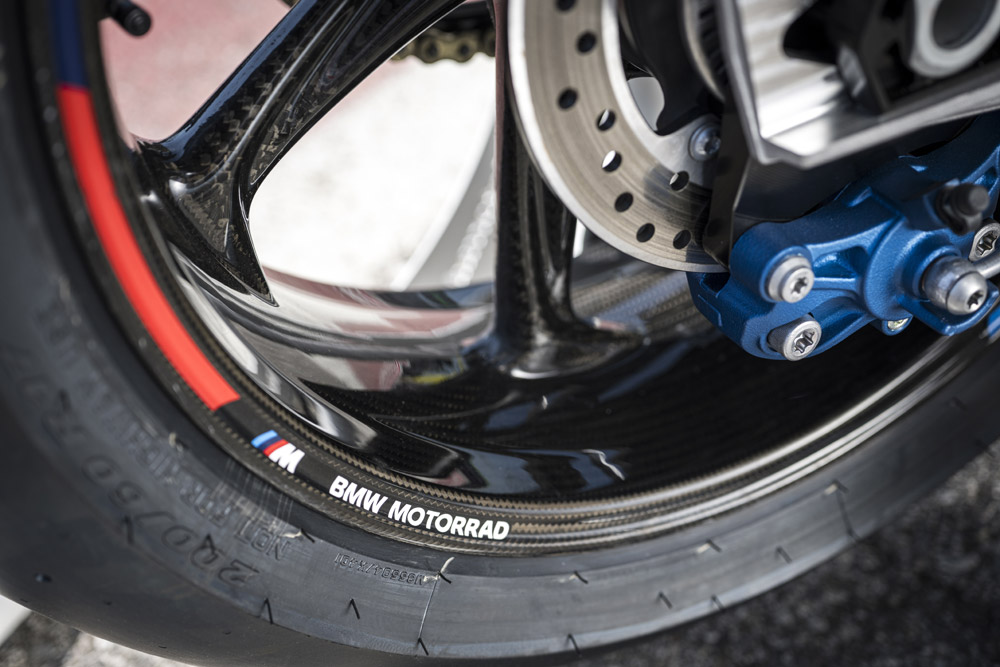
BMW claims a mere 427 pounds ready to ride with the 2025 M, which is a teeny-weeny bit heavier than it was in 2024 (think about 2.1 pounds). That being said, the 2025 M is remarkably light on its tires/feet and will change its line at the first hint of rider input. Running a little wide? Push your outside leg against the tank, and the chassis will tighten its line with obedience. The carbon-fiber wheels from the aftermarket M Competition Package will see to that, and their reduced rotating/unsprung mass, wrapped in gorgeous sticky Pirelli slicks, will thus help you accelerate out of the corner faster than you ever thought possible.
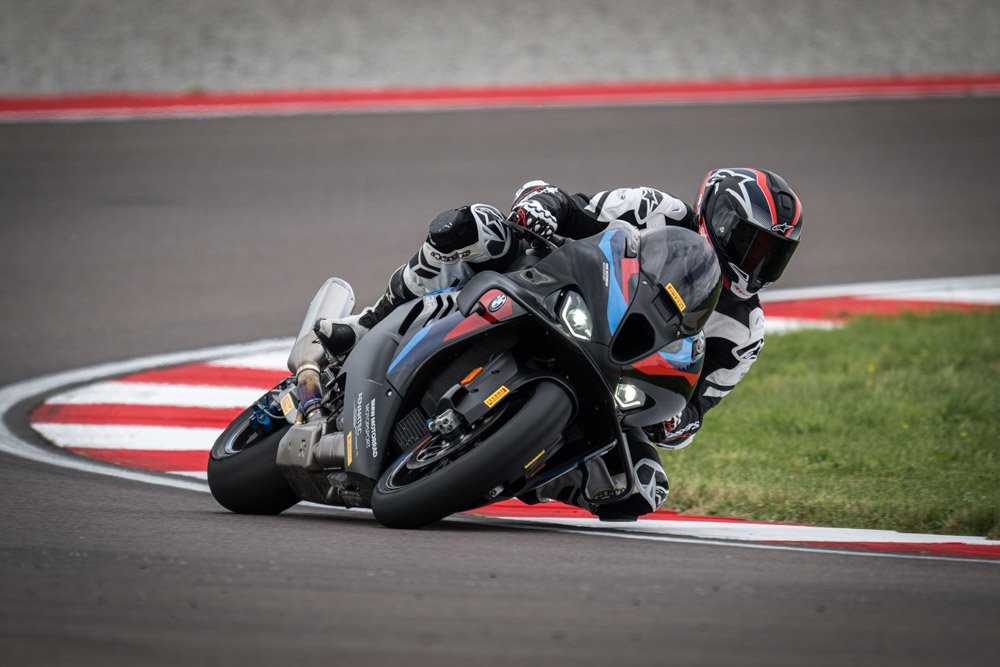
Even though this is as head-down-ass-up a superbike as you can possibly buy, the ergonomics are quite comfortable for a six-foot-one rider with a 32-inch inseam and less flexibility than he would like, such as myself.
Part of the M’s rider position comes from inputs from Razgatlioglu, and his teammate Michael van der Mark, who both like a roomy cockpit with wide-set handlebars that have a hint of supermoto about them. Having such a rider stance allows you to really take the bull by the horns and is a position arguably pioneered by Jonathan Rea, who famously likes big, flat MX-style ’bars on his race bikes.
As such, the M allows you to move about the cockpit easily, giving you a comfortable ride position that lets you ride harder for longer.
When it comes time to haul yourself up from high speed, the blue M-badged calipers (for all intents and purposes, they are Brembo Hypure four-piston radially mounted calipers), mated to a Nissin radial master cylinder, do the job as well as anything on the market.

There’s more than enough feel at the brake lever and certainly enough stopping power, which allows you to keep focused on not binning BMW’s pride and joy as you steer the chassis into the upcoming corner.
And, if you really want to get funky with it, you’ve got BMW’s Brake Slide Assist that will help you kick the back end out and drift into corners if you’re not used to (or simply don’t use) the rear brake. In terms of Instagram fodder, it doesn’t get much better than backing in a superbike that costs well north of $30,000 and looking like a complete gangster while doing so.
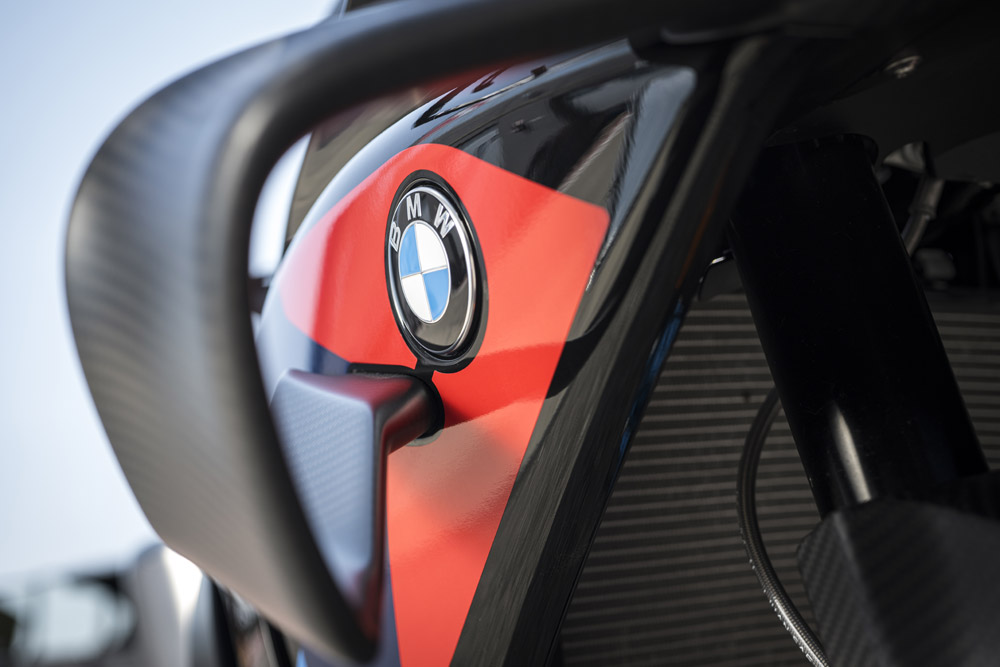
The BMW M 1000 RR is a motorcycle that makes you feel like a king slayer. It looks devastatingly handsome in the black, blue and red of our test bike, and, when paired with that rival in red, it represents the very pinnacle of performance sports motorcycles you can ride on the street.
It’s also one of the most irrelevant machines you can buy. It has almost no place on public roads due to its extreme spectrum of performance, but that’s precisely why it’s so important. These bikes probably won’t get much faster than this in the coming years. (They might, who knows? But I highly doubt it.) The M 1000 RR represents the very, very best in what a manufacturer can do for its paying customer. It’s a halo bike, and a damn good one at that.
What a superbike age we live in.CN

2025 BMW M 1000 RR Specifications
| MSRP | $34,040 (base model) |
| Engine | Inline 4-cylinder |
| Valvetrain | 16-valve, DOHC, BMW ShiftCam intake variable timing |
| Displacement | 999cc |
| Bore x stroke | 80 x 49.7mm |
| Compression ratio | 14.5:1 |
| Cooling System | Liquid |
| Max power (claimed) | 205 hp @ 13,000 rpm |
| Max torque (claimed) | 83 lb-ft @ 11,100 rpm |
| Fuel system | Electronic injection, variable intake pipe |
| Exhaust | 4-2-1 |
| Rider aids | M Quick Action Throttle (58°), Slide Control, Brake Slide Assist, DTC, MSR, Wheelie Control, Launch Control, Pit Lane Limiter, ABS Pro Slick setting |
| Transmission | Six-speed |
| Chassis | Cast aluminum twin-spar |
| Front suspension | 45 mm Marzocchi fork, fully adjustable |
| Rear suspensionMarzocchi | shock, fully adjustable |
| Front-wheel travel | 4.7 in. |
| Rear-wheel travel | 4.6 in. |
| Front brake | Dual 4-piston Brembo Hypure monobloc calipers, 320mm discs, ABS |
| Rear brake | Single-piston caliper, 220mm disc, ABS |
| Front tire | 120/70 ZR17 in. |
| Rear tire | 200/55 ZR17 in. |
| Rake | 24° |
| Trail | 4.0 in. |
| Wheelbase | 57.4 in |
| Seat height | 34 in. |
| Fuel capacity | 4.3 gal. |
| Weight (wet, claimed) | 427 lbs. |

Click here to read the 2025 BMW M 1000 RR Review in the Cycle News Digital Edition Magazine.
Click here for the latest Cycle News Sportbike motorcycle reviews and news.
Click here for more BMW motorcycle reviews and news.

