Cycle News In The Paddock
COLUMN
Does Suzuki Build a Better Yamaha Than Yamaha?
Still calming down after an epic Oz GP (Welcome back, Phillip Island. Welcome back, real grand prix racing.), the sudden ascendancy of Rins and the sleek but so far this year unexceptional Suzuki give pause for thought.
What did they do right? What have they done wrong until now? And why on earth are they giving up racing?
Suzuki’s first MotoGP bike, at the 2002 dawn of the four-stroke class, was a 60-degree V4 that had the virtue of unique engine architecture and a fine baritone voice, and the vice of being gutless and unreliable.
The quirky narrow-angle vee was dictated by the decision to make an engine to fit the two-stroke RGV chassis. It required a balance shaft; the engine in turn needed a very high compression ratio to make enough power to compensate, leading to major engine-braking problems. And it chewed up its valve springs. Luckily in those days engines weren’t sealed and nor were their numbers limited.
These were early days, before the development of (for example) effective slipper clutches and engine-braking electronics, and pneumatic valve springs. Work continued, though major success remained elusive, except in wet weather. By the time of Suzuki’s first withdrawal in 2011 the vee-angle was a wider 75 degrees, still unique, but the riders’ complaints about speed and acceleration hadn’t changed.
Returning in 2015 after licking their wounds and regrouping, the smallest Japanese team eschewed technical adventure and embraced convention: an inline four that mirrored their street bikes. And, sneered many insiders, was a copy of the Yamaha, with its cross-plane combustion timing and spin-reversing combined balance- and jack-shaft.
But it seemed that Suzuki had also borrowed some other important characteristics from Yamaha, and in some regard improved on them. The GSX-RR was a sweet-natured fine-handling machine, lacking only in out-and-out performance.
This they were able to address, up to a point. Inline fours, with extra crankshaft main bearings and big-ends and that balance shaft, have more internal friction than V4s. As a consequence, they lack punch out of slow corners and struggle somewhat for top speed. But at tracks with fast corners, they can run higher corner speeds and all the while the new Suzuki became ever more competitive.
The first win (by Maverick Vinales) came at Silverstone in 2016, and while they didn’t actually follow thick and fast after that, by 2020 Joan Mir was able to rack up enough strong finishes, though only one race win, to take the championship.
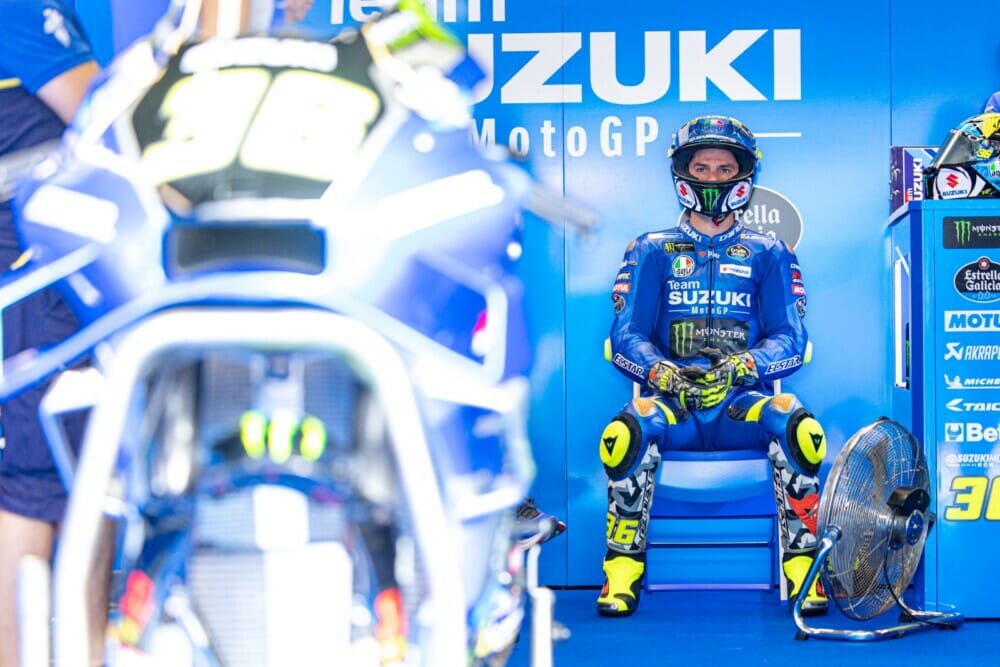
On Sunday in Australia, Yamaha must have been thinking it is time they copied Suzuki. For while the YZR-M1 has become a MotoGP poor relation that only Quartararo can ride fast—using exceptional talent, courage and determination—only one person needed to ride the Suzuki GSX-RR fast, and Alex Rins won the race.
A valedictory one-off, at a track where the rider makes the difference.
Suzuki is in Dorna’s dogbox for its repeat withdrawal from MotoGP, a decision that left the team reeling, and the rest of the paddock, too.
Not least because of the implications. If a long-standing racing company like Suzuki feels comfortable turning its back on the sport—who’s next? Honda, struggling to find form against the rising tide of Eurobikes? Yamaha, ditto? Are we headed towards a Ducati one-make championship? (The entry list and results sometimes suggest we are already halfway there.)
Quartararo, to be fair, might also have challenged for victory, in a seven-strong freight train covered by less than nine-tenths, part of the second-closest top 10 in history—if he hadn’t blundered under braking, dropped to the back, then fallen off trying to catch up again.
Errors only partly the return of a tendency to choke under pressure, and more just because of the superhuman effort required to keep Yamaha among the fast gang. Using every last little scrap of talent sometimes has these consequences. The next-best Yamahas, all credit to them, were Cal Crutchlow and Darryn Binder at the far end of the points.
Even before its last year, the Suzuki had usurped the Yamaha’s mantle as a friendly bike, with handling and manners so sweet that it could rival the more powerful V4s without having to flirt with disaster.
Why can’t Yamaha do the same?
It’s because the margins in modern MotoGP are tiny, and the mechanical contest so very close. The difference between a winning bike and a 15th-placed bike is very small indeed but enough to make the latter look like a bit of a klutz. And to punish its riders accordingly. Honda riders are as familiar with this feeling as those on Yamahas.
And because also of the nature of a fast-flowing circuit—which gives riders the chance to overcome bike problems with their own skill. If only there were more like this.CN
Click here to read the In The Paddock Column in the Cycle News Digital Edition Magazine.
Click here for all the latest MotoGP news.