https://magazine.cyclenews.com/i/1414541-cycle-news-2021-issue-39-september-28/130?
Cycle News In The Paddock
COLUMN
Beginner’s Luck
Racing used to be predictable. History has long spells when you could pick a winner before a wheel had turned, or before you’d even arrived at the track. One rider, or in richer spells, one of two (possibly three) riders.
Think Hailwood, Agostini, Sheene and Roberts, Spencer and Lawson, Rainey and Schwantz, Doohan, Rossi, Marquez, etc.
Familiar, experienced riders ruled. Rookies took time to learn. As 1981 champion Marco Lucchinelli put it recently, you had to break a few bones before you got there. That’s how it worked.
Not anymore.
This is a year when beginners’ luck is extraordinarily strong, in all three classes.
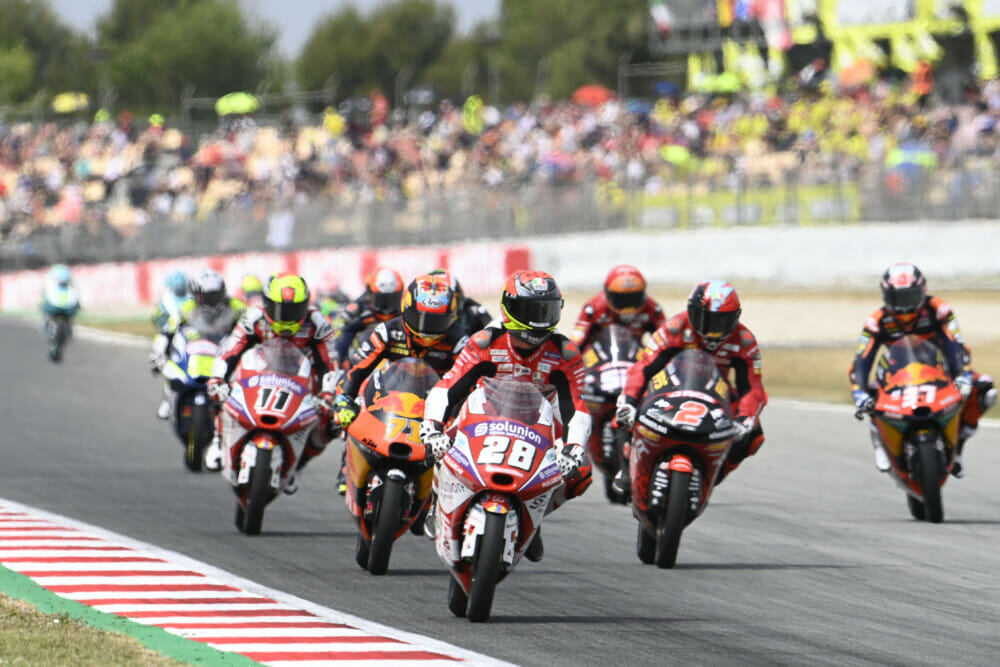
The Moto3 Championship is led by a rookie (Acosta) chased by another rookie (Garcia). Fresh from the Red Bull Rookies Cup, Acosta has won five out of his first 14 grand prix races, a feat not achieved even by Rossi or Marquez.
Moto2 is being hotly disputed by a rookie (Fernandez), hounding the well-seasoned Remy Gardner. The Spaniard actually has five wins to Gardner’s four, but the older rider has finished every race, and only three times off the podium; the rookie has only three other top-three finishes and crashed out once.
MotoGP is not so different, and last Sunday at Misano, yet another precocious performance proved the point.
After Brad Binder’s rookie win at Brno last year and this year Jorge Martin’s poles, podiums and win, now it was another new boy’s turn. In his 14th MotoGP race, on a two-year-old Ducati regarded as intrinsically flawed, Moto2 champ Enea Bastianini was blazing.
He cut through from 12th on the grid, scything past former race-winners like Marquez, Miller and Rins, to a threatening third.
More than that, he lost nothing on speed to Bagnaia and Quartararo ahead of him, setting fastest lap of the race, a new record. They remained out of his reach only because of the ground he’d lost fighting through in the early laps.
Winner Bagnaia, at 24, was the oldest on the podium. Quartararo is 22, Bastianini 23.
What a contrast to the oldies.
Rossi, a triple MotoGP winner here, was, once again, nowhere, mired in 17th. Better than fellow veteran, the returned Dovizioso, back on Yamaha and plumb last, aged 42 and 35, respectively.
Commentators have been talking of “the changing of the guard” all year. It’s easy to see that experience counts for less and less in MotoGP’s frantic new normal.
It’s not so easy to understand why.
Something similar prevails in all forms of professional sport, from tennis onwards, because of a number of factors.
Most important, better training. This has come along with a major social sea-change, itself driven by both opportunity and reward, as the financial benefits of sporting success have doubled and redoubled in the past couple of decades.
Back in the 1980s and 1990s, when I first reported on the World Championships, most of the riders I interviewed had started riding motorcycles on the street. Faster than their friends, they discovered they had a knack for it. And took it to the track.
Hopelessly old-fashioned.
Things started to change when Americans and the odd Australian turned up. Beneficiaries of the minibike boom of the 1960s they’d cut their teeth on dirt tracks with other youngsters. It was a new phenomenon back then. It is now a basic requirement.
Modern grand prix racers start long before street-legal age, belting around on minibikes on go-karts or oval dirt tracks from the age of six or so, usually with their excited fathers urging them on.
Talent is obvious early, and those who show it then move up through increasingly well-supported and well-organized feeder series, where they are expertly coached. Dorna has promoted these assiduously, worldwide.
When the best of them arrive at GP level aged 16, they are already seasoned competitors, up against rivals they know well.
The Marquez and Espargaro brothers, Maverick Vinales, Alex Rins and Joan Mir, for example, have known and raced against one another (according to age overlaps) for years and years.
There’s more.
Continual technical developments reward new techniques. Chassis technology grows more sophisticated in small but important increments, tires develop rather faster, while adjustable geometry such as holeshot squatting and corner-exit droop are the latest significant advances, making major inroads.
Older riders, inevitably set in their ways, have more trouble adapting. Something to do with old dogs and new tricks.
The kids bring fresh attitudes and new techniques. They can experiment without even thinking about it.
Or is it even simpler?
That—vaulting power and speed notwithstanding—modern MotoGP bikes are just too easy to ride.
Switch on the traction control, engage electronic aids, set the controls for the checkered flag. Then open the twistgrip and hold on tight.
Wouldn’t you hate for that to be true? CN
Click here to read the In The Paddock Column in the Cycle News Digital Edition Magazine.
Click here for all the latest MotoGP news.