Cycle News Wheelspin
COLUMN
USMC Combat Motorcycles
By Keith Dowdle
I’ve spent the majority of my life working in the motorcycle industry, but I did enlist in the United States Marine Corps when I was 24 years old. I needed a short break to give the struggling motorcycle dealership where I was working a chance to recover from the economic downturn in 1986, and I had always wanted to be a Marine, so I raised my right hand and signed up. Shortly after completing boot camp and the basic schools, I was serving in the Philippines with an infantry unit, known as grunts in the Marine Corps, and I was loving it. Every day was a new adventure, and I truly enjoyed being a grunt. Swinging through the jungle with my M16—all of that oorah fun stuff.
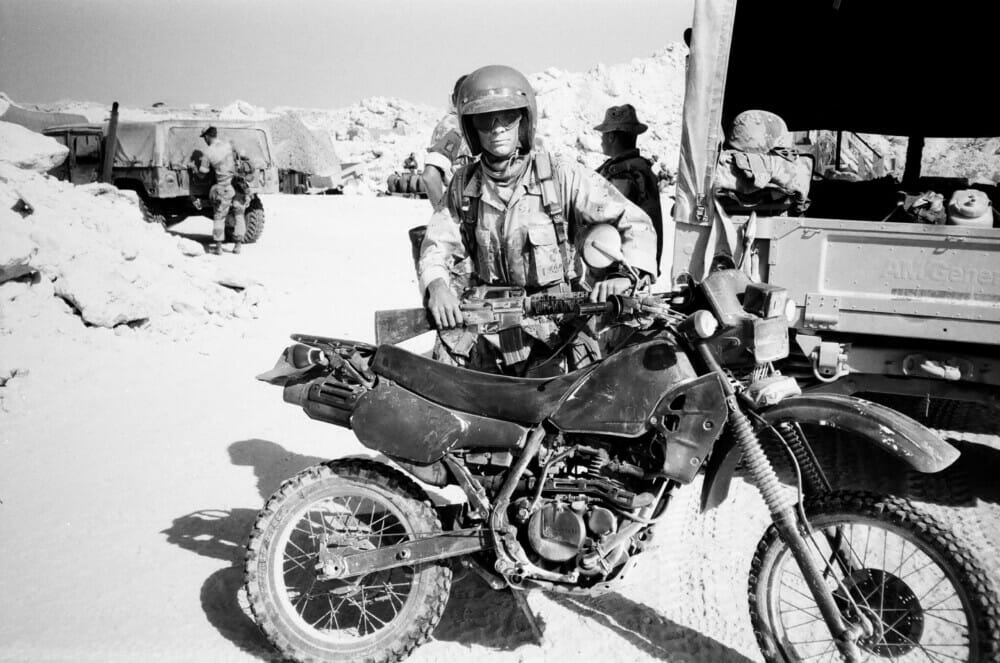
But one afternoon my commanding officer, the CO, called me into his office and told me that I’d be on the next plane back to Camp Pendleton and report to First Marine Division Combat Motorcycles. As it turned out, an old high school friend of mine was commissioned as a Marine Corps officer a few years before I joined. He was now a captain and was working with the CO of First Marine Division Schools, who was looking for a qualified Marine with experience with off-road motorcycles to take over the Combat Motorcycle Operators Course. My name rose to the top of their list of candidates, and I would soon be entrusted with a completely new job teaching Marines how to operate a motorcycle for tactical reconnaissance. For the next two years, I rode a motorcycle every day, taught Marines how to ride dirt bikes, and had the absolute best job anyone could ever dream of having. My CO gave me autonomy and authority, and I pretty much ran my own program.
All of the fun and games ended on August 1, 1990, when Iraq invaded Kuwait. I was ordered to report for duty under the Commanding General (CG) of the First Marine Division in Saudi Arabia. I arrived there in mid-August, and along with a few thousand other Marines, I waited by the dock at a large shipping port for the maritime prepositioning ships (MPS) to arrive. These MPS ships are positioned all over the world and are stocked full of everything the Marine Corps needs to quickly get into the fight. To my surprise, when the ships arrived, sure enough, there was a fleet of combat motorcycles at my disposal. The bikes that we were using at the time were Kawasaki KLR250s slightly modified for military operations, basically just a green paint job, some extra crash protection, and blackout lights for nighttime operations. Once the bikes were off the ship, I was told to set up a training course and to expect my first group of trainees to arrive within a few days.
Now remember, we’re in the middle of the Arabian Desert—not exactly the best place to teach someone how to ride a motorcycle for their first time. The sand there was deep and difficult, and to make matters worse, the CG wanted these Marines trained in three days versus three weeks, which is how long the course was at Camp Pendleton. Over the next four months, I taught U.S. Marines, British Royal Marines, Navy Seals, Army Rangers, and some guys who wouldn’t identify themselves how to ride motorcycles in the open desert. The instructions were simple: get on, start it up, and follow me. If you crash, get back on and catch up. Fortunately, I only had three trainees with injuries that were serious enough to need medevac during that entire time. I’m calling that pretty damn good considering the circumstances.
January came and the war had started. I was still reporting to the CG, but now the mission had changed from training to operations. Fifteen Marines from around the Corps, all of whom had already been qualified to operate combat motorcycles, were assigned to my charge. I paired up teams of two based on their riding abilities, and I gave them the missions that I was confident they could handle. I wanted the best riders with me, and we took the toughest missions simply because of our ability to stay on the bike in deep sand. Our missions varied from day to day depending on what the CG needed. Some days we would act as snipers laying down harassing fire (basically trying to get the Iraqis to shoot back at us so that we could identify their exact location), some days we would run recon missions to locate enemy units and report their location or call for fire, and other times we would run frag orders and map overlays to various commanders at the front of the fight.

The scariest missions were when we’d be sent up to retrieve intelligence reports from our Force Recon guys. You’ve probably never heard of Force Recon, but they’re the baddest of the bad. Guys who are trained as both Navy Seals and Army Rangers (and probably a lot of other stuff that we’re not supposed to know about). These guys would be dressed like locals (think Taliban)—beards and all—and they would be as far from anywhere as you could get. They were hard to find, and once we found them, we weren’t always certain that they were friendly since they looked so much like the locals. Tiptoe in, and if they didn’t start shooting, they’re probably the guys we’re looking for, that was our strategy.
The ground war in the Gulf lasted exactly one hundred hours, and some people discount our service in that war for that reason, but we were surrounded by death and destruction, and we feared for our lives every day. I’m glad that it was short and even happier that I never saw a dead American. There were fatalities, but no one in my unit died, and if we’re not heroes because of that, that’s fine with me. Combat Motorcycles ultimately led to a fantastic career in the motorcycle industry for me, and I know that the other Marines I served with went on to great things in their lives as well. Several of us are planning on getting back together for a ride, this time with no one shooting at us, hopefully. CN
Click here for all the latest motorcycle Industry News on Cycle News.

