Photography by RS, CN and Randells Media
“The first, number-one thing I’ll tell you with Pikes Peak,” Tracy begins, “is you will not remember 156 turns the first time you go there. You may think you will and with all the study you’ve been doing you’ll be pretty darn close, but the reality is, under race circumstances, it’s real easy to get lost. There’s no markers, there’s turn-ins where the exit is straight sky, or the tops of green trees… it’s so different from track racing.”
And with that, barely two minutes into my chat with Pikes Peak multi-disciplined, multi-winner Greg Tracy, I knew I’d better pay close attention to the sounds coming from his lips if I am to pilot my KTM 1290 Super Duke R to any form of safe race success up America’s Mountain.
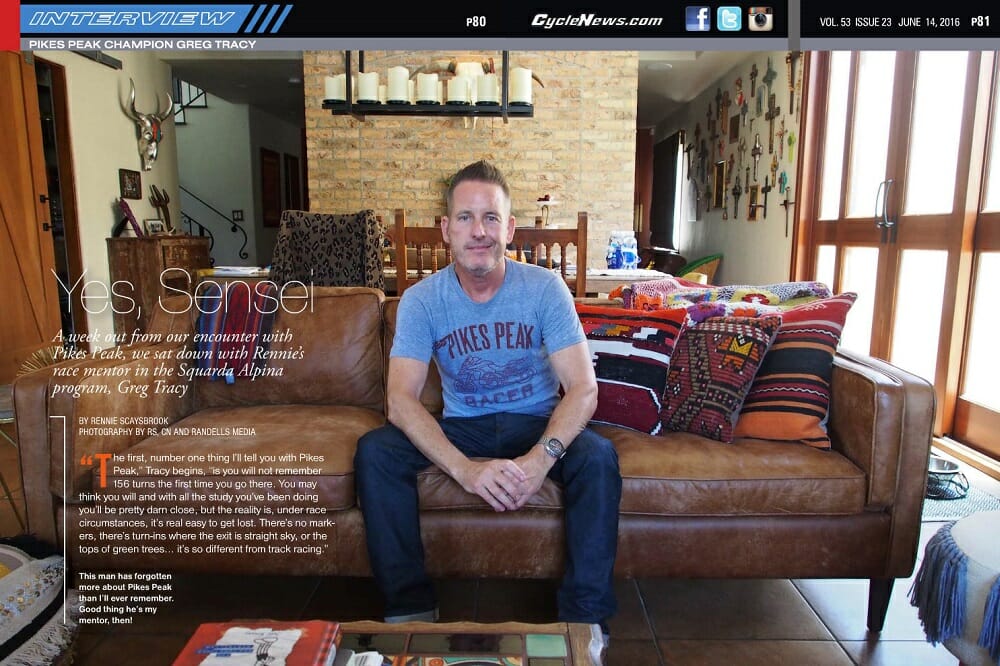
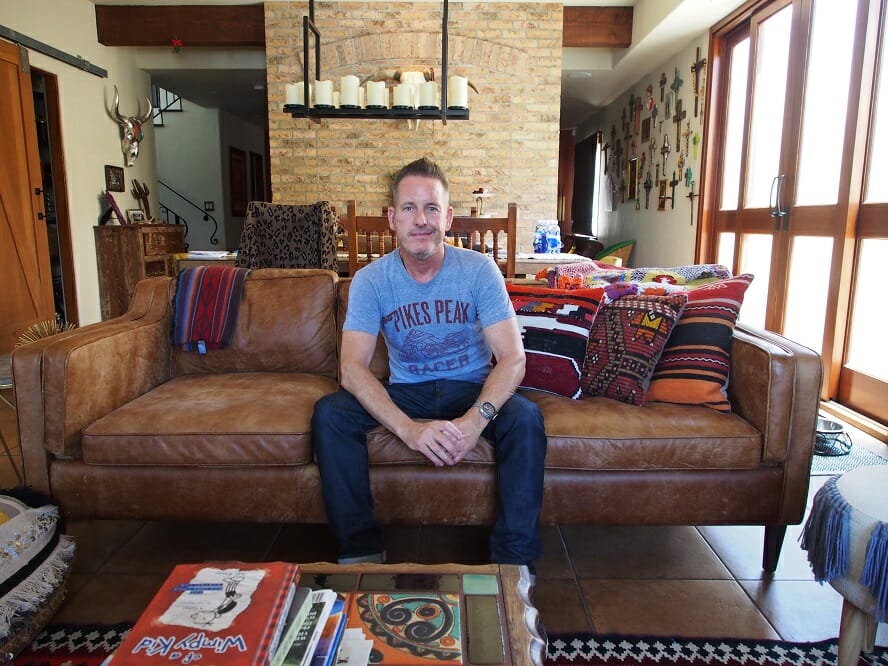
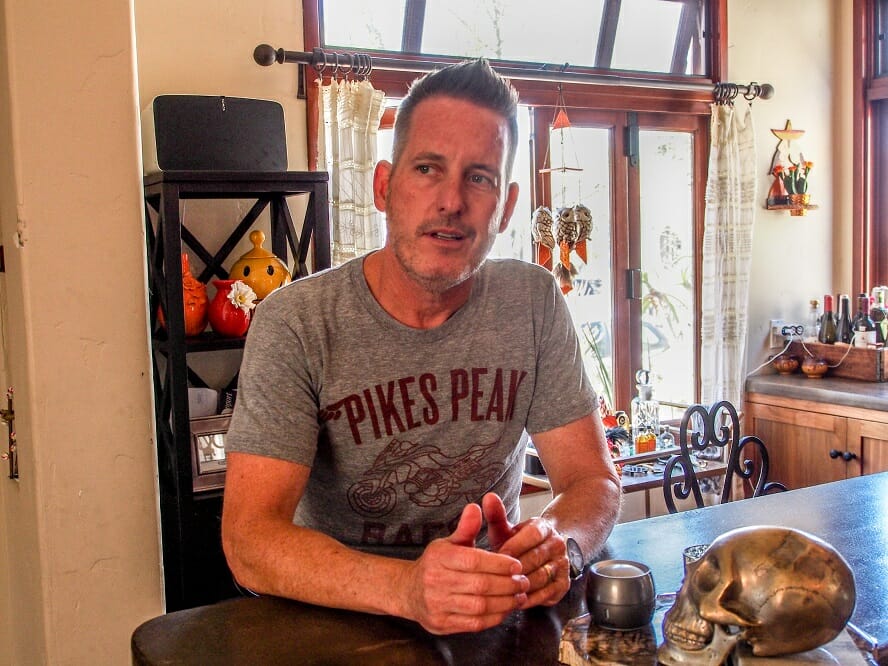
Greg Tracy is my race mentor in the Squarda Alpina program, a safety team set up by Ducati North America as a way of giving back to the Pikes Peak International Hill Climb. The squad is part of a unique approach by the multi-race winning manufacturer to help ensure the longevity of a race they still hold the outright lap record for with Tracy’s fellow Squadra tutor, Carlin Dunne. Each rider competing at Pikes Peak this year is assigned a mentor, mine being the guy who’s video of a 9:58 second run back in 2012 I can legitimately say I’ve watched 150 times—and that’s a conservative guess. I’ve got massive respect for this man. Anyone who can win at Pikes on any form of machinery is all right in my book. Greg’s done it in both a bike and car, so he gets double.
“In track racing,” Greg continues, “you go lap after lap, making adjustments and mental notes. If you turn in too early on one lap, you remember and make adjustments for the next time you go round. Or the exit of the corner might be a little wet, the next time I’ll remember that. At Pikes you only get one time, and because of the way the practice is set up, you get these blocks in your head about the bottom section, middle section and top section. You then have a day off and the one and only time you get a full run, is race day. And the race can be run 20-30 degrees hotter than practice. So as long as you’re expecting change and are prepared for that, you can do well there.”
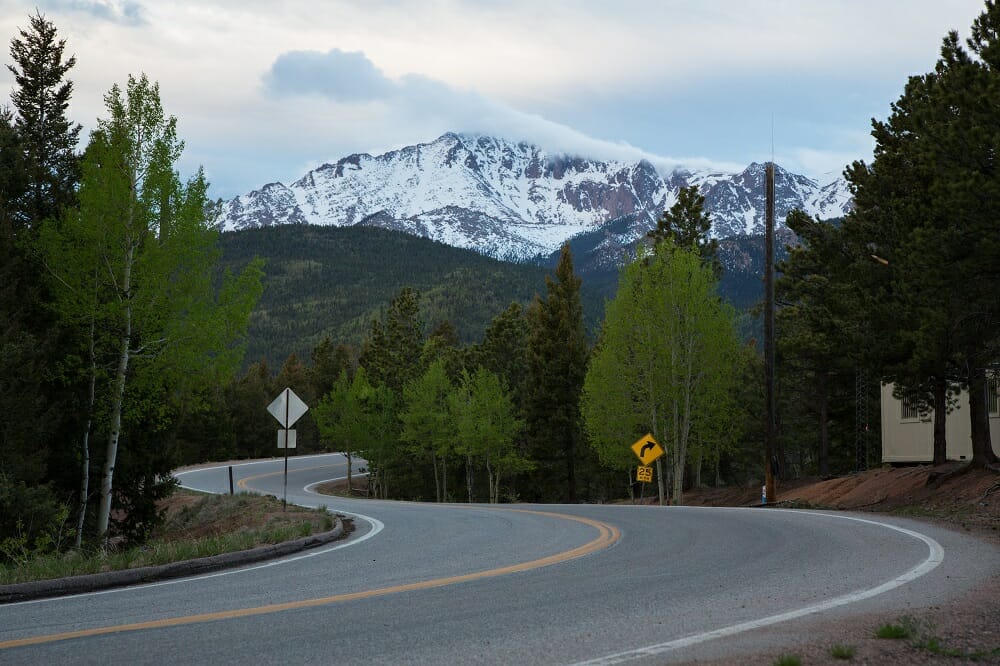
Pikes Peak is unique not just because it is a motorsport event run up the side of a mountain whose tallest point is about half the altitude of a cruising airliner. It’s unique also due to the fact the practices are run between 5:30 a.m. and 9:00 a.m., when the majority of Colorado Springs is either still sleeping or eating breakfast.
“In the middle and top sections at those times, it’ll be sub-freezing,” Tracy notes. “You won’t be able to feel your finger tips or toes in practice, so the track temperature is colder than what most tire companies even have any testing data for. But the race can be 60, 70, 80 degrees and run at anywhere from 10 a.m. to 2 p.m. So setting your bike up for a 45-degree day when the race is that much hotter is a challenge in itself.”
Tires are the most critical factor in any road motorcycle sport, especially at Pikes Peak. As the bike and I climb up the mountain, the tires will be getting colder, and colder, and colder.
“You don’t maintain tire temperature,” Greg says. “People think you do, and that’s when a lot of crashes happen. Once you take the tires off the warmers at the start, a mile and a half into the run they will be at the track temperature. By the time you reach the Picnic Grounds straightaway, that’s when they start to lose temperature, and a lot of guys crash there because the front tire has already lost too much temperature.”
That’s about two and a half miles into the run. Two and a half miles and the tires have already seen their best days. Bloody hell.
“You won’t have any heat in the tires when you get to the top. But that’s all about adapting your riding to the conditions,” Greg says. “You have to be adaptable. A lot of road race guys come to the track and think they are going to slay it, and they don’t because they are riding under completely different circumstances. The track changes all the time. There’s stuff on the road in the race that may not have been there in practice. Melted snow, hay bails, dust, even spectators. You have to be ready for it.”
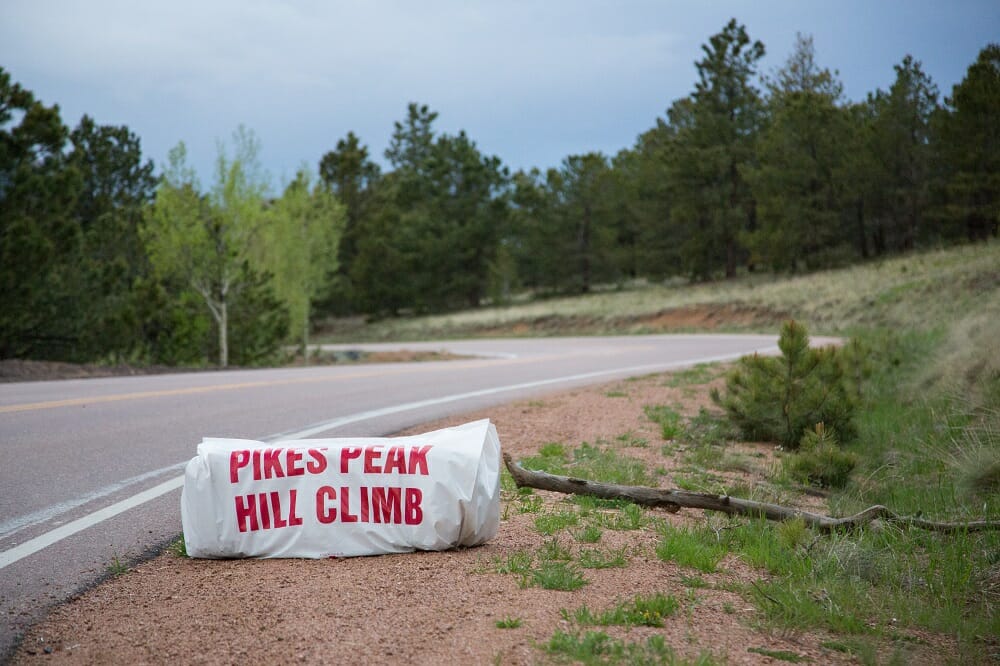
One thing this race, and for that matter all races, have in common, is the singular goal of linking all the corners to make a fast lap time. Pikes is no different. At the Colin Edwards Texas Tornado Boot Camp, the first thing they teach is corner exit.
“You can’t attempt a corner if you don’t know about the exit,” Edwards once told me. “How fast is the exit? Where do you pick up the throttle? What’s the camber? What’s on the other side?”
These sentiments are ringing truer by the day as I approach the race—they have just been further hammered home by Greg.
“To do well, you have to put all the corners together, make sure your exit speeds are good,” Greg says. “Obviously, if you’re on absolute race-winning pace your braking and corner lines have to be perfect, so it’s no different to any other track.”
So what are Greg’s favorite corners to make up some of those precious few seconds?
“I really like the super high-speed stuff. I like to push the edge of the speed. Across the top, out of Boulder Park, up the kinks to the 19 Mile Sweep left-hander, up to Cog Cut, that’s gnarly. You’re commitment level there has to be so high. But if you get it right, you can make three, four seconds.
“I also like Bottomless Pit. It’s the one time where you’re going downhill, so you can make up time there.”
For those that don’t know, Bottomless Pit is at the end of two sixth gear left hand sweepers. Balls to the wall stuff. But then, the whole track is, really.
“Cove Creek, up to Elk Park, depending on your practice, you can get blinded by the sun. You won’t know when it’ll happen. You’ll come around the corner up to Elk Park at 120 mph and you’ll get totally blinded. You can’t see for a few seconds. Get ready for that. A few guys have been caught out by that.”
Um, okay, sir.
“The exit of Ragged Edge is critical to gaining speed because there’s a pretty good incline leading into it. Get on the power real quick on the exit. It’s a hard one to do because there’s a 600ft cliff on the edge. But you’ll be hustling. You’ve got a good bike.”
I mention that the part I think the KTM will shine will be exactly not where Greg normally shines. One of the top qualities in the Super Duke’s arsenal is how quickly it steers, so I’m hoping between Brown Bush Corner (the first right hand hairpin) up to Devil’s Playground (the start of the super-gnarly fast stuff), is where I might be able to make some time.
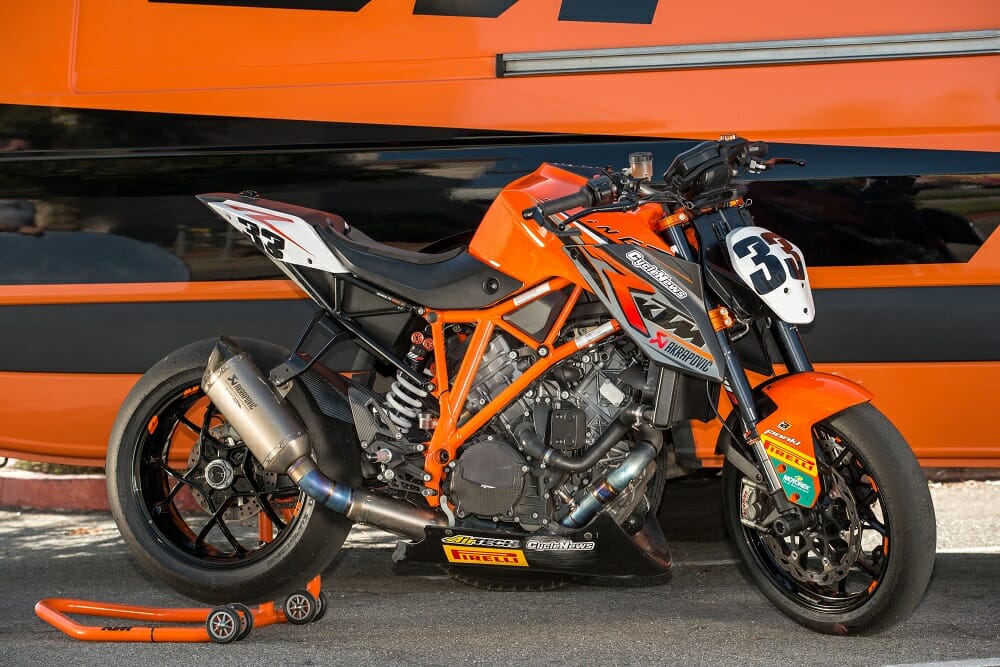
“Torque is nice, and your bike has plenty of that,” Greg says. “The main thing is to make sure it steers and stops nicely. I like to run my bikes a bit on the softer side than what some other guys like, so you will have to play around a fair bit to get the feeling you want, but your bike looks great—I can’t wait to see how you go on it.”
Me neither.
By the time you read this, we will have done the official tire test and I’ll be either in the fetal position or amped to the teeth at the prospect of racing America’s Mountain on June 26. A year’s worth of planning and preparation is almost at its end.
I can’t wait.
That Sub-10 Run
As I mentioned, I’ve been spending more than a healthy amount of time watching Greg’s 9:58sec run from 2012. This is it in all its glory for you to see:

Squadra Alpina
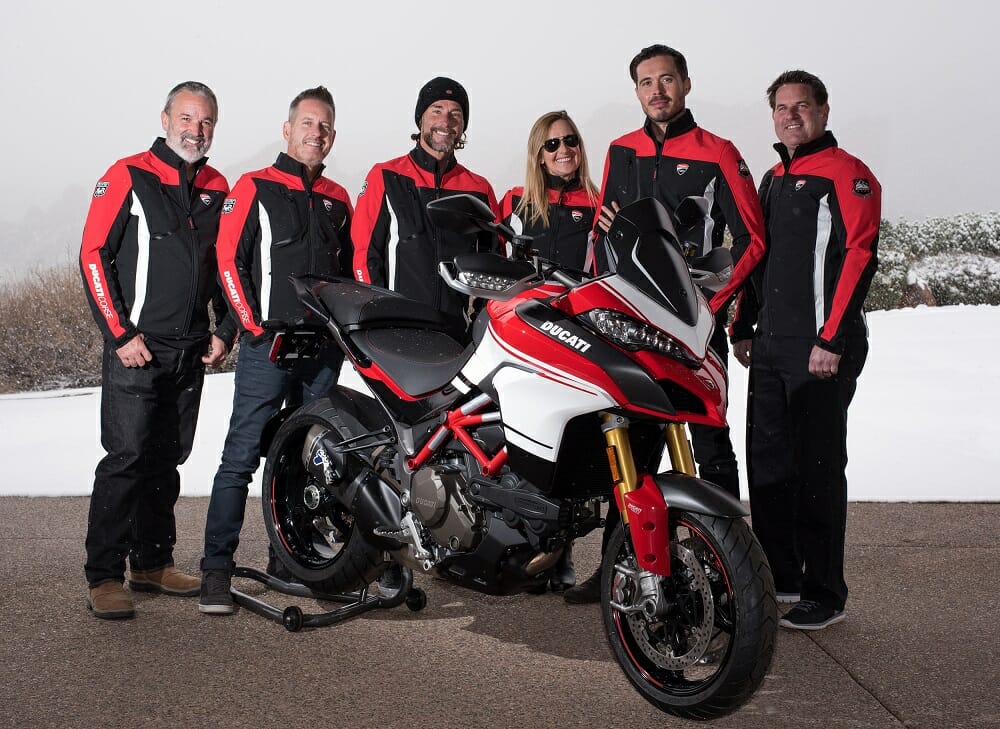
The Squadra Alpina is a remarkable posse of Pikes Pros assembled purely in the name of keeping me and 33 other motorcycle racers as safe on the mountain as possible. The brainchild of Ducati North America, the manufacturer that has done so well at Pikes Peak it’s named a version of its all-conquering Multistrada after it, the crew comprising Squadra Alpina is packed with knowledge only race winners can acquire—some of which I’ll be using to until the end.
The squad reads like a who’s who of Pikes Peak history. Overall motorcycle lap record holder Carlin Dunne heads the list of mentors. 2011 Rookie of the Year, 2011, 2012 and 2014 King of the Mountain and 2014 Electric Bike winner, Dunne has a perfect record at Pikes Peak—undefeated in every attempt.
Micky Dymond needs no introduction. A three-time AMA Champion (twice MX, once Supermoto), he also won the Rookie of the Year at Pikes in 2005 as well as the overall title.
Gary Trachy is a 12-time PPIHC competitor who has taken victory eight times on the mountain across multiple classes.
Greg Tracy is a seven time Pikes Peak Champion and one of only three riders to break the 10-minute mark alongside Dunne and Jeremy Toye and the only to do it on a bike and in a car.
Paul and Becca Livingstone husband-wife team of Becca and Paul Livingston from Spider Grips will be designing and administering the Race Smart Program.