Cycle News Archives
COLUMN
In 1977, Cycle News staff compared vans to see which was best as a bike transporter, mini-workshop, storage room and motel, all in one.
By Kent Taylor
’Cause like a princess she was laying there, moonlight dancin’ off her hair. She woke up and took me by the hand. She’s gonna love me in my Chevy van and that’s all right with me.
Ride-sharing, as evidenced by these song lyrics, has been around for quite some time, at least fifty years. Singer/songwriter Sammy Johns had his hit “Chevy Van” way back in 1975, long before Uber or Lyft were pairing up total strangers for nighttime rides in locked vehicles. Nobody said capitalism doesn’t come with some risks, so it is either gas or assess the situation carefully, with both parties agreeing upon fair compensation, because nobody rides free.
Also evident in the above lyrics is the fact that Sammy Johns certainly wasn’t a motocross racer. Otherwise, after taking his hand, Sammy’s traveling companion would’ve bumped her head on the handlebar grip of his Maico 440, scraped her knee on the corner of his toolbox, and stained her bell-bottom blues with an oily, black circle, courtesy of the motorcycle’s silencer tip. Also, her hair would smell like Castrol R pre-mix, which would be kinda sexy, but the point here is that in 1970, vans were made for one purpose: doing it—in the dirt!
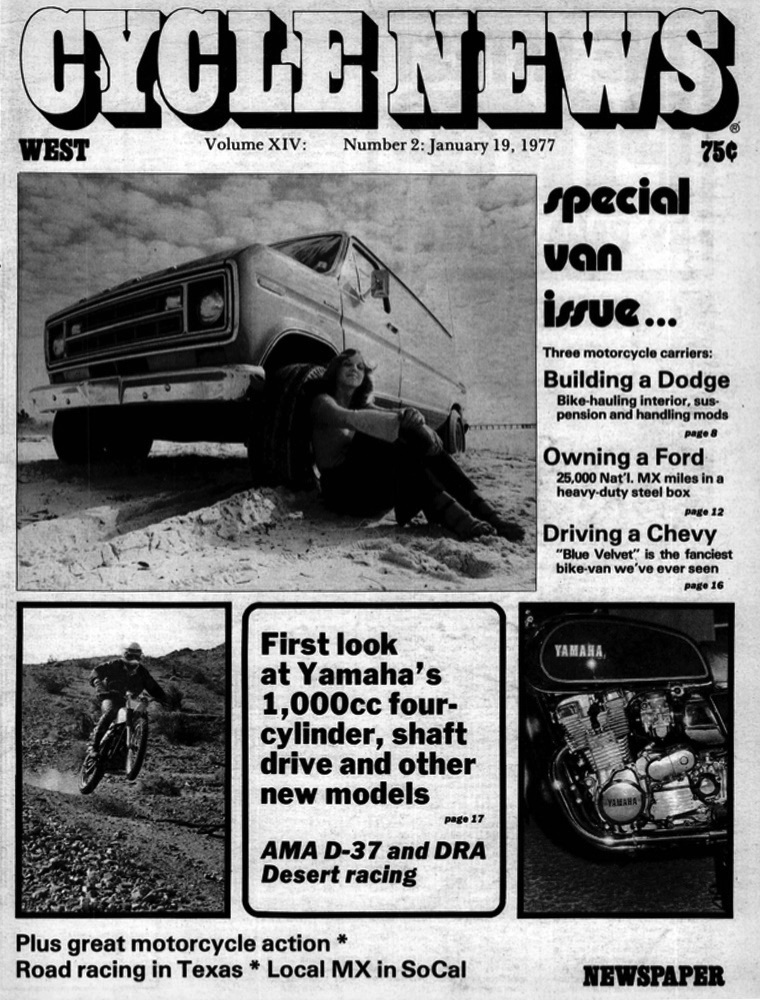
Nearly 48 years ago to this day, Cycle News published a “Special Van Issue,” in which they took a look at offerings from Dodge, Ford and, of course, Chevy. Unlike motorcycle road tests, conducted using machines on loan from a distributor or dealer, the CN crew reported on their own personal vehicles, highlighting strengths, weaknesses and modifications that made these haulers well-suited for racers on the go.
“To most of the American youth culture…a van has become the ultimate means of expression for the 1970s,” wrote freelance contributor Jim Gianatsis. “The Greek” covered Pro Motocross in the 1970s and depended on a 1976 Ford E-250 Econoline van to help him get from Unadilla to Saddleback and all points in between. Expression may be free, but gasoline is not, and the thirsty 351 Ford V8 drank an entire gallon of fuel every 12 miles. He hoped to add a set of Hooker side pipes when they became available “to give it better gas mileage and more power.” A J.I.L AM/FM 8-track was an aftermarket addition to help him stay entertained (and awake) on the long road trips. Included in the package was a CB radio, allowing Jim to bench race with truckers, smokeys and 11 long-haired friends of Jesus in a chartreuse microbus.
The official Cycle News van in 1977 was a Dodge B200, Chrysler’s standard-length offering at that time, slightly shorter than the Maxi. No motorcyclist can resist modifying their ride, and the big, hollow-as-a-tin-can Dodge was soon being renovated for both comfort and performance. The van’s storage space would be insulated with six-inch housing insulation and covered up with paneling called Aspenite, available from the local K-Mart. Aspenite was apparently a flexible material, which made easier the task of getting the paneling to shape into place. A plywood floor was added, along with a wall, which would seal off the cabin area. A great idea, which would separate the work area of the van from the driver and passenger. A seat/bunk combo was added, with storage space underneath.
Performance-wise, the crew felt the van was a little top-heavy. Front-end heavy, too. Not much to do about that, but the staff did attempt to minimize the handling trouble, first with a set of B.F. Goodrich Radial T/A tires, which would be fitted to slightly wider custom wheels. Anti-sway bars and Gabriel shocks were bolt-on mods. Net result?
“So, what did we accomplish?” the staff wrote. “Were we able to convert a Dodge van into a quick-handling race-winning machine? Nope. A van with its large ‘sail area’ [it gets blown around], its high center of gravity, and its gross imbalance of weight, front to rear, will never handle like a mid-engine racer. But we did take a vehicle that has all of those faults and make it into one that’s fun to drive.”
The 1977 Chevy van featured was owned by a racer who also happened to be an employee at the local Chevrolet dealer. A fancy paint job on the outside and a blue velvet roof, along with cabinets, closets, an icebox and a pump-style kitchen sink on the inside, made for a classy ride. The interior furnishings also made for a more congested space, however, so only one bike could be hauled in “Blue Velvet.” The custom paint, wheels and awning helped this vehicle secure the most-posh status of the three vans.
By the mid-’80s, the battle for more suspension meant that bikes were now too tall for the Dodges, Fords and Chevys. Mini-pickups were now speeding by the fuel pumps, where those guzzling vans were getting refilled too many times in too few miles. The artistic murals faded, the sun set on the moonroofs, and the race van slipped away like smoke from…a chimney. Vans truly were an expression of the racer’s personality, maybe even his soul. It was a great time in the history of moto. It’s a shame we won’t be passing through again.CN
Click here to read the Archives Column in the Cycle News Digital Edition Magazine.
Subscribe to six decades of Cycle News Archive issues
VIDEO | Cycle News Show Issue 2