Cycle News Archives
COLUMN
The Bike That Nearly Brought a Great Name Back
During the halcyon days of Italian motorcycle Grand Prix domination, the name Mondial was never far from the top of the podium. The Milanese concern captured 10 riders and constructors’ World Championships between 1949 and 1957—the year they swept the World 125cc and 250cc crowns before pulling out of GP racing with fellow Italian constructors MV Agusta and Morini.

The company eventually died a slow and very public death by the end of the 1960s, and seemingly a great name was confined to the history books until Italian printing tycoon Roberto Ziletti bought the rights to the Mondial name from the Boselli family at the end of last century.
Ziletti’s dream was to create a machine that would see Mondial racing and winning again at the highest level, and he set his sights on the World Superbike Championship.
The machine he would use was an all-new bespoke design of only 250 examples, using a Suzuki TL1000R engine. However, just before the Piega was shown to a salivating public at the 2000 EICMA Show in Milan, Suzuki reneged on the deal to supply engines and Ziletti was left with a gorgeous chassis but no engine!
Faced with a rather embarrassing scenario, Ziletti called on what must be the longest-standing corporate favor in motorcycle history and landed a supply of the Honda SP1 engine. The favor stretches back to that stellar 1957 season when Count Giuseppe Boselli, at the request of a young Sochiro Honda, sold the Japanese engineer one of his factory 125cc race bikes so Honda could study the technology that was being used to win grand prix races. The Honda Motor Company never forgot the deed, so when Ziletti came calling for a new engine to fit in the Piega, Honda duly paid the favor back. It was quite remarkable because Honda very rarely (if ever) gives out their engines for use in another manufacturer’s chassis.
So Ziletti had his engine, and the world got to see his first creation at the 2000 Intermot Show. The next two years would see the machine go through various development stages, where they experimented with their own Mondial brand brake and suspension components. This came to nothing because the production version, scheduled for the 2003 model year, came out with top-of-the-line Paoli forks, Öhlins shock and Brembo brakes. The outsourcing continued during the construction to the point where the only parts made by Mondial themselves were the wheels. Assembly was done at the brand-new factory, conveniently located right near the historic Monza circuit (perfect for a few high-speed tests!).
The Mondial Piega was then and is now a thing of beauty. It didn’t look like a Ducati or MV Agusta, Bimota or Benelli, it was totally unique, and with the lightweight aluminum chassis and liberal use of carbon fiber, it topped the scales at just over 374 pounds semi-wet (claimed, oils but no fuel). So that gave a theoretical weight of around 420 pounds with a full 5.2 gallons of fuel. This was 33 pounds lighter than the SP1 it pinched its engine from, and with the top-line suspension and brakes fitted, this thing was sure to be a weapon. And it was.
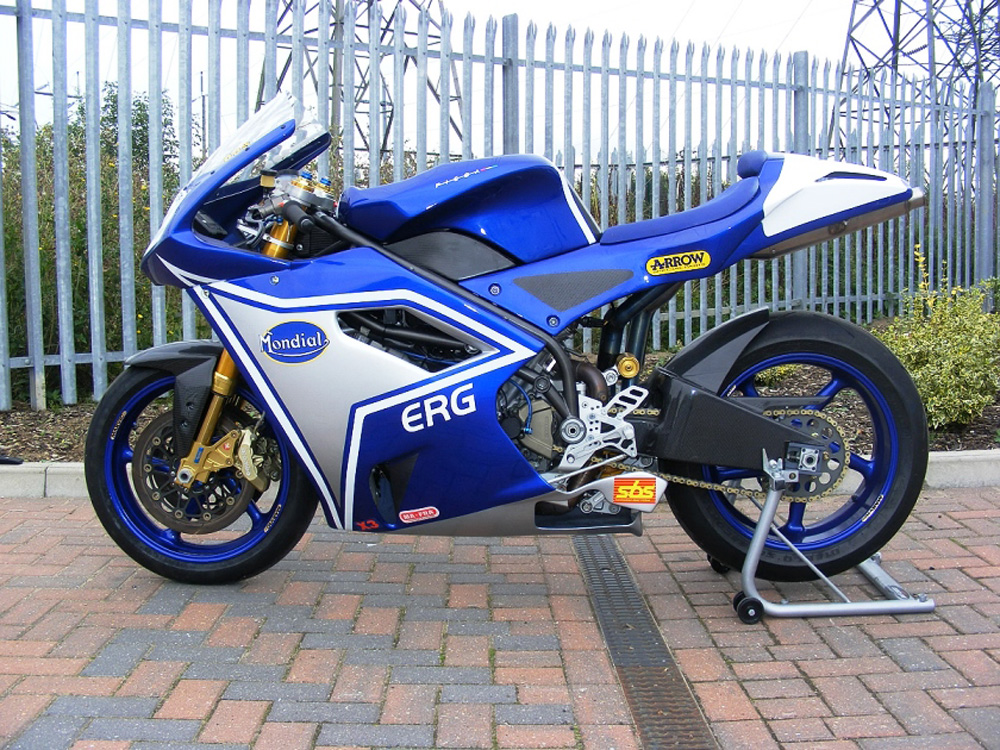
The Piega’s light and nimble chassis made it a challenger to the Ducati 999 at the time and far more a track beast than the SP1. Whereas the SP1 was a road bike designed to be raced, the Piega was the exact opposite—there was no pillion seat, no luggage points, all-carbon-fiber bodywork—it was a racer with lights. Such a narrow focus meant the Piega was only going to appeal to a certain number of riders, but if you were lucky enough to have a spin on a Piega, you knew you were on something special—almost like a two-wheeled version of the Pagani Zonda supercar.
Sadly, for Mondial, the bike barely lasted a year and a half of production. The company didn’t last long and was placed in the hands of the Monza Bankruptcy Court in July 2004 with barely 35 Piegas constructed.
Their timing for Superbike racing could not have been worse, either. This was a time when rule changes were afoot to let 1000cc four-cylinder machines with upwards of 190 horsepower race against 1000cc twins, which meant the Piega’s 139 horsepower as standard stood no chance in the power race. You could buy a race kit for a Piega that bumped power upward of 150 horsepower but these were few and very far between.
The Piega is the (so far) last stand for this once glorious Italian racing name. Mondial was one of the greatest names during racing’s early days, and even though Ziletti’s heart was clearly in the right place, it remains one of modern motorcycling’s greatest tragedies that one of the most powerful men in the Italian printing game, with a personal fortune of some small countries, couldn’t make the blue and silver company roar again. CN
Click here for all the latest Road Racing news.
Click here to read the Archives Column in the Cycle News Digital Edition Magazine.
Subscribe to nearly 50 years of Cycle News Archive issues